
Does a Humidifier Help With a Cold or the Flu?
November 22, 2026

TL;DR
A clean humidifier can ease a stuffy nose, a dry cough and a scratchy throat in dry winter air. It won't cure a cold or the flu. Filterbuy's advice is to keep the sickroom at 40% to 50% humidity, with the unit several feet from the bed. Clean it every third day so it doesn't add mold or bacteria to your air.
Key Takeaways
A humidifier eases symptoms; it doesn't treat the virus. The CDC lists one as a comfort step for colds.
Cool mist is safer around children, because steam vaporizers can burn, according to Mayo Clinic.
Aim for 40%–50% humidity while sick. The EPA advises against humidifying above 50%.
By Filterbuy's estimate, a closed 12-by-12-foot bedroom needs only about ⅓ to 1 gallon of humidifier output a day. Buy for output, not tank size.
Filterbuy's point of view: we've built air filters in our own U.S. factories since 2013, so we treat a sickroom as one air system: the humidifier handles dry air, and filtration handles what floats in it.
Does a Humidifier Help With a Cold?
Yes, a humidifier can help with a cold, but only with comfort. A humidifier is a device that adds water vapor to indoor air, and moister air can loosen mucus and calm a dry, tickly cough. It won't kill cold viruses or shorten a cold, which usually lasts less than a week, according to the Centers for Disease Control and Prevention (CDC).
Filterbuy checked humidifier advice against the research and found the evidence thinner than most guides admit. Mayo Clinic says cool-mist humidifiers may ease coughing and congestion from a cold, but says more research is needed. A 2017 Cochrane review of six trials with 387 people found no clear benefit or harm from breathing heated, humidified air.
Does a Humidifier Help With the Flu?
Using a humidifier for flu symptoms works the same way as for a cold: it eases congestion and a dry cough. It does nothing to the influenza virus itself. If you're at higher risk, call your doctor early; antivirals work best when started within two days of symptoms, according to the CDC's flu treatment guidance.
Humidity may matter more for the people you live with. In a 2013 PLOS ONE study by researchers at CDC's National Institute for Occupational Safety and Health (NIOSH), flu virus in simulated coughs kept 70.6% to 77.3% of its infectivity after an hour at 23% relative humidity or lower. At 43% or higher, it kept only 14.6% to 22.2%. Dry heated air is one reason flu season peaks in winter.
Filterbuy pairs a sickroom humidifier with clean air. Run a HEPA air purifier sized for each occupied room. If you have central HVAC, use a MERV 13 filter for cold and flu season with the furnace fan set to On.
If the outdoor AQI is over 100, switch to an EPA-recommended MERV 13 filter if you have an HVAC system, and run HEPA air purifiers in each room with windows closed. See setting up a flu recovery room at home and cold vs. flu: how to tell which one you have.
Should You Use a Humidifier When Sick?
Most adults and children can use a humidifier when sick, as long as the unit is clean and the room stays at or below 50% humidity. At 40% or higher on a hygrometer, a humidifier mostly pushes the room toward winter mold problems.
Asthma or allergies: ask a healthcare professional first, since Mayo Clinic warns that dirty units or excess humidity can trigger flare-ups.
Babies and young children: the American Academy of Pediatrics recommends a cool-mist humidifier, according to Children's Hospital of Philadelphia (CHOP).
Warning signs: turn it down if windows fog or the room smells musty.
Humidifier for Congestion and Cough: What Moist Air Can Do
A humidifier for cough or congestion works best on symptoms dry air makes worse, especially a stuffy nose and a dry cough. For fever or body aches, it does little. Humidified air can help break up mucus so you can cough it up, according to MedlinePlus.
We built Filterbuy's symptom check because "a humidifier helps a cold" is too vague to act on. It pairs each symptom with a CDC-backed step to add.
Source: Filterbuy symptom check, built from CDC cold care tips, MedlinePlus and Mayo Clinic.
Best Humidifier for a Cold: Cool Mist, Warm Mist or Evaporative?
The best humidifier for cold symptoms is a cool-mist model you'll actually clean every few days. Warm and cool mist humidify equally well, Mayo Clinic explains, so the differences are burn risk and what else comes out.
Source: Filterbuy humidifier comparison, built from the EPA's Use and Care of Home Humidifiers and Mayo Clinic.
Together, these sources show a conflict most guides skip: pediatric sources point parents to cool mist, yet the EPA says ultrasonic and impeller cool-mist units spread the most minerals and microbes.
Filterbuy's pick for a sickroom resolves it: an evaporative humidifier, the one type that is both cool and, per the EPA, low in mineral and microbe spread. Its wick is a filter, though, so keep it fresh with our humidifier filter cleaning and replacement guide.
What Humidity Should You Aim for When Sick?
Aim for 40% to 50% relative humidity in the sickroom, and don't go above 50%, where mold and dust mites thrive. That's the range MedlinePlus suggests, and the U.S. Environmental Protection Agency (EPA) says not to humidify past 50%.
Filterbuy ran the numbers for a closed 12-by-12-foot bedroom with 8-foot ceilings at 70°F. At 45% humidity, the air in that room holds only about 9 ounces of water. Bringing it up from a dry 20% takes about 5 ounces.
Filterbuy's sizing rule: air leaks out, so a humidifier must keep replacing moisture. By our estimate, a closed 12-by-12-foot bedroom needs about ⅓ gallon a day if it's snug and up to 1 gallon if it's drafty. Start it overnight on low, with an automatic shut-off, as CHOP recommends, and turn it up only if the hygrometer stays under 40%.
What the math taught us is that visible mist is not a gauge. An oversized unit in a small, closed room overshoots quickly, and the extra water condenses on the window. On freezing nights, drop to 30%–40% if the glass fogs; see what humidity your house should be in winter.
Where to Put a Humidifier When Sick
Put a humidifier several feet from the bed and aim the mist into open air. MedlinePlus advises about 6 feet from the bed, and for a child, CHOP says at least 3 feet from the bed or crib.
Raise it on a dresser with a waterproof tray underneath.
Keep it out of reach of children and pets.
Give it space. The EPA says to keep nearby carpet and drapes dry, so keep it off walls and curtains.
Keep it away from HVAC vents and the thermostat. No health source we reviewed covers this; Filterbuy's HVAC experience does.
Put the hygrometer across the room, since a gauge next to the humidifier reads high.
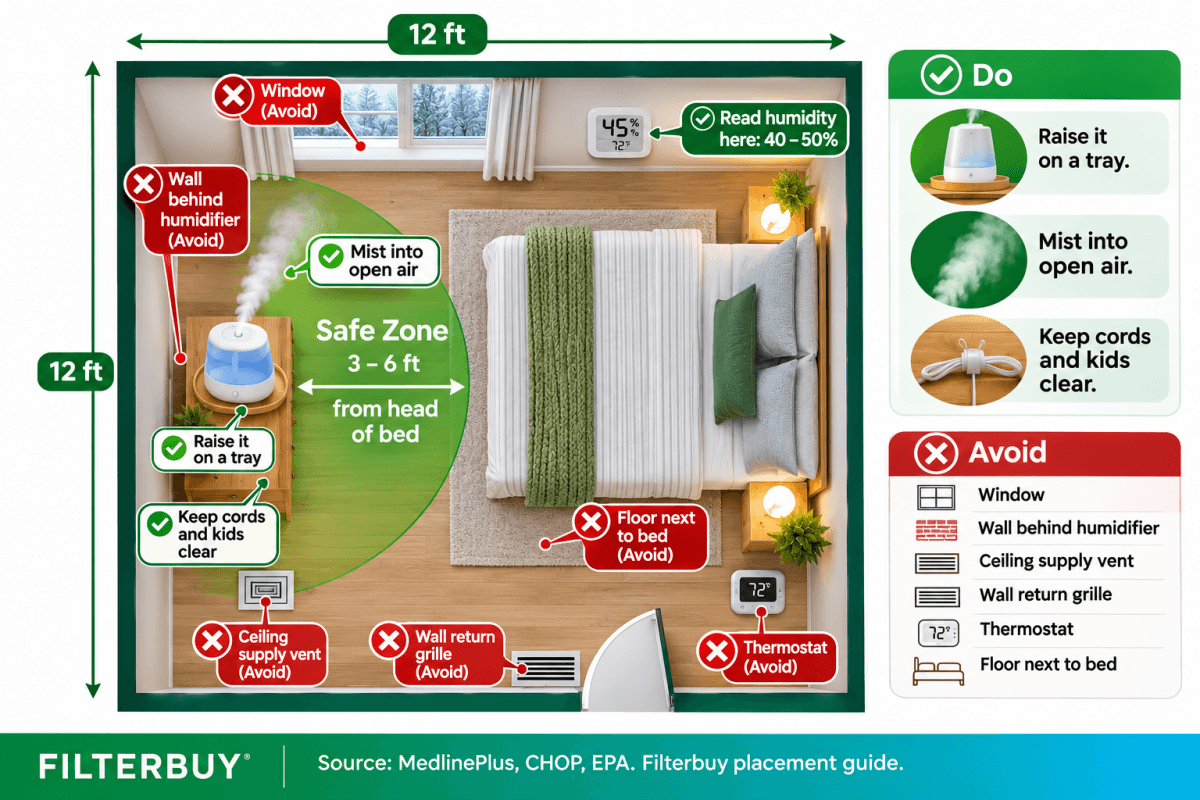
I tell homeowners to keep a humidifier out of the path of a supply or return vent. The airflow scatters the mist, and an ultrasonic unit running tap water sends mineral dust into the return, where it ends up on the HVAC filter.
How to Keep a Humidifier From Making You Sicker
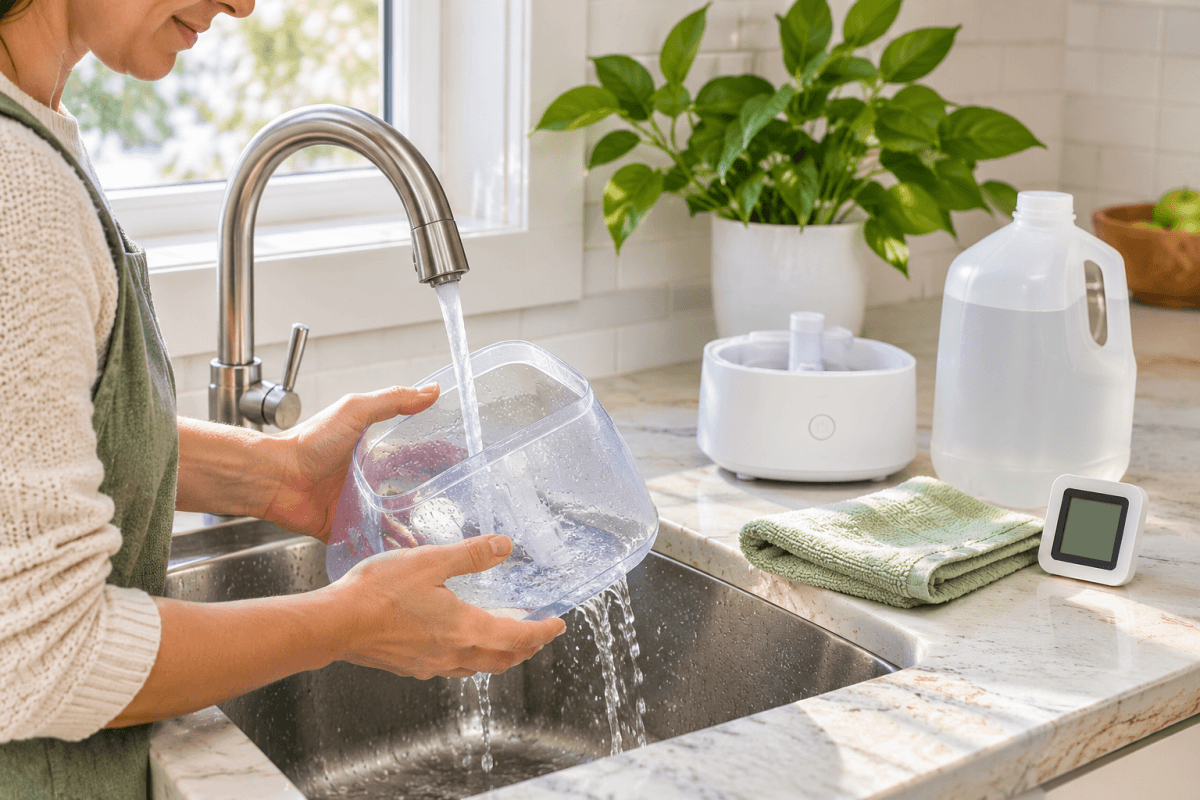
A dirty humidifier can release bacteria and mold into the air, which Mayo Clinic says may trigger flu-like symptoms or even lung illness. The EPA's care routine for portable units:
Empty, dry and refill the tank daily.
Clean it every third day, using 3% hydrogen peroxide unless the manual says otherwise.
Use distilled water, since tap-water minerals leave white dust.
Add nothing to the water unless the manufacturer says to, as Mayo Clinic advises.
Replace wicks and filters on the manufacturer's schedule.
When to See a Doctor
Most colds and flu cases resolve at home. Still, the CDC says to seek care for:
Trouble breathing or fast breathing
Dehydration
A fever lasting longer than 4 days
Symptoms lasting more than 10 days without improving
Fever or cough that improves, then returns or worsens
A chronic medical condition that gets worse
For a baby under 3 months with a fever of 100.4°F (38°C) or higher, call right away, per the CDC's common cold fact sheet. Wheezing or labored breathing in a baby can mean RSV rather than a cold. In an emergency, call 911.
Supporting Statistics
1. 3.7 Million Flu Illnesses So Far This Season
3.7 million U.S. flu illnesses
50,000 hospitalizations and 2,800 deaths
Source: CDC FluView, Week 45, data through November 14, 2026
2. Colds Come Back Every Winter
2–3 colds a year for the average U.S. adult; children often get more
Colds are a top reason for missed school and work
Source: CDC, About Common Cold
3. Steam Remedies Still Burn Children
4–5 children treated by one Shriners Children's Boston nurse practitioner in a single season for second-degree burns from home steam remedies, which take 2–4 weeks to heal
3 in 10+ U.S. burn-center admissions are scalds from hot liquids or steam
61% of scald patients are under age 5
Why it matters: Filterbuy and Shriners both advise a store-bought cool-mist humidifier, never boiling water, near kids
Sources: Shriners Children's, March 2026; UW Medicine, citing American Burn Association data
Frequently Asked Questions
Can a Humidifier Make a Cold Worse?
It can, if the unit is dirty or the room gets too damp. Humidity above 50% invites mold and dust mites.
Can I Put Vicks or Essential Oils in My Humidifier?
Only in a medicine cup or pad built for it. Mayo Clinic advises against adding anything to the water.
Glossary
- Relative Humidity (RH)
- Water vapor in the air compared with the most it can hold at that temperature.
- Hygrometer
- A small gauge that measures indoor humidity.
- MERV 13
- A high rating on the Minimum Efficiency Reporting Value (MERV) filter scale that captures most fine particles.
- HEPA
- High-efficiency particulate air, a filter standard for portable air purifiers.
About the Author and Reviewer
Michelle Wan writes about indoor air quality for Filterbuy, which has manufactured air filters in the U.S. since 2013. She researched this page and ran its calculations. David Clark, a Licensed HVAC Technician, reviews Filterbuy's HVAC guidance.
More from Filterbuy: Dry air in your house in winter
Breathe Easier While You Recover
Filterbuy doesn't recommend a humidifier brand here. We make the other half of sickroom air: MERV 13 filters in 600+ sizes, built in our own U.S. factories. We also carry whole-house humidifier filters.