
How Long Does the Flu Last? A Day-by-Day Recovery Timeline
November 22, 2026

TL;DR
The flu usually lasts a few days to less than two weeks. You'll feel worst in the first three to four days and start to turn the corner between days four and seven. A cough and tiredness can hang on past two weeks. If you're at higher risk, or your symptoms improve and then come back, call your doctor. Any emergency warning sign needs care right away.
Key Takeaways
Recovery usually takes a few days to under two weeks, according to the Centers for Disease Control and Prevention (CDC).
A flu fever typically lasts three to four days, per the CDC.
The cough often outlasts everything else. A postinfectious cough can last three to eight weeks and affects 11% to 25% of adults after a respiratory infection, per a 2024 Canadian Medical Association Journal (CMAJ) review.
Prescription antivirals can shorten the flu by about a day if started within two days of symptoms, the CDC says.
Feeling better and then worse again is a warning sign. A fever or cough that improves and then returns or worsens needs a doctor.
Your home's air is part of recovery. By Filterbuy's estimate, running your HVAC fan On through an EPA-recommended MERV 13 filter clears flu particles from a typical home's air in about an hour, versus about 11 hours on Auto.
How Long Does the Flu Last?
The flu (influenza) is a contagious respiratory illness caused by influenza viruses, and most cases last a few days to less than two weeks, with the worst symptoms in the first three to four days. Symptoms usually show up about two days after you're infected and ease through the rest of the first week. A lingering cough and fatigue can stretch flu recovery time past two weeks.
Flu Symptoms Day by Day: The Full Flu Timeline
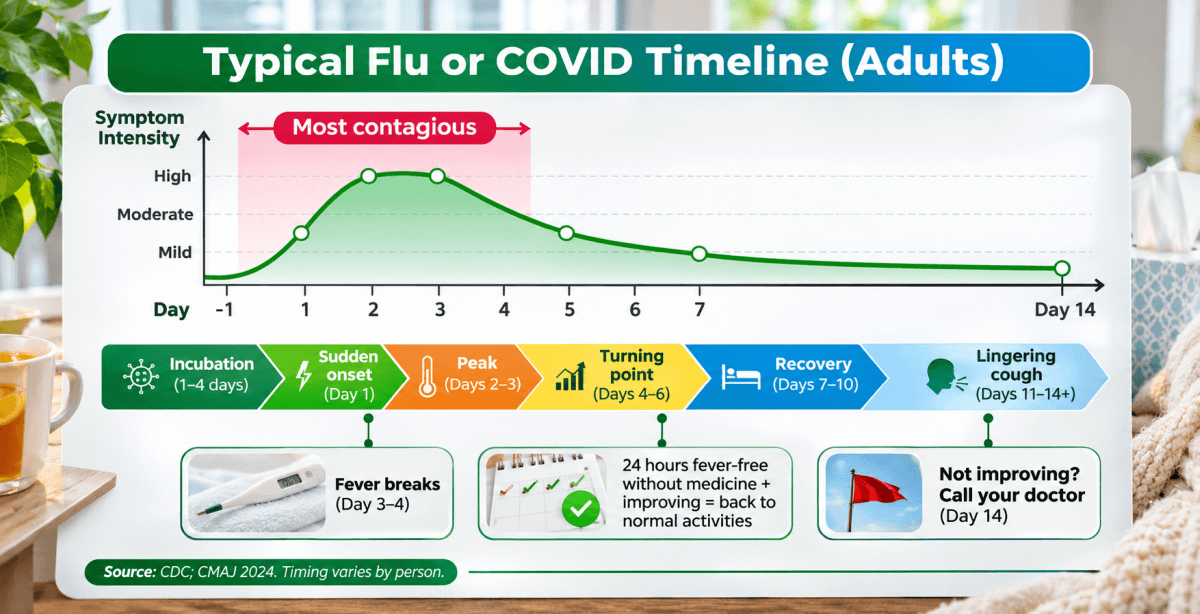
Flu symptoms hit suddenly, one to four days after exposure. They peak by day three or four, then fade over a week or more. You're most contagious in the first three days, starting about a day before symptoms appear.
Filterbuy flu timeline, built from CDC and CMAJ guidance. Timing varies by person.
Sources: CDC, How Flu Spreads and Signs and Symptoms of Flu; Liang et al., CMAJ 2024.
Not sure it's the flu? See cold vs. flu: how to tell which one you have.
How Long Does a Flu Fever Last?
A flu fever typically lasts three to four days, according to the CDC. It runs highest in the first two or three days and breaks around day four, usually the first sign the worst is over. The CDC counts a fever as gone only when it stays down without fever-reducing medicine.
How Long Does the Flu Last in Adults?
For a healthy adult, the flu usually means three to seven days of feeling truly sick, followed by a week or so of getting your energy back.
Recovery often takes longer for people at higher risk of flu complications. That includes adults 65 and older, pregnant people, people with weakened immune systems, and adults with asthma, COPD, diabetes or heart disease.
When Do You Start Feeling Better With the Flu?
Most people start feeling better with the flu around days four to seven, once the fever breaks and body aches fade.
Filterbuy's recovery check answers the question you'll ask every day: is this still normal? Emergency warning signs need care right away, on any day.
Filterbuy recovery check, built from CDC and CMAJ guidance.
Sources: CDC Signs and Symptoms of Flu; CDC flu treatment; Liang et al., CMAJ 2024.
When can you go back to work or school? The CDC's guidance for when you're sick says you can return to normal activities once two things have been true for at least 24 hours: your symptoms have been improving, and you've had no fever without fever-reducing medicine. You may still be contagious, so take extra precautions for the next five days. See also how long the flu is contagious.
How to Shorten Flu Recovery Time
Flu recovery time is usually a few days to under two weeks, and a prescription antiviral is the one treatment shown to shorten it, by about a day. According to the CDC's flu treatment guidance, antivirals work best when started within two days of the first symptoms, and they're recommended for people at higher risk.
Beyond that, help your body recover:
Rest, especially through the peak days.
Fluids, especially with a fever.
Over-the-counter symptom relief, as the label or your pharmacist directs.
Make Your Home's Air Easier to Recover In
Filterbuy has made HVAC filters in our own U.S. factories since 2013, so the air at home is the part of recovery we know best:
Keep indoor humidity between 30% and 50%. Mayo Clinic recommends this range. In a study by CDC's National Institute for Occupational Safety and Health (NIOSH), coughed flu virus kept 70.6% to 77.3% of its infectivity after an hour at 23% relative humidity or lower, but only 14.6% to 22.2% at 43% or higher. When we ran the numbers, 30°F outdoor air at 70% humidity dropped to about 16% once heated to 70°F with no moisture added (why flu season happens in winter). That's squarely in the NIOSH study's most-infectious range. On freezing days, stay near the low end; see our ideal indoor humidity in winter chart.
If you have central HVAC, switch to a MERV 13 filter. The U.S. Environmental Protection Agency (EPA) recommends a filter rated MERV 13 or higher to better filter airborne particles, including viruses. The filter only works while the fan runs, so set the thermostat fan to On. By Filterbuy's estimate, clearing 99% of airborne flu particles from a typical closed-up 2,000-square-foot house takes about 11 hours with the fan on Auto and about an hour with it On through a MERV 13 filter. Real rooms clear more slowly; see furnace fan On or Auto.
Run a HEPA air purifier in each occupied room, starting with the sickroom, and keep the sickroom door closed. Without central HVAC, these purifiers are your main defense. Our guide to setting up a flu recovery room at home walks through it.
If the outdoor AQI is over 100, from wildfire or wood smoke, do both: keep the EPA-recommended MERV 13 filter in your HVAC system and a HEPA purifier running in each room, with windows closed.
Clean air doesn't cure the flu or shorten it. It can make the sickroom more comfortable and cut how long flu virus lingers in your home's air.
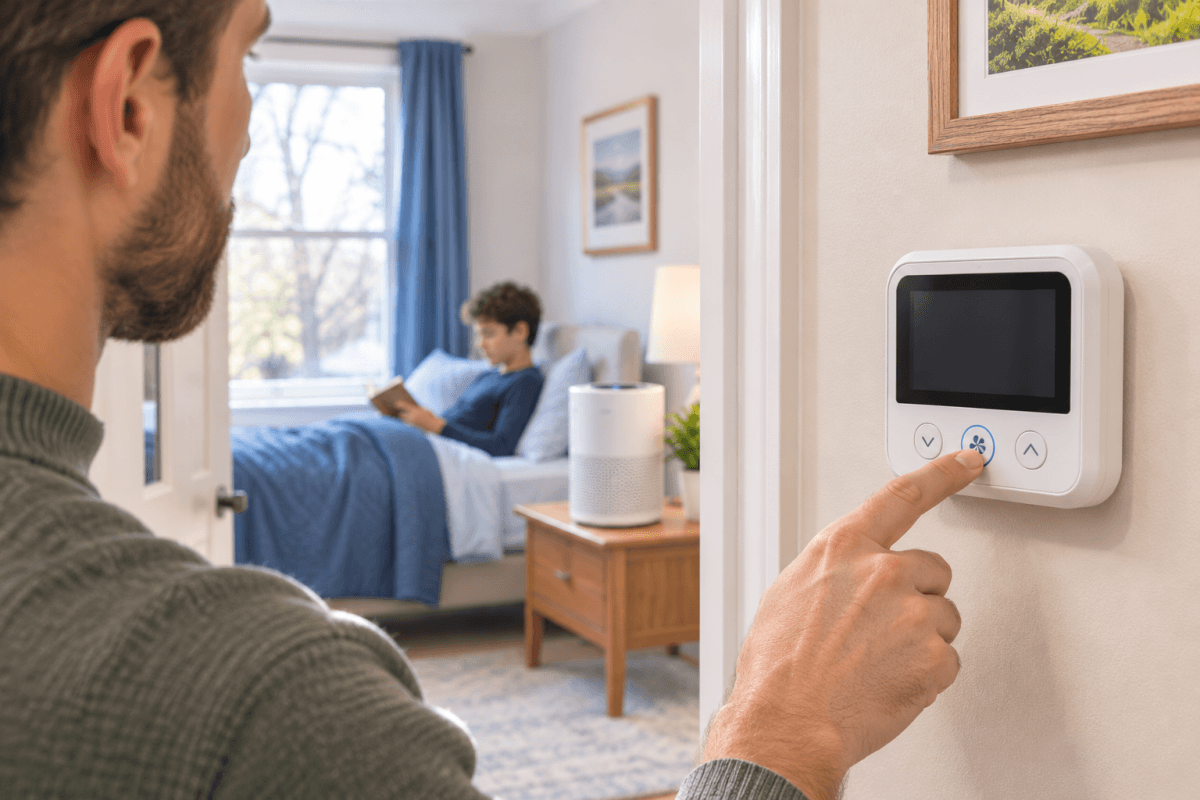
“When someone has the flu, I tell homeowners two things: switch the fan from Auto to On, and pull the filter to look at it. A clogged filter moves less air through the house.”
When to See a Doctor for the Flu
Most people with the flu recover at home, but some symptoms need medical care right away. The CDC's emergency warning signs in adults include:
Difficulty breathing or shortness of breath
Persistent pain or pressure in the chest or abdomen
Persistent dizziness, confusion or inability to stay awake
Seizures
Not urinating
Severe muscle pain, weakness or unsteadiness
Fever or cough that improves, then returns or worsens
Worsening of a chronic medical condition
Children have additional warning signs, such as fast breathing or bluish lips; see the CDC's full list. In an emergency, call 911.
Supporting Statistics
1. At Least 2.6 Million U.S. Flu Illnesses So Far This Season
The stat: 2.6 million illnesses, 36,000 hospitalizations and 2,100 deaths this season, as of November 7, 2026.
Why it matters: Filterbuy's day-by-day flu timeline helps you tell whether your illness is following the usual course.
Source: CDC FluView, Week 44, published November 13, 2026.
2. Vaccinated Adults Hospitalized With Flu Had a 31% Lower Risk of Death
The stat: Among adults hospitalized with flu, vaccinated patients had a 26% lower risk of ICU admission and a 31% lower risk of death than unvaccinated patients (2021 review).
Why it matters: A flu shot can make a hard case less severe.
Source: CDC, Benefits of the Flu Vaccine.
3. Americans Spend About 90% of Their Time Indoors
The stat: Americans spend about 90% of their time indoors, where some pollutants run 2 to 5 times higher than outdoors, according to the EPA.
Why it matters: Recovery means even more time inside, which is why Filterbuy focuses on your home's air.
Frequently Asked Questions
What Day of the Flu Is the Worst?
Days two and three are usually the hardest, when fever, chills and body aches peak. Most people notice a clear change once the fever breaks, around day four.
Can the Flu Last Three Weeks?
The flu itself rarely lasts three weeks, but a postinfectious cough can last three to eight weeks. If other symptoms are still around after two weeks, or you start getting worse, see a doctor.
Does the Flu Shot Make the Flu Milder If You Still Get Sick?
Often, yes. If you catch the flu anyway, the CDC notes that vaccinated people hospitalized with flu had less severe illness than unvaccinated patients.
Glossary
- Incubation Period
- The time between catching the flu virus and your first symptoms, usually one to four days.
- Antiviral
- A prescription medicine that fights the flu virus, unlike antibiotics.
- Postinfectious Cough
- A cough lasting three to eight weeks after an infection clears.
- MERV 13
- A high rating on the Minimum Efficiency Reporting Value (MERV) filter scale that captures a large share of fine particles.
- HEPA
- High-efficiency particulate air, a filter standard for portable air purifiers.
Breathe Easier While You Recover
While you're on the mend, check your HVAC filter; if it's due, see our picks for the best MERV 13 air filters for viruses. Filterbuy makes MERV 13 filters in more than 600 sizes in our own U.S. factories. Shop MERV 13 filters in your size.
Shop MERV 13 Air Filters →