
Winter Storm Preparedness Checklist
October 23, 2026

What Goes on a Winter Storm Preparedness Checklist?
A winter storm preparedness checklist covers three things: your heating system, your home, and an emergency kit that lasts at least three days. Store one gallon of water per person, per day, plus non-perishable food, and test your smoke and carbon monoxide alarms.
Then get your furnace or heat pump ready for days of nonstop use, starting with a fresh air filter and a spare in your exact size. Finish it all during a Winter Storm Watch, before roads ice over and deliveries stop.
Not sure which filter to stock? Take the quick quiz below, or shop filters cut to your exact size.
Your Winter Storm Checklist
Three areas to cover before the storm reaches you.
Heating System
- Swap in a fresh HVAC air filter
- Order a spare in your exact size
- Find and clear outdoor furnace vents
Home
- Test smoke and carbon monoxide alarms
- Insulate pipes; find the water shutoff
- If away, keep heat at 55°F or higher
Emergency Kit (3+ days)
- 1 gallon of water per person, per day
- No-cook food and medicines
- A spare filter for every return vent
Best time to finish: a Winter Storm Watch
Often issued 1–3 days ahead, before roads and deliveries stall.
Stock the Right Spare Before the Storm
Answer 3 quick questions and we'll match you to your perfect filter.
TL;DR
A winter storm preparedness checklist covers your home and heating system, plus a stocked emergency kit. Before it hits, store at least three days of water (one gallon per person per day) and non-perishable food, test your smoke and carbon monoxide (CO) alarms, and ready your furnace or heat pump for days of nonstop use.
Key Takeaways
Finish your prep during a Winter Storm Watch, because a Warning means the storm is already here or close.
The Centers for Disease Control and Prevention (CDC) says portable generators belong outdoors, more than 20 feet from doors, windows, and vents.
Order a spare filter before the Watch, because carriers can’t reach iced-over streets.
The National Weather Service (NWS) calls winter storms "deceptive killers" because most deaths come indirectly, from things like cold exposure and carbon monoxide rather than the snow itself. At Filterbuy, we’ve cut and pleated air filters to order in our own U.S. plants since 2013, so we tend to see a storm from inside the furnace cabinet, and this checklist covers the heating steps most storm lists skip.
"After a heavy snow, most no-heat calls I see on high-efficiency furnaces trace back to a drift or an ice cap over the exhaust pipe. Clearing it by hand at the wall usually gets the heat back on."
David Clark, Licensed HVAC Technician, Filterbuy HVAC Solutions
Before the Storm: Your Home and Heating System Checklist
The best time to prepare is when the NWS issues a Winter Storm Watch, often one to three days ahead. Match each alert below to an action, and follow your local forecast at weather.gov.
Source: National Weather Service. Alert criteria vary by local NWS office. The Extreme Cold Warning replaced the Wind Chill Warning in October 2024.
For the full alert ladder, see Filterbuy’s winter storm watch vs. warning guide, or our ice storm warning guide if freezing rain is the threat.
Heating System Checklist
During a cold snap, your furnace or heat pump may run almost nonstop for days. That’s when we see the most avoidable failures, most of them tied to airflow.
Replace your HVAC air filter. A clogged filter chokes airflow, so the system works harder and a furnace can trip its safety shutoff.
Order a spare in your exact size. Read all three numbers on the frame, including depth, the one Filterbuy’s manufacturing team sees ordered wrong most often. Our guide to measuring your air filter helps if the print has worn off.
Go thicker if your slot allows. On Filterbuy’s production line, 4-inch filters get deeper pleats than 1-inch filters, which gives them more room to load during a long storm.
Schedule a tune-up if it is overdue. The CDC recommends having a qualified technician service fuel-burning appliances every year.
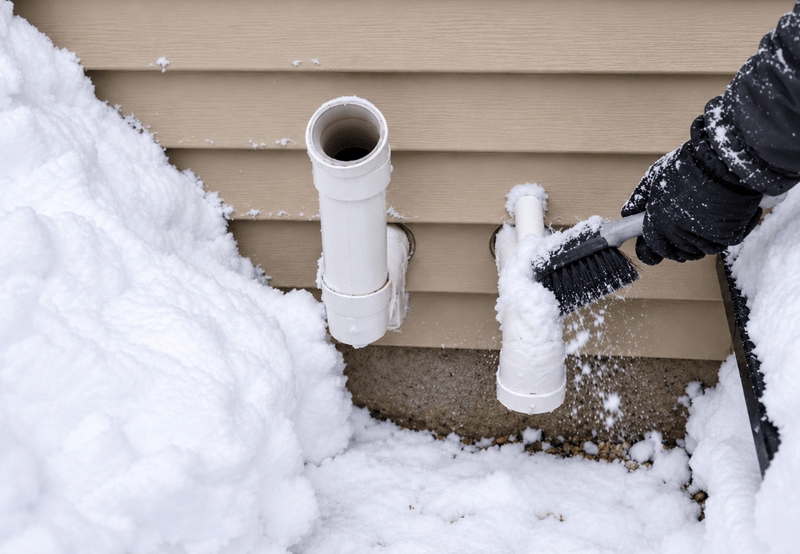
Locate outdoor vents. High-efficiency furnaces vent through plastic pipes on an outside wall, and drifting snow can bury them. Find yours now, and read how to clear a frozen furnace vent pipe safely.
Clear space around a heat pump. Keep 18 to 24 inches clear on every side, and call a technician if ice lingers for hours. Our guide to getting your heat pump ready for winter has more.
Top off fuel and test alarms. Deliveries may not reach you for days, so fill up early. Put battery-backup CO detectors near every sleeping area.
"The question I get most is which MERV to buy. The one to ask first is whether the filter you are holding actually fills the slot. A rating describes the media, not the gap around it."
Michelle Wan, Brand Manager and Air Quality Writer, Filterbuy
Home Checklist
Find your main water shutoff valve and insulate exposed pipes. In a hard freeze, let faucets drip and open sink cabinets on outside walls.
If you’ll be away, leave the heat set no lower than 55°F, as Ready.gov advises.
Set up a check-in plan with family and a neighbor, especially anyone living alone. Filterbuy’s winter storm emergency plan maps it hour by hour.
What Should Be in an Emergency Kit for a Winter Storm?
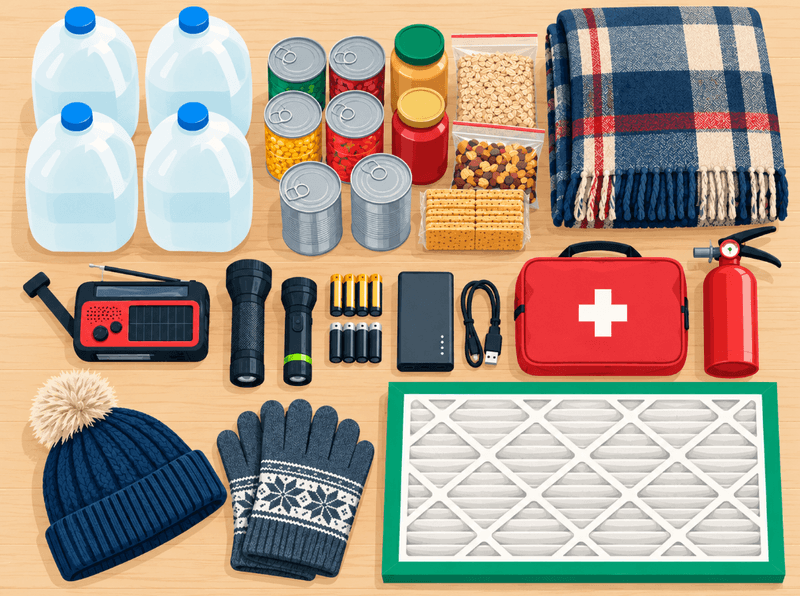
An emergency kit for a winter storm should keep your household fed and warm for at least three days without power. A family of four needs 12 gallons of drinking water to cover three days. Filterbuy also adds one item most lists leave out, a spare filter for every return vent.
Sources: National Weather Service and Ready.gov emergency kit guidance.
Car Emergency Kit
In the car, keep blankets, a flashlight, a first aid kit, a phone charger, snacks, water, an ice scraper, and jumper cables.
How Do You Stay Safe During a Winter Storm?
Once the storm hits, the biggest dangers inside are fire and carbon monoxide from backup heat. Filterbuy makes air filters, so we’ll say it plainly: no filter can capture CO, because it’s a gas.
Which Heat Sources Are Safe Indoors?
In a cold, dark house, it’s tempting to grab anything that gives off heat.
Sources: CDC carbon monoxide prevention guidance, EPA, and CPSC space heater guidance. Filterbuy synthesis.
For placement tips and safety features, see our space heater safety guide.
Know the signs of CO poisoning. Headache, dizziness, weakness, nausea, and confusion are the most common. If an alarm sounds or anyone feels these symptoms, get everyone outside and call 911. Our guide to winter carbon monoxide safety goes deeper.
Protect Your Indoor Air While You Are Sealed In
With the windows shut for days, the same dust and wood smoke keep cycling through your filter. Our guide to winter indoor air quality explains what helps.
If the Power Goes Out
Gather in one room, layer up, keep the fridge closed, and unplug electronics before service returns. For steps by heating system, see heating your home in a winter power outage.
What Should You Do After a Winter Storm?
After a winter storm, clear your vents and check your filter before the heat runs for hours. From Filterbuy’s side of the filter, the riskiest moment comes when the power returns and the system reheats a cold house, often through a smoke-loaded filter with vents still iced over.
Clear snow and ice from furnace vents, the heat pump, dryer vents, and the gas meter.
Check your HVAC filter before the long reheat, and replace it if it looks gray or clogged.
If a pipe froze, open the faucet and warm the pipe slowly with a hair dryer, starting closest to the faucet. Never use an open flame.
Shovel in short sessions and push snow instead of lifting it. Stay away from downed power lines.
Throw out refrigerated food that sat above 40°F for more than two hours, following USDA food safety guidance.
Check on older neighbors who live alone.
Restock your kit, spare filter included, before the next storm.
Pro Tip: Every Filterbuy filter is cut to order and ships within 24 hours, but no carrier can reach an iced-over street. Auto-delivery puts a spare in your exact size on the shelf before you need it.
Supporting Statistics
1. Only 48% of U.S. adults assembled or updated emergency supplies in the past year.
FEMA's 2023 National Household Survey of 7,604 adults also found that just 18% had tested a family communication plan.
Source: FEMA, 2023 National Household Survey on Disaster Preparedness
2. Hypothermia contributed to 13,419 U.S. deaths from 2003 to 2013.
The CDC notes that cold kills about twice as many Americans each year as heat. In a 2014 Wisconsin review, 4 of 27 victims were found in homes with unused or nonfunctional furnaces. Filterbuy's take: a working furnace is life-safety equipment.
Source: CDC MMWR, Hypothermia-Related Deaths (2015)
3. Billion-dollar winter storms cost the U.S. $62.6 billion from 1980 to 2020.
NOAA counted 19 of these storms in that span, linked to 1,052 deaths.
Source: NOAA NCEI, U.S. Billion-Dollar Weather and Climate Disasters
Winter Storm Preparedness FAQ
What is the difference between a Winter Storm Watch and a Winter Storm Warning?
A Watch means conditions favor a significant storm, so it’s time to prepare. A Warning means heavy snow, sleet, or ice is happening now or about to start, so stay put.
Should I change my air filter before a winter storm?
Yes, if it’s due or close to it. In Filterbuy’s experience, a filter that looked fine in October can be choked by December.
Will my furnace work if the power goes out?
Usually not, because most furnaces and heat pumps need electricity to run. A gas furnace can run on a generator, but only through a transfer switch installed by an electrician.
How do I keep my furnace vents clear of snow?
Mark both PVC vent pipes with a tall stake before the storm. During and after snowfall, clear about a 3-foot circle around each one by hand or with a soft brush rather than a shovel.
How often should I check my air filter in winter?
Check it once a month and again after any long storm, and replace it if it looks gray or clogged.
Glossary
Carbon monoxide (CO): A colorless, odorless, poisonous gas produced when fuel burns.
Filterbuy: A family-owned U.S. manufacturer of pleated HVAC air filters, cut to order in its own plants since 2013.
HVAC air filter: The replaceable filter in a home's heating and cooling system that traps airborne particles.
MERV: Minimum Efficiency Reporting Value, a 1-to-16 rating of how well a filter captures airborne particles.
National Weather Service (NWS): The federal agency that issues weather watches and warnings.
Ready for the next storm? Put a spare Filterbuy filter in your exact size on the shelf, and browse our winter home and HVAC guides.