
Winter Storm Emergency Plan: Protect Your Home, Heat & Air
October 15, 2026
TL;DR
A winter storm emergency is any snow, ice, or extreme-cold event that can knock out your power and heat or keep you home. Filterbuy's approach to winter storm emergency preparedness has three phases: build a 72-hour kit and prep your heating before the storm, keep vents clear and fuel-burning devices outdoors during it, and restart your HVAC carefully afterward. Throughout, watch for invisible carbon monoxide.
Key Takeaways
Losing power in a winter storm usually means losing central heat, because most furnaces, heat pumps, and boilers need electricity.
Snow drifting over a high-efficiency furnace's vent pipes can shut it down or push carbon monoxide indoors.
Filterbuy's rule of thumb: put in a fresh air filter before the storm so a hard-working furnace doesn't strain.
What Counts as a Winter Storm Emergency?
A winter storm emergency is a snow, ice, or extreme-cold event that puts people in danger or cuts off essential services like power and heat. The National Weather Service (NWS) issues the weather alerts, while governors and local officials issue emergency declarations. The practical test: if a storm could cut your power or keep you inside for 72 hours, treat it as an emergency.
Source: National Weather Service (NWS). Extreme Cold Warning replaced the Wind Chill Warning in October 2024.
A winter storm emergency alert can also reach your phone through Wireless Emergency Alerts or the FEMA App. For more on each alert, read Filterbuy's winter storm watch vs. warning guide.
The Filterbuy Storm Clock: Your Winter Storm Emergency Checklist
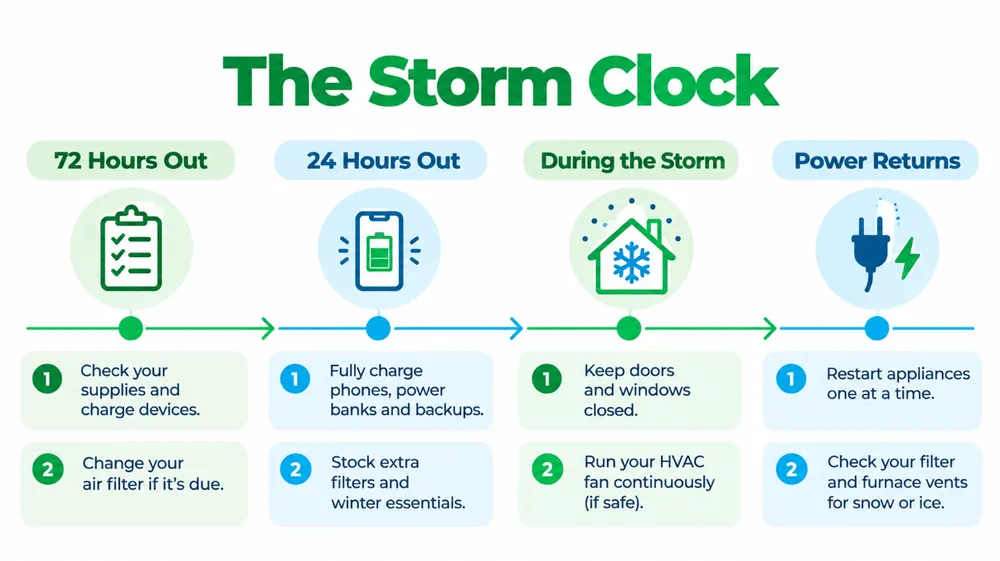
The Filterbuy Storm Clock is a timed winter storm emergency checklist. Most storm lists stop at food and flashlights. Filterbuy has made air filters in the U.S. since 2013, so we built it to cover what those lists miss: your heat and your indoor air. Start when a Watch is issued, often one to three days ahead.
The Filterbuy Storm Clock. Generator distance per CDC guidance.
What Goes in a Winter Storm Emergency Kit?
A winter storm emergency kit should carry every person and pet in your home through at least 72 hours. For water, FEMA's Ready.gov recommends one gallon per person per day. Round out your winter storm emergency supplies with:
Nonperishable food and a manual can opener
Warm layers, blankets, hats, and gloves
Flashlights, extra batteries, and a battery or hand-crank NOAA Weather Radio
Charged power banks
A battery-backup carbon monoxide alarm outside each sleeping area and on every level, as the U.S. Fire Administration (USFA) recommends
A 7-day supply of medications and a first-aid kit
Cash, since ATMs and card readers stop working without power
Pet food, a snow shovel, and ice melt or sand
Your Winter Storm Emergency Car Kit
Your car needs a winter storm emergency car kit of its own. Following Ready.gov's car kit list, pack an ice scraper, blankets, jumper cables, water, snacks, and sand or cat litter. If you get stranded, the Centers for Disease Control and Prevention (CDC) advises staying with the car and running the heater for about 10 minutes each hour, with a window cracked and the exhaust pipe clear of snow.
How Do You Stay Warm Safely During a Winter Storm Power Outage?
When the power goes out, central heat usually goes with it, because nearly every furnace, heat pump, and boiler needs electricity to run its blower, igniter, or controls. Gather in one room, close off unused rooms, and layer up. The Environmental Protection Agency (EPA) warns never to heat with a gas stove or oven, grill, or camp stove, or to warm up a car in a garage.
Protect pipes by letting faucets on outside walls drip and opening sink cabinets. If one freezes, the EPA says to thaw it with a hair dryer, never a torch.
The biggest hidden danger is carbon monoxide (CO), an odorless, colorless gas produced whenever fuel burns.
By the numbers: More than 400 Americans die from unintentional, non-fire CO poisoning each year, more than 100,000 visit emergency rooms, and over 14,000 are hospitalized, according to the CDC.
The CDC says to run generators outdoors only, more than 20 feet from doors, windows, and vents, and the U.S. Consumer Product Safety Commission (CPSC) adds that a porch or carport is still too close. If a CO alarm sounds or anyone feels headachy, dizzy, nauseated, or confused, get everyone outside into fresh air and call 911.
Since Filterbuy makes air filters, we'll be direct: no air filter can capture carbon monoxide, because it's a gas. Clear vents and working CO alarms keep you safe.
Space heaters carry their own risk: the National Fire Protection Association's (NFPA) Home Heating Fires report ties them to most home heating fire deaths, so keep them 3 feet from anything that can burn. See Filterbuy's space heater safety guide for more.
Who Needs a Winter Storm Emergency Plan First?
Plan first for older adults and anyone on powered medical equipment. The February 2021 Texas winter storm shows why. According to the Texas Department of State Health Services, 107 of the 158 people who died of hypothermia were 60 or older, and 25 more deaths came from illnesses made worse by lost dialysis, oxygen, or power. The CDC also warns that infants should never sleep in a cold room.
Before the storm, ask a doctor about backup power for medical equipment and find your nearest winter storm emergency shelter or warming center (call 211 if you aren't sure). During an outage, check on older neighbors often.
Why Are Furnace Vents a Hidden Winter Storm Hazard?
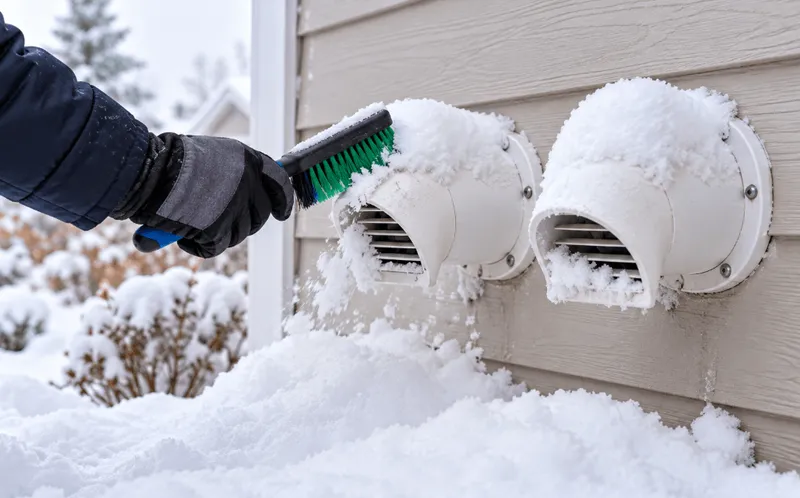
High-efficiency gas furnaces vent through two white PVC pipes on an outside wall, often low enough for snow to bury them. When a drift covers them, most furnaces shut themselves off. Some don't, and carbon monoxide can back up into the house.
To keep furnace vents clear:
Before the storm, mark both pipes with a tall stake so you can find them under the snow.
Clear about a 3-foot circle around each pipe with a gloved hand or a soft brush rather than a shovel, as New Castle County, Delaware recommends.
Recheck every few hours while snow drifts. The EPA also advises clearing dryer and water heater vents.
If the furnace stays off after you clear the vents, follow Filterbuy's steps on how to reset a furnace.
Heat pumps need care too. Brush snow off the outdoor unit, but never chip ice from the coil, because the unit's defrost cycle takes care of it. See Filterbuy's frozen furnace vent pipe guide and our steps to get your heat pump ready for winter.
“After a heavy snow, most no-heat calls I see on high-efficiency furnaces trace back to a drift or an ice cap over the exhaust pipe. Clearing it by hand at the wall usually gets the heat back on.”
David Clark, Licensed HVAC Technician, Filterbuy HVAC Solutions
What Should You Do When the Power Comes Back On?
When the power comes back, restart your home in stages and bring the heat back at a normal setting.
Plug electronics back in gradually, since Ready.gov's power outage guidance notes that power can return with surges.
Make sure vents and outdoor units are clear of snow and ice.
Set the thermostat to heat at your usual temperature.
After a long, freezing outage, follow your heat pump's warm-up guidance.
If the furnace won't start, turn off its service switch for 30 to 60 seconds, then back on.
Check the air filter, and replace it if it's wet, clogged, or overdue.
According to FoodSafety.gov, a closed fridge keeps food safe for about 4 hours and a full freezer for about 48. When in doubt, throw it out.
How Does a Winter Storm Affect Your Indoor Air?
Winter storms are hard on indoor air. The EPA notes that winter storms can trap harmful pollutants inside. With the windows shut, particles from fireplaces, candles, wood stoves, and gas cooking linger while your furnace circulates the same air for hours.
Filterbuy's advice is simple: put in a fresh, correctly sized filter when a Watch is issued, and check it again after the storm. From our manufacturing floor: a 4-inch filter handles a long storm better than a 1-inch because each pleat is deeper. Never run your system without one.
See how often to change your furnace filter in winter. Filterbuy cuts filters to order in more than 600 sizes, and auto-delivery keeps a spare waiting for the next storm. Find your filter size on Filterbuy's sizes chart.
Supporting Statistics
11 hours: In 2024, U.S. electricity customers spent an average of 11 hours without power, nearly double the prior decade's average, and major storms caused 80% of that time (U.S. Energy Information Administration).
19 of 246: Carbon monoxide caused 19 of the 246 deaths in the February 2021 Texas winter storm, some from ice-blocked heating vents (Texas Department of State Health Services).
30%: From 2014 to 2016, winter home fires made up only 8% of U.S. fires but caused 30% of fire deaths (U.S. Fire Administration).
Frequently Asked Questions
What does a winter storm emergency declaration mean for me?
With a winter storm emergency declaration, a governor or local government activates emergency powers and resources. That can mean travel restrictions, open shelters, and state help with plowing and power restoration.
Will my furnace work during a winter storm power outage?
Usually not. A gas furnace needs electricity for its blower, igniter, and controls, so it stops when the power goes out even if gas is still flowing. A generator can run it only through a transfer switch installed by a licensed electrician. Filterbuy's guide to heating during a winter power outage covers each system.
How do I know if snow is blocking my furnace vent?
Watch for a furnace that keeps shutting off shortly after it starts, unusual smells, more condensation on windows, or a CO alarm, the warning signs New Castle County, Delaware lists. Clear the pipes by hand, and if the alarm is sounding, get everyone outside and call 911 first.
Can an air filter protect my family from carbon monoxide?
No. Carbon monoxide is a gas, and no air filter can capture it. Battery-backup CO alarms near each sleeping area and clear furnace vents are your real protection. A clean filter still matters because it keeps your furnace moving air through long storm run times.
How much water should I store for a winter storm emergency?
FEMA's Ready.gov recommends one gallon of water per person per day. For a 72-hour kit, a family of four needs at least 12 gallons, plus extra for pets.
Glossary
Extreme Cold Warning: An NWS alert, formerly the Wind Chill Warning, for dangerously cold air.
National Weather Service (NWS): The federal weather agency that issues watches and warnings.
FEMA / Ready.gov: The Federal Emergency Management Agency and its preparedness site.
CPSC: The U.S. Consumer Product Safety Commission, the federal product-safety regulator.
Carbon monoxide (CO): An odorless, colorless, poisonous gas produced whenever fuel burns.
High-efficiency furnace: A gas furnace rated about 90% AFUE (annual fuel utilization efficiency) or higher that vents through PVC pipes.
Filterbuy: A U.S. manufacturer of HVAC air filters, cut to order in its own plants since 2013.
Heat pump: An electric system that heats and cools by moving heat between indoor and outdoor air.