
Polar Vortex Collapse: What It Means for Your Home's Air, Heat, and HVAC
October 15, 2026

TL;DR
A polar vortex collapse happens when the strong winds that normally corral frigid air over the Arctic break down, usually after a sudden stratospheric warming (SSW). Once the vortex weakens or splits, Arctic air can pour into the United States for days or weeks. Early forecasts point to a higher-than-usual chance of a disruption in January–February 2027, so now is the time to service the furnace, put in a fresh air filter, test carbon monoxide alarms, and keep indoor humidity near the low end of 30% to 50%.
Key Takeaways
A polar vortex collapse is a breakdown of the Arctic's high-altitude winds, not a storm. Its usual trigger, an SSW, occurs roughly six times per decade.
The cold shows up later. A disrupted vortex raises the odds of colder weather in the eastern U.S., and those effects can take up to two months to reach the surface.
Winter 2026–2027 carries a stronger-than-usual disruption signal. Seasonal models show the vortex weakening in mid-winter as a very strong El Niño builds.
Carbon monoxide is the cold-snap danger you can't see. In the February 2021 Texas freeze, more than 1,400 people sought emergency care for CO poisoning.
Why a Filter Maker Watches the Stratosphere
At Filterbuy, we're a family-owned American manufacturer, and we build every filter to order in our own U.S. plants. Because of that, we read a polar vortex forecast as lead time rather than a scary headline. Most cold snaps arrive with a few days' notice. A disrupted vortex often shows up in the models weeks ahead, leaving time to put in a fresh filter and set a spare on the shelf before the cold lands.
"When polar vortex starts trending, my first thought is the filter slot. Homes that ride out a long freeze best started it with a clean filter and a spare."
- Michelle Wan, Brand Manager and Air Quality Writer, Filterbuy
What Is a Polar Vortex Collapse?
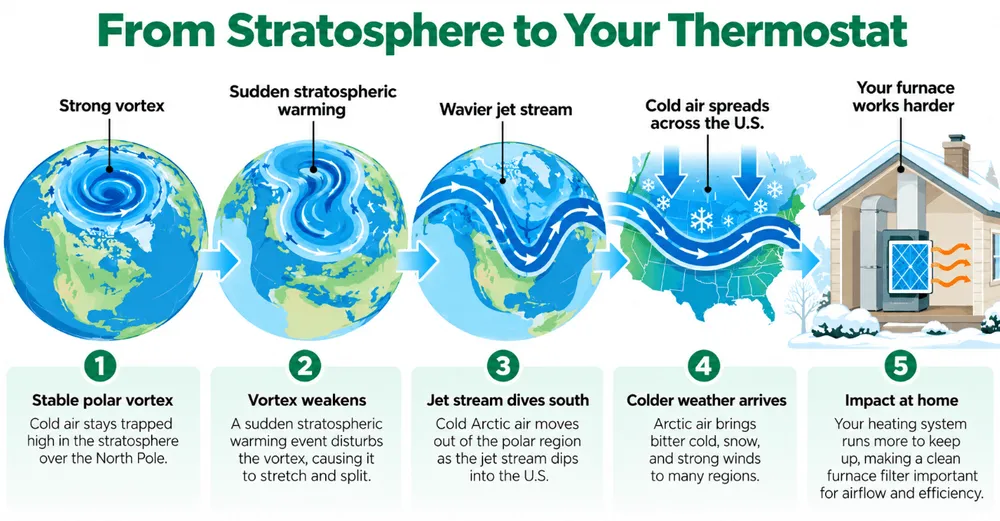
A polar vortex collapse is the rapid weakening, displacement, or splitting of the stratospheric polar vortex: a ring of strong west-to-east winds that circles the North Pole roughly 10 to 30 miles up each winter. While that ring holds, the coldest air stays locked over the Arctic. When it breaks down, that air can slide south into the mid-latitudes, including the United States.
The usual trigger is a sudden stratospheric warming (SSW). Large atmospheric waves push energy up from below, slowing or even reversing the vortex winds and warming the polar stratosphere quickly.
You will not see any of this on radar. The change happens high above the weather, where it reshapes the jet stream, the fast river of air that steers storms across the U.S. As the jet stream buckles, Arctic air can plunge farther south and stay longer.
Will the Polar Vortex Collapse in Winter 2026–2027?
A collapse in winter 2026–2027 is possible, and early signals point to above-normal odds, though no forecast can promise one yet. As of mid-October 2026, the seasonal model from the European Centre for Medium-Range Weather Forecasts shows the vortex starting near normal before weakening unusually from late December into January and February 2027.
The main driver is a very strong El Niño in the tropical Pacific. Strong El Niño years tend to weaken the vortex in the second half of winter, and current guidance suggests any resulting cold is more likely to hit the United States than Europe, according to Severe Weather Europe's 47-winter analysis. NOAA's Climate Prediction Center agrees: its October 8, 2026 update put the odds of a strong-to-very-strong event lasting through January–March 2027 above 83%.
That points to a possible "backloaded" winter: a mild December, then a sudden flip. A sudden stratospheric warming began on January 5, 2021, and the extreme cold that followed in February knocked out power across Texas. For local conditions, check Filterbuy's live U.S. air quality map.
How Much Warning Do You Get Before a Polar Vortex Collapse Brings Cold?
More than most people expect. Forecast models often flag a weakening vortex a couple of weeks ahead, and the cold at the surface, if it comes, can trail the stratospheric event by days to two months. In 2021, NOAA noted that models were predicting the January weakening by mid-December.
Treat each stage as a cue to prepare, not a guarantee of cold.
How Does a Polar Vortex Collapse Affect Your Home?
Deep cold strains the furnace and the air indoors at the same time.
Your Furnace Runs Harder, and Your Filter Fills Faster
During a deep freeze, a furnace can run almost nonstop. All that runtime pulls more dust, pet dander, and debris through the filter, so it loads far faster than the label suggests. Once it clogs, airflow drops, the system strains, and an overheating safety switch can shut the furnace off right when you need heat most.
"A filter that looks fine in October can be completely choked by December, and that's when we see the most avoidable furnace failures."
- Filterbuy manufacturing team, from our guide to how often to change your furnace filter in winter
The Air Gets Too Dry, Then Too Wet in the Wrong Places
Heated winter air dries out quickly, so many people reach for a humidifier. Push it too far, though, and moisture condenses on cold windows and walls, where it can feed mold. The EPA recommends keeping indoor relative humidity below 60%, ideally between 30% and 50%.
Carbon Monoxide Risk Spikes
Carbon monoxide (CO) has no color or smell, which makes it especially dangerous during a cold snap. When the power goes out, people turn to grills, generators, and idling cars for warmth. During the February 2021 Texas winter storm, at least 11 CO deaths were confirmed and more than 1,400 people sought emergency care.
Which Heating System Do You Have, and What Changes?
Where your home is most vulnerable depends on how you heat it. Most cold-weather advice assumes a gas furnace, so Filterbuy built this matrix to cover other common systems. For heat pumps, the U.S. Department of Energy links low airflow and dirty filters to weaker performance.
A filter slot on a furnace or air handler means forced air. Radiators or baseboard loops usually mean a boiler.
How to Prepare Your Home for a Polar Vortex Collapse
The easiest way to prepare is to knock out the simple, low-cost tasks now, before forecasts turn urgent and HVAC schedules fill up.
Book a furnace tune-up. A technician can catch a weak igniter, a cracked heat exchanger, or a failing blower motor before the deep freeze arrives.
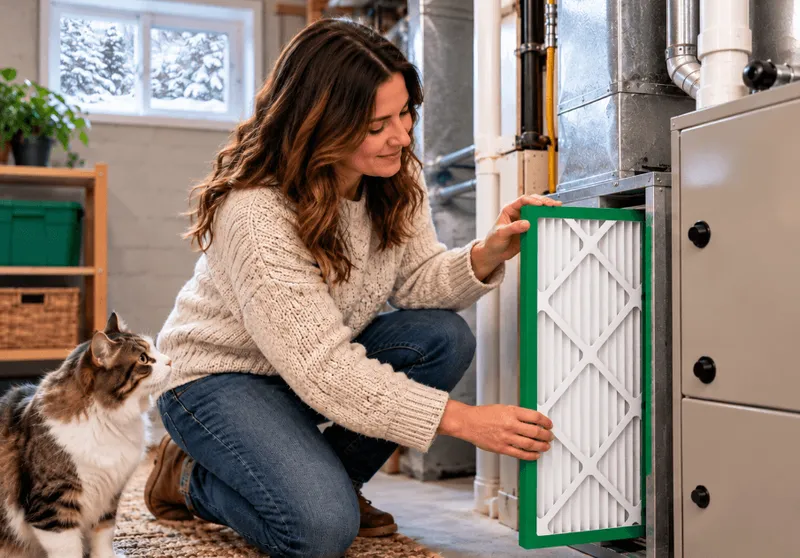
Change your air filter, and keep a spare on hand. Filterbuy's rule of thumb: when forecasters start saying "polar vortex," put in a fresh filter and set a spare beside the furnace. After that, check it monthly and again midway through any multi-day freeze. See how often to change your air filter for schedules by depth.
Choose the right MERV rating. Filterbuy's MERV 8 handles everyday dust, MERV 11 adds pet dander, and MERV 13 catches the finest particles if your system is rated for it. Check which MERV rating your system can handle before you upgrade.
Test carbon monoxide alarms on every level. Put in fresh batteries and make sure an alarm sits near each sleeping area.
Clear outdoor vents. After snow, clear the furnace intake and exhaust pipes, dryer vents, and gas meters.
Keep humidity in range. Use a hygrometer to hold indoor humidity around 30% to 40% in extreme cold.
Plan for outages safely. Run generators outdoors only, at least 20 feet from doors, windows, and vents, per CDC guidance. Never heat the house with a grill, a camp stove, or a car running in the garage.
One last tip from Filterbuy's production floor: the sizing mistake we see most often is the wrong depth. Before the cold arrives, measure your air filter in all three dimensions, then set up auto-delivery so we cut your exact size to order and ship it before you need it.
Supporting Statistics
Space heating accounts for 42% of the energy used in U.S. homes, about $519 per household in 2020 (U.S. Energy Information Administration).
Americans spend about 90% of their time indoors, where some pollutants run 2 to 5 times higher than outdoors (U.S. EPA).
More than 500 Americans die of carbon monoxide poisoning each year, according to the CDC.
Frequently Asked Questions
Does a polar vortex collapse always mean extreme cold?
No. A collapse raises the odds of a cold outbreak, but where the cold lands depends on how the vortex breaks down and how the jet stream responds. Some sudden stratospheric warmings barely register at the surface.
Should I change my air filter more often during a polar vortex?
Usually. Long furnace run times load the filter faster, so check it monthly and again midway through any multi-day freeze.
Does a polar vortex affect indoor air quality?
Yes, indirectly. Sealed homes trap pollutants, and a clean filter does most of the cleanup while the cold lasts.
How long does polar vortex cold last?
A single Arctic outbreak typically lasts days to weeks. After a major disruption, though, the odds of colder-than-normal weather can stay higher for several weeks, according to NOAA.
Is climate change causing more polar vortex collapses?
Scientists have not reached a consensus on whether Arctic warming makes these disruptions more frequent.
Glossary
Polar vortex: A large area of low pressure and cold air surrounding both of Earth's poles, strongest in winter.
Stratospheric polar vortex: The ring of strong westerly winds 10 to 30 miles above the North Pole that holds Arctic air in place.
Sudden stratospheric warming (SSW): A winter event in which the polar stratosphere warms fast and vortex winds weaken or reverse.
Heat pump: An electric system that moves outdoor heat indoors, often with backup electric heat.
Jet stream: A fast band of upper-level wind that steers storms.
El Niño: A periodic warming of the tropical Pacific that shifts global weather.
MERV: Minimum Efficiency Reporting Value, a 1–16 scale rating how well an air filter captures particles.
Carbon monoxide (CO): An odorless, colorless, poisonous gas produced by burning fuel.
Relative humidity: Moisture in the air relative to the most it can hold at that temperature.