May 13, 2026

Combat dry air, static shocks and humidity problems this winter with practical, family-tested fixes from a U.S. air filter manufacturer.
Indoor relative humidity in a typical northern home falls below 30 percent by the first hard freeze, and that one number triggers almost every winter indoor air quality complaint we hear: skin like sandpaper, doorknobs that zap, hardwood floors developing gaps that weren't there in October. The fix is moisture, not heat. Cranking the thermostat actually makes the problem worse, because forced-air heating pulls in cold outdoor air, warms it, and dries it out further with every cycle.
Filterbuy has been making air filters in the United States for more than a decade and shipping them factory-direct to families across the country. Every winter, our customer notes fill with the same three or four complaints. The patterns below come from those conversations, paired with the science behind why dry winter air does what it does — and how to fix it without buying a new HVAC system.
Humidity, dry air, and static are the three most common winter indoor air quality problems we help homeowners solve, and they're really one problem with three faces. Static electricity in winter starts when indoor relative humidity falls below 40 percent and becomes a daily nuisance below 30 percent. After more than a decade of shipping filters from our U.S. factory, the pattern we see is consistent: shocks taper off above 40 percent humidity and disappear above 55 percent. The fastest fix is moisture, not more heat. Run a portable humidifier overnight, drop your thermostat 2°F so the furnace dries the air less, and check your number with a $15 hygrometer.
1. Dry winter air is a humidity problem, not a temperature problem. Turning the thermostat up makes it worse, not better.
2. The EPA recommends keeping indoor humidity between 30 and 50 percent year-round. In winter, 30 to 40 percent is the practical sweet spot.
3. Static shocks, dry skin, cracked hardwood, and lingering colds often share one root cause: indoor humidity that has slipped below 30 percent.
4. Above 60 percent relative humidity, your home tilts the other way and starts encouraging mold and dust mites. Balance is the goal, not maximum moisture.
5. A whole-home humidifier is the single most effective fix, but the supporting cast does most of the actual work: a clean HVAC filter, sealed air leaks, and a slightly lower thermostat setting.
Cold air can't hold much water vapor. Outdoor air at 20°F and 70 percent relative humidity, once pulled inside and heated to 70°F, suddenly has the capacity to hold much more moisture than it actually carries with it. The reading on your hygrometer can crash below 15 percent before your furnace shuts off for the first time.
Forced-air heating makes the situation worse. Every furnace cycle pulls cool, dry air through small leaks around recessed lights, attic hatches, rim joists, and ductwork. The blower distributes it, the cycle repeats, and your home dries out a little more each hour the heat is on. By February in a typical northern climate, this routine can shave 20 to 30 percentage points off your indoor relative humidity.

Dry air symptoms. Your body's mucous membranes need moisture to do their job. When indoor humidity drops too low, people report dry skin, chapped lips, itchy eyes, scratchy morning throats, and nosebleeds that arrive out of nowhere. The house tells on itself, too: gapping hardwood, separating crown molding, drooping houseplants, and pianos that suddenly need tuning.
Static shocks. Static electricity is a humidity problem in disguise. Walking across carpet in socks creates friction that transfers electrons between surfaces, a phenomenon called the triboelectric effect. In humid air, moisture quietly conducts that charge away before it can build up. In dry air, the charge has nowhere to go, so it accumulates on you until you touch a doorknob, a doorframe, or your spouse. The shocks start around 40 percent relative humidity and turn into a daily annoyance below 30 percent.
Humidity that swings too high. Some homes, especially newer tight-envelope construction, swing the other way and trap moisture indoors. The tells are window condensation, musty closets, and bathroom mold creeping along grout lines. EPA's Mold Course warns that anything sustained above 60 percent relative humidity starts encouraging both mold growth and dust mite populations, which is why humidifying aggressively can backfire on you.
Here's the chart we hand homeowners when they ask:
• Under 25% — Very dry, static, irritation. Furnace running hard, almost no humidity control.
• 25–30% — Noticeably dry. Mild static, dry skin, occasional nosebleeds.
• 30–40% — Comfortable winter range. Sweet spot for most homes.
• 40–50% — Comfortable, slightly humid. Watch for window condensation on cold nights.
• 50–60% — Humid. Acceptable in summer; high in winter.
• Over 60% — Too humid. Mold, dust mites, and condensation risk.
A $15 hygrometer from any hardware store reads humidity in two or three rooms, which matters because homes are rarely uniform. Your basement runs wetter than the second floor in winter. A south-facing bedroom often runs drier than a north-facing one on the same day, even with the same thermostat setting.
1. Install a whole-home humidifier on your HVAC. This is the single most effective fix. A whole-home humidifier connects directly to your forced-air system and pushes moisture to every room your ductwork already serves. Bypass units are the most common and economical. Fan-powered models add more moisture per cycle. Steam units work best for heat pumps and oversized homes. Whichever you choose, pair it with a humidistat so it shuts off automatically once you hit your target.
2. Upgrade your HVAC filter and stay on a 60 to 90-day change cycle. A clogged filter restricts airflow, forces your furnace to run longer, and dries your air faster. A MERV 11 or MERV 13 pleated filter supports both humidity control and air cleanliness without straining most residential systems. For the filter angle in detail, our guide on how air filters help with winter allergies walks through it.
3. Seal the leaks pulling dry attic air into your home. Air infiltration around recessed lights, attic hatches, rim joists, and ductwork is the silent driver of indoor humidity loss in winter. Weatherstrip the attic hatch, caulk window trim, and ask a contractor about mastic-sealing your duct connections. None of this is glamorous, but it changes the math on every other fix on this list.
4. Drop the thermostat 2 to 3°F. This sounds backwards, but the less your furnace runs, the slower your air dries out. Properly humidified air at 68°F feels as warm as desert-dry air at 72°F. The U.S. Department of Energy estimates a 7 to 10°F nighttime setback for 8 hours can cut heating costs by as much as 10 percent, and most homeowners find the comfort trade invisible.
5. Quick static-fighting moves you can do tonight:
• Run a portable humidifier in your bedroom while you sleep.
• Take a hot shower with the bathroom door cracked open, since moisture migrates faster than you'd think.
• Set wide, shallow pans of water near your heat registers.
• Mist your houseplants and add a few more if you have room. They're small but steady moisture sources.
• Switch to leather-soled slippers. Rubber soles trap static charge while leather grounds it harmlessly.
• Touch a metal surface (a key, a coin) before grabbing a doorknob. The charge discharges over a wider area, so the spark stays invisible.
6. Mind the upper limit, too. If your windows are fogging up, your closets smell musty, or your bathroom grout is darkening, you're past 50 percent humidity and heading into mold territory. Run bathroom and kitchen exhaust fans, dehumidify the basement if you have one, and dial the humidistat back.
7. Get a hygrometer before you buy anything else. A $15 hardware-store hygrometer ends the guesswork. Once you can see your number, every other decision on this list becomes obvious. You either need more moisture, less moisture, or you're already in the sweet spot.
"After more than a decade of shipping filters from our U.S. factory to families across the country, we can usually guess a homeowner's humidity number from their zip code and furnace age before they tell us anything else. Almost every winter complaint we hear, whether it's static shocks, dry sinuses, or cracked wood, traces back to that one reading falling below 30 percent."
— Filterbuy Air Quality Team
Seven sources we lean on ourselves when customers ask hard questions. None of them are selling anything, and all are worth bookmarking for the season.
1. U.S. EPA: Care for Your Air – A Guide to Indoor Air Quality. The plain-English federal primer on managing humidity, ventilation, and common indoor pollutants. Source of the 30 to 50 percent indoor humidity recommendation we cite throughout this page.
2. U.S. EPA: The Inside Story – A Guide to Indoor Air Quality. The deeper booklet that pairs with Care for Your Air. Covers pollutants, source control, ventilation strategies, and the often-cited stat that Americans spend roughly 90 percent of their time indoors.
3. U.S. EPA: Mold Course – Chapter 2 (Why and Where Mold Grows). The clearest federal explanation of why indoor humidity above 60 percent invites mold and dust mites. Useful if you're tempted to over-humidify.
4. Mayo Clinic: Humidifiers – Ease Skin, Breathing Symptoms. A doctor-vetted overview of how humidifiers work, what 30 to 50 percent humidity does for sinuses and skin, and how to clean a humidifier so it doesn't become its own problem.
5. National Institute of Environmental Health Sciences (NIEHS): Indoor Air Quality. The NIH-affiliated overview of indoor air health risks, useful when you want a research-led perspective beyond the EPA's consumer guidance.
6. U.S. Department of Energy: Programmable Thermostats. DOE's plain explanation of how a 7 to 10°F setback for 8 hours per day can save up to 10 percent on heating and cooling, which is the math behind tip #4 above.
7. ASHRAE Standard 55: Thermal Environmental Conditions for Human Occupancy. The industry standard your HVAC contractor works from. It defines acceptable indoor temperature, humidity, and air movement for occupant comfort and is the reason your contractor uses a specific humidity range.
~90% of time spent indoors. Americans spend roughly 90 percent of their time indoors on average, where concentrations of some pollutants run 2 to 5 times higher than typical outdoor levels.
Source: U.S. EPA Report on the Environment, Indoor Air Quality
30–50% recommended indoor humidity range. The EPA recommends keeping indoor relative humidity between 30 and 50 percent year-round to manage allergens, irritation, and condensation risk.
Source: U.S. EPA, Care for Your Air
>60% is where mold trouble starts. EPA guidance: indoor relative humidity should be kept below 60 percent (ideally 30 to 50 percent) because sustained humidity above 60 percent encourages mold growth and supports dust mite populations.
Source: U.S. EPA Mold Course, Chapter 2
Most homeowners spend winter chasing comfort one degree at a time. They nudge the thermostat up, the air dries out further, and the cycle keeps running until spring resets it for them. The whole loop is avoidable. Indoor humidity, not indoor temperature, is the lever that controls how a home actually feels in February.
One piece of advice if you only take one: buy a $15 hygrometer before you buy anything else. Once you can see your number, every decision after that becomes obvious, whether the question is humidifier or no humidifier, filter upgrade or no upgrade, thermostat setback or no setback. You stop guessing and start adjusting based on what your house is actually doing.
One honest caveat: more humidity is not always the answer. Newer, tightly built homes can swing the other direction fast and end up trapping moisture instead of losing it. Balance is the goal, not maximum moisture or maximum heat. The aim is steady, sensible air your family can stop thinking about.
1. Buy a hygrometer and place it in your most-used room. Check it every morning for a week.
2. If your reading is below 30 percent, pull your current HVAC filter and look at it. If it's gray, replace it with a fresh MERV 11 or MERV 13 pleated filter.
3. Run a portable humidifier in the driest room overnight for a few nights and recheck the hygrometer.
4. If the readings stay stubbornly low, or if you're tired of refilling tanks, ask an HVAC pro about a whole-home humidifier sized to your ductwork and heating system.
5. Recheck weekly through the heating season. Aim for 30 to 40 percent while it's cold outside, and step it down if you start seeing window condensation.
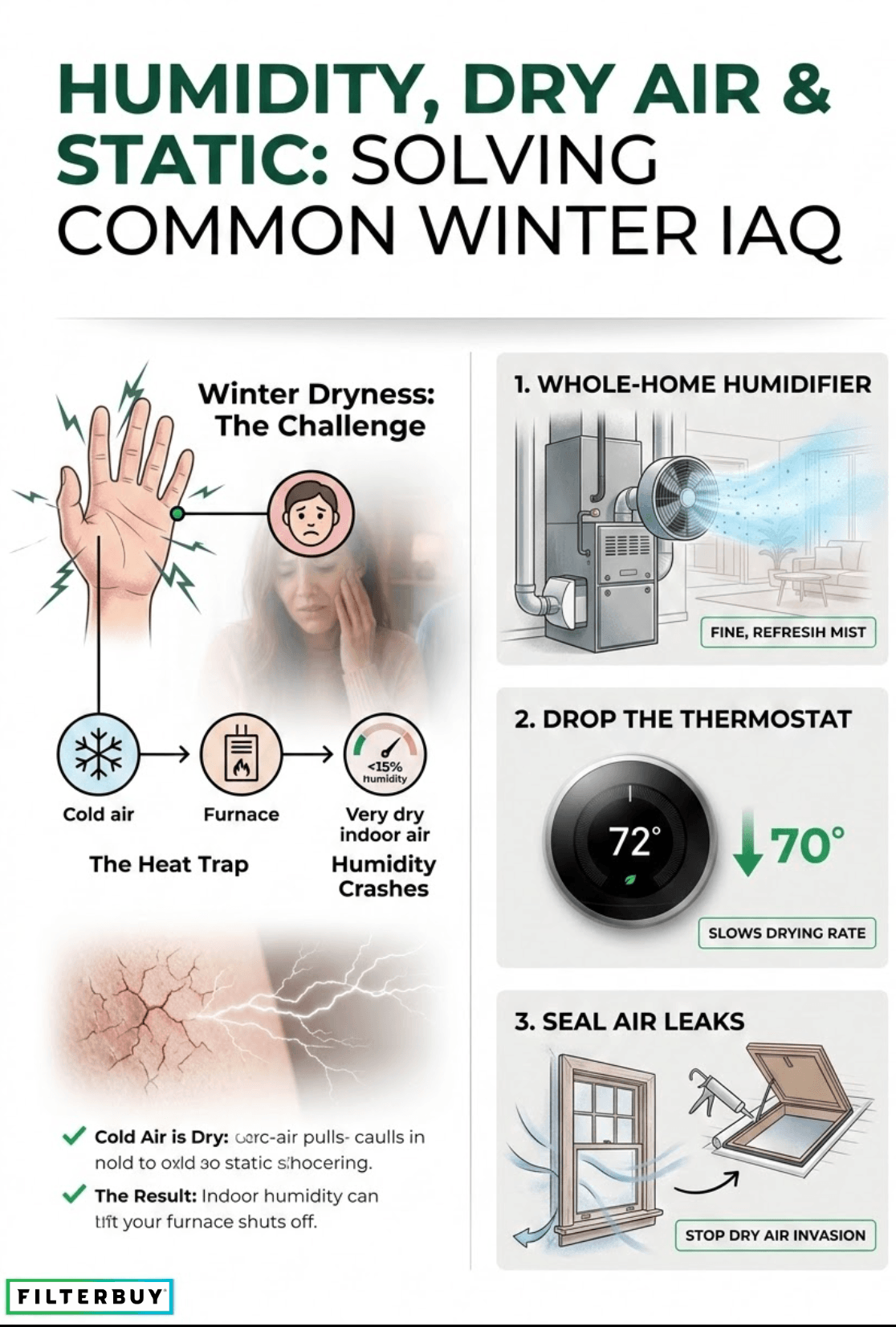
Cold outdoor air holds very little moisture. When your furnace pulls that air inside and heats it, indoor relative humidity drops sharply, often below 30 percent. Forced-air heating, air leaks around attics and rim joists, and longer furnace run times all compound the effect. The fix is to add moisture back through a humidifier, sealed leaks, and shorter furnace cycles.
Aim for at least 40 percent relative humidity to substantially reduce static shocks, and around 55 percent to eliminate them almost entirely. In winter, 30 to 40 percent is the realistic sweet spot. It's high enough to tame most static but low enough to avoid window condensation. The EPA's broader recommended range for indoor air is 30 to 50 percent year-round.
You can add moisture passively. Take longer hot showers with the bathroom door cracked open. Set wide pans of water near your heat registers, mist your houseplants daily, and add a few more if you have room. Switch to leather-soled slippers, since rubber traps static charge while leather grounds it harmlessly. Drop your thermostat 2 to 3°F so the furnace runs less. None of this replaces a humidifier, but it buys you breathing room until you install one.
Anything sustained above 50 percent during a cold snap is too high. Once outdoor temperatures drop into the teens or single digits, even 45 percent indoor humidity can trigger window condensation. Above 60 percent, you risk mold, mildew, and dust mite populations growing rapidly. If you see fog on the windows in the morning, dial the humidistat down.
A clean, high-efficiency filter doesn't add moisture, but it removes the dust, pollen, and dander that low humidity stirs up more aggressively. It also keeps airflow strong so your humidifier can do its job. Change pleated filters every 60 to 90 days during heavy winter use, because a clogged filter forces the furnace to run longer and dries your air faster.
A whole-home humidifier connects to your HVAC and humidifies every room your ductwork already serves. Set it once and forget it for the season. A portable handles one room at a time and needs refilling and cleaning every few days. If dry air is a multi-room or whole-season problem, a whole-home unit pays back fast in comfort and time saved. If the trouble is confined to one bedroom, a portable is fine.
Dry air, static, and humidity swings all share one root cause, and most of the fix starts with a clean, high-efficiency filter sized right for your system. Filterbuy makes 600+ filter sizes in the USA, ships factory-direct with free shipping, and offers auto-delivery so you never run out mid-cold-snap. That's Better Air For All, and it starts with your next filter change.
