
The Coldest Cities in the US, Ranked
October 26, 2026
In a city where the heat runs for months, change your furnace filter on your heating load instead of the calendar. Every hour the blower runs, it pulls your home's air through that filter, so the longest winters fill it fastest.
Heating degree days measure that load. Fairbanks logs about 13,420 a year and International Falls about 10,181, based on NOAA climate normals. Put in a fresh filter when you turn on the heat, check it every month, and swap it again a few weeks before your coldest month, which is January in most of these cities. With auto-delivery, the next filter arrives before the deep cold does.
Stock Up Before Your Coldest Month
Fast and free 2-day delivery to most US states.
How Hard Furnaces Work In The Coldest US Cities
Heating degree days per year. More HDD means more furnace runtime.
More Runtime Means More Filter Changes
Check monthly and swap a few weeks before your coldest month.
Source: NOAA 1991 to 2020 climate normals, 65°F base.
Answer a few quick questions and we'll match you to the right filter for winter.
TL;DR:
Utqiaġvik, Alaska, is the coldest city in the United States, averaging just 13.6°F a year according to NOAA's 1991–2020 climate data. In the Lower 48, the title goes to International Falls, Minnesota, at 37.4°F. Across most of the northern and eastern US and nearly all of Alaska, the coldest day of the year arrives in January, when furnaces and filters work hardest.
Key Takeaways
Utqiaġvik, Alaska (13.6°F) is the coldest US city by average annual temperature, and International Falls, Minnesota (37.4°F) is the coldest in the Lower 48.
Grand Forks averages about 51 nights below 0°F a year, nearly three times as many as Anchorage.
Heating degree days (HDD) measure how much heating a city needs. Utqiaġvik needs about 19,000 HDD a year, roughly twice as many as Duluth.
At Filterbuy, we've built air filters in the US for over a decade and shipped millions of them to homes like yours. Every year between November and March, our customer calls about stuffy air and heavily discolored filters climb, and we've pulled February filters that turned black in just 30 days. We wanted to know which cities put filters under the most strain, so we paired NOAA's temperature ranking with each city's heating demand.
The 10 Coldest Cities in the US, Ranked by Average Temperature
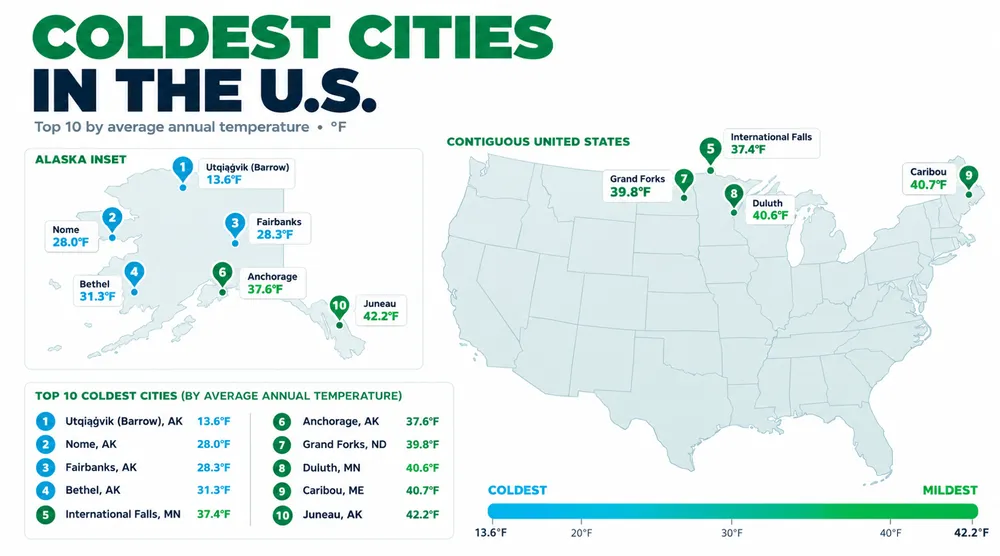
Ranked by average annual temperature in NOAA's 1991–2020 climate normals, the top 10 coldest cities in the US are Utqiaġvik, Nome, Fairbanks, Bethel, International Falls, Anchorage, Grand Forks, Duluth, Caribou, and Juneau. Six of the ten are in Alaska.
| Rank | City | Avg. temp (°F) | Heating degree days | Coldest month |
|---|---|---|---|---|
| 1 | Utqiaġvik (Barrow), AK | 13.6 | 19,026 | February |
| 2 | Nome, AK | 28.0 | 13,485 | January |
| 3 | Fairbanks, AK | 28.3 | 13,420 | January |
| 4 | Bethel, AK | 31.3 | n/a | January |
| 5 | International Falls, MN | 37.4 | 10,181 | January |
| 6 | Anchorage, AK | 37.6 | 9,978 | January |
| 7 | Grand Forks, ND | 39.8 | 9,533 | January |
| 8 | Duluth, MN | 40.6 | 9,115 | January |
| 9 | Caribou, ME | 40.7 | 9,048 | January |
| 10 | Juneau, AK | 42.2 | n/a | January |
Source: NOAA 1991–2020 climate normals for each city's primary weather station (NCEI and National Weather Service). Heating degree days use a 65°F base. n/a means no 1991–2020 annual value could be confirmed.
How Filterbuy ranked these cities: Temperatures and heating degree days come from each city's primary NOAA weather station (1991–2020 normals), via NCEI and National Weather Service reports. Where you see "n/a," we couldn't confirm a 1991–2020 annual HDD figure for that station.
What Is the Coldest City in the US?
The coldest city in the US is Utqiaġvik, Alaska, formerly Barrow. As the country's northernmost city, it sits about 320 miles inside the Arctic Circle and averages 13.6°F over the year. Unusually, its coldest month is February, not January.
Among Alaska's larger cities, Fairbanks is the coldest. It averages 28.3°F and once reached −66°F, on January 14, 1934. With about 290,000 residents and a 37.6°F average, Anchorage is the coldest major US city, colder than any large city in the Lower 48.
The Coldest Cities in the Lower 48
International Falls, Minnesota, is the coldest city in the contiguous United States, averaging 37.4°F a year. The border town has earned its nickname, the "Icebox of the Nation": January averages 5.0°F, and the daily high stays below freezing on about 109 days a year.
The rest of the Lower 48's coldest cities sit along the Canadian border and the Great Lakes:
Grand Forks, North Dakota (39.8°F): Open, flat plains leave the city exposed to Arctic air.
Duluth, Minnesota (40.6°F): Lake Superior keeps summers cool and winters snowy.
Caribou, Maine (40.7°F): The city sits too far inland for the Atlantic to soften its winters.
Fargo, North Dakota (42.4°F): Fargo, just outside the top 10, is among the coldest Lower 48 cities over 100,000 people.
Coldest Cities in the US in Winter
An annual average can hide how harsh a winter actually feels. Filterbuy pulled two counts from NOAA's 1991–2020 station normals: the days when the high never climbs above freezing, and the nights that drop below zero (NCEI: Fairbanks, Grand Forks, Anchorage; NWS: International Falls).
| City | Days high stays at or below 32°F | Nights at or below 0°F |
|---|---|---|
| Fairbanks, AK | 154 | 114 |
| Nome, AK | 163 | 72 |
| International Falls, MN | 104 | 57 |
| Grand Forks, ND | 101 | 51 |
| Caribou, ME | 91 | 38 |
| Anchorage, AK | 104 | 19 |
Source: NOAA 1991–2020 climate normals (NCEI station summaries; National Weather Service for International Falls). Annual averages, rounded to whole days.
Nome logs more freezing days than Fairbanks, yet Fairbanks gets far more nights below zero. And Grand Forks, warmer than Anchorage on paper, sees nearly three times as many below-zero nights. Subzero stretches are when your furnace runs hardest, so they say more about your filter's workload than the yearly average.
Thinking About Living in One of the Coldest Cities?
Anchorage, Fargo, Duluth, and Grand Forks pair full city services with long winters. If you're touring homes there, ask how old the furnace is and when it was last serviced, and check the filter size printed on its frame. Older homes often take odd sizes, and Filterbuy cuts custom filters in any size.
When Is the Coldest Day of the Year?
Across most of the northern and eastern US and nearly all of Alaska, the coldest day of the year falls in January. NOAA's National Centers for Environmental Information (NCEI) defines the "coldest day" as the calendar date with the lowest normal low temperature in the 1991–2020 climate normals.
| Region | Typical coldest day | What drives it |
|---|---|---|
| West of the continental divide | December | Pacific air masses keep the West closer to the solar cycle |
| East of the Rockies | January | Cold Canadian air settles over snow cover that reflects sunlight |
| Alaska | January (February in Utqiaġvik) | Most stations reach their lowest normal low in January |
| Hawaii and Puerto Rico | February–early March | Low-latitude islands reach their coolest point latest |
Source: NOAA National Centers for Environmental Information (NCEI), coldest-day maps based on 1991–2020 climate normals. Any given year can run earlier or later.
That date is also creeping later, by 3 to 6 days at many stations (NCEI). Look up your town on NOAA's interactive coldest-day map.
What Heating Degree Days Tell You About a Cold City
Heating degree days (HDD) measure how much heating a place needs to keep buildings warm. Each day's HDD equals 65°F minus that day's mean temperature, so a day averaging 40°F adds 25 HDD. Added up over a year, HDD let you compare how hard furnaces work from one city to the next (U.S. EIA).
Filterbuy's take: your filter schedule should follow heating demand, not average temperature. Nome and Fairbanks average within half a degree of each other, and their heating loads are nearly identical (13,485 vs. 13,420 HDD). Utqiaġvik, on the other hand, needs about twice the heat of Duluth or Caribou. In coastal Alaska, Anchorage still logs about 174 heating degree days in July, so filters there work year-round.
More HDD means more furnace runtime, and every time the blower runs, it pulls your home's air through the HVAC filter. That's why Filterbuy's guide on how often to change your HVAC filter recommends checking it every month.
In Filterbuy's experience, winter is "the season most homeowners underestimate." As our team puts it, "a filter that looks fine in October can be completely choked by December, and that's when we see the most avoidable furnace failures."
Source: Filterbuy, how often to change your furnace filter in winter
How to Protect Your Home's Air in the Coldest Cities
In the coldest cities, homes stay sealed for months while the furnace recirculates the same air, leaving the HVAC filter to do most of the cleaning. Protecting that air comes down to timing filter changes around your coldest month and choosing a filter your system can handle.
Five steps help:
Follow a cold-city filter calendar. Put in a fresh filter when you turn on the heat, check it once a month, and swap it again a few weeks before your coldest month. For nine of our ten cities that's January; in Utqiaġvik, it's February. ENERGY STAR also recommends a monthly check and a new filter at least every three months.
Book a fall furnace tune-up. ENERGY STAR advises servicing your heating system each fall.
Match the MERV rating and thickness to your home. MERV 8 handles everyday dust and lint, MERV 11 adds pet dander and pollen, and MERV 13 captures finer particles like wood smoke. Filterbuy's MERV rating chart shows which rating fits your system. If your slot takes a 4-inch filter, it's the better choice for long winters. On Filterbuy's production line, a 1-inch filter gets 14 pleats per foot and a 4-inch gets 8 much deeper ones, so the thicker filter holds more dust between changes.
Test your carbon monoxide detectors. A sealed house and a hard-running furnace make working CO alarms important, and ENERGY STAR's home maintenance checklist includes testing them.
Put filter changes on autopilot. Filterbuy builds filters in the USA in more than 600 sizes and ships them free. With auto-delivery, a fresh filter shows up before your coldest stretch begins.
For more help, see Filterbuy's guides on how to change a furnace filter and winter indoor air quality.
Supporting Statistics
42% of US home energy goes to space heating, rising to 53% in Midwest homes. Source: U.S. EIA; EIA Midwest data
Some indoor pollutants run 2 to 5 times higher than outdoor levels, and Americans spend about 90% of their time indoors. Source: U.S. EPA
Carbon monoxide poisonings peak in January, a month that averaged 69 deaths and 2,511 nonfatal exposures in CDC's 2001–2003 analysis. Source: CDC
Frequently Asked Questions
What is the coldest city in the US?
Utqiaġvik, Alaska, is the coldest US city, with an average of 13.6°F a year. In the contiguous US, the coldest city is International Falls, Minnesota, at 37.4°F.
What is the coldest major city in the US?
Anchorage, Alaska, home to about 290,000 people, averages 37.6°F a year.
When is the coldest day of the year in the US?
Most of the East and Alaska hit their coldest day in January, while most of the West bottoms out in December, according to NOAA.
How often should I change my furnace filter in a cold city?
Check it monthly during heating season, replace it at least every three months, and put in a fresh one a few weeks before your coldest month.
Is there a 2026 update to these rankings?
Yes. This ranking uses NOAA's 1991–2020 normals, which remain the official 30-year averages in 2026.
Glossary
Climate normals: NOAA's official 30-year weather averages; the current set covers 1991–2020.
NOAA: The National Oceanic and Atmospheric Administration, the federal weather and climate agency.
Heating degree day (HDD): A measure of heating demand equal to 65°F minus a day's mean temperature, with negative values counted as zero.
Coldest month: The month with the lowest normal average temperature at a weather station.
MERV: Minimum Efficiency Reporting Value, a 1–16 scale rating how well an HVAC filter captures airborne particles.
Breathe easier all winter with Filterbuy. A clean, American-made filter protects your family's air and your furnace. Find your filter size, set up auto-delivery so you never miss a change, and check your local AQI.