
Cabin Air Filter Replacement Cost: What You Should Pay in 2026
July 29, 2026
By Michelle Wan · Reviewed by David Clark, Licensed HVAC Technician · Published July 29, 2026 · Updated July 29, 2026
TL;DR
A cabin air filter replacement costs roughly $60 to $130 at a repair shop and $15 to $50 if you do it yourself. About half of a shop bill is labor, not the filter. On most vehicles, the filter sits behind the glove box and takes ten to fifteen minutes to swap, which is why the same job can be a fair price or a bad deal depending on where you have it done.
Key Takeaways
The national average for a professional cabin air filter replacement is about $86 to $114, according to RepairPal’s repair estimator.
Labor accounts for roughly half the bill. On a Toyota Camry, RepairPal estimates $43–$48 in parts against $46–$68 in labor.
Doing it yourself costs $15 to $50, the price of the filter alone, and takes ten to fifteen minutes on most cars.
A cabin air filter is one of the lowest-cost-per-mile items you own: roughly two-tenths of a cent per mile when you replace it yourself.
How much does a cabin air filter replacement cost?
A cabin air filter replacement costs between $60 and $130 at most repair shops, with a national average of roughly $86 to $114 according to RepairPal’s cost estimator. Quick-lube chains can come in under that, and dealerships above it. Doing the job yourself costs only the price of the filter, generally $15 to $50. The work itself is identical.
Shop labor-rate ranges via PartCatalog; DIY and dealer ranges via Mechanic Insights.
The spread is wide because the filter is cheap and the access isn’t standardized. Labor rates also vary by metro area, so the same job costs more in an expensive city than a rural one.
Cabin air filter replacement cost by vehicle
Cabin air filter replacement cost by vehicle ranges from about $60 on a Honda Civic to about $131 on a Chevrolet Silverado 1500. The differences come from filter price and how long a technician needs to reach the housing, not from how expensive the vehicle is. These are RepairPal’s estimator figures for the most common vehicles on U.S. roads:
Source: RepairPal Cabin Air Filter Replacement Cost Estimator, 2026. Ranges combine parts and labor.
A Honda Civic and a Toyota Corolla sit in the same class but differ by $40 to $50. That gap is access time, not parts. Some vehicles use two cabin filters that must be replaced together, doubling the parts line.
Parts vs. labor: where your money actually goes
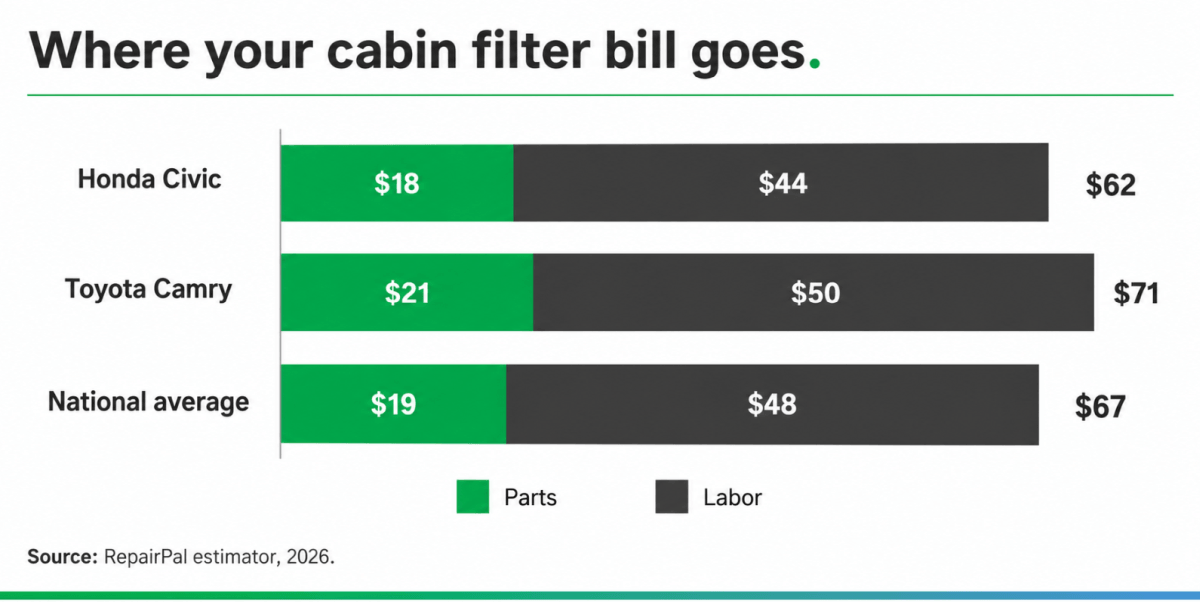
On a typical cabin air filter replacement, labor is roughly half the bill. RepairPal’s estimates for two of the most common cars in America make the split visible:
Parts and labor figures: RepairPal estimator, 2026. Labor share calculated by Filterbuy from those figures.
The number nobody puts on the estimate
A Civic’s $30 to $44 labor charge for a ten-to-fifteen-minute swap works out to $120 to $264 an hour. That’s not gouging; it’s a labor minimum doing what labor minimums do. Dividing the labor line by the time the job takes is the only way to see what the convenience costs, and no estimate prints it.
Where we sit in this
Filterbuy manufactures cabin air filters. We don’t install them and we don’t bill labor, so we know what the part costs and have no stake in the half you pay a technician. Fair warning, though: if you skip the shop you still buy a filter, and we sell filters. The numbers above are RepairPal’s, not ours.
“We build the part, so we know what it’s worth. What surprises people is the other half of the bill: ten minutes behind a glove box, priced like a repair.”
The Filterbuy Team
Should you do it yourself? Try the glove-box test
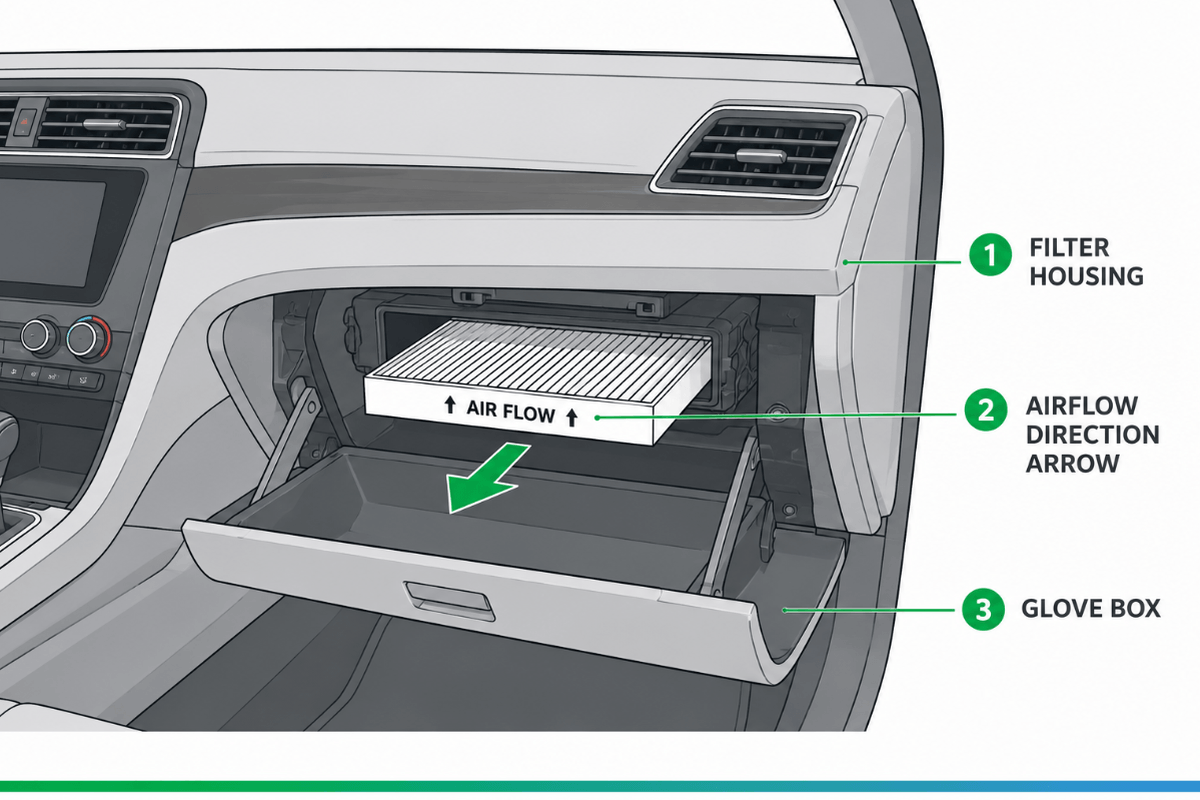
Do it yourself if the filter sits behind the glove box, which covers most vehicles. Pay a shop if it sits under the dash, under the cowl, or behind a trim panel. At Filterbuy we call this the glove-box test, and it takes about sixty seconds:
Open your owner’s manual to the cabin air filter entry and find where the filter lives.
Behind the glove box: empty it, squeeze the sides to release the stops, let it swing down, and slide the new filter in facing the arrow. No tools.
Under the dash, cowl, or trim: pay the shop. A handful of broken trim clips costs more than the labor you saved.
If your quote is over $130 and the filter is behind the glove box, ask the shop to separate parts from labor on the estimate and to show you the old filter.
Asking for a parts-and-labor breakdown isn’t confrontational. It’s how you tell a fair quote from a padded one, and any reputable shop will do it without blinking. If you’re not sure the filter is even due, check the signs your cabin air filter needs replacing first. And you can buy the filter yourself even when a shop installs it. Parts markup is a real line item, and most shops will fit a customer-supplied filter.
What clean cabin air actually costs per mile
At a $25 DIY filter over 12,000 miles, cabin air filtration costs about two-tenths of a cent per mile, or roughly $0.07 a day. Have a shop do it at $100 and you’re still under a cent per mile, at about $0.27 a day.
Most automakers recommend replacing the filter every 12,000 to 15,000 miles or once a year.
Your car is a small room you breathe in for about an hour a day; your home is the big one you breathe in for the other twenty-three. A home HVAC filter does the same job at a much larger scale and runs whenever your system cycles. If a cabin filter is worth $25 a year, so is checking your local air quality.
When yours is due, you can find the right Filterbuy cabin air filter for your vehicle: HEPA-certified media rated to capture 99.97% of particles down to 0.3 microns, cut to your vehicle’s exact specs and made in the USA. Set up auto-delivery and the next one shows up before you think about it.
Essential Resources: What to Check Before You Pay
Seven things worth a few minutes before you say yes to a quote.
1. Get the real price for your exact car
RepairPal’s estimator gives you a fair-price range for your year, make, and model, not a national average that has nothing to do with your car.
2. Know what a fair estimate looks like
The FTC’s Auto Repair Basics spells out what a written estimate should show you: parts and labor, listed separately. You can ask for the old filter back, too. Do it.
3. Do it yourself without risking your warranty
Worried a DIY filter voids your coverage? It doesn’t. The FTC’s auto warranty guide confirms your warranty holds when you use aftermarket parts or skip the dealer.
4. Skip the labor charge entirely
Filterbuy’s step-by-step guide walks you through the glove-box swap. No tools, no appointment, and none of the labor.
5. Make sure you even need one yet
Our replacement guide covers the 12,000-to-15,000-mile window and what shortens it. The cheapest filter is the one you don’t need yet.
6. Figure out which filter is worth paying for
Particulate, carbon, or HEPA? Filterbuy’s guide to choosing a cabin air filter matches the filter to how you actually drive, so you’re not paying for efficiency you’ll never use.
7. Find the one that fits your car
Enter your year, make, and model to see exact-fit options and pricing. HEPA-certified, made in the USA, shipped free.
The Numbers Behind What You’ll Pay
4.9%. The one-year rise in vehicle maintenance and repair prices, January 2025 to January 2026. Older estimates now run low. (Bureau of Transportation Statistics, 2026)
$13,318. Average U.S. household spending on transportation in 2024. A $100 filter job is under 1% of that. (Bureau of Labor Statistics, 2024 data)
13,476 miles. What the average American driver logs in a year. That sits inside the 12,000–15,000-mile window, so once a year works. (Federal Highway Administration)
Frequently asked questions
How much should a cabin air filter replacement cost?
A fair price is $60 to $130 at a shop, with a national average near $86 to $114. If your quote exceeds $130 and the filter sits behind the glove box, ask for a parts-and-labor breakdown first.
Is it cheaper to replace a cabin air filter yourself?
Yes. It costs only the filter, typically $15 to $50, and removes the labor charge that is about half of a shop bill. On most vehicles the swap takes ten to fifteen minutes and needs no tools.
Why do dealerships charge more for a cabin air filter?
Dealership labor rates commonly run $100 to $180 per hour versus $50 to $100 at an independent shop, and dealers often apply a labor minimum and use OEM parts. The work is the same.
How often do you have to pay for a cabin air filter replacement?
Most manufacturers recommend replacement every 12,000 to 15,000 miles or once a year, so most drivers pay for it annually. Replace it sooner if you drive in heavy dust, wildfire smoke, or high pollen, and see what happens if you never replace it.
About the author
Michelle Wan is Filterbuy’s Brand Manager and air quality writer (B.A., University of California, Santa Cruz). Working directly with Filterbuy’s manufacturing team across its four U.S. factories, she bases her guidance on how filters are actually built and used, not just spec sheets.
Reviewed for technical accuracy by David Clark, a Licensed HVAC Technician. Filterbuy has manufactured air filters in the USA since 2013 and ships factory-direct in 600+ sizes, including HEPA-certified auto cabin air filters.
Sources
Glossary
Cabin air filter: A filter inside a vehicle’s HVAC system that removes airborne particles from outside air before it enters the passenger compartment. See what a cabin air filter does.
Labor cost: The shop’s charge for the technician’s time, calculated from an hourly labor rate; roughly half of a typical cabin filter bill.
Labor rate: The hourly rate a shop bills for technician time, commonly $50–$100 at independents and $100–$180 at dealerships.
Labor minimum: A shop’s smallest billable labor increment, which can make a ten-minute job cost the same as a thirty-minute one.
HEPA-certified media: Filter media independently verified to capture 99.97% of airborne particles as small as 0.3 microns.
Glove-box filter: A cabin air filter positioned directly behind the glove box, reachable without tools; the cheapest configuration to service.