September 21, 2026
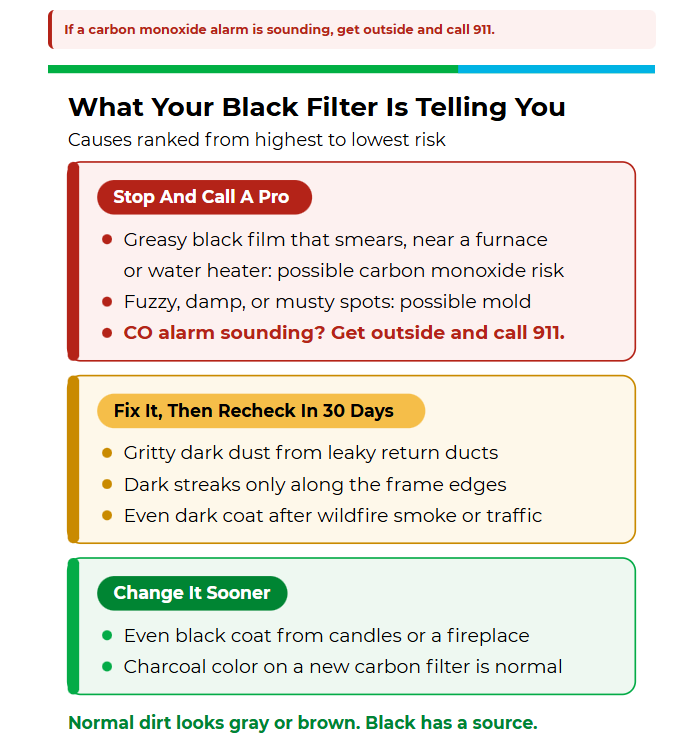
Your air filter is black because it caught soot or fine grime, usually from candles or a fireplace. Normal dirt turns a filter gray or brown, so true black always has a source. Soot near a furnace or water heater can point to carbon monoxide risk, and fuzzy or damp patches can mean mold. The chart below ranks each cause by risk, and the quick quiz under it helps you choose your next step.
If a carbon monoxide alarm is sounding, get outside and call 911.
Ruled out the urgent causes? Filterbuy makes pleated MERV 8, MERV 11, and MERV 13 filters in hundreds of standard and custom sizes, with fast and free 2-day delivery to most US states.
Shop Air Filters By SizeAnswer a few quick questions and we'll point you to the right next step for your home.
Author: Michelle Wan, Brand Manager and Air Quality Writer, Filterbuy
Technically reviewed by: David Clark, Licensed HVAC Technician
Published: September 21, 2026 | Updated: September 21, 2026
A black air filter has usually caught soot or fine grime, so find the source and change the filter sooner. Two findings call for more than a new filter. Soot traced to a furnace or water heater can point to carbon monoxide risk, and fuzzy or damp patches can mean mold.
Candles and wood-burning fireplaces are the most common sources of filter soot.
Soot around a gas furnace, water heater, or boiler signals incomplete combustion, the same process that produces carbon monoxide.
Mold on a filter looks patchy and fuzzy, and it only grows where moisture reaches the filter.
An air filter turns black when it collects dark particles faster than everyday dust can dull it to gray. Usually that means candle or fireplace soot. Less often it is mold, dirt from leaky ducts, or an appliance that is not burning cleanly, and four clues on the filter will tell you which.
At Filterbuy, we manufacture air filters in our own U.S. plants, and our standard pleated media leaves the line white. So when one comes out black, the color came from your home.
Most black air filters are harmless, but one cause is not. Soot from a malfunctioning fuel-burning appliance tops the risk ladder because the incomplete combustion that makes soot also produces carbon monoxide. Mold comes next because it means moisture is reaching the system. The middle rungs call for a fix or a closer look, and candle soot is low risk.
| LIKELY CAUSE | RISK | WHAT YOU SEE | OTHER CLUES | WHAT TO DO |
|---|---|---|---|---|
| Fuel-burning appliance soot | Urgent | Fine, greasy black film that smears | Soot near the furnace or water heater, yellow burner flame | Stop using it and call a technician. If a CO alarm sounds, get out and call 911 |
| Mold growth | High | Raised, fuzzy, or slimy spots | Damp filter, musty smell, clogged drain line | Turn the system off and call an HVAC pro |
| Leaky return ducts | Moderate | Gritty dark dust, sometimes insulation fibers | Fast loading, ducts in attic, crawlspace, or garage | Have ducts inspected and sealed |
| Air bypassing the filter | Moderate | Dark streaks along the frame edges | Gaps, wrong size, bent frame | Measure the slot and refit |
| Wildfire smoke or traffic grime | Moderate | Uniform dark gray to black | Smoke events, busy roads | Check AirNow and follow the smoke steps below |
| Candle, fireplace, or incense soot | Low | Even black coat across the face | Film above vents, dark carpet edges | Trim wicks to ¼ inch and burn less |
| Activated carbon filter | None | Charcoal color on a new filter | Label says carbon, as on Filterbuy Odor Eliminator filters | No action needed |
You can read a black air filter with four clues: color, texture, pattern, and timing. When two or three clues point the same way, the cause is usually clear.
| CLUE | WHAT TO CHECK | WHAT IT POINTS TO |
|---|---|---|
| Color |
Gray to brown is normal loading. True black is not. |
Black points to combustion particles. Mold can be black, gray, or green. |
| Texture | Brush the surface with a gloved finger. | Powder that smears is soot. Raised, fuzzy, or slimy spots are mold. |
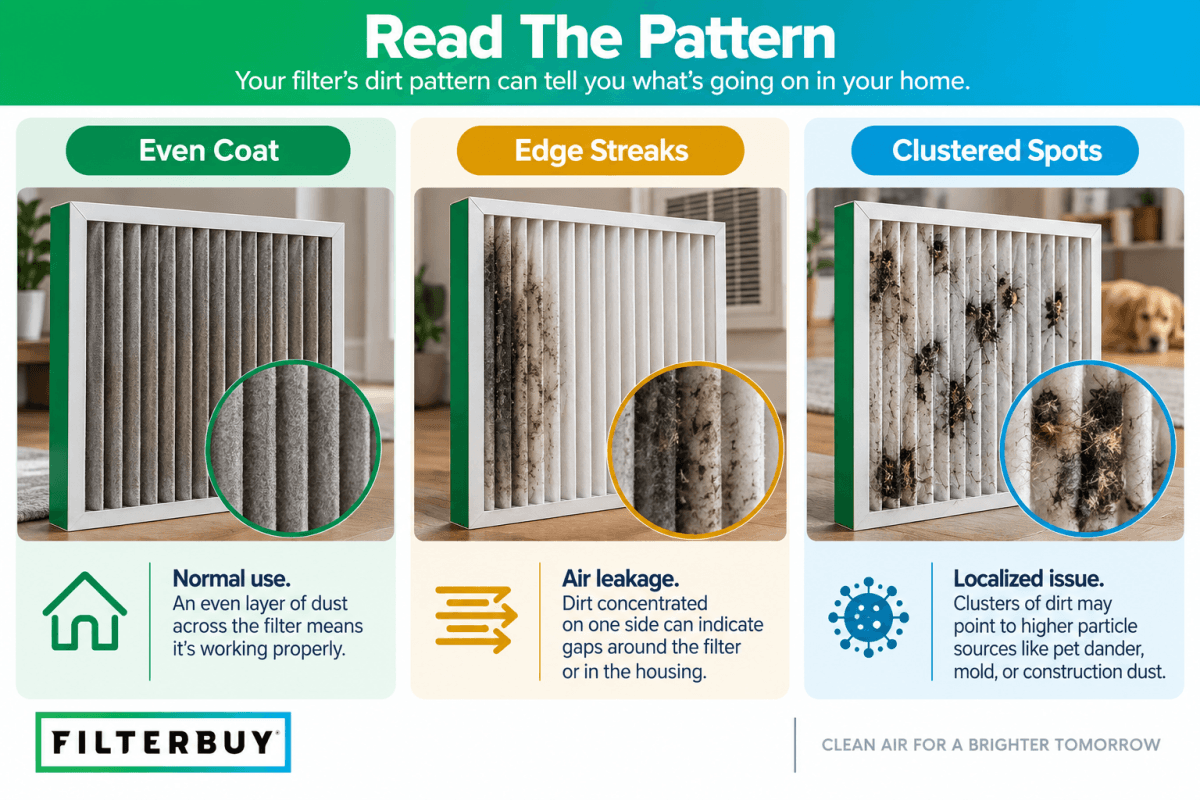
| Pattern | Where the dark area sits on the filter face. | Even coat: airborne soot. Edge streaks: air bypass. Clustered spots: moisture. |
| Timing | How long the filter has been installed. | Black within 30 days means a strong, steady source. |
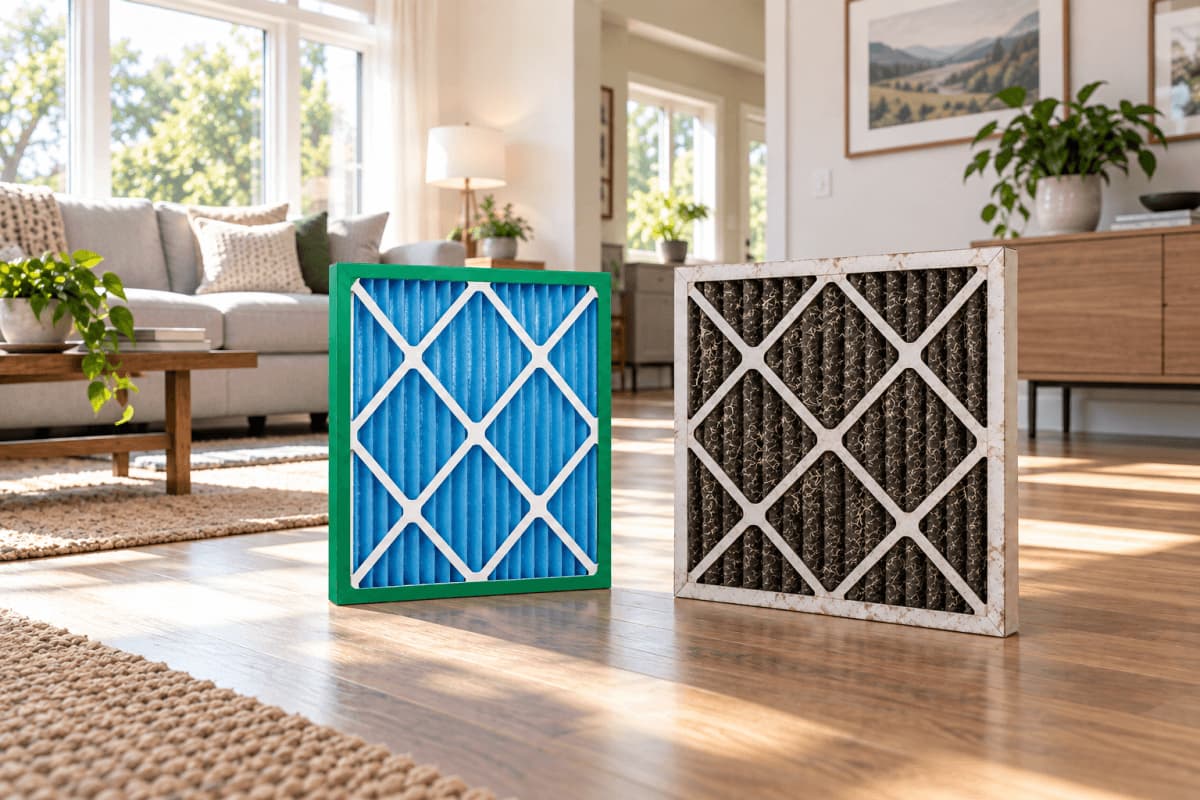
Filterbuy's own side-by-side of a new filter and the same 1-inch filter after 90 days shows even gray loading, not black. You can also compare yours against Filterbuy's guide to what a normally dirty filter looks like, or hold it next to white paper, a check the American Lung Association recommends.
Most black soot on a home air filter starts with an open flame indoors. Candles, incense, fireplaces, and wood stoves all release unburned carbon, and your filter catches it.
The National Candle Association says a candle soots when its wick gets too long or a draft disturbs the flame, and it recommends trimming the wick to 1/4 inch before every burn. That makes a candle near a return grille the worst case.
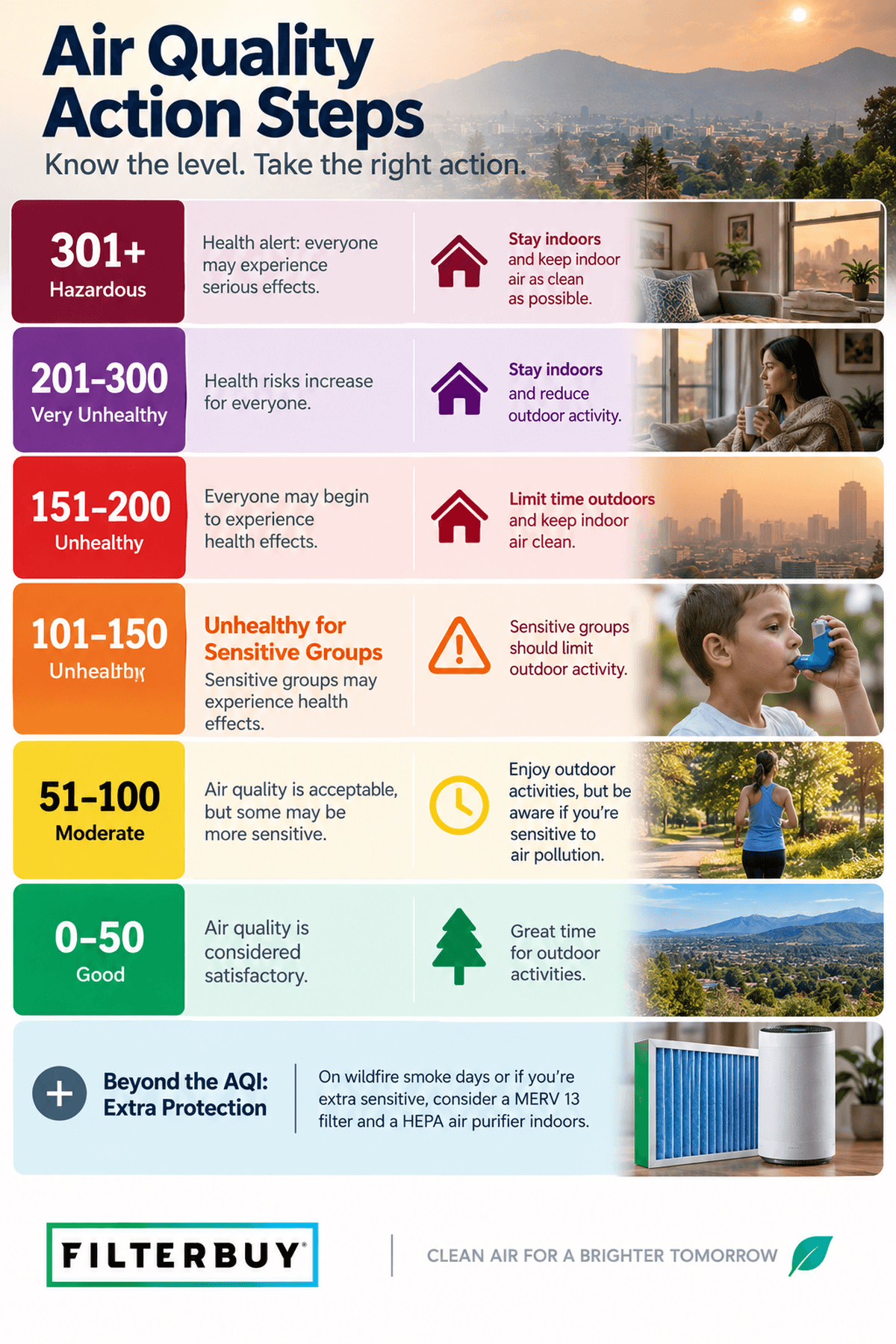
Start with the AirNow Fire and Smoke Map and your local air agency first. When the AQI climbs above 100, switch to a MERV 13 filter if you have an HVAC system, and run a HEPA air purifier in each room. Set the thermostat fan to On and keep the house closed up. MERV 13 is the filter rating the EPA's indoor air filtration guidance for wildfire smoke recommends for central systems during smoke.
Filterbuy's MERV 13 vs HEPA comparison explains how the two layers split the work, and in a home without central air, HEPA air purifiers are the main defense. For replacement timing, see how often to change your air filter when AQI is high.
| STEP | WHAT TO DO | WHOSE GUIDANCE |
|---|---|---|
| Official guidance | Check AirNow and your local air agency first, and follow any instruction to stay indoors or leave. | AirNow and local authorities |
| HVAC filter | Switch to MERV 13 in your size. Check your HVAC manual for filter compatibility, the same fit check as confirming a size. | EPA recommends MERV 13 or higher during smoke. The above-100 trigger is Filterbuy's. |
| Thermostat fan | Set the fan to On so the system filters continuously, not only while heating or cooling. | EPA |
| HEPA air purifiers | Run a HEPA air purifier in each room, bedrooms first. | Filterbuy (EPA describes one clean room) |
| Purifier sizing | Pick a purifier with a smoke CADR of at least two-thirds of the room's square feet. A 300 sq ft bedroom needs a smoke CADR of about 200. | EPA |
| Ozone | Skip ionizers and ozone generators. Choose a CARB-certified purifier that makes little or no ozone. | EPA |
| Close up | Keep windows and doors shut, and skip candles, frying, and smoking while smoke is in. | Filterbuy |
| No central air | HEPA air purifiers become the main defense. | EPA |
| Filter checks | Check the filter often and replace it when it looks dirty, even well before the normal schedule. Keep a spare on hand. | EPA |
A black air filter points to an appliance problem when the soot traces back to a gas furnace, water heater, boiler, or gas fireplace rather than candles. A healthy gas flame burns steady and blue. Soot on or around a fuel-burning appliance means the fuel is not burning completely, which is how carbon monoxide forms.
The U.S. Consumer Product Safety Commission's carbon monoxide fact sheet reports more than 200 U.S. deaths a year from carbon monoxide produced by non-automotive consumer products such as malfunctioning furnaces.
Watch for these signs:
Soot on the furnace cabinet, water heater, flue pipe, or vent connections.
A yellow, orange, or flickering burner flame.
Soot that returns with no candles or fireplace in use.
Headaches, dizziness, or nausea that ease when you leave the house.
If you see soot around an appliance, stop using it and call a licensed HVAC technician. If a carbon monoxide alarm goes off or anyone has symptoms, the CPSC advises getting outside and calling 911, and it recommends carbon monoxide alarms on every level of the home. CDC carbon monoxide guidance advises having fuel-burning appliances professionally serviced every year.
You are probably looking at mold if the black shows up as raised, fuzzy, or slimy spots instead of an even, powdery coat, especially when the filter feels damp or smells musty. Mold only grows where there is moisture, so mold on a filter means water is reaching it, most often from a clogged condensate drain line or high indoor humidity.
The U.S. Environmental Protection Agency's guide to mold, moisture, and your home says not to run an HVAC system you suspect is contaminated with mold, because it can spread mold through the building. It also advises against touching mold barehanded and recommends indoor humidity below 60 percent, ideally 30 to 50.
Turn the system off and bag the filter. Then have a professional fix the moisture before it runs again. If an odor lingers, read what a musty air filter smell means.
When a filter turns black within a month, a strong, steady source is loading it. The usual suspects are daily candles or incense, a wood stove in regular use, outdoor smoke, or leaky return ducts.
Timing helps narrow the list:
| HOW FAST IT WENT BLACK | MOST LIKELY SOURCES | FIRST CHECK |
|---|---|---|
| Within a few days | A wildfire smoke event or heavy fireplace or wood stove use | Check AirNow and recent burning. If neither fits, check fuel-burning appliances |
| Within about a month | Daily candles or incense, a wood stove in regular use, leaky return ducts | Pause candles or incense for one filter cycle, then compare the next filter |
| Faster than your usual schedule | Occasional candles, high-heat cooking, busy-road traffic | Shorten your interval and recheck at 30 days. Filterbuy auto-delivery can match the new schedule |
| Only after many months | An overdue filter darkened by ordinary dust | Replace it and write the date on the frame |
| Mostly along the edges, at any age | Air bypassing the filter | Measure the slot and refit |
ENERGY STAR duct sealing guidance estimates that about 20 to 30 percent of the air moving through a typical home's ducts is lost to leaks, holes, and poor connections, so fast-loading, gritty dark dust is a good reason to have yours inspected and sealed.
A Lawrence Berkeley National Laboratory study of filter bypass modeled about 10 percent of air slipping past a filter in a loose slot and about 25 percent past one with a large gap, and noted that leaky return ducts can draw in particles from attics, crawlspaces, and garages.
Fit problems leave a telltale sign: dark lines along the frame edges and on the slot walls. Filterbuy cuts every standard filter half an inch under its nominal size, which leaves about a quarter inch on each side in a true-to-size slot. If your slot runs wider than its label, that gap grows and the edge streaks follow. Check yours with this guide on how to measure your air filter, and see how often to change your HVAC filter for the baseline schedule.
When you find a black air filter, rule out carbon monoxide and mold first, then trace the source. All you need is disposable gloves and a plastic bag.
If a carbon monoxide alarm is sounding or anyone feels dizzy or nauseated, leave the house and call 911.
Pull the filter out in good light and note its color, texture, pattern, and smell.
If it is damp or fuzzy, bag it and leave the system off. Then call an HVAC professional.
Look over each fuel-burning appliance. If you see soot nearby or a flame that is not steady and blue, stop using it and call a technician.
If both checks are clear, install a new filter with the airflow arrow pointing toward the equipment, following this step-by-step filter replacement guide. The Department of Energy's Building America filter installation guide confirms that direction. Then write the date on the frame.
Check it again in 30 days. If it is black again, keep narrowing the source.
If a technician is coming, have these ready:
| WHAT TO HAVE READY | WHY IT HELPS |
|---|---|
| The black filter, bagged, plus photos of both faces | Shows color, texture, and pattern without handling the filter again |
| A photo of the empty filter slot | Reveals fit gaps behind edge streaks |
| Where else you have seen soot in the house | Helps separate appliance soot from candle or fireplace soot |
| Any flame color you have seen through a viewing window, without removing panels | A yellow or orange flame points to incomplete combustion |
| The date each fuel-burning appliance was last serviced | The CPSC and CDC both recommend yearly professional servicing |
| Your carbon monoxide alarm history | Tells the technician whether carbon monoxide has already been detected |
| An indoor humidity reading from an inexpensive meter | The EPA recommends keeping indoor humidity below 60 percent to limit mold |
For homes that burn candles or wood, or sit in smoke-prone areas, Filterbuy MERV 13 air filters are the tier built for smoke and other fine particles. Compare tiers in Filterbuy's guide to how MERV ratings work, and check your HVAC manual for filter compatibility before moving up.
If odors linger, Filterbuy Odor Eliminator carbon filters add activated carbon to pleated media. Their charcoal-colored media can make a clean filter look dirty. Check your HVAC manual for compatibility here too.
Before you upgrade, make sure the filter fits, as Filterbuy's Michelle Wan explains:
“The question I get most is which MERV to buy. The one to ask first is whether the filter you are holding actually fills the slot. A rating describes the media, not the gap around it.”
| CAUSE YOU FOUND | FIX FIRST | FILTER TO INSTALL |
|---|---|---|
| Candle, fireplace, or cooking soot | Trim wicks, burn less, keep flames away from returns | Filterbuy MERV 13 |
| Wildfire smoke or traffic grime | Follow the smoke steps and check the filter often while smoke lasts | Filterbuy MERV 13 in your size |
| Lingering smoke or cooking odors | Ventilate while cooking | Filterbuy Odor Eliminator carbon filter |
| Air bypassing the filter | Measure the slot, replace warped frames | Correct size in your current tier, or a Filterbuy custom size for odd slots |
| Leaky return ducts | Have the ducts inspected and sealed | Your current tier, checked monthly |
| Mold growth | Fix the moisture source with an HVAC pro | New filter after the system is cleared |
| Fuel-burning appliance soot | Have the appliance inspected and repaired | New filter after the repair |
1. 3.9 million U.S. homes reported mold in one year.
Another 11.2 million had water leaking inside.
Why it matters: Mold on a filter starts with moisture.
Source: 2023 American Housing Survey housing quality data, U.S. Census Bureau and HUD.
2. 47% of U.S. homes heat mainly with natural gas.
Why it matters: Fuel-burning heat can leave soot when combustion goes wrong.
Source: EIA analysis of residential heating fuels, U.S. Energy Information Administration (2024 data).
3. 47% of U.S. homes showed dampness or mold in field studies.
That average spans seven studies and more than 24,000 homes.
Why it matters: Check for moisture before blaming dust.
Source: Berkeley Lab research on building dampness prevalence, Lawrence Berkeley National Laboratory.
Filterbuy makes pleated MERV 8, MERV 11, and MERV 13 filters in hundreds of standard and custom sizes, with fast and free 2-day delivery to most US states.
No. A normally dirty filter turns gray or brown, so black always has a source.
The filter itself is not the hazard, but what turned it black can be, especially soot from a malfunctioning gas appliance or mold from a moisture problem.
Only if it is labeled washable. Standard pleated filters, including Filterbuy's, are single-use, and a moldy filter should be bagged and replaced.
Edge streaks mean air is going around the filter rather than through it. Measure the slot and install a filter that seats snugly.
Soot. Unburned carbon particles left when fuel or wax burns incompletely.
Carbon monoxide (CO). A colorless, odorless, poisonous gas produced by incomplete burning of fuels.
Incomplete combustion. Burning that leaves soot and carbon monoxide behind.
Mold. A fungus that grows on damp surfaces and comes in many colors.
Filter bypass. Air that flows around a filter instead of through it.
MERV. Minimum Efficiency Reporting Value, the industry scale for filter capture.
AQI. The EPA's daily Air Quality Index.
HEPA. A filter standard for portable air purifiers, never home HVAC systems.
CADR. Clean Air Delivery Rate, a portable cleaner's filtered-air output.
Activated carbon. Porous carbon added to some filters, including Filterbuy Odor Eliminator filters, for household odors.
Michelle Wan is Brand Manager and Air Quality Writer at Filterbuy, where she works directly with the US manufacturing team. She earned her bachelor's degree at the University of California, Santa Cruz.
