
What AQI Is Actually Dangerous? Thresholds That Depend on You
September 4, 2026
Author: Michelle Wan | Reviewed by David Clark, Licensed HVAC Technician | Published September 4, 2026
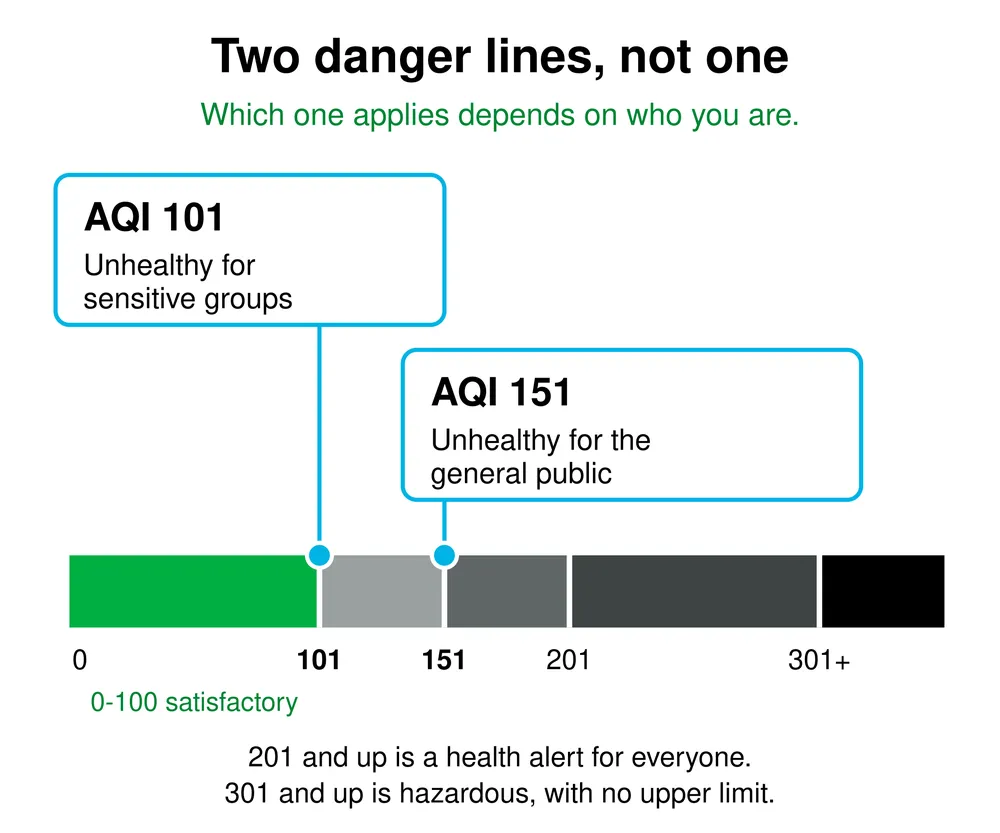
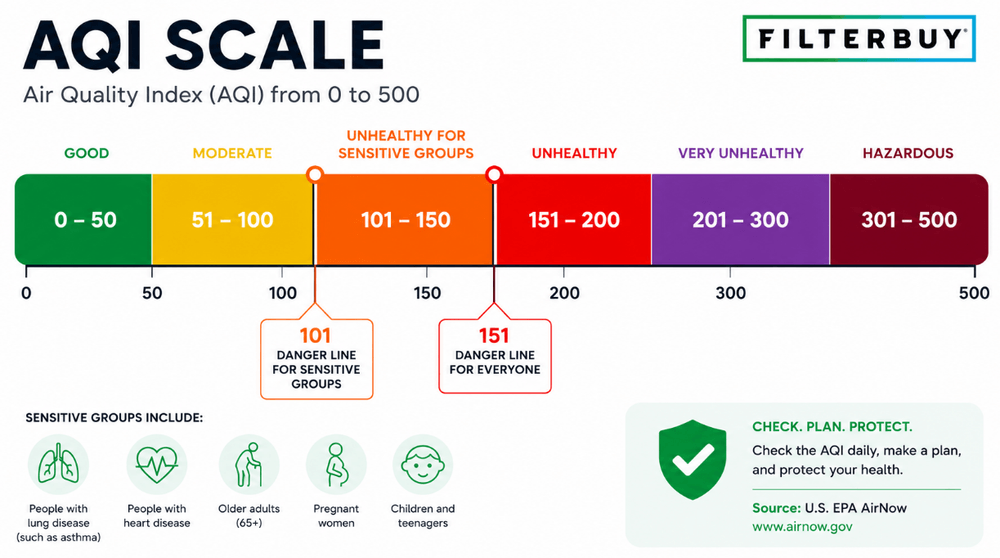
There is no single AQI number that is dangerous for everyone. The EPA draws two lines: AQI 101, where the air becomes unhealthy for sensitive groups, and AQI 151, where it becomes unhealthy for the general public.
Your own line sits somewhere in that range. It depends on your health, your age, and how hard and how long you are breathing outdoor air.
AQI 101 to 150, unhealthy for sensitive groups. Asthma, heart disease, diabetes, children, and older adults.
AQI 151 to 200, unhealthy. Some of the general public may feel effects too.
AQI 201 to 300, very unhealthy. EPA calls this a health alert for everyone.
AQI 301 and up, hazardous. Emergency conditions, with no upper limit.
Above AQI 100 the indoor response is the same for every household: close up, recirculate, and run a filter rated MERV 13, or as high as your system accommodates, which captures microscopic particles. Match one to your home with the quiz below.
Answer 3 quick questions and we will match you to the right filter for your home.
TL;DR: There is no single AQI number that is dangerous for everyone. The U.S. EPA treats AQI 101 as the first threshold where sensitive groups feel effects, and AQI 151 as the point where the general public may too. Your personal danger line sits somewhere in that range depending on your health, your age, and how hard and how long you are breathing outdoor air.
Key Takeaways
AQI 101 is the first official danger threshold, covering asthma, heart disease, diabetes, children and older adults.
AQI 151 is where danger becomes general. EPA says some of the general public may feel effects too.
AQI 201+ is a health alert for everyone, and 301+ counts as emergency conditions.
How hard you breathe changes the math. Dose is concentration × breathing rate × time, so a hard workout at a moderate AQI can beat resting at a high one.
The pollutant driving the reading changes who is at risk. EPA lists anyone active outdoors as sensitive to ozone only, and heart disease to particles but not ozone.
Above AQI 100, run both defenses. EPA points to a MERV 13 filter if your HVAC takes one, plus a sized HEPA air cleaner in each room you use.
The full scale runs Good (0–50), Moderate (51–100), Unhealthy for Sensitive Groups (101–150), Unhealthy (151–200), Very Unhealthy (201–300) and Hazardous (301+). The cutoff for Good fell from 12.0 to 9.0 µg/m³ of PM2.5 in May 2024, so older charts are wrong.
Is There One AQI Number That Is Dangerous For Everyone?
No. The AQI has two danger lines, not one. AQI 101 is where air quality officially becomes unhealthy for sensitive groups. AQI 151 is where it becomes unhealthy for the general public. Per EPA’s AQI Basics, at or below 100 is satisfactory; above it the air turns unhealthy for sensitive groups first, then for everyone.
That two-stage design is what most articles skip. Asking "what AQI is dangerous" without saying dangerous for whom is either too cautious for a healthy adult or too relaxed for a child with asthma.
The gap: The agencies publishing the AQI write for whole cities at once, because that is who they address. Filterbuy has built air filters in its own U.S. plants since 2013, and nearly every question we get about a reading is really about one house and the people in it. Population-level advice, household-level decision. Hence answering by group rather than by number.
What Is Your Personal AQI Danger Threshold?
Your danger threshold is the AQI at which you change what you had planned to do outside. For most healthy adults that is around 151, for an EPA-defined sensitive group closer to 101, and heavy exertion drops it lower still.
For particle pollution EPA lists heart or lung disease, older adults and children, and its clinical guidance adds diabetes and lower socioeconomic status. Ozone adds healthy adults active outdoors, and smoke events add pregnant people.
AQI action threshold by group
A Filterbuy table, built from the cautionary statements in the EPA Technical Assistance Document for the Reporting of Daily Air Quality. Not medical advice; ask your clinician for your own number.
Read More: unhealthy for sensitive groups.
One caveat: the live number averages recent hours, so it lags both ways. Near your line, direction matters more than value. A 95 climbing through a smoky afternoon is already past 101 in practice.
“People ask us whether 120 is bad. The honest answer is another question: bad for whom, doing what, for how long? Once you know your own number, checking the air stops being a source of anxiety and becomes a ten-second decision.”
— Michelle Wan, Brand Manager and Air Quality Writer, Filterbuy
Why The Danger Line Moves: The Dose Equation
Two people in the same air do not receive the same exposure. EPA sets out why in Patient Exposure and the AQI: inhaled dose equals concentration multiplied by breathing rate multiplied by time. Concentration is the only one the AQI reports. The other two are yours.
EPA puts moderate exertion such as light jogging at 25 to 45 liters of air per minute, heavy exertion above 45, and rest at roughly 6 to 8. Set those against two ordinary afternoons and the comparison surprises people.
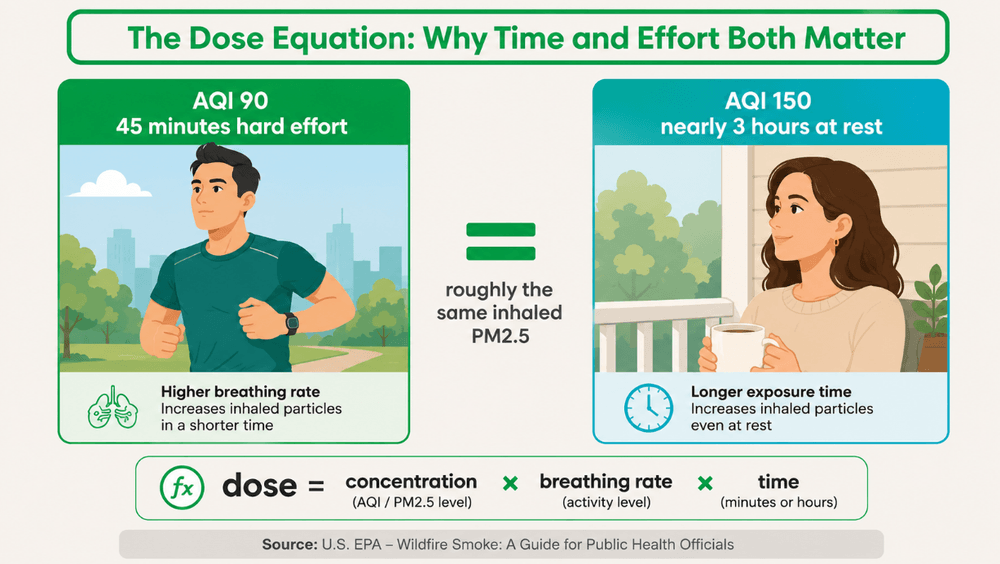
A 45-minute hard run at AQI 90 delivers roughly the same inhaled PM2.5 dose as sitting still outdoors for nearly three hours at AQI 150.
AQI 90 is about 30 µg/m³ of PM2.5, so at 50 L/min for 45 minutes you move 2.25 m³ of air and take in roughly 67 µg. AQI 150 is 55.4 µg/m³, and at a resting 7 L/min the same 67 µg takes about 174 minutes.
A Filterbuy calculation, run for this page from EPA’s intake-dose equation and current PM2.5 breakpoints. Illustrative; breathing rates vary widely.
This is why guidance says to reduce exertion, not just time outside. Gardening thirty minutes instead of an hour cuts your dose without keeping you in all day.
Same Number, Different Risk: Check Which Pollutant Is Driving It
Two AQI 110 days can put different people at risk, because EPA does not use one fixed sensitive-groups list. It publishes a separate list per pollutant. Comparing them turns up an asymmetry that rarely reaches consumer guidance.
Who is sensitive to what
Source: U.S. EPA, Technical Assistance Document for the Reporting of Daily Air Quality, Table 4. Nitrogen dioxide and sulfur dioxide carry their own lists and rarely drive a reading. Highlighted entries are the ones that move between pollutants.
Read the third column. Anyone active outdoors appears only under ozone. Heart disease appears under particles and carbon monoxide, but not ozone. A healthy runner is in a sensitive group on a high-ozone afternoon and is not on a smoky one at the same AQI. Heart disease is the reverse.
AirNow, most weather apps and the Filterbuy AQI lookup by ZIP code all name the main pollutant beside the number. Two seconds to read, and it tells you whether today’s 110 is your 110.
How High Can The AQI Get?
The AQI goes higher than most charts suggest, because Hazardous is open-ended. EPA defines it as 301 and above with no ceiling, so a reading past 500 is still Hazardous, on the same linear slope used between 301 and 500, per its AQI reporting guidance.
Nothing changes what you do above 301; our guide to the hazardous air quality range covers that end of the scale.
What To Do Indoors Once The AQI Passes 100
Your outdoor threshold is personal; the indoor one is not. Once the AQI passes 100, the same two-part response makes sense in every household, because cleaning the air you are sitting in has no downside. Start with the air handler you own: close up, set the HVAC to recirculate, and run the fan continuously.
Whether it helps comes down to the filter. EPA’s Guide to Air Cleaners in the Home says to select a filter rated at least MERV 13, or as high as your system will accommodate. That is a testing threshold, not marketing: MERV 13 and above must show at least 50% removal efficiency for the smallest particles tested. If your system takes one, it is the highest-leverage change available above 100. We match rating to reading in what MERV rating for high AQI.
Two things Filterbuy has learned making them:
Check your filter during a smoke event, not after. Fine particles load a filter far faster than house dust, so one that looked fine last week can clog in two smoky days.
Confirm your system handles MERV 13 first; EPA notes most do if the filter is replaced often. More in all about MERV ratings.
Then Add A Hepa Air Cleaner In Each Room You Use
EPA treats the two as complementary, because they do different jobs: A central filter cleans the whole house, but only while the fan runs. A portable HEPA unit cleans one room continuously. Above AQI 100 the pairing holds indoor particle levels down, so put a unit in each room the household uses, bedrooms first.
Size each unit to its room, not by price. EPA’s Guide to Air Cleaners in the Home sets a minimum clean air delivery rate, or CADR, by room size. Match or beat it.
Sizing a portable HEPA air cleaner by room
Source: U.S. EPA, Guide to Air Cleaners in the Home. CADR figures assume an 8-foot ceiling and are for estimation. Size for the room with its door shut, since an open door enlarges the space the unit is treating.
Two caveats. Portable units are particle-rated, so they do nothing for ozone; and with no ducted system they are all of the plan rather than half. Filterbuy stocks replacement purifier filters, because a loaded cartridge is just a noisy fan.
Check your local AQI now, or look it up by ZIP code, then match your filter to the air. Find your exact filter size and shop Filterbuy MERV 13 filters, or set up auto-delivery so a fresh one arrives before the next smoke season. If your return is an odd size, you can build a custom filter.
Supporting Statistics
Three findings behind the case that the line is personal, and that the indoor response works.
757 days at AQI 101 or above across the 35 largest U.S. metro areas in 2024.
Roughly two city-days above the threshold for every day of the year, down from 2,080 in 2000. Crossing 101 is routine. Source: U.S. EPA, Our Nation’s Air: Trends Through 2024.
A 7.3%% rise in all-cause mortality per 10 µg/m³ of PM2.5, including below the national standard.
Harvard tracked all 60.9 million Medicare beneficiaries across 460 million person-years, and the association held below the standards then in force. Cleaner is better, not risk-free. Source: Di et al., NEJM 2017, via NIH PubMed Central.
An indoor-to-outdoor PM2.5 ratio of 0.22 with both defenses running, against 0.55 with the filter alone.
Researchers monitored a home through a wildfire event. A MERV 13 filter in the central system held the ratio to a mean of 0.55; adding a portable air cleaner cut it to 0.22. The two-part response above, measured. Source: Interventions to Reduce PM2.5 in a Residence during a Wildfire Event, via NIH PubMed Central.
Frequently Asked Questions
Is AQI 100 dangerous?
AQI 100 tops the Moderate category and is not dangerous for the general public. It is where unusually sensitive people may notice effects.
Is AQI 150 dangerous?
AQI 150 tops the Unhealthy for Sensitive Groups range, so it is a danger threshold for asthma, heart disease, diabetes, children and older adults. At 151 everyone is included.
At what AQI should I stop exercising outside?
Sensitive groups should cut heavy outdoor exertion at 101. Healthy adults exercising hard should ease off well before 151, because a high breathing rate multiplies the dose inhaled.
Is AQI 200 dangerous for healthy adults?
Yes. AQI 201 begins Very Unhealthy, which EPA calls a health alert where risk is increased for everyone regardless of health status.
Does a high outdoor AQI mean my indoor air is bad?
It can. Fine particles infiltrate through gaps and ventilation. Closing up, recirculating, and running MERV 13 alongside a HEPA cleaner measurably reduces indoor PM2.5.
General health information based on U.S. EPA guidance, not medical advice. If you have a heart or lung condition, are pregnant, or care for someone in a sensitive group, ask a clinician for thresholds specific to you.
Sources
Glossary
AQI (Air Quality Index): EPA's index for outdoor air, in six color-coded categories from Good to Hazardous.
Sensitive groups: EPA's term for people at higher risk: heart or lung disease, older adults, children, diabetes, lower socioeconomic status.
PM2.5: Fine particles 2.5 microns or smaller. Drives most smoke-event readings and travels deep into the lungs.
Ground-level ozone: Formed when sunlight reacts with vehicle and industrial emissions. Drives readings on hot days.
Hazardous (301+): The top category, 301 and above with no upper limit. Older guidance called values past 500 "Beyond the AQI".
MERV: Minimum Efficiency Reporting Value, the 1-to-16 particle-capture scale. MERV 13 is the lowest EPA recommends for homes.
HEPA and CADR: HEPA is the media in most portable air cleaners. CADR, or clean air delivery rate, is how much filtered air a unit produces per minute, and how you size one.
Main pollutant: The pollutant with the highest sub-index that day. It sets the AQI number and which list applies.