
Wildfire Smoke and Pregnancy: Risks by Trimester and How to Stay Safe
July 13, 2026
By Michelle Wan•Reviewed by David Clark, Licensed HVAC Technician (HVAC & filtration guidance)•Published July 13, 2026•Updated September 4, 2026
How to Protect Yourself From Wildfire Smoke During Pregnancy
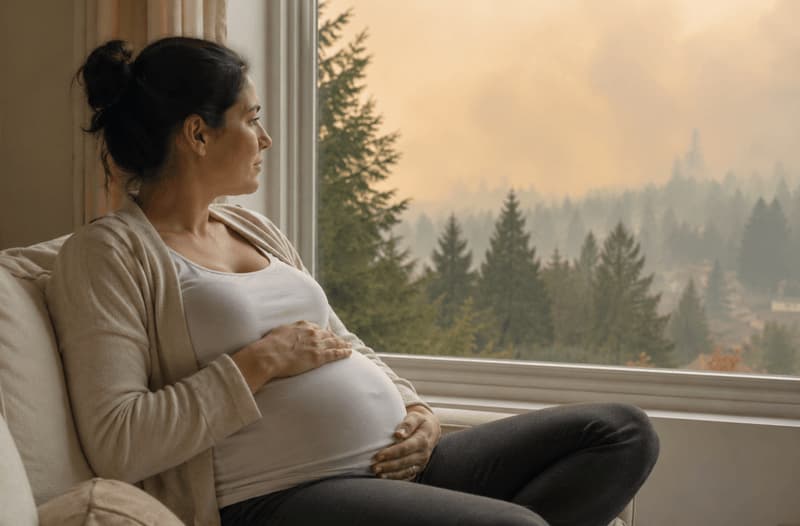
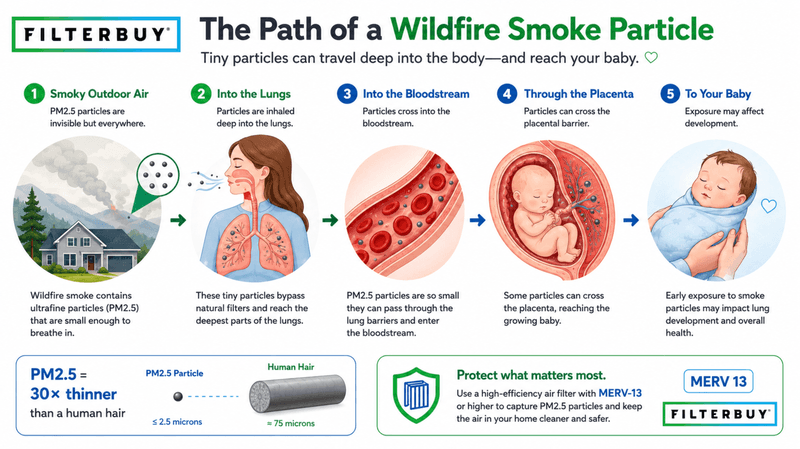
Yes, wildfire smoke can be harmful during pregnancy. The fine particles in it (PM2.5) can reach your bloodstream and affect the placenta, and health agencies link smoke exposure to higher rates of preterm birth and low birth weight.
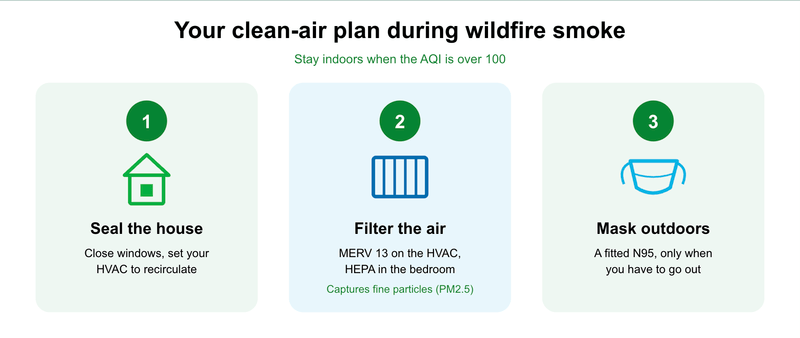
The good news: the fix is mostly indoors. Watch your local AQI, stay inside when it climbs above 100, run a MERV 13 filter on recirculate, and wear a fitted N95 on the rare trips you can't avoid.
Not sure which filter fits your system? Answer a few quick questions and we'll match you to the right one.
Quick answer: Wildfire smoke exposure during pregnancy has been linked in observational studies to outcomes such as preterm birth and lower birth weight, though the science is still developing. You can lower your exposure by staying indoors on smoky days, filtering your home air with a high-efficiency HVAC filter and a HEPA air cleaner, and following local air quality alerts and evacuation orders.
If you are pregnant and watching the sky turn hazy, worry is a natural response. You want clear answers about what wildfire smoke means for you and your baby, and practical steps you can take today. This guide gives you both, drawn from public health agencies and recent peer-reviewed research.
Here is what matters most upfront: reducing your exposure is something you can act on, even while the science still has open questions. Below you will find what current evidence shows, how researchers describe risk across pregnancy, and a clear plan for keeping your indoor air cleaner during smoke events.
What Current Evidence Says
Public health agencies including the CDC and EPA identify pregnant people as more sensitive to wildfire smoke, and recommend limiting exposure to fine particle pollution (PM2.5).
The Society for Maternal-Fetal Medicine (SMFM), in its January 2025 alert on wildfires and air quality, recommends avoiding outdoor activity when the Air Quality Index (AQI) exceeds 100.
Observational studies, including Picciotto et al. (Environment International, 2024) and Sherris et al. (The Lancet Planetary Health, 2025), have reported associations between wildfire-smoke exposure and outcomes such as preterm birth and reduced birth weight.
These are associations, not proof of cause and effect. Individual risk depends on many factors, and most pregnancies exposed to smoke go on to have healthy outcomes.
Is Wildfire Smoke Harmful During Pregnancy?
Wildfire smoke contains fine particulate matter known as PM2.5 — particles small enough to travel deep into the lungs and enter the bloodstream. The CDC and EPA both identify pregnant people as more sensitive to this kind of air pollution, alongside groups such as young children and older adults.
Why Pregnancy Calls for Extra Caution
Breathing rates change, the cardiovascular system works harder, and the body is already managing significant physical demands. Public health guidance therefore treats reducing smoke exposure as a sensible precaution.
It helps to keep the risk in perspective. Research points to associations between smoke exposure and certain pregnancy outcomes, but association is not the same as causation. Many people breathe smoky air during pregnancy and have healthy babies. The goal is not to eliminate every particle, which is impossible, but to lower your exposure in ways that are realistic and effective.
What Researchers Know
PM2.5 from wildfire smoke can enter the bloodstream and is associated with inflammation and other physiological stress.
Multiple observational studies have found links between higher smoke exposure and outcomes such as preterm birth and lower birth weight.
Reducing exposure to fine particle pollution is a widely endorsed precaution for sensitive groups.
What Remains Uncertain
Whether wildfire smoke directly causes specific pregnancy outcomes, versus being one contributing factor among many.
How much exposure, and over what timeframe, meaningfully changes risk for an individual.
Whether any single trimester is truly more vulnerable, since study findings vary and rely on observational data.
This honesty matters. The science is active and evolving, and newer work such as Brew et al. (AJOG, 2026) and Liang et al. (Frontiers in Environmental Health, 2026) continues to refine what we understand. Treat the guidance below as sound precaution rather than a guarantee.
Which Trimester Is Most Affected by Wildfire Smoke?
Short answer: no trimester has been established as the most dangerous. Studies have reported associations at different stages of pregnancy, and their findings do not point to a single window of concern. Everything in the table below reflects observational associations, not proven cause and effect.
| Trimester | What Some Studies Have Observed | How to Read This |
|---|---|---|
| First Trimester |
Some observational research has linked exposure during early pregnancy with certain adverse outcomes. | Findings are associations only. Early pregnancy is a period of rapid change, so limiting exposure is reasonable. |
| Second Trimester |
Associations with outcomes such as altered fetal growth have appeared in some studies. | Results vary across studies. This is not evidence that the second trimester is uniquely risky. |
| Third Trimester |
Several studies have reported associations between late-pregnancy exposure and preterm birth or lower birth weight. | Association does not mean your pregnancy will be affected. Precautions still apply. |
The practical takeaway is the same across all three trimesters: reducing your exposure to wildfire smoke is a reasonable step no matter how far along you are. Do not read the table as a reason to relax during any stage — consistent, sensible precautions serve you best throughout.
What AQI Is Unsafe During Pregnancy?
The Air Quality Index (AQI) reports how polluted the air is, with higher numbers meaning worse conditions. You can check your local AQI in real time at AirNow.gov.
For pregnant people, SMFM recommends avoiding outdoor activity when the AQI exceeds 100. That threshold gives you a simple, actionable rule: when the number climbs above 100, plan to stay indoors with your air filtered as well as your setup allows.
AQI Action Guide for Pregnancy
| AQI Level | Category | What to Do While Pregnant |
|---|---|---|
| 0–50 | Good | Normal activity is generally fine. |
| 51–100 | Moderate | Stay alert to changing conditions. Consider limiting prolonged or heavy outdoor exertion. |
| 101–150 | Unhealthy for Sensitive Groups | SMFM advises avoiding outdoor activity above AQI 100. Stay indoors and keep indoor air cleaner. |
| 151–200 | Unhealthy | Stay indoors. Run air filtration, keep windows closed, and wear a well-fitted N95 if you must go out. |
| 201+ | Very Unhealthy to Hazardous | Minimize all outdoor exposure. Follow local health guidance and any evacuation orders. |
How Can You Reduce Wildfire Smoke Exposure While Pregnant?
You cannot control the smoke outside, but you have real influence over the air you breathe indoors. The steps below draw on EPA and CDC guidance on reducing smoke exposure at home. None of them eliminate risk, but together they can meaningfully lower how much PM2.5 you take in.
1. Check the AQI and Local Evacuation Alerts
Start every smoky day by checking AirNow.gov for your current AQI and monitoring local news or emergency channels for evacuation notices. This tells you whether to stay in, keep the kids in, and how aggressively to run your filtration. Sign up for local alerts if your area offers them.
2. Create a Cleaner-Air Room
Pick one room where you spend a lot of time — ideally a bedroom — and make it your cleaner-air space. Keep windows and doors closed, avoid activities that add particles, and concentrate your air-cleaning efforts there. A smaller sealed room is easier to keep clean than an entire house. EPA's clean room guidance walks through the setup.
3. Use the Highest-Efficiency HVAC Filter Your System Can Safely Handle
If you have central heating and cooling, a higher-efficiency filter can capture fine particles as air circulates. EPA suggests a filter rated MERV 13, or the highest efficiency the system can safely handle. Not every system is designed for a MERV 13 filter, so check your equipment or ask an HVAC professional before upgrading. (See our guide to the best MERV rating for wildfire smoke.)
During a smoke event — and only with a compatible system — running the HVAC fan continuously helps filter the air more often, rather than only when heating or cooling cycles on. Switch back to normal operation once the smoke clears.
4. Add a Portable HEPA Air Cleaner When Possible
A portable air cleaner with a true HEPA filter can further reduce PM2.5 in your cleaner-air room.
HEPA and MERV 13 are not the same thing. HEPA is a higher-efficiency standard used in standalone air cleaners; MERV 13 is a rating for HVAC filters. Using both a compatible HVAC filter and a portable HEPA cleaner gives you two layers of filtration. Size the portable unit to the room for best results. Our MERV 13 vs. HEPA comparison breaks down the difference.
5. Wear a NIOSH-Approved N95 When an Outdoor Trip Cannot Be Avoided
If you must go outside during heavy smoke, a NIOSH-approved N95 respirator can reduce how many fine particles you inhale. Certification matters, but so does fit — a respirator only works well when it seals against your face, so choose a size and style that fits snugly with no gaps. Cloth and surgical masks do not filter PM2.5 effectively. If breathing through an N95 feels difficult, take breaks and talk with your provider.
6. Reduce Indoor Particle Sources
While you are keeping outdoor smoke out, avoid adding particles indoors. Skip candles, incense, frying and broiling, vacuuming without a HEPA filter, and any smoking inside. These activities raise indoor PM2.5 and work against your filtration efforts.
7. Follow Evacuation Orders
Filtration and staying indoors are for smoke management, not for riding out a fire. If officials issue an evacuation order for your area, leave. Your safety and your pregnancy come first, and no home filtration setup is a substitute for getting out of harm's way.
What Should You Prepare Before Wildfire Season?
A little planning before smoke arrives makes a stressful situation far more manageable. Use this readiness checklist while the air is still clear.
Confirm your HVAC filter size. Check the dimensions printed on your current filter so you can buy the right replacement without guessing.
Stock spare filters. Smoke can clog filters faster, and stores may sell out during fire season.
Choose your cleaner-air room now. Decide which room you will seal and equip, and clear any clutter that would make sealing it harder.
Check portable air cleaner readiness. Confirm your HEPA unit works and that you have replacement filters sized for the room.
Buy well-fitting N95 respirators. Get NIOSH-approved N95s in a size that seals to your face before you need them.
Bookmark AirNow.gov. Save the AQI site and sign up for local emergency alerts.
Build an evacuation bag. Include medications, prenatal records, water, and essentials in case you need to leave quickly.
Talk with your provider. Ask about your specific situation, especially if you have asthma or another respiratory condition.
When Should You Call a Doctor About Wildfire Smoke During Pregnancy?
Smoke exposure by itself does not automatically require extra scans or appointments. Current SMFM guidance does not recommend additional monitoring based on smoke exposure alone. That said, contact your provider if you notice symptoms that concern you.
Reach out to your OB-GYN, midwife, or maternal-fetal medicine specialist if you experience:
Trouble breathing, chest tightness, or wheezing that does not ease when you get to cleaner air
A worsening of asthma or another respiratory condition
Reduced fetal movement, contractions, or any sign of preterm labor
Severe or persistent headache, dizziness, or heart palpitations
Any symptom that feels wrong or leaves you worried
When in doubt, call. Your care team would rather hear from you than have you wait, and they can advise based on your individual health.
Don't Wait for the Smoke: Get Your Filters Ready Now
Wildfire smoke is a real concern during pregnancy — and it is also something you can respond to with practical, effective steps. The research so far shows associations between smoke exposure and certain pregnancy outcomes, while leaving important questions open. That uncertainty is a reason for sensible precaution, not panic.
Focus on what you can control: check the AQI, stay indoors when it climbs above 100, keep your indoor air as clean as your setup allows, wear a well-fitting N95 when you have to go out, and follow evacuation orders without hesitation. Prepare before the season starts so smoke never catches you off guard.
Filterbuy's expertise is residential air filtration, not prenatal medical care. For questions about your pregnancy, your OB-GYN, midwife, or maternal-fetal medicine specialist is your best source of guidance.
Get ready before the smoke arrives. Confirm your HVAC filter size today, and if your system is compatible, explore Filterbuy MERV 13 filters so you have clean-air-ready replacements on hand for wildfire season.
Frequently Asked Questions
Does Wildfire Smoke Cause Miscarriage Or Birth Defects?
Current evidence does not establish that wildfire smoke causes miscarriage or birth defects. Some observational studies link smoke exposure to outcomes such as preterm birth and lower birth weight, but these are associations, not proven cause and effect. Most pregnancies exposed to smoke result in healthy babies, and reducing exposure remains a sensible precaution.
Is Any Trimester Safe From Wildfire Smoke?
No trimester is considered safe or definitively the most dangerous. Studies have reported associations at different stages, and findings vary. The consistent advice across all three trimesters is to limit exposure to smoke whenever air quality is poor.
Can An Air Purifier Or Filter Protect My Baby From Smoke?
Filtration can lower the amount of fine particle pollution in your indoor air, which reduces your exposure. It does not eliminate risk or guarantee any outcome for your pregnancy. Think of a HEPA air cleaner and a compatible high-efficiency HVAC filter as tools that make your indoor air cleaner, used alongside staying indoors and following AQI guidance.
What Aqi Level Should Make A Pregnant Person Stay Indoors?
The Society for Maternal-Fetal Medicine recommends avoiding outdoor activity when the AQI exceeds 100. Check your local AQI at AirNow.gov, and remember that conditions can change quickly during active fires.
Do N95 Masks Work During Pregnancy?
A NIOSH-approved N95 can reduce how many fine particles you inhale outdoors, but only if it fits well and seals against your face. Cloth and surgical masks do not filter PM2.5 effectively. If breathing through an N95 feels hard, take breaks and check with your provider.
Should I Get Extra Ultrasounds After Smoke Exposure?
Smoke exposure alone does not require additional scans under current SMFM guidance. If you have symptoms that worry you, contact your provider, who can decide what monitoring, if any, makes sense for your situation.
Sources and Further Reading
Medical disclaimer: This article is for general informational purposes only and is not a substitute for professional medical advice, diagnosis, or treatment. Always consult your qualified healthcare provider with any questions about your pregnancy or health. Filterbuy provides residential air filtration products and does not provide medical care.
Ready your home before the smoke rolls in
Shop the Filterbuy MERV 13 filters that millions of U.S. households already rely on during fire season, made in the USA in 600+ sizes, shipped fast and free, with auto-delivery so a fresh one arrives right when it's time to swap.
Shop MERV 13 filters for smoke protection