September 22, 2026
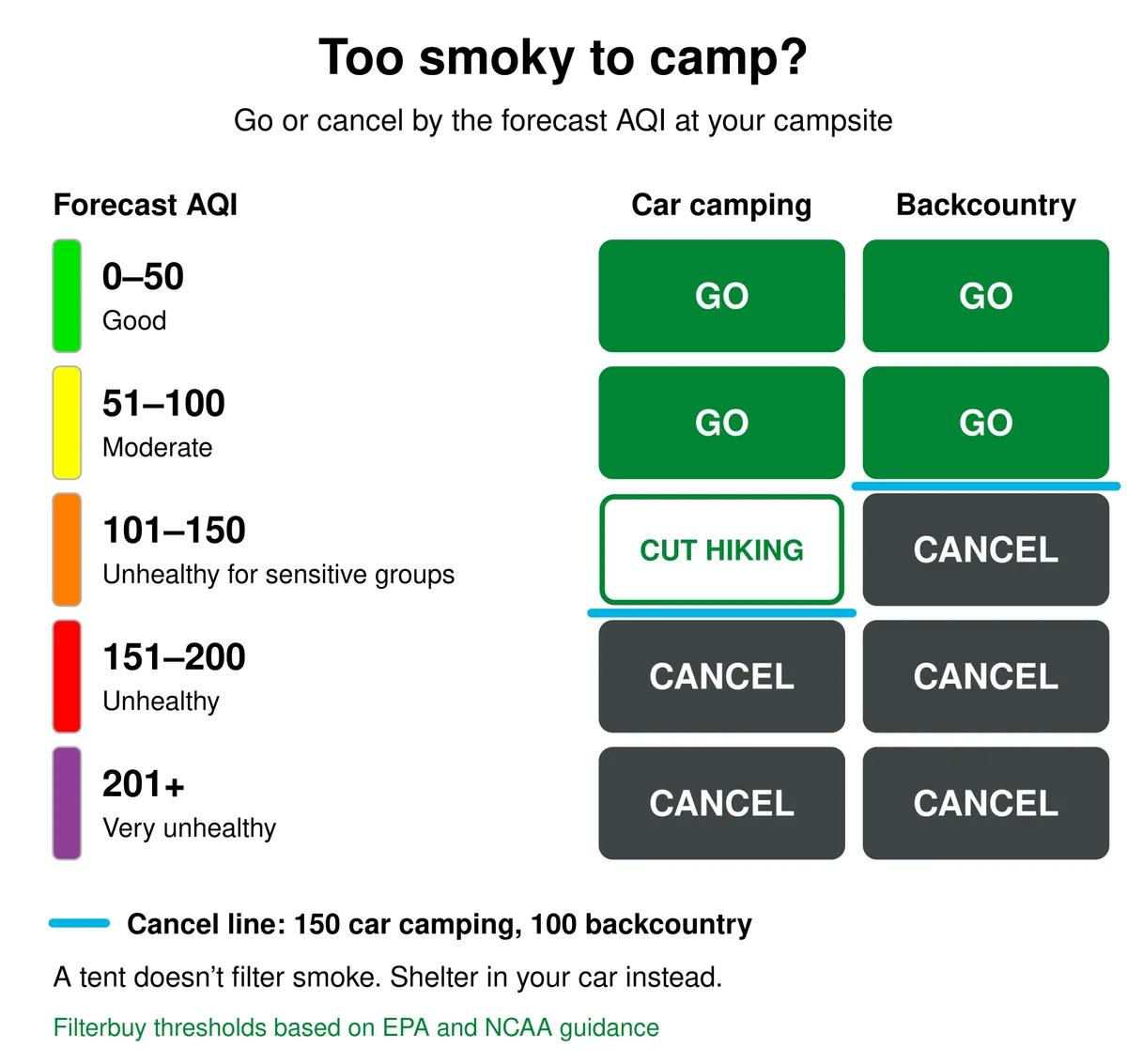
Cancel or move a car camping trip once the forecast AQI at your campsite reaches 150. For backcountry trips, where your car is more than an hour away, cancel once it passes 100. A tent doesn’t filter smoke, so if you get caught, wait it out in your car with the windows up and the air on recirculate. Getting your home ready for fire season, too? Take the quick quiz below to find the right filter for your system.
Answer a few quick questions and we’ll match you to the right filter for your home.
If the forecast AQI at your campsite reaches 150, cancel or move the trip, and cancel backcountry trips once it passes 100 unless you can get out quickly. Camping is harder on your lungs than most outdoor activities because you breathe campsite air around the clock, and hiking moves three to six times more air than sitting still. Check Filterbuy’s live US air quality index map before you leave home.
AQI 150 is the cancel line for car camping. Above it, EPA advises everyone to reduce long or intense activity.
AQI 100 is the cancel line for backcountry trips where your vehicle is more than an hour away.
Smoke depends on three things. EPA multiplies how smoky the air is by how hard and how long you breathe it.
Campsite air is usually worst from midnight to mid-morning, when an overnight inversion holds smoke near the ground.
A tent does not filter smoke. At most campsites, a car recirculating with a clean cabin filter is the best shelter.
No signal? Use your eyes. If landmarks about 3 miles away have disappeared, the air is unhealthy for everyone.
Nearly all wildfire smoke advice, ours included, ends the same way: go inside and let a filter clean the air. Filterbuy has manufactured air filters in the U.S. since 2013, so we know how much that advice depends on four walls and a filter. A campsite has neither, which makes it the hardest place to deliver on our mission of Better Air For All. Past the trailhead, your only exposure controls are whether to go, how hard to hike, and where to sleep.
Filterbuy’s cancel line is AQI 150 for car camping and 100 for backcountry trips. That is stricter than NCAA guidance, which cancels outdoor practice only above AQI 200, because practice ends after two hours and a camping trip keeps you outside day and night.
Filterbuy thresholds based on EPA and NCAA guidance. Sensitive groups, per EPA, include people with heart or lung disease, older adults, children and teens, and pregnant people.
Check your destination on Filterbuy’s live US air quality index map, which has park-level trackers such as Yosemite National Park and free alerts when air quality turns unhealthy.
EPA defines your inhaled smoke dose as concentration multiplied by breathing rate multiplied by time, and camping can raise all three at once.
Breathing rate is the factor most smoke advice overlooks. EPA puts hiking at 25 to 45 liters of air per minute, and vigorous hiking above 45. A resting adult breathes roughly 8. So minute for minute, a strenuous hike at AQI 100 puts more particulate in your lungs than sitting in a camp chair at AQI 200.
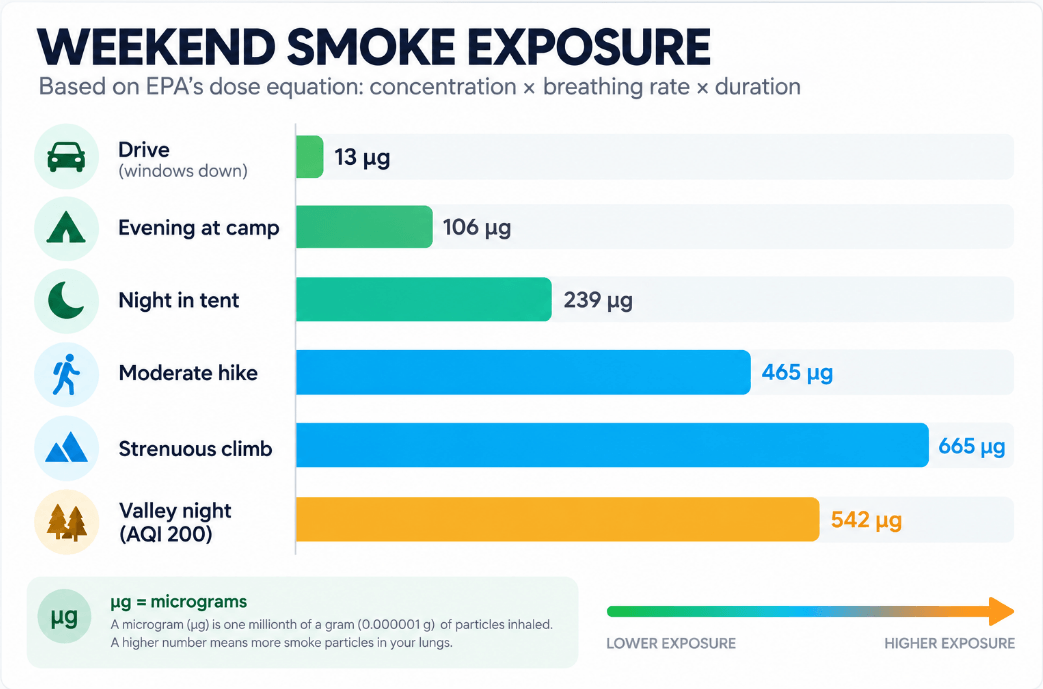
Filterbuy ran EPA’s equation on an ordinary smoky weekend at AQI 150:
Filterbuy analysis using EPA’s dose equation at AQI 150 (55.4 µg/m3). Resting hours, including sleep, use 8 L/min, so overnight figures are upper bounds.
The hike turns out to be the weekend’s biggest dose: four hours on the trail delivers about twice the smoke of a night in the tent, and a strenuous climb nearly three times as much. The one exception is a valley campsite, where an overnight inversion can push the night past a moderate hike.
Start checking 48 hours out, and make your final call the evening before: at most Recreation.gov campgrounds, cancelling after midnight the day before check-in forfeits the first night. The AirNow Fire and Smoke Map, from EPA and the U.S. Forest Service, shows PM2.5 readings alongside fire locations and smoke plumes. For larger fires, Air Resource Advisors also publish Smoke Outlooks that forecast air quality in six-hour blocks, which shows whether dawn or afternoon is the better window.
A monitor thirty miles away may not match your campsite, and many sites have no signal at all. For both problems, the Oregon Department of Environmental Quality and the Nevada Division of Environmental Protection publish a simple field method: find the farthest landmark you can still make out, estimate its distance, and look up the result below. Filterbuy has matched each band to the camping calls in Table 1.
Ranges from Nevada DEP, adapted from the federal Wildfire Smoke Guide. Because they predate EPA’s 2024 AQI update, conditions at the smoky end may be a category worse than shown.
Face away from the sun. Glare on smoke makes it look thinner than it is.
Use the tree test. If you can make out individual trees on a ridgeline, it is generally less than five miles away.
Set reference points when you arrive. Before dark, check the distance to two or three landmarks on an offline map, so you can read the air at 6 a.m. without a signal.
The method is less reliable in fog or high humidity, and Oregon DEQ advises acting on symptoms whatever the view.
Campsite air usually bottoms out between midnight and mid-morning, the very hours when packing up is hardest. At night, the atmospheric lid that caps pollution sinks, sometimes to just a few hundred feet, and holds smoke near the ground until the morning sun warms the surface. That is why Washington smoke forecasters routinely flag valley drainages for the worst overnight air.
Camp above the valley floor. Bench and ridge sites sit above the smoke that pools along creeks and canyon bottoms.
Plan around the morning reading. A 2 p.m. AQI can make a site look far better than it will be at dawn.
A tent does not filter smoke, because PM2.5 passes straight through nylon and mesh.
Assumes a clean cabin filter; see the CO2 caution below.
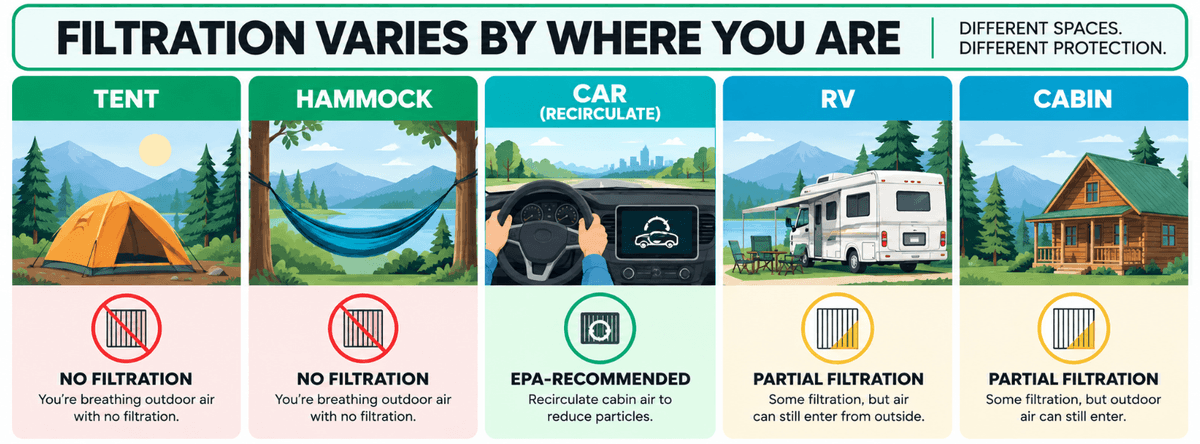
At most campsites, your car is the best place to wait out the smoke. EPA’s guidance is to close the windows and run the air conditioner on recirculate, and how well that works depends on the cabin air filter behind the dash.
“Most campers’ only filter is the one behind the glove box, and most vehicles ship with a basic paper cabin filter never built to stop smoke. A check before fire season is the cheapest smoke protection a camper can buy.”
— Filterbuy Team
Recirculation has one catch: it also traps the CO2 you exhale. One vehicle study found 70 percent recirculation inadvisable with more than one passenger in cool weather, or two in warm weather, so alternate between recirculate and fresh air. Never run an engine in an enclosed space.
“Recirculate is only as good as the filter it runs through. A fresh cabin filter does most of the work, and a loaded one does noticeably less. If you camp in fire country, swap it before the season starts.
— David Clark, Licensed HVAC Technician
Decide on your exit trigger before you need one. Choose a route with bailout points, carry a two-way satellite messenger, and head out if breathlessness, chest pain, headache, or coughing appear. If you see a smoke column or smell smoke you cannot trace to a campfire, leave immediately, as both the Washington Trails Association and the Pacific Crest Trail Association advise.
A well-fitted N95 or P100 cuts exposure at least tenfold, while cloth masks and bandanas neither seal nor filter smoke. Even a good respirator has limits, though. It does not block carbon monoxide, facial hair and sweat can break its seal, and EPA warns that wearing one during exertion raises the risk of heat illness. Use it to make the walk out safer, then leave the smoky area.
Heavy smoke clogs a cabin filter quickly, so check yours after the trip and fit a fresh auto cabin air filter if airflow has dropped. Filterbuy’s cabin filters use HEPA-certified media and are made in the U.S. to exact OEM dimensions. At home, EPA recommends a MERV 13 filter if your system can take one. Customers tell us every fire season that older systems struggle with MERV 13, so our guide to the best MERV filter for wildfire smoke starts with compatibility before you buy a MERV 13 filter. During fire season, we recommend inspecting it every 30 to 45 days, and our smoke-event checklist covers the rest of the house.
Related: wildfire smoke and the AQI | how long wildfire smoke stays in the air
17% more asthma ER visits at AQI 101. When wildfire smoke pushed the AQI to 101 or higher in 19 days in 2023, CDC found that asthma-related emergency visits ran 17 percent above expected. That is why Table 1 shifts at 101. Source: CDC, MMWR, 2023
383,000 camper-days a year under smoke, and few cancel. Across 1,069 western campgrounds, about 4 percent of camper-days fell under adverse smoke, yet occupancy dropped only 1.3 percentage points on those days. Source: Resources for the Future, 2021
100+ smoke monitors inside national parks. The National Park Service feeds readings from 65 park units into the EPA Fire and Smoke Map. Source: National Park Service
Is AQI 100 safe for camping?
For easy car camping, usually yes, but it is marginal for strenuous hiking. Backcountry trips should be cancelled once the AQI passes 100.
Can I sleep in smoke if the tent is zipped?
No. A tent does not filter PM2.5, so if the overnight AQI is forecast above 150, sleep in your vehicle or head home.
Should I cancel if the fire is 100 miles away?
Base the decision on the forecast AQI at your campsite rather than the distance, since smoke routinely travels hundreds of miles.
Will I lose money if I cancel for smoking?
Usually a little. Most Recreation.gov campgrounds keep a $10 fee and the reservation fee, plus the first night if you cancel the day before or day of arrival. Closures for fire or other emergencies are refunded in full.
AQI (Air Quality Index): EPA’s 0 to 500 scale for reporting air pollution and its health risk.
PM2.5: Fine particles under 2.5 micrometers, the main health hazard in wildfire smoke.
Inhaled dose: Concentration multiplied by breathing rate multiplied by exposure time.
Temperature inversion: A warm air layer that traps smoke near the ground, often overnight.
N95 respirator: A tight-fitting NIOSH Approved respirator that filters at least 95 percent of particles.
MERV 13: The HVAC filter rating EPA recommends for capturing smoke particles.
Filterbuy: A U.S. manufacturer of HVAC, furnace, and cabin air filters, founded in 2013.
