
AQI 200: What It Means, and Where Unhealthy Air Becomes Very Unhealthy
September 3, 2026
Author: Michelle Wan, Brand Manager & Air Quality Writer | Filterbuy | Reviewer: David Clark, Licensed HVAC Technician | Published: September 3, 2026 | Updated: September 3, 2026
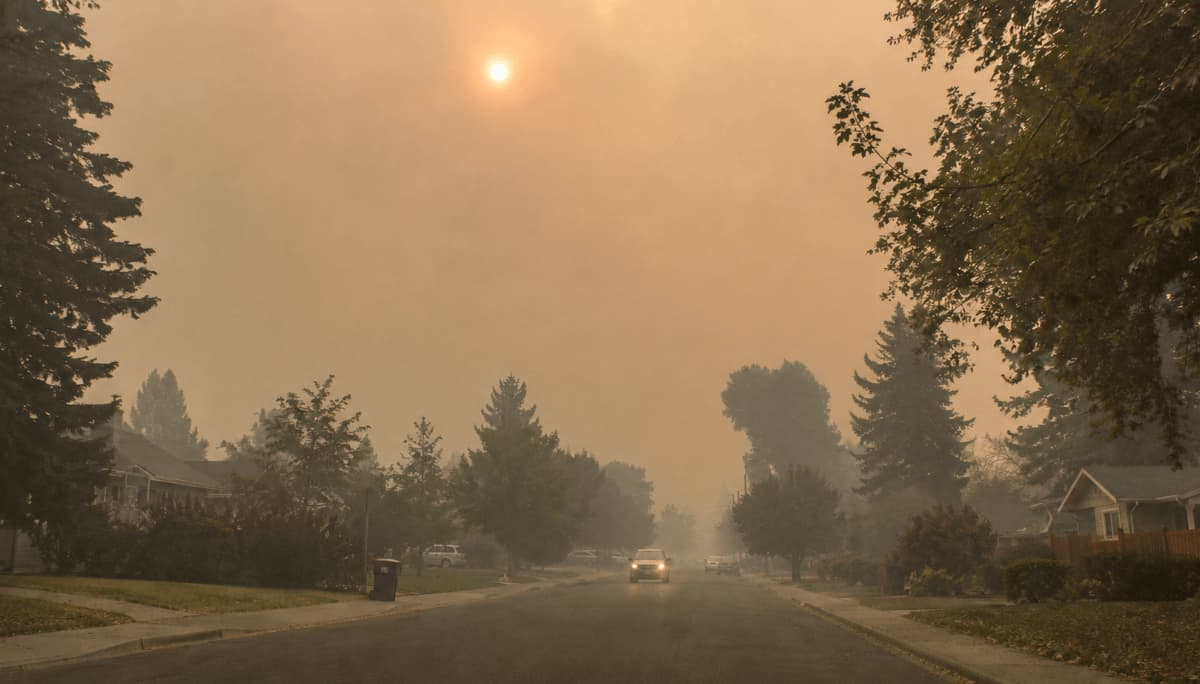
An AQI of 200 is the top of the EPA’s Unhealthy category, which runs 151 to 200 and shows red on air quality maps. It is not Very Unhealthy — that band starts at 201. What changes at this level is who it reaches: effects extend to the general public, not sensitive groups alone. Indoors, EPA points to a MERV 13 filter with your HVAC fan set to On once the AQI passes 100.
What each rating captures:
MERV 8 - dust, lint, and pollen.
MERV 11 - finer particles like pet dander and mold spores.
MERV 13 - particles down to 0.3 microns, including smoke. The rating federal smoke guidance names.
Not sure which rating your system takes? Answer 3 quick questions and we’ll match you to the right filter.
Or skip the quiz and shop air filters made in our U.S. plants.
TL;DR
An AQI of 200 is the highest reading inside the U.S. EPA's Unhealthy category, which runs from 151 to 200 and shows red on air quality maps. It is not Very Unhealthy, and that band does not begin until 201. What changes here is who gets affected, since health effects now reach the general population, not sensitive groups alone. Indoors, close the house up, fit a MERV 13 in your HVAC, and run a HEPA purifier in each room you use.
Key Takeaways
AQI 200 is the top of the Unhealthy (Red) range, 151 to 200. Very Unhealthy (Purple) begins at 201.
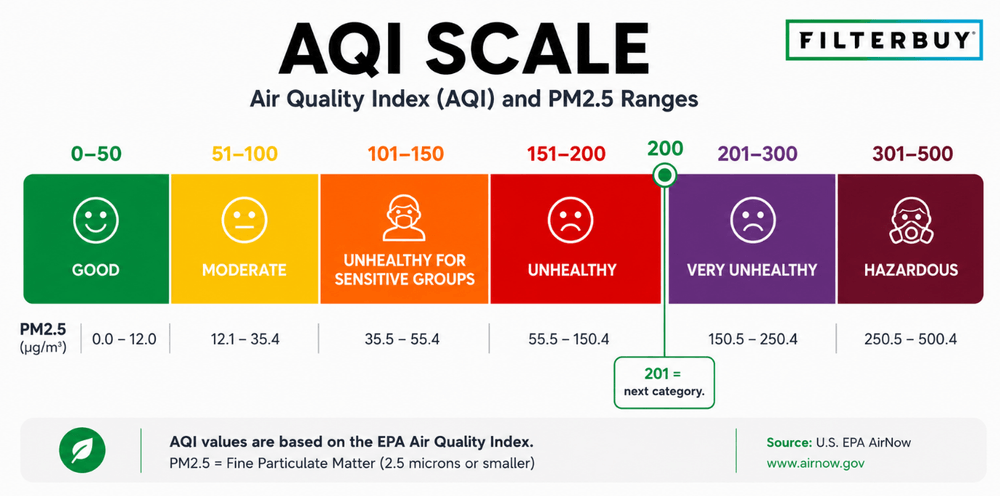
One red day is not one exposure level. At AQI 200, PM2.5 measures 125.4 µg/m³, double the 55.5 µg/m³ at AQI 151.
EPA advises sensitive groups to avoid prolonged outdoor exertion, everyone else to reduce it.
Wildfire smoke and ozone drive most U.S. readings near 200, with winter inversions behind the rest, each on its own timeline.
Once the AQI passes 100, move to a MERV 13 filter in your HVAC with the fan on, and add a HEPA purifier in each room you use. Neither removes ozone.
What Does An AQI Of 200 Mean?
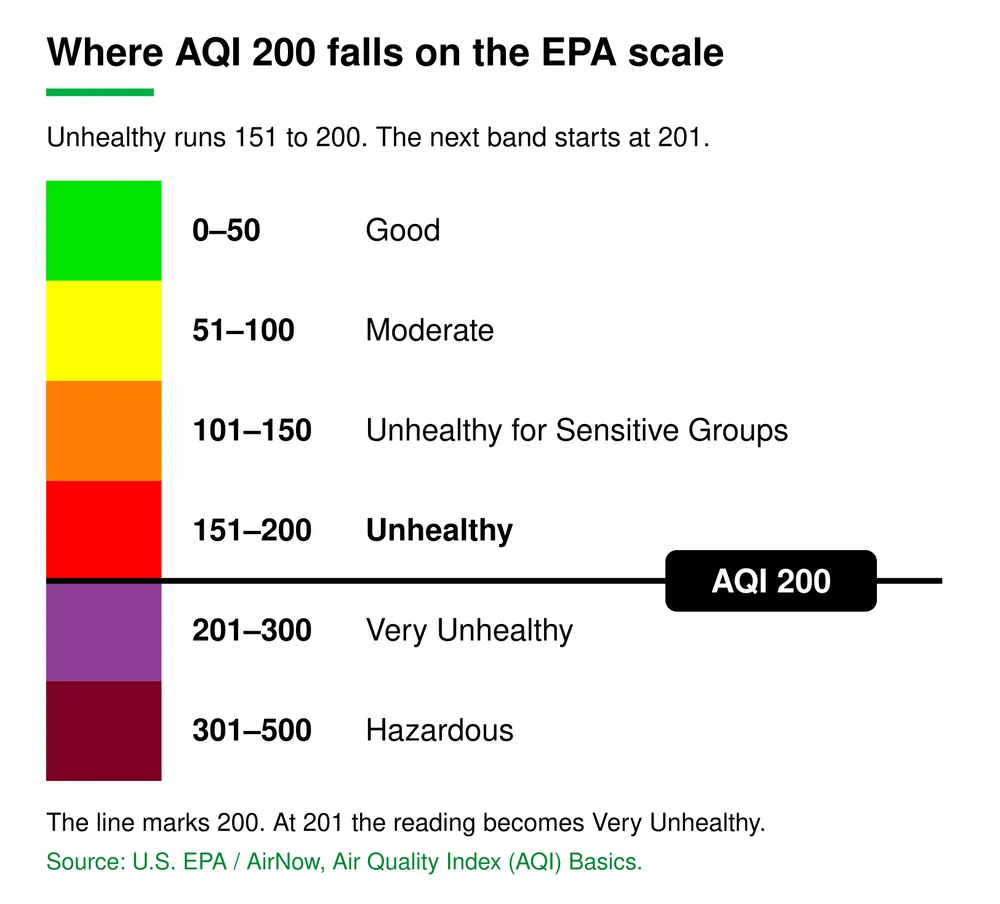
An AQI of 200 sits at the ceiling of the Unhealthy category on the U.S. Environmental Protection Agency's Air Quality Index, the 0–500 scale the EPA uses to report daily air quality. The category runs from 151 to 200 and appears in red.
Coverage often calls 200 "Very Unhealthy," but the label arrives one point early.
Source: U.S. EPA / AirNow, Air Quality Index (AQI) Basics. An AQI of 200 sits at the top of the Unhealthy category, not in Very Unhealthy.
The distinction matters less for today than for tomorrow’s forecast, since a predicted 210 falls into a stricter category.
The Number Hides A Wide Range Of Actual Pollution
Two days can both show red and be nothing alike, because the breakpoints inside that band stretch a long way.
Source: U.S. EPA Air Quality System, AQI Breakpoints. An AQI of 200 carries more than twice the fine particle load of an AQI of 151, though both show as red.
An AQI of 200 carries more than twice the fine particle load of an AQI of 151, though both show on the map in the same red. The color gives the category, not the dose.
Is An AQI Of 200 Dangerous?
An AQI of 200 is not an emergency for a healthy adult, but it is unhealthy air for everyone, which is what the category name describes.
EPA's risk assessment puts numbers to that. Among healthy adults and children at moderate exertion, roughly 30% are estimated to experience moderate or greater lung function impairment, and about 5% moderate to severe respiratory symptoms (EPA, Patient Exposure and the Air Quality Index). Those figures describe people exerting themselves outdoors, which is why guidance targets exertion rather than time outside.
Symptoms include eye and throat irritation, coughing, chest tightness, shortness of breath, and headache. Anything that does not ease indoors, especially chest pain or breathing trouble, warrants a call to a doctor.
What Causes An AQI Of 200, And What It Means Indoors
An AQI of 200 from smoke and an AQI of 200 from ozone are the same number describing two different problems. Each pollutant reaches 200 at its own concentration and averaging window, and each clears on a different schedule. That matters indoors, because a pleated filter captures particles while ozone is a gas.
Source: U.S. EPA Air Quality System, AQI Breakpoints table. Durations reflect typical U.S. patterns; a single event can run longer.
On an ozone day, closing the house still lowers your exposure, since less outdoor air gets in, but the filter is not doing that work. Odors and VOCs need activated carbon, the layer that Filterbuy, a U.S. air filter manufacturer, builds into its Odor Eliminator filters. Ozone itself is best handled by limiting outdoor air and exertion.
Those windows also explain the timing. Ozone is scored over eight hours and PM2.5 over twenty-four, so an ozone 200 covers the worst stretch of today and a smoke 200 a full day. Check the live USA AQI map from Filterbuy for the pollutant driving your number.
What To Do When The AQI Hits 200
Outdoors, reduce exertion rather than avoid going out. EPA asks sensitive groups to avoid prolonged outdoor exertion and everyone else to reduce it. Reschedule the run and the yard work. A walk to the car is fine; forty-five minutes of hard breathing is not.
Indoors, stop bringing outdoor air in and keep filtering what is inside. Americans spend roughly 90% of their time indoors, so your filter, not the outdoor number, sets your exposure.
Close windows and doors and keep them shut through the evening.
Set your HVAC fan to On, not Auto. On Auto the blower runs only during a heating or cooling call, so the filter idles most of the hour.
Switch your system to recirculate and close any fresh-air intake, per EPA clean room guidance.
Run a HEPA air purifier in each room you use. Size each to its room and run it on high. If you can manage only one, put it in the bedroom.
Do not add your own particles. Skip candles, frying, vacuuming.
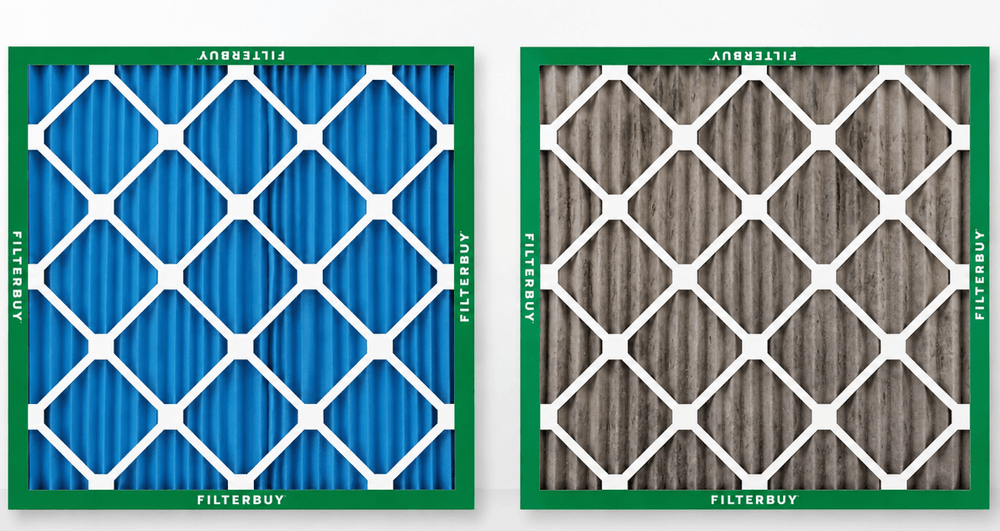
Check your filter daily during a smoke event. EPA advises replacing it once the media looks dark and keeping spares on hand. Filterbuy auto-delivery ships them on schedule.
Which Filter You Want In The Slot
Filter efficiency is the one variable fully under your control. Once the AQI passes 100, EPA points to MERV 13, or the highest rating your system handles, with the fan running. MERV 13 goes in the HVAC slot. HEPA belongs in portable units, since its airflow resistance is beyond what a residential blower is built for.
Check your owner's manual or ask an HVAC technician before raising MERV ratings. Source: U.S. EPA, Reduce Smoke Exposure Indoors.
What We Would Add, From The Factory Side
Filterbuy has built pleated filters in its own U.S. plants since 2013, serving over two million households, in 600-plus sizes and custom cuts. Most guides stop at "upgrade to MERV 13." Two things decide whether that upgrade does anything, and neither is the number on the box. The first is whether your blower can pull air through the media. The second is whether the filter seals in the track, because a MERV 13 sitting loose lets smoky air slip past the edges. If your system will not take one, MERV 11 is the step down.
David Clark, the licensed technician who reviews this page, makes the same point on our hazardous air quality guide. Older systems were often never sized for the static pressure a MERV 13 adds, and a clear day is the time to find out.
What Changes When The AQI Crosses 201 Into Very Unhealthy?
At 201 the reading enters Very Unhealthy (Purple) and guidance tightens. Sensitive groups avoid all outdoor activity, everyone else prolonged exertion.
The step-up is measurable. In the same EPA assessment, expected lung impairment rises from roughly 30% in the Unhealthy range to about 50% (EPA, Patient Exposure and the Air Quality Index).
Indoors, nothing changes. The same closed house and filter carry more load, for longer. If readings keep climbing toward 300, see our guide to hazardous air quality at AQI 301 and above.
Supporting Statistics
How often, how harmful, what helps.
757 days. Across 35 major U.S. cities, the combined ozone and PM2.5 AQI hit Unhealthy for Sensitive Groups or worse on 757 days in 2024, down from 2,080 in 2000.
Source: U.S. EPA, Our Nation’s Air: Trends Through 2024
17% higher. Asthma emergency department visits ran 17% above expected across 19 wildfire smoke days in 2023. CDC counted a smoke day as any day a monitor reported AQI 101 or higher.
Source: CDC, Morbidity and Mortality Weekly Report (McArdle et al., 2023)
About 50% vs. 24%. A high-efficiency HVAC filter with the fan set to On may cut indoor PM2.5 by about 50%. The same system running continuously on a typical low-efficiency filter cuts it by about 24%.
Source: U.S. EPA, Strategies to Reduce Exposure Indoors
Frequently Asked Questions
Is AQI 200 the same as Very Unhealthy air?
No. AQI 200 is the top of the Unhealthy category (151–200, red). Very Unhealthy is 201–300, purple. They sit one point apart, which is why the labels get mixed up. See the full AQI scale, 0 to 500.
Can I go outside when the AQI is 200?
Yes, briefly and without exerting yourself. EPA asks everyone to reduce prolonged outdoor activity and sensitive groups to avoid it. During smoke a fitted N95 or KN95 helps; cloth and surgical masks do not.
Does an air purifier help at AQI 200?
Yes, for particles, in the room it serves. The fuller setup is a MERV 13 in the HVAC plus a HEPA purifier in each room you use. Neither removes ozone.
Should I change my air filter more often during a high-AQI stretch?
Yes. Smoke loads a filter far faster than dust. Replace it when the media looks dark, whatever the calendar says. Shop MERV 13 replacement filters.
Glossary
AQI (Air Quality Index): The EPA's 0–500 scale for daily outdoor air quality, in six color-coded categories.
Unhealthy (AQI 151–200): The fourth AQI category, red. The general public may feel effects; sensitive groups more serious ones.
Very Unhealthy (AQI 201–300): The fifth AQI category, purple, carrying increased risk for everyone.
PM2.5: Fine inhalable particles 2.5 micrometers or smaller, behind most high AQI readings.
Ground-level ozone: A gas formed when sunlight and heat react with vehicle and industrial emissions. Drives high summer readings.
Temperature inversion: A weather pattern in which warm air traps cooler air and its pollution near the ground.
MERV (Minimum Efficiency Reporting Value): The ASHRAE 1–16 scale rating particle capture. MERV 13 is the PM2.5 benchmark.
Sensitive groups: Children, older adults, pregnant people, and anyone with asthma, lung disease, or heart disease.
HEPA filter: Certified to capture 99.97% of particles at 0.3 microns. Built for portable air cleaners, not HVAC ductwork.
N95 / KN95 respirator: A close-fitting mask certified to capture at least 95% of fine airborne particles.
Carbon (activated carbon) filter: Media that adsorbs gas-phase pollutants such as odors and VOCs, which pleated filters pass through.
Sources
Air Quality Index (AQI) Basics. U.S. EPA / AirNow. The six AQI categories and their value ranges.
AQI Breakpoints table. U.S. EPA Air Quality System. Concentrations behind each AQI value (CSV download).
Patient Exposure and the Air Quality Index. U.S. EPA. Estimated lung-function and symptom rates by AQI category.
Create a Clean Room During a Wildfire. U.S. EPA. MERV 13, fan-On, recirculate, and portable air cleaner guidance.
A Guide to Air Quality and Your Health. AirNow. Activity guidance for each category (PDF).
Written by Michelle Wan, Brand Manager and Air Quality Writer at Filterbuy. Reviewed for technical accuracy by David Clark, Licensed HVAC Technician. Filterbuy has manufactured air filters in the United States since 2013, in its own plants in Alabama, Florida, Pennsylvania, and Utah.