July 21, 2026
Author: Michelle Wan, Brand Manager and Air Quality Writer | Reviewer: David Clark, Licensed HVAC Technician | Published: July 21, 2026 | Updated: July 21, 2026
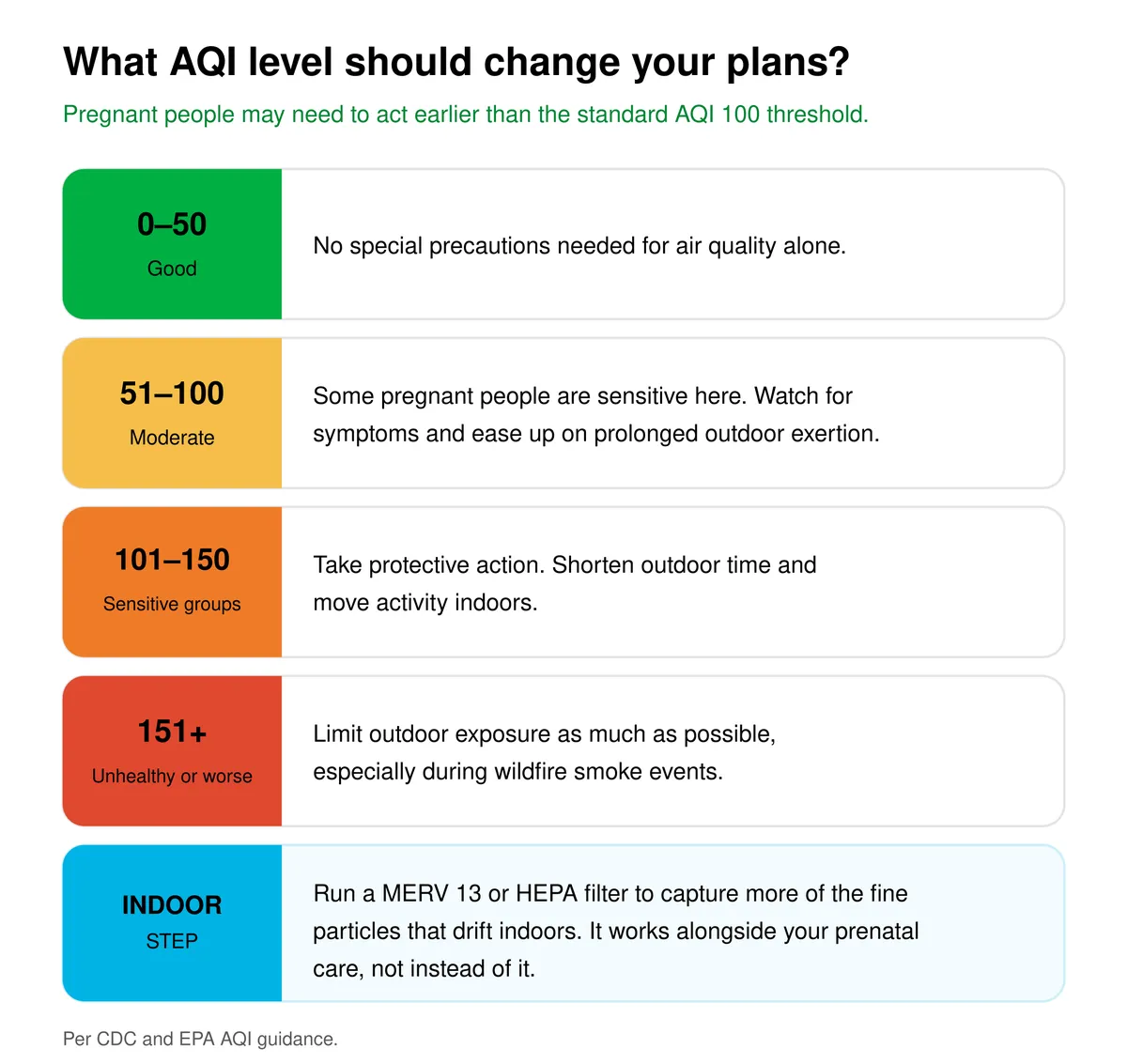
Yes — outdoor air pollution, especially fine-particle PM2.5, is a known pregnancy risk factor. Research links it to a higher risk of preterm birth and low birth weight. Health agencies advise checking the daily Air Quality Index (AQI) and taking protective steps as it climbs; some pregnant people should start as low as 51.
Indoors, the CDC recommends a MERV 13 or HEPA filter, which captures more of the fine particles that drift in — one step that works alongside your prenatal care, not instead of it.
Not sure which filter fits your system? Answer a few quick questions and we'll match you to the right one.
Outdoor air pollution, especially fine particulate matter (PM2.5), is linked to higher risk of preterm birth, low birth weight, and hypertensive disorders like preeclampsia. A review of 32 million U.S. births found PM2.5 or ozone exposure tied to higher preterm birth risk in 19 of 24 studies and low birth weight risk in 25 of 29. The CDC and EPA advise checking the Air Quality Index (AQI) daily and taking protective action above 100, with some pregnant people sensitive as low as 51. A MERV 13 or HEPA-rated filter cuts indoor exposure, but works alongside your prenatal care provider, not instead of one.
The CDC notes that pregnancy already raises blood volume, cardiac output, and heart rate, and ACOG's Committee Opinion links air pollution exposure, especially PM2.5, to preterm birth and low birth weight.
A systematic review covering more than 32 million U.S. births found that PM2.5 or ozone exposure was tied to a higher risk of preterm birth in 19 of 24 studies and low birth weight in 25 of 29 studies.
The CDC instructs pregnant patients to check the AQI daily and act once it passes 100, noting some pregnant people are sensitive even between 51 and 100.
Wildfire smoke adds a seasonal spike in PM2.5 that the EPA specifically flags as a risk for pregnant people.
The CDC recommends HVAC filters rated MERV 13 or higher, or HEPA filters, to meaningfully reduce indoor air pollution.
Nearly 380,000 babies were born preterm in the U.S. in 2024, about 1 in 10 births, according to March of Dimes.
Yes. Pregnancy already raises blood volume, cardiac output, and heart rate, adding cardiovascular stress before outside exposure is factored in, per the CDC. ACOG's Committee Opinion on reducing prenatal exposure to toxic environmental agents links air pollution, especially PM2.5, with preterm birth and low birth weight. Fine particles small enough to reach deep into the lungs can trigger inflammation and stress the placenta, interfering with blood flow between mother and fetus, and can promote blood clot formation.
PM2.5 has the deepest body of pregnancy-specific research, which is why AQI guidance and indoor air recommendations center on particle pollution first.
Households can match filtration to AQI-driven pollutant spikes before a high-pollution day arrives.
A review of 57 U.S. studies covering more than 32 million births found PM2.5 or ozone exposure associated with higher preterm birth risk in 19 of 24 studies and low birth weight risk in 25 of 29, with asthma patients and Black mothers showing the highest risk. A separate meta-analysis found a 10 µg/m³ increase in PM2.5 exposure raised preterm birth risk 13–15% and low birth weight risk 13–28%. The American Lung Association adds that this stress can increase hypertensive disorders, including preeclampsia, and damage the placenta, with risks compounding for people managing asthma or another chronic condition.
These are population-level associations, not individual predictions, but the consensus supports treating air pollution as a known prenatal risk factor.
Not clearly. Most large studies measure exposure across an entire pregnancy, so “first trimester is riskiest” is more assumption than settled finding.
Source: Frontiers in Public Health meta-analysis and CDC Clinical Overview of Heat and Pregnancy, both cited above.
Practical takeaway: monitor air quality throughout pregnancy, not just the first trimester.
The AQI is the EPA's daily air pollution scale, 0 to 500. Above 100, the CDC and EPA classify outdoor air as unhealthy for sensitive groups, including pregnant people. Some are sensitive even between 51 and 100.
Source: CDC and EPA AQI guidance. Some pregnant people are sensitive below the 100 threshold that applies to the general population.
AirNow.gov provides real-time AQI readings by ZIP code. Filterbuy's live AQI and wildfire smoke map also tracks nearby smoke.
Wildfire smoke can push PM2.5 far higher than typical urban pollution, and far faster. The EPA includes pregnant people among at-risk groups during smoke events, and the CDC notes smoke pollutants are associated with adverse birth outcomes. During a smoke advisory, treat the AQI as the deciding factor for outdoor plans. See Filterbuy's wildfire smoke and AQI guide for a full walkthrough.
Check the AQI daily through AirNow.gov before planning outdoor time.
Shift outdoor activity to mornings or evenings, when pollution and ozone are lower.
Reduce exertion outdoors on elevated-AQI days, since heavier breathing pulls in more pollutants.
Keep car windows up and use recirculated air in traffic or during a smoke advisory.
Talk with your provider about risk factors like asthma or hypertension, which lower your sensitivity threshold.
Keep a spare, correctly sized filter, such as a MERV 13, on hand before smoke season.
Given my health history, at what AQI should I start taking precautions, rather than the general 100 threshold?
Are there air quality patterns near me, like a highway or regular wildfire smoke, you'd factor into my care plan?
Are there symptoms beyond usual pregnancy symptoms I should report right away?
Does my home setup, including filter rating and ventilation, make sense given my risk factors?
Does guidance change based on how far along I am if smoke or a pollution event hits?
Indoor air is not automatically cleaner than outdoor air. The CDC notes it can be as polluted, with cigarette and e-cigarette smoke, candles, and air fresheners as common indoor sources on top of whatever drifts in from outside.
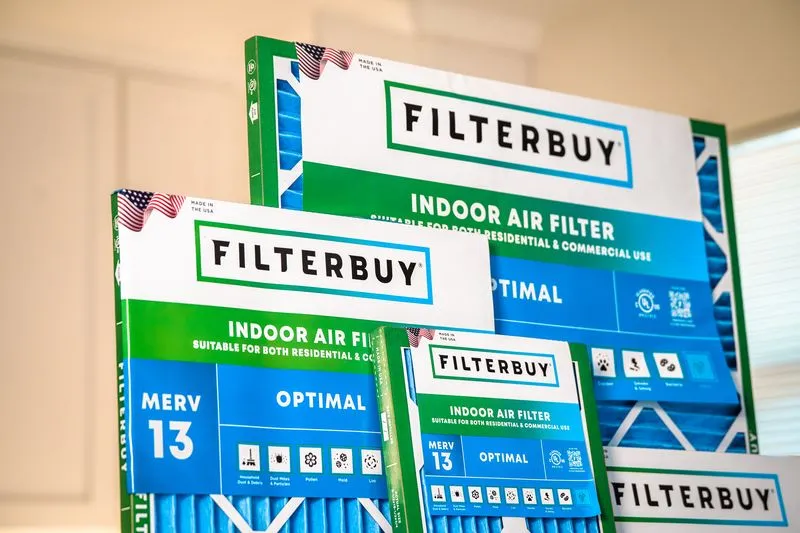
For outdoor air infiltrating a home, filtration is one tool public health guidance points to. The CDC recommends HVAC filters rated MERV 13 or higher, or HEPA filters, replaced roughly every 60 to 90 days depending on local pollution.
A furnace filter addresses airborne particles passing through your HVAC system. It doesn't address every route of exposure, isn't a substitute for prenatal care, and no study claims filtration alone eliminates these risks. It can reduce one source of indoor particulate exposure on days when going outside isn't a good option.
See a side-by-side HEPA versus MERV filter comparison, or shop Filterbuy's MERV 13 air filters, built to CDC's recommended rating in more than 600 sizes.
"We build every filter to a stated MERV rating because families shouldn't have to guess what their HVAC system is actually capturing. If your household is watching the AQI more closely right now, matching your filter to that rating—MERV 13 or higher when your system supports it—is one of the most straightforward, measurable steps you can take to improve your indoor air."
David Heacock, Founder and CEO, Filterbuy
1. Check Today's AQI Before You Plan Outdoor Time — EPA's real-time AQI tool by ZIP code.
Source: EPA AirNow, AQI Basics
2. Know the AQI Number That Should Change Your Plans — CDC's action threshold: act above 100, some sensitive as low as 51.
Source: CDC, Clinical Overview of Heat and Pregnancy
3. Get the Clinical Playbook Doctors Are Trained On — EPA's course on counseling patients on particle pollution exposure.
Source: EPA, Patient Exposure and the Air Quality Index
4. See Why Pregnancy Raises Your Risk — American Lung Association on why pregnant people and fetuses are uniquely vulnerable.
Source: American Lung Association, Who Is Most Affected by Outdoor Air Pollution
5. Read the Medical Guidance Behind Prenatal Counseling — ACOG Committee Opinion No. 832 names air pollution and PM2.5 among factors linked to preterm birth and low birth weight.
Source: ACOG, Committee Opinion No. 832
6. Review the Largest U.S. Study on Air Pollution and Birth Outcomes — A review of 32 million U.S. births linking PM2.5 or ozone exposure to higher preterm birth and low birth weight risk.
Source: NIH (PMC), Systematic Review on Air Pollution, Heat Exposure, and Birth Outcomes
7. See Where Preterm Birth Rates Stand Today — March of Dimes: nearly 380,000 U.S. babies born preterm in 2024, about 1 in 10 births.
Source: March of Dimes, 2025 Report Card on Preterm Birth
1. PM2.5 Dose-Response Meta-Analysis — A 10 µg/m³ PM2.5 increase during pregnancy raises preterm birth risk 13–15% and low birth weight risk 13–28%.
Source: Frontiers in Public Health
2. 2025 Wildland Fire Statistics — The U.S. saw 77,850 wildfires in 2025, burning more than 5.1 million acres; smoke can spike local PM2.5 faster than everyday pollution.
Source: National Interagency Fire Center
3. 2024 Asthma Capitals Report — Nearly 28 million people in the U.S. live with asthma; air pollution amplifies risk for this population, including pregnant people.
Source: Asthma and Allergy Foundation of America
Some studies have explored a possible link between air pollution and early pregnancy loss, but the evidence is less extensive than the research on preterm birth and low birth weight. Discuss any concerns with your prenatal care provider.
Outdoor activity may still be possible at moderate AQI levels, but reducing intensity and taking more breaks can help limit exposure. People with asthma or other respiratory conditions may need to take extra precautions beginning at lower AQI levels.
No. Air filtration helps reduce indoor particle exposure, but it does not eliminate the health risks associated with air pollution. A MERV 13 HVAC filter or HEPA air purifier should be used as part of a broader strategy that includes checking the AQI and following guidance from your prenatal care provider.
The AQI scale itself does not change, but wildfire smoke can raise pollution levels rapidly. During smoke events, pregnant people are considered part of the at-risk population and should take extra precautions when AQI levels rise.
No. Pregnancy alone increases sensitivity to air pollution. Conditions such as asthma or hypertension may further increase risk, but pregnant people without these conditions should still follow AQI guidance and take appropriate protective measures.
AQI: The EPA's 0-to-500 scale for daily outdoor air pollution; higher numbers mean greater health concern.
PM2.5: Fine particulate matter 2.5 microns or smaller, small enough to reach deep into the lungs and bloodstream.
Ozone: A gas formed when vehicle and industrial pollutants react in sunlight and heat; a common contributor to elevated AQI on hot days.
Preterm Birth: Delivery before 37 weeks, a leading cause of infant morbidity and mortality.
Low Birth Weight: A birth weight under 2,500 grams (about 5.5 pounds), tied to higher risk of infant mortality and later health complications.
Preeclampsia: A hypertensive disorder that can develop in the second half of pregnancy and cause serious complications for mother and baby.
MERV Rating: A 1-to-16 scale rating how effectively an HVAC filter captures airborne particles; MERV 13 or higher is CDC-recommended. Filterbuy manufactures pleated filters in MERV 8, 11, and 13.
HEPA Filter: A filter standard capturing at least 99.97 percent of particles at a specified size, more restrictive than standard HVAC filter ratings.
