
Compatible & Generic Air Purifier Filters, Factory-Direct | Filterbuy
November 16, 2026
TL;DR
A compatible air purifier filter is a replacement made by a company other than the purifier brand, sized to match the original filter code. A well-made one cleans like the original for less, while a poorly made one leaks air around its edges. Filterbuy makes compatible filters for GermGuardian, Honeywell HPA-series, PureGuardian, Black+Decker, and Idylis purifiers in its U.S. plants and ships them free in the continental U.S.
Key Takeaways
"Compatible," "generic," "aftermarket," "off-brand," and "third-party" all mean a filter not made by the purifier's original equipment manufacturer (OEM).
A good compatible filter matches the OEM code and dimensions, seals without gaps, and states a capture rating.
No universal air purifier filter fits every machine, because fit is model-specific.
Federal law generally bars a company from voiding a purifier warranty just because you used a third-party filter.
Over a year, Filterbuy's Filter B and C replacements cost $17–$25 less than the genuine filters.
When the AQI tops 100, Filterbuy recommends a MERV 13 HVAC filter plus a True HEPA purifier in each room.
What Is a Compatible Air Purifier Filter?
A compatible air purifier filter is a replacement built by an independent manufacturer to fit a specific purifier model in place of the original part. It's also called generic, aftermarket, off-brand, or third-party.
The OEM filter is the one the purifier maker sells, such as Filter B (FLT4825) from GermGuardian, a Guardian Technologies brand. A cheap generic and a well-built compatible filter can look identical online.
Are Generic Air Purifier Filters as Good as OEM Filters?
Some generic filters perform as well as the originals, and some don't. The difference comes down to fit and an honest efficiency rating.
More often than not, the problem isn't the purifier itself, but the filter.
Filterbuy
HEPA means at least 99.97% capture at 0.3 microns, which the EPA's HEPA filter explainer calls the most penetrating particle size. A "HEPA-type" label without a number promises little, as our guide to HEPA ratings explained shows.
How Do I Know a Compatible Filter Will Fit My Purifier?
A compatible filter fits when its code and dimensions match the OEM filter and it seals tightly. Run these five checks first.
Match the filter code. Find it on the purifier label or the old filter's frame (for example, FLT4825). Retailer listings often disagree on fit, so Filterbuy built its GermGuardian filter finder from the model lists on Filterbuy product pages.
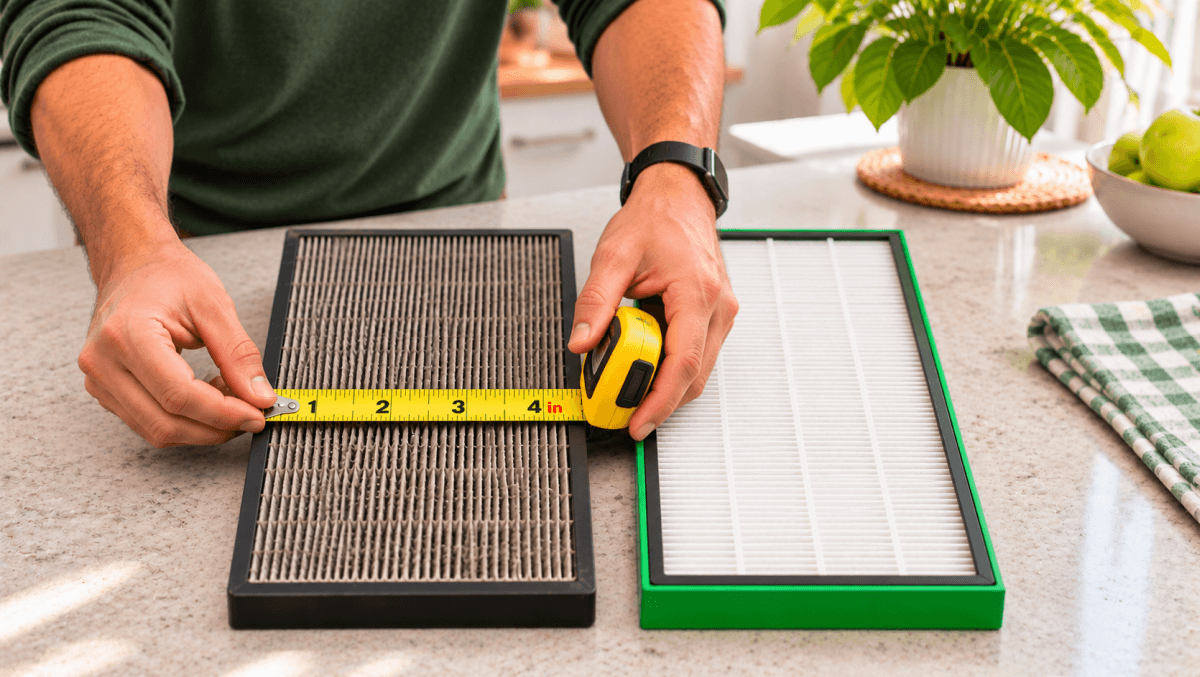
Measure the old filter. GermGuardian Filters B and C look almost identical, but C is taller. That's why we name our replacements by size: 4x16 and 4x19.
Check the seal. Install the filter facing the right direction, then look for gaps between the frame and the housing. Any gap lets air slip past.
Read the efficiency claim. Look for a capture percentage tied to a particle size.
Match the layers. If the original had a carbon layer for odors, the replacement needs one too. See carbon vs. HEPA filter layers.
Pro Tip: Photograph the old filter's label before tossing it, since purifier stickers fade.
Which Compatible Air Purifier Filters Does Filterbuy Make?
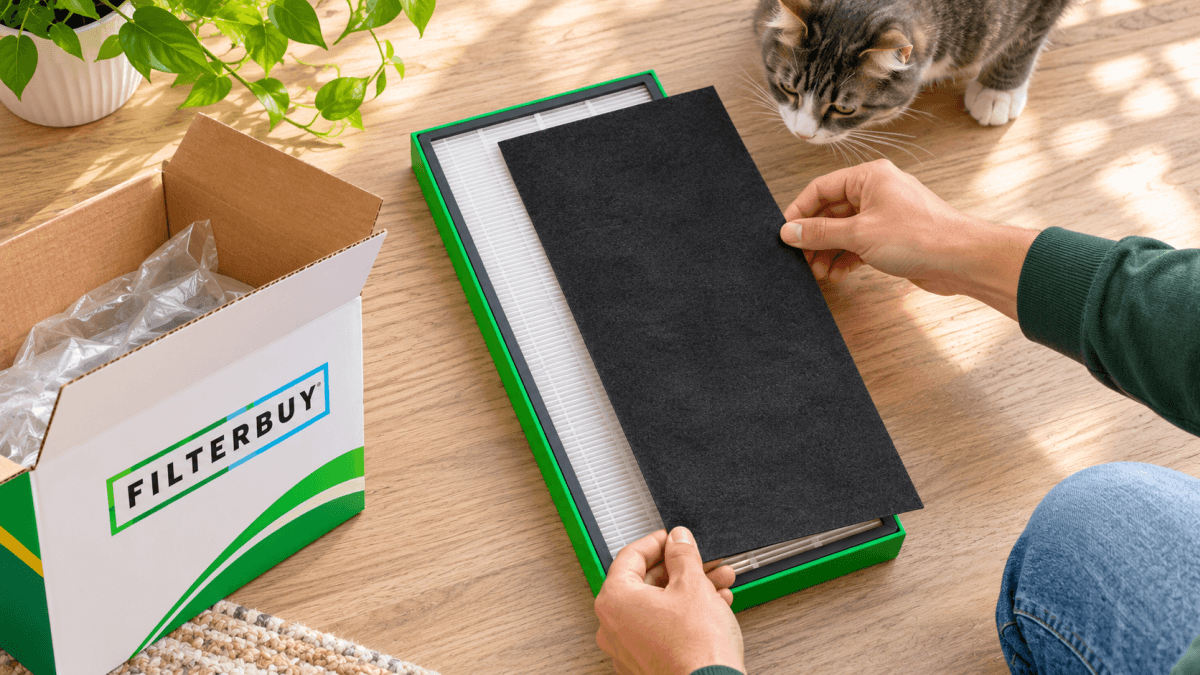
Filterbuy makes two types of compatible air purifier filters. Complete filters pair True HEPA-rated pleated media with an activated carbon layer in one drop-in unit. Cut Carbon pre-filters are thin coconut-shell carbon sheets, pre-cut to fit specific models.
That's why the Filterbuy lineup is narrow: we list a replacement when we can build it to fit. We label every product "compatible," never "genuine," because that distinction is what a warranty conversation turns on. Filterbuy isn't affiliated with the brands below. Honeywell owners can confirm fit in our guide to Honeywell-compatible replacement filters.
Filterbuy rates the complete filters True HEPA, and the carbon layer adsorbs cooking smells and some volatile organic compounds (VOCs). For Honeywell HPA models, Filterbuy makes the carbon pre-filters only, not the HEPA filter.
If a purifier isn't listed, Filterbuy doesn't make a filter for it yet, and the OEM filter is the safest choice. Our guides to Levoit air purifier filters and Blueair air purifier filters explain what each model takes.
Shop Filterbuy air purifier replacement filters
Is There a Universal Air Purifier Filter?
No. Every main filter is shaped to one housing, so a one-size cartridge would leave gaps. Carbon sheet comes closest, and only as a pre-filter, so Filterbuy pre-cuts its Cut Carbon pre-filters for each model, such as 15.5 x 4.5 inches for GermGuardian Filter B.
Will a Third-Party Filter Void My Air Purifier Warranty?
In general, no. The federal Magnuson-Moss Warranty Act bars a manufacturer from making warranty coverage depend on its branded parts, unless it supplies those parts free. It can still deny a claim if it shows the filter caused the damage.
The Federal Trade Commission (FTC) enforces the Act. In July 2024, FTC staff sent warning letters to air purifier sellers aeris Health, Blueair, Medify Air, and Oransi about statements tying warranties to specified parts.
If you're told a compatible filter voided your warranty, report it at ReportFraud.ftc.gov. This is general information, not legal advice.
How Much Do Compatible Air Purifier Filters Cost per Year?
Since Filterbuy and GermGuardian use different schedules, we priced a full year on each brand's published schedule. Our Filter B and C replacements cost less, while the genuine Filter E wins at its current sale price.
Genuine: two filters a year (6-month cycle) at GermGuardian store prices, plus one 4-pack of Filterbuy carbon pre-filters ($16.85) for carbon changes every 2–3 months. Filterbuy: four complete filters a year at the 4+ price. Prices checked November 16, 2026. Auto Delivery takes another 5% off.
A single Filterbuy filter costs $14.99 to $24.99, with 30% off each at four or more. Check genuine prices for Filter B, Filter C, and Filter E.
Should You Buy a Compatible or OEM Filter?
When a Compatible Filter Makes Sense
One matches the OEM code and dimensions
You want fresh carbon every 90 days, built in
When the OEM Filter Makes More Sense
No compatible filter matches the purifier model
The genuine filter is on sale below the compatible price, as Filter E is now
Why Buy Compatible Filters Factory-Direct From Filterbuy?
Filterbuy builds each filter in its plants in Alabama, Pennsylvania, Texas, and Utah and ships it with no distributor markup. Orders leave within 24 hours, most arrive in 3–4 business days, and shipping is free in the continental U.S., per our shipping and returns policy.
Filterbuy is a second-generation, family-owned manufacturer in Talladega, Alabama. To skip tracking dates, Auto Delivery sends the next filter on schedule.
How Often Should You Replace a Compatible Air Purifier Filter?
Filterbuy recommends a new complete air purifier filter about every 90 days, because in our experience the carbon gets used up before the HEPA media clogs. Cut Carbon pre-filters follow the same rhythm, or sooner with pets or smoke. Washing carbon won't revive it.
Weak airflow or odor means a filter is overdue. See how often to replace air purifier filters and the signs of a clogged air purifier filter.
What Should You Do When the AQI Tops 100?
When the Air Quality Index (AQI) climbs above 100, Filterbuy recommends two steps: switch to a MERV 13 filter if your home has an HVAC system, and run a True HEPA air purifier in each room. Above 100, the EPA rates air quality as unhealthy for sensitive groups first, then for everyone as the number rises.
HVAC filter: For central air or a forced-air furnace, the EPA recommends MERV 13 filters, or as high as the system can handle, with the fan running continuously.
Room purifiers: Size each one to its room and check filters more often, since smoke loads them faster.
Supporting Statistics
Americans spend 90% of their time indoors. Some indoor pollutants run 2 to 5 times higher than outdoors. Source: EPA Report on the Environment.
1 in 4 adults has seasonal allergies. In 2024, 25.2% of U.S. adults had a diagnosed seasonal allergy. Source: CDC National Center for Health Statistics.
HEPA cleaners cut PM2.5 by up to 60%. In a randomized Washington State trial, homes with HEPA cleaners had:
60% lower PM2.5 in children's bedrooms
42% lower PM2.5 in living areas
Frequently Asked Questions
Are Off-Brand Air Purifier Filters Safe to Use?
Yes, if they match the purifier's filter code and dimensions, seal without gaps, and state a capture rating. Filterbuy lists the exact models each filter fits.
Do Compatible Filters Reduce My Purifier's Clean Air Delivery Rate (CADR)?
A tight-fitting compatible filter with comparable media should keep a purifier near its rated clean air delivery rate (CADR). To size CADR to a room, see what size air purifier you need for your room.
Glossary
- Activated carbon:
- Porous carbon that adsorbs odors and gases.
- AQI (Air Quality Index):
- The EPA's 0–500 daily air pollution scale.
- CADR (clean air delivery rate):
- How much filtered air a purifier delivers.
- Cut Carbon pre-filter:
- Filterbuy's pre-cut carbon sheet that sits in front of the main filter.
- HEPA (high-efficiency particulate air):
- A Department of Energy standard requiring at least 99.97% capture at 0.3 microns.
- MERV 13:
- A high-efficiency HVAC filter rating the EPA recommends during smoky periods.
- Magnuson-Moss Warranty Act:
- The 1975 federal consumer warranty law, enforced by the FTC.
- OEM (original equipment manufacturer):
- The company that made the purifier.
- PM2.5:
- Fine airborne particles 2.5 microns or smaller.
- VOCs (volatile organic compounds):
- Gases released by paints and cleaners.