
Can You Run Your Air Conditioner Without a Filter?
October 1, 2026
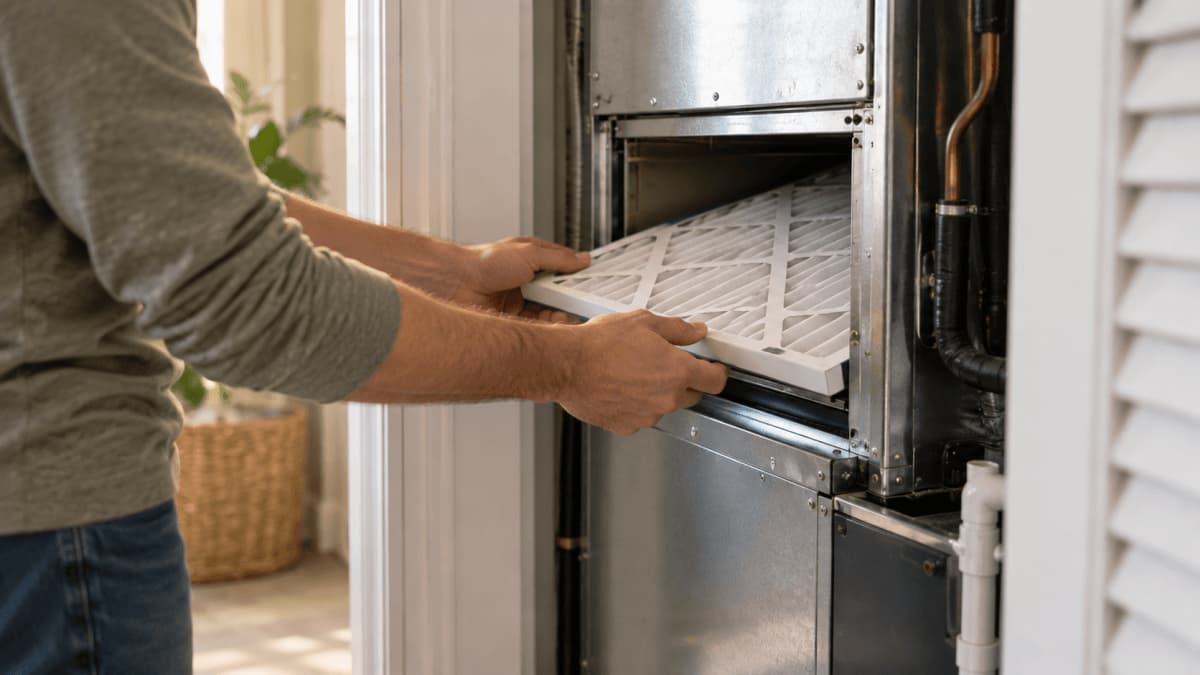
No — running your air conditioner without a filter is not recommended. Even a short run lets dust slip past the blower and coat the evaporator coil, which blocks airflow and forces the compressor to work harder. In an emergency you have a few hours at most before buildup starts; after that, strain and repair risk climb fast. If your filter is missing or clogged, replace it as soon as you can — shop replacement filters.
Not sure which filter fits your system? Take the quick match quiz below.
Answer a few quick questions and we'll match you to the right filter for your system.
Written by Michelle Wan · Technically reviewed by David Clark, Licensed HVAC Technician · Updated October 2, 2026
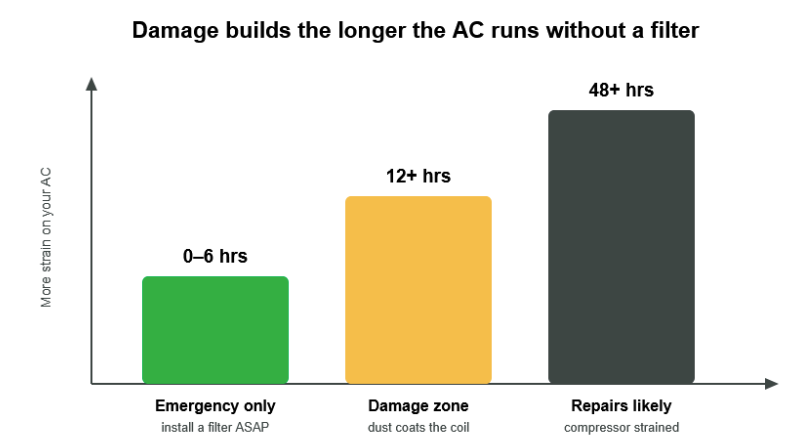
Short answer: no. You shouldn't run your air conditioner without a filter, though a few hours in an emergency won't destroy it. Without a filter, dust travels straight to the evaporator coil, sticks to the cold, damp fins, restricts airflow, and washes into the condensate drain. The damage is cumulative, not instant. In a clean home you have roughly 6–8 hours before it's worth worrying about. With pets, pollen, or construction dust, far less.
[ Find your exact filter size → ]
The quick version
Key Takeaways
Running your AC without an air filter is never recommended, but a few hours in a clean home won't cause damage you'd notice.
Roughly 6–8 hours is a sensible emergency ceiling; 2–4 hours with pets or pollen; zero during construction or wildfire smoke.
The first real-world failure is usually a clogged condensate drain, not a dead compressor. Weeks or months unfiltered is where coil cleaning costs start.
ENERGY STAR advises checking your filter monthly during heavy-use seasons and changing it at least every three months. Our replacement schedule by filter thickness goes further.
How Long Can You Run Your AC Without a Filter?
In a clean home with no pets or construction, roughly 6–8 hours is a reasonable emergency ceiling for running an AC unit without a filter. There's no single safe number, and any source that gives you one without asking about your home is guessing. In our experience the variable that decides it isn't the clock. It is how much particulate is moving through your air.
Windows assume a typical residential system. Household dust load is the variable that matters most.
The honest version: a few hours unfiltered in a normal home won't destroy your air conditioner. Weeks of it might cost you a coil cleaning. The reason we say don't do it isn't drama. The fix is an $8–$25 filter and the alternative is a service call.
Can I Run My AC Without a Filter for One Night?
You can, and one night in a normal home is unlikely to cause damage you'd ever notice. It is still not a habit to build. Over eight to ten hours, dust that would have been caught at the return reaches the evaporator coil and sticks to the wet fins. One night's worth is a thin film. Thirty nights' worth is a service call. If you've already done it, install a filter in the morning.
Can I Run My AC Without a Filter Temporarily?
Temporarily is the only defensible version of this. The problem is that "temporarily" has a way of becoming "I forgot." If you're genuinely between filters, keep it under 6–8 hours in a clean house, skip it entirely with pets or construction, and order the replacement before you turn the system on. The story we hear on service calls isn't a bad decision. It is a reasonable short-term one, followed by a busy month.
When Running It Unfiltered Is the Right Call
If the real choice is between a dirty coil and a dangerously hot house, run the air conditioner. We manufacture filters for a living and we are still telling you that, because the two risks are not the same kind of risk. A fouled coil is a repair with a price on it. Heat illness is not something you can pay for later.
The CDC lists people at higher risk from heat as adults 65 and older, infants and young children, pregnant women, people with heart disease, and children with asthma. If someone in your home falls into one of those groups and it is genuinely hot, the filter question waits until morning. Nothing on this page outranks that.
Two things that surprise people:
A fan is not a substitute once it is hot enough. CDC guidance is that fans should only be used when indoor temperatures are below 90°F. Above that, a fan can increase body temperature instead of lowering it. That is the single most useful thing we learned writing this page, and it is why we would rather you ran the system unfiltered overnight than sat in a 95°F room with a box fan.
You may not have to choose at all. If the system is down entirely, you can reach an air-conditioned public space by dialing 2-1-1 or contacting your local health department. Check conditions first on the CDC HeatRisk dashboard, and the EPA's guidance on extreme heat and indoor air quality covers how to handle both problems at once when smoke or poor outdoor air is also in play.
Then, once it is safe: put a filter in, look at the coil at your next change, and get a spare on the shelf so the next heat wave is not also a filter emergency. The whole point of knowing your size in advance is that you never have to weigh these two things against each other again.
What Will Happen If You Run Your AC Without a Filter?
Four things happen, in this order. None are instant, which is exactly why the problem sneaks up on people.
Dust reaches the evaporator coil. The coil is cold and damp during a cooling cycle, so particles stick on contact. Department of Energy guidance describes it plainly: when airflow is obstructed, dirt bypasses the filter and accumulates on the coil, cutting its heat-absorbing capacity.
The condensate drain clogs. This is the failure most homeowners actually experience. Dust washes off the wet coil into the drain pan and blocks the line. That is one of the classic signs of a filter problem.
Airflow drops and cycles lengthen. As fins load up, the system moves less air and runs longer. Lawrence Berkeley National Laboratory researchers who modeled residential coil fouling found it plays out over years, and concluded that eliminating filter bypass belongs in routine maintenance, which is exactly what no filter removes.
Indoor air quality drops. With nothing at the return, particles recirculate. The EPA identifies HVAC filtration as a core strategy for capturing smoke, spores, and pollen indoors.
Compressor failure is what people fear most, and it's real. But it sits at the end of a long chain, not the start. One night unfiltered doesn't threaten your compressor. A full season in a dusty house eventually can.
What We See From the Manufacturing Side
Most homeowners who run an air conditioner without a filter did not choose to. They could not find their size. That is the pattern Filterbuy sees from the manufacturing end of this problem, and it is the part the repair-side version of this article misses.
Most advice about running an AC without a filter comes from technicians who arrive after the damage. Filterbuy comes at it from the other end. We are an American air filter manufacturer. We have built filters in Alabama, Pennsylvania, Texas, and Utah since 2013, and our team takes orders from people standing in front of an empty filter slot right now, phone in hand.
Almost nobody runs their system unfiltered on purpose. In our experience the sequence is nearly always the same. The old filter comes out. The slot turns out to be an odd size the hardware store doesn't stock. The system goes back on "just for tonight" while someone figures it out. Then the week gets away from them.
That is why Filterbuy stocks 600+ standard sizes and cuts filters to any dimension on request. It is also why the most useful thing on this page might not be the timeline at all. It is knowing that "I can't find my size" has a fix that takes about two minutes.
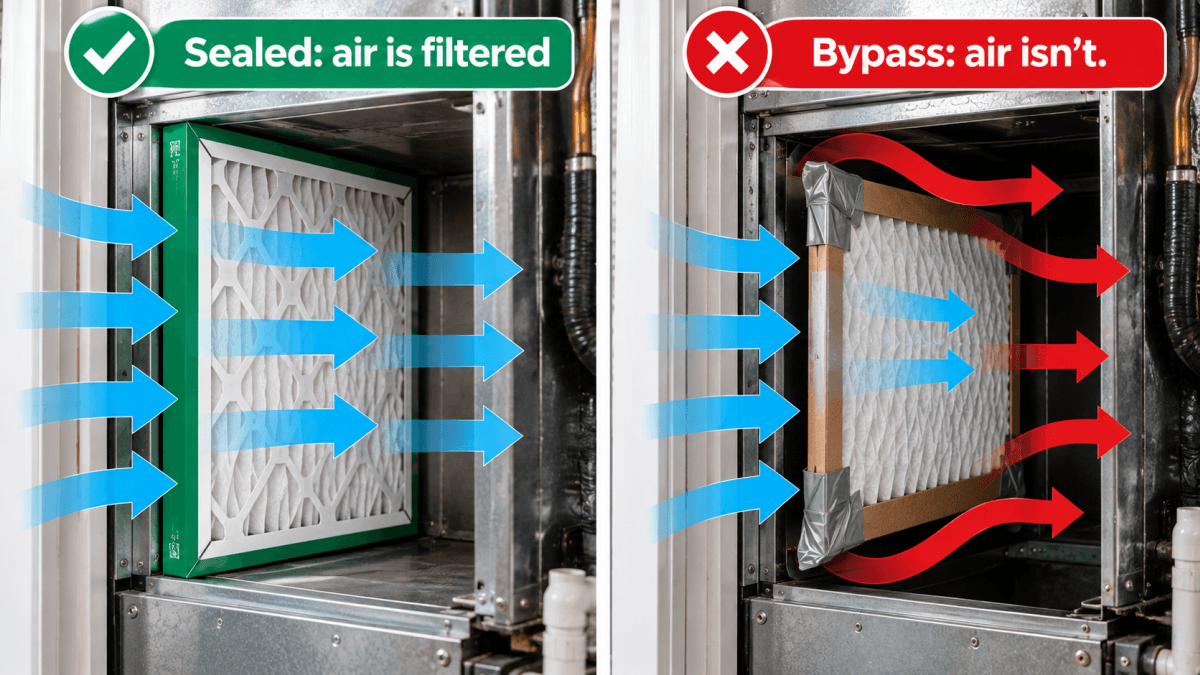
The second thing Filterbuy sees constantly is fit, not quality. Our support team fields a steady stream of questions about filters that "don't work," and a large share turn out to be correctly rated filters sitting loose in an oversized slot. Air takes the gap. That matches what the Lawrence Berkeley researchers found when they modeled coil fouling: bypass around a good filter undoes much of its benefit. A filter that doesn't seal is closer to no filter than most people assume. That is also the honest reason we don't recommend the taped-media workaround below.
“The service calls that actually hurt aren’t the people who ran it one night. They’re the ones who ran it for a season because nobody ever told them their slot was a non-standard size. By the time I open the air handler, the coil is grey and the drain line is packed. That repair was avoidable at the point of purchase, not at the point of failure.”
So the guidance on this page isn't "never, under any circumstances." It is the version we would give a neighbor: a few hours won't hurt you, the real risk is the month you didn't plan for, and the fix is knowing your size before you need it.
No Filter Right Now? Do This Instead.
Turn the system off if the house is tolerable. It's the only option with zero risk.
Write down your filter size first. It's printed on the old frame. If it's gone, measure the slot and check it against the standard size chart.
Use fan-only mode sparingly, and not at all above 90°F indoors. Air still crosses the coil in fan mode, so this buys comfort, not protection. And CDC guidance is explicit that fans should only be used when indoor temperatures are below 90°F, because above that a fan can raise body temperature rather than lower it.
Skip the cut-to-fit media trick if you can. You'll see this everywhere: tape furnace filter media over the return. Here's the part nobody mentions: filtration only works when air is forced through the media, and a taped patch doesn't seal at the edges. Air takes the easy path around it. Filterbuy manufactures that media, so we will say it plainly: a loose patch buys less protection than it looks like. The EPA says the same about fit: a filter must sit snugly, with no air leaking around it.
Order a correctly sized replacement. Most standard sizes ship free and fast; odd sizes can be made to your exact dimensions. Find your exact size →
Check three things on install. Airflow arrow toward the blower, snug fit with no edge gaps, and one look at the coil while the panel is open. The full replacement checklist has the detail.
I Ran My AC Without a Filter for a Month. What Now?
Most systems that ran unfiltered for a few weeks in a normal home are not ruined. This is the call Filterbuy's support team gets most often, and the honest answer is usually reassuring: coil fouling is gradual, not a switch that flips. What you're checking now is whether measurable buildup happened, and you can do that yourself first.
Signs it actually cost you something. They overlap with the usual signs your filter is clogged:
Cooling cycles running noticeably longer than they used to
Weak airflow at the supply registers
Visible dust on vent grilles and around the return
Water pooling near the air handler, which is the clogged condensate drain again
A musty smell when the system kicks on
Frost or ice on the refrigerant line
What to do today: install the correct filter, flush the condensate drain line, shorten your next two changes to 30 days each, and watch performance for two weeks. Here's what a neglected filter actually costs you over time.
When to call a professional: visible fouling on the coil fins, ice on the refrigerant line, standing water at the air handler, or a cooling deficit that doesn't clear after a clean filter goes in. Angi's 2026 cost data puts professional coil cleaning around $250 on average, ranging roughly $75–$700. That is the gap Filterbuy points to when customers ask whether a spare filter is worth keeping on the shelf.
Doesn't Removing the Filter Improve Airflow?
Technically yes, which is why this myth survives. Pull the filter and static pressure drops, the blower moves more air, and for a day or two the system may feel like it's cooling better.
The catch is where that air goes. A fouled coil restricts airflow far more than any filter ever did. It does so permanently, and at the point where restriction does the most damage. You trade a small restriction you can replace for the price of a filter for a large one that needs a technician.
If your system feels genuinely starved for air, the filter usually isn't the culprit. Check for a filter that's overdue, a MERV rating higher than your blower was designed for, blocked registers, or a duct problem.
Does This Apply to Window Units, Portables, and Mini-Splits?
The physics are identical everywhere: dust reaching a cold, wet coil. The filters and the stakes differ. Filterbuy builds for most of these formats, and the stakes track how hard the coil is to reach.
A damp washable filter is worse than a missing one. Let it dry fully before reinstalling.
One rule holds across all of them: a damp washable filter is worse than a missing one. Let it dry completely before it goes back in. Note that mini-split filters work differently, and in heating season the same problem shows up as clogged furnace filter symptoms.
Supporting Statistics: What the Research Shows
Three findings from federal agencies and national-lab research that sit underneath the guidance on this page.
88% of U.S. households use air conditioning, and two-thirds rely on a central system or central heat pump.
Source: U.S. Energy Information Administration, 2020 Residential Energy Consumption Survey, the largest responding sample in the program's history at 18,496 households.
Why it matters: central systems are the ones where the filter sits in front of a buried evaporator coil. That is exactly where the cost of running unfiltered shows up, and it is the configuration most readers of this page have.
Doubling the pressure drop across a test evaporator coil took 140 grams of deposited dust, about five ounces, in controlled laboratory experiments. In the same study, filter efficiency was the single largest factor determining how fast a coil fouled: moving from a low-efficiency MERV 2 filter to a MERV 12 extended time-to-fouling roughly sevenfold, and the modeled base-case coil took 7.6 years to reach that point.
Source: Siegel, Walker & Sherman, "Dirty Air Conditioners: Energy Implications of Coil Fouling", Lawrence Berkeley National Laboratory, presented at the ACEEE Summer Study on Energy Efficiency in Buildings (full paper).
Why it matters: this is the research behind our timeline. Coil fouling is measured in years and in ounces of accumulated dust, not in hours. That is why we tell you plainly that one night without a filter will not wreck your system. The same study is the clearest evidence that the filter, not luck, is what keeps that clock slow. Its authors specifically flag filter bypass as a problem worth eliminating, and running with no filter at all is total bypass.
Americans spend roughly 90% of their time indoors, where concentrations of some pollutants run 2 to 5 times higher than typical outdoor levels.
Source: U.S. Environmental Protection Agency, Report on the Environment: Indoor Air Quality.
Why it matters: the equipment argument is only half the reason to keep a filter in place. With nothing at the return, whatever is already circulating keeps circulating, through the rooms where people spend nearly all of their time.
Frequently Asked Questions
How long can you run an AC unit without a filter?
Roughly 6–8 hours in a clean home with no pets or construction. With pets, heavy pollen, or renovation dust, far less. Damage is cumulative rather than instant, so one evening is very different from one month.
Can I run my AC without an air filter overnight?
One night in a normal home is unlikely to cause damage you'd notice. Install a filter the next day and check the coil at your following change. Making a habit of it is where the cost shows up.
Will running my AC without a filter void the warranty?
Not the whole warranty, in most cases. But it can void coverage for the damage it causes. Most manufacturers require documented filter maintenance, and repairs traced to unfiltered operation are typically excluded while the rest of your coverage stands. Keep your filter receipts.
Is it bad to run an AC without a filter?
Yes, though the honest answer depends on how long. A few hours in a clean home causes no damage you would ever notice. Weeks or months of unfiltered operation is what loads the evaporator coil, clogs the condensate drain, and turns a $15 filter into a service call.
What should I do if my filter tore or I ran out?
Turn the system off if the house is tolerable, note your size from the old frame, and order a replacement. If you must run it meanwhile, keep it short, and skip it entirely if there's construction dust in the air.
Don't Get Caught Without One
Measure your old filter, pick the right MERV rating, and keep a spare on the shelf. That habit prevents almost every version of this problem.
Filterbuy has built filters in the USA since 2013 and manufactures in Alabama, Pennsylvania, Texas, and Utah, with 600+ sizes plus custom, shipped factory-direct. Set up auto-delivery and you'll never answer this question again.
[ Find your exact filter size → ]
Sources
U.S. Department of Energy, Energy Saver: Air Conditioner Maintenance
U.S. EPA: Extreme Heat and Indoor Air Quality
See More
Get a quick overview of what happens when an air conditioner runs without a filter and why proper filtration matters for your home's air and HVAC system.