
Topeka Real-Time AQI Tracker


Get Alerts For Unhealthy AQI In Your Area
When air quality in your area reaches unhealthy levels, we'll send you a quick alert, along with expert tips on how to reduce your exposure.
What's Actually In Topeka Air Today?
What High AQI Means for Your Lungs in Topeka
How to Read AQI
The Air Quality Index (AQI) measures how polluted the air is and how it may affect your health.
0–50 (Good): Air quality is satisfactory.
51–100 (Moderate): Acceptable, but some pollutants may pose minor concerns.
101–150 (Unhealthy for Sensitive Groups)
151–200 (Unhealthy)
201–300 (Very Unhealthy)
301+ (Hazardous)
Moderate
Still okay for most, but if you have asthma or allergies, take it easy and avoid long outdoor workouts.
Shop MERV 11 filters→What's the Right Filter for Your AQI Level?


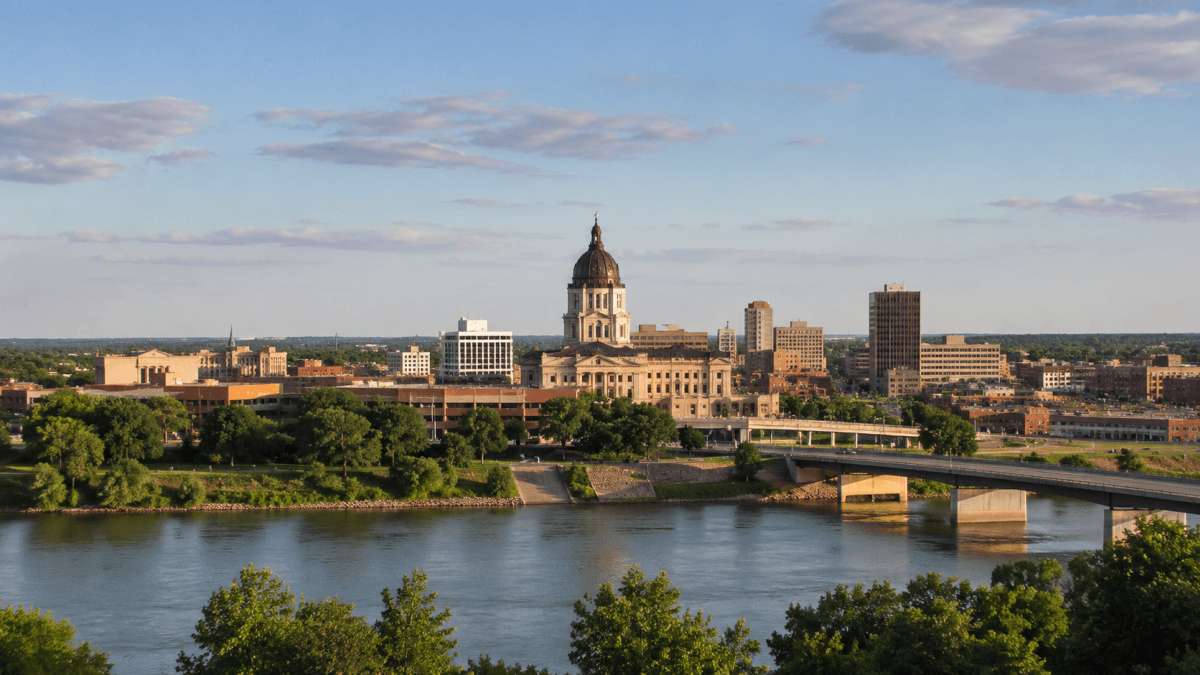
Check Today's Live Real Time Air Quality Index AQI Map in Topeka, Kansas Now
TL;DR
The live air quality index (AQI) map above shows current outdoor conditions in Topeka, Kansas. Readings here usually sit between Good and Moderate, with ground-level ozone driving summer numbers and fine particulate matter driving winter and prairie-burn spikes. Most AQI tools stop at that outdoor number. Because we make air filters, we pay just as much attention to what happens next, when that air is pulled through your HVAC system into your rooms.
Key Takeaways
Topeka's air is measured at the Topeka/KNI site in Shawnee County, one of roughly 20 in KDHE's statewide network.
Shawnee County is designated attainment for every current national air quality standard.
The Topeka metro's roughly 233,000 residents put it below the 350,000 threshold for mandatory daily AQI reporting.
Flint Hills prescribed burning each March and April carries smoke into Topeka from counties west and south, though Shawnee County sits outside the 16-county restriction zone.
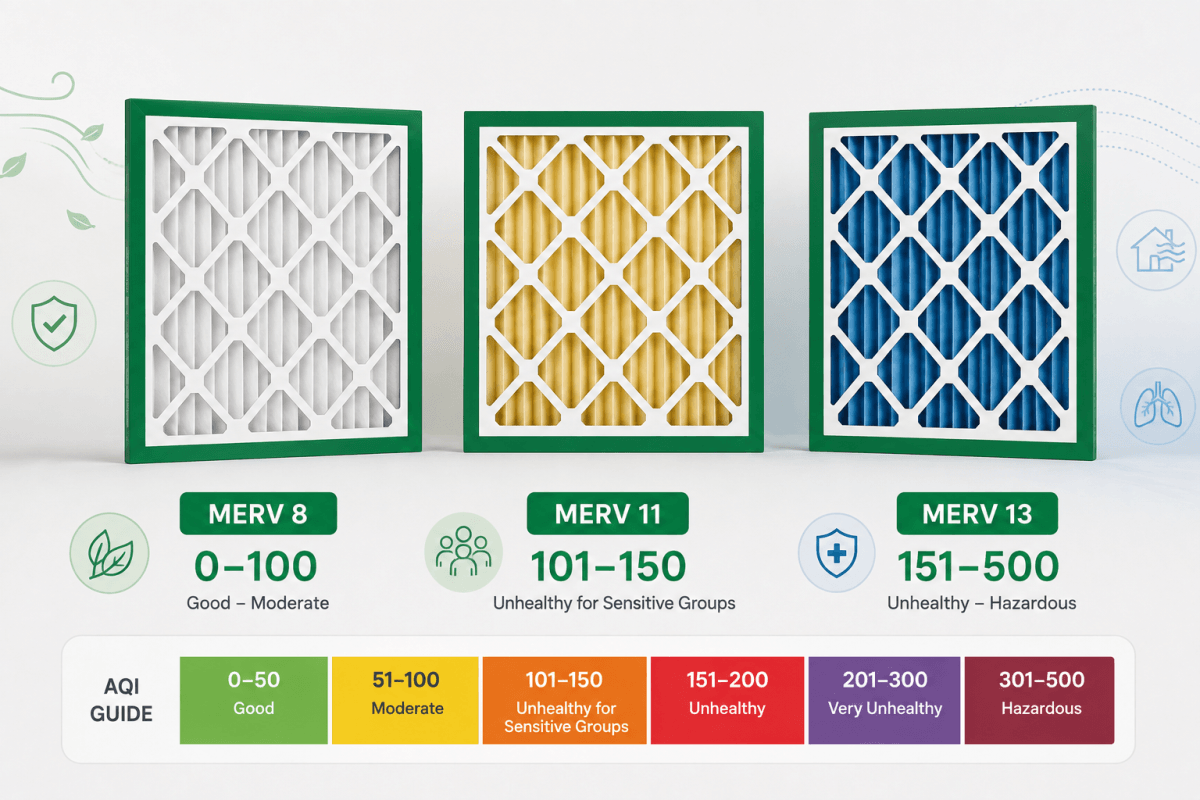
MERV 13 is the tier Filterbuy recommends for smoke, and AQI 100 is where we tell Topeka customers to switch to it.
A live AQI number answers half the question, and we spend our days on the other half. Filterbuy makes the pleated filters Topeka's outdoor air passes through once it gets inside a house, and that vantage point shapes everything below.
What Today's Topeka AQI Reading Means
The Air Quality Index is a 0-to-500 scale EPA uses to report how clean or polluted outdoor air is. The map shows the highest category for whichever pollutant leads in Topeka right now, usually ozone or fine particulate matter, and the lower the number, the cleaner the air.
Why Topeka's AQI Coverage Is Thinner Than Wichita's
Here's a detail almost no other Topeka air quality page mentions. Federal rules require daily AQI reporting only for metro areas above 350,000 residents. The Topeka metro had roughly 233,000 residents in 2025, so it isn't federally required to publish a daily index at all.
KDHE still feeds real-time Topeka/KNI data into EPA's AirNow system, which is what makes the map above work. Topeka has fewer monitors than Wichita or Kansas City, and some consumer apps fill the gap by interpolating from stations outside the county. Our advice is to read the map as a regional signal and to trust a rising trend over any single reading.
How Flint Hills Burn Season Shapes Topeka's Spring Air
Topeka's most distinctive air quality driver isn't traffic. It's prescribed fire. In an average year ranchers burn roughly 2.1 million acres of tallgrass prairie across the Flint Hills of Kansas and Oklahoma, mostly in March and April, to preserve the prairie and improve forage.
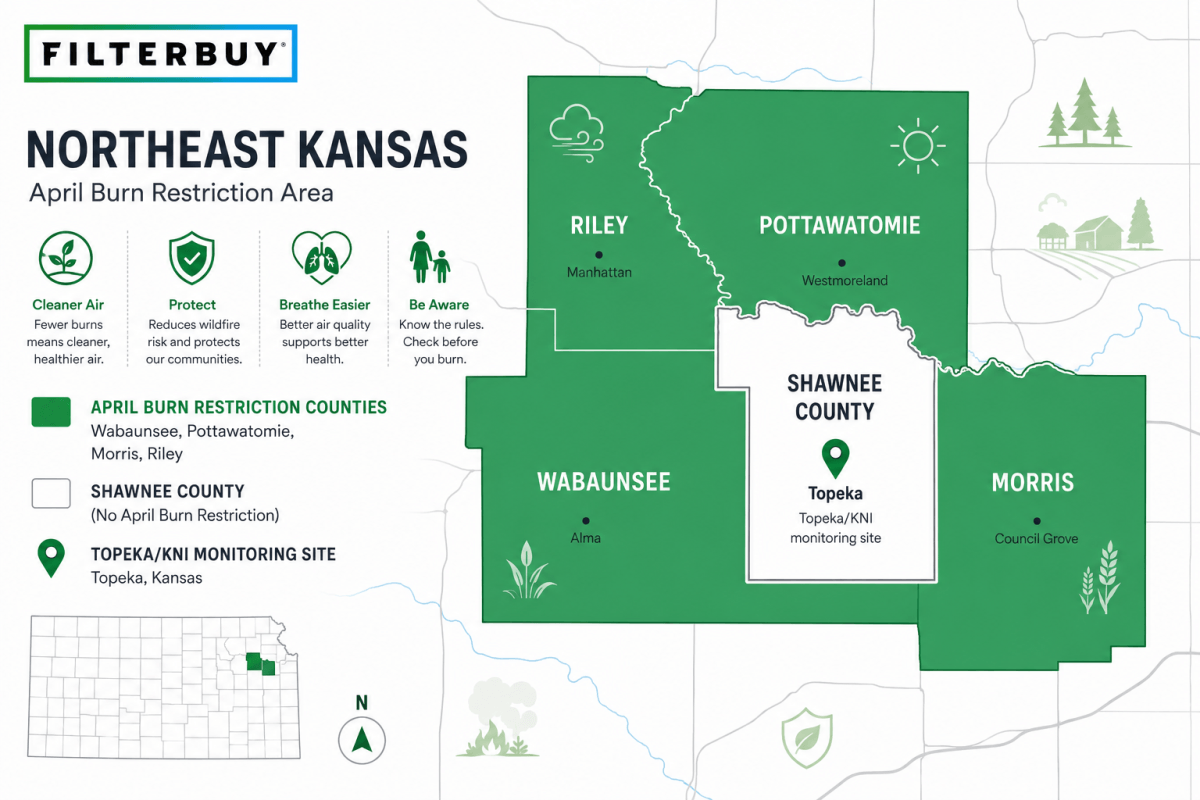
Kansas regulation K.A.R. 28-19-645a restricts certain April open burning in 16 counties. Wabaunsee, Pottawatomie, Morris, and Riley are on it, and all four sit west or southwest of Topeka. Shawnee County isn't, and that gap explains most of what confuses people about Topeka's spring air.
One wrinkle is worth knowing. The Topeka metro spans five counties: Shawnee, Jackson, Jefferson, Osage, and Wabaunsee. Because Wabaunsee sits on the restricted list, the metro straddles the line, with part of it burning under state restriction each April while Shawnee County carries on unchanged. The restricted zone begins at the metro's western edge, which is why smoke can reach a Topeka driveway within hours of ignition whenever the wind turns south.
KDHE runs a smoke modeling tool from March 1 and issues advisories when burning lifts regional AQI, so a Good morning reading can turn Moderate by evening. Filterbuy built this page around that calendar, not the live number alone.
Topeka's Seasonal AQI Calendar
The table shows which pollutant leads Topeka's air quality season by season. Filterbuy's guidance shifts with it.
For a broader regional picture, compare today's reading with the live maps for Lawrence, Kansas City, KS, and Wichita, or zoom out to the statewide Kansas air quality map and the nationwide AQI map.
How To Read And Use This Live AQI Map
Find your ZIP code on the Topeka map rather than relying on a citywide average.
Read the number and color against the scale table, then check which pollutant is driving it.
Recheck if temperatures climb, winds shift south, or KDHE issues a smoke advisory.
Matching Your Air Filter To Today's AQI Reading
Topeka's outdoor reading doesn't stop those pollutants from reaching you indoors, and the filter in your furnace or air handler decides how much of it circulates through the rooms you live in.
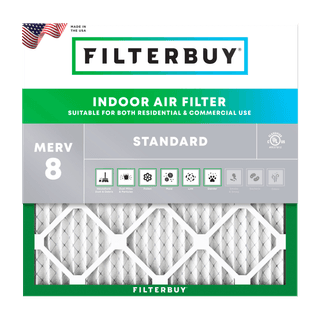
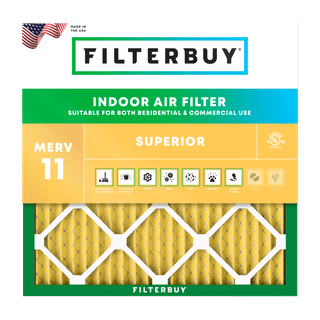
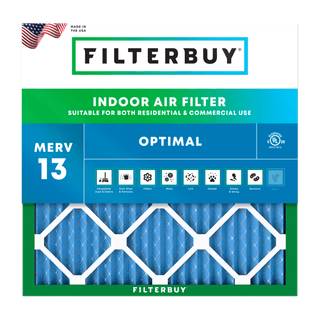
We manufacture MERV 8, MERV 11, and MERV 13 pleated filters in the USA in more than 600 sizes, because fit decides the outcome as much as the rating does. On a smoke day a loose frame lets particles slip around the media instead of through it.
When Wildfire Smoke Reaches Topeka
Topeka doesn't need a nearby fire to see its AQI climb. Smoke from Canadian and Western U.S. wildfires regularly crosses the Great Plains, and when it settles over northeast Kansas, PM2.5 can stay elevated for days under clear skies.
Wildfire particulate isn't interchangeable with everyday urban particulate. Federally funded peer-reviewed research indicates wildfire-specific PM2.5 drives a higher rate of respiratory hospitalizations than particulate from ordinary sources. EPA recommends an HVAC filter rated MERV 13 or higher in a central system during smoky periods, and notes most furnaces and HVAC systems accommodate MERV 13 without equipment problems when the filter is replaced frequently. Filterbuy recommends that same tier for Topeka's smoke weeks.
What To Do When Topeka's AQI Reaches 100
AQI 100 is where Filterbuy tells customers to act. EPA sets no AQI threshold for changing a filter, so treat 100 as our line rather than a federal one. Check AirNow and KDHE guidance first, then work through four steps.
Fit a MERV 13 filter in the HVAC if the system runs a lower tier. Your central system moves far more air than any portable unit, so this is the whole-home layer.
Set the thermostat fan to On instead of Auto, since Auto only filters while the system is heating or cooling.
Run a portable HEPA air cleaner in each occupied room, bedrooms first. Choose a unit whose smoke CADR is at least two-thirds of the room's square footage, so a 300-square-foot bedroom wants a smoke CADR near 200. Skip anything that produces ozone.
Close the house up. Windows and doors shut, and no candles, frying, or vacuuming without a sealed unit while smoke is in.
Apartments and older Topeka homes without ductwork have no whole-home layer, so portable HEPA cleaners are the primary defense there rather than a supplement.
During a smoke or burn stretch, check the filter instead of waiting on the calendar. Replace it once it looks dark brown or black, which can come well before the normal interval, and keep a spare on hand
Filterbuy manufactures pleated air filters in the USA, with company history detailed on its About Us page.
7 Trusted Air Quality Resources For Topeka Residents
Each resource below shaped a Filterbuy recommendation on this page.
Understand Exactly What Your AQI Number Means
AirNow's AQI Basics guide breaks down all six color categories and the five pollutants it tracks.
Check Topeka's Federal Attainment Status
EPA's Kansas nonattainment status report lists every Kansas county designated nonattainment for a national standard. Shawnee County doesn't appear.
See Kansas Monitoring Data Directly From The State
KDHE's Air Quality Index page explains how Kansas reports the AQI and where its data comes from.
Track Flint Hills Burning Rules And Smoke Modeling
The Kansas Flint Hills Smoke Management regulations page lists the 16 counties under April open burning restrictions and the state smoke management plan.
Learn Why Fine Particles Carry The Real Health Weight
CDC's air pollutants overview covers the six criteria pollutants and practical steps for people with asthma or COPD.
Get The Full Picture On Long-Term Exposure
The American Lung Association's Health Impact of Air Pollution report distills decades of research into what ongoing exposure does.
Read The Rule Behind Daily AQI Reporting
The federal AQI reporting requirement in 40 CFR Part 58 sets the 350,000-population threshold for which metros must publish a daily index.
Supporting Statistics: The Research Behind This Page's Guidance
Three federal findings shaped the guidance above.
1. Wildfire Smoke Raises Respiratory Hospitalizations Up To 10 Percent
A 10 µg/m³ rise in wildfire PM2.5 raised hospitalizations 1.3 to 10 percent.
The same rise in ordinary PM2.5 raised them 0.67 to 1.3 percent.
For Topeka: treat smoke faster than a routine AQI bump.
Source: NOAA Institutional Repository, Aguilera et al. 2021, NOAA Grant NA17OAR4310284.
2. Topeka Falls Below The Federal AQI Reporting Threshold
The Topeka metro held roughly 233,052 residents in 2025.
Federal rules mandate daily AQI reporting only above 350,000.
For Topeka: fewer monitors feed the map than in Wichita.
Source: U.S. Census Bureau via the Federal Reserve Bank of St. Louis.
3. Correct Sizing Removes 80 Percent Of Smoke Particles
Size a room air cleaner to a smoke CADR of two-thirds the room's square footage.
That sizing clears 80 percent of smoke particles.
For Topeka: sizing beats brand.
Frequently Asked Questions
Glossary
AQI (Air Quality Index): An EPA 0-to-500 scale converting pollutant levels into six color-coded categories.
PM2.5: Fine particulate matter 2.5 micrometers or smaller, able to reach deep into the lungs.
Ground-Level Ozone: A gas formed when emissions react with sunlight and heat.
MERV Rating: Minimum Efficiency Reporting Value, a 1-to-20 filter efficiency scale.
Attainment: An EPA designation meaning an area meets a national air quality standard.
Prescribed Burn: A planned, controlled fire used to manage rangeland, such as the Flint Hills prairie burns.
KDHE: The Kansas Department of Health and Environment, which runs the state's monitoring network.
Sensitive Groups: Children, older adults, and people with asthma, COPD, or heart disease.