
Kansas City Real-Time AQI Tracker


Get Alerts For Unhealthy AQI In Your Area
When air quality in your area reaches unhealthy levels, we'll send you a quick alert, along with expert tips on how to reduce your exposure.
What's Actually In Kansas City Air Today?
What High AQI Means for Your Lungs in Kansas City
How to Read AQI
The Air Quality Index (AQI) measures how polluted the air is and how it may affect your health.
0–50 (Good): Air quality is satisfactory.
51–100 (Moderate): Acceptable, but some pollutants may pose minor concerns.
101–150 (Unhealthy for Sensitive Groups)
151–200 (Unhealthy)
201–300 (Very Unhealthy)
301+ (Hazardous)
Moderate
Still okay for most, but if you have asthma or allergies, take it easy and avoid long outdoor workouts.
Shop MERV 11 filters→What's the Right Filter for Your AQI Level?



Check Today's Live Real Time Air Quality Index AQI Map in Kansas City, KS Now
By Michelle Wan · Reviewed by David Clark, Licensed HVAC Technician · Published August 18, 2026 · Updated August 18, 2026
TL;DR
The live map above shows the current Air Quality Index number and color for Kansas City, KS. At or below 100 is generally satisfactory, above 100 calls for care among sensitive groups, and above 150 affects everyone. Ozone and fine particle pollution, or PM2.5, drive nearly all the variation here. On a high reading, close the windows and run a clean, high-efficiency HVAC filter.
Key Takeaways
The live AQI map above reports Kansas City, KS conditions from EPA AirNow data.
Kansas City, KS sits in Wyandotte County, and its ozone reading comes from the JFK station run by the Kansas Department of Health and Environment.
Wyandotte County has no active nonattainment designation, but its JFK monitor sits closest to the federal ozone limit of any Kansas station in the metro.
The Mid-America Regional Council recorded 123 green days, 37 yellow, 2 orange, and 1 red across the 2025 Kansas City ozone season.
Kansas City, KS and Kansas City, MO share one airshed but are monitored by different state agencies.
What’s Actually In Kansas City Air Today?
Two pollutants drive nearly all the day-to-day change here: ground-level ozone and fine particulate matter, known as PM2.5. Ozone forms on warm, sunny, low-wind days when vehicle exhaust and industrial emissions react in sunlight. PM2.5 is the soot-sized fraction from traffic, power generation, wood smoke, and wildfire smoke blown in from far away.
For today’s number, read the live map above. The color and value reflect whichever pollutant is highest, which is how the EPA index works.
Ozone is a warm-weather problem peaking in the afternoon. PM2.5 can spike in any month, climbing fastest during smoke transport and on cold, still days when an inversion traps emissions.
How Do You Read Today’s Kansas City AQI Number?
The AQI runs 0 to 500 in six color-coded categories, where a higher number means more pollution and greater health concern. Find your number on the live map, match it to the row below, and act on that guidance. The categories are set by the EPA AirNow program and identical nationwide, so 85 here means what 85 means anywhere.
AQI categories are set by the U.S. EPA and are identical nationwide. PM2.5 breakpoints were revised effective May 6, 2024.
The EPA lowered the annual PM2.5 standard to 9.0 micrograms per cubic meter in 2024 and revised the PM2.5 AQI breakpoints at the same time. The ozone AQI uses an eight-hour average rather than an instant reading, which is why a hot afternoon can feel worse than posted. Our guide explains how the Air Quality Index works in full.
What High AQI Means For Your Lungs In Kansas City
Ozone and particle pollution affect the airways, and effects begin below the federal standards. The CDC describes both as pollutants that may harm the health of hundreds of thousands of Americans each year. The American Lung Association likens breathing ozone to a sunburn inside the lungs.
Sensitive groups feel it first: people with asthma or COPD, children, adults over 65, and anyone exercising outdoors.
Below 100, most people can carry on normally. Between 101 and 150, sensitive groups should shorten strenuous outdoor exertion. Above 150, everyone should cut prolonged exertion, and above 200 avoid it.
Timing helps more than people expect. Ozone builds through the day and peaks in the afternoon and early evening, so the same run is a different exposure at 7am than at 6pm. The EPA advises rescheduling outdoor exertion to the morning when ozone is forecast high. Between March and October here, that one change costs nothing and cuts real exposure.
With a diagnosed respiratory or cardiac condition, your clinician’s guidance takes precedence over any AQI threshold.
Where Does Kansas City, KS Air Quality Data Come From?
These numbers come from physical stations, not a model. The Kansas Department of Health and Environment, or KDHE, operates the state network and reports the data the EPA uses to calculate the AQI. In Kansas City, KS that station is the JFK site in Wyandotte County. The Mid-America Regional Council, the bi-state planning agency for the metro, compiles six regional monitors and issues the daily SkyCast forecast through AirQKC.
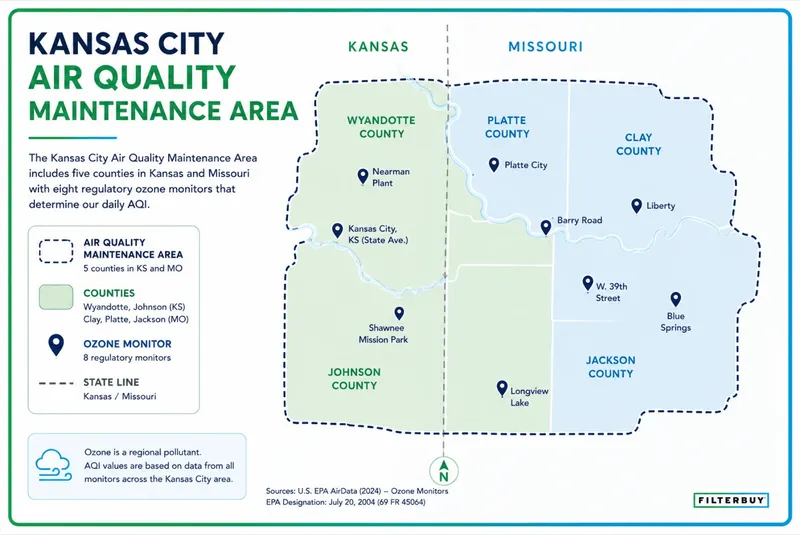
A design value is the three-year average of a monitor's fourth-highest daily eight-hour ozone reading. The federal eight-hour ozone standard is 70 ppb. Source: Mid-America Regional Council, 2025 Ozone Season Summary.
The design value determines federal compliance. It is the three-year average of a monitor’s fourth-highest eight-hour reading. The standard is 70 ppb, and because the rule rounds down, a monitor does not violate until 71. JFK came in at 69.
When Is Ozone Season In Kansas City, KS?
Ozone season here runs March 1 through October 31, and most Ozone Alerts land between June and August. Ozone needs heat, sunlight, and stagnant air, so the worst days land in mid to late afternoon. In 2025 MARC logged 123 green days, 37 yellow, 2 orange, and 1 red. Four exceeded the 70 ppb standard, and JFK accounted for two.
When smoke rather than ozone drives the spike, the Kansas wildfire smoke map shows active fires statewide, and the AirNow Fire and Smoke Map plots live PM2.5 alongside.
How Kansas City, KS Air Quality Differs From Kansas City, MO
Both cities breathe the same air but are measured separately, which explains most confusion. The federal maintenance area covers Wyandotte and Johnson counties in Kansas plus Clay, Platte, and Jackson in Missouri. Pollution crosses that line freely. Governance does not.
Ozone forms downwind of its sources over an afternoon, so the two sides can post very different peaks on the same date. The Mid-America Regional Council 2025 ozone season summary shows it plainly.
On July 9, 2025, the region’s worst air day of the season, Rocky Creek in Missouri hit 88 ppb, deep in the Unhealthy band. JFK in Kansas City, KS read 63 ppb that afternoon, which is Moderate. A KCK household watching a metro number prepared for air it never breathed.
Five weeks earlier it inverted. On June 1 JFK posted 72 ppb, the highest in the region, while Liberty sat at 61. Each side takes a turn.
Check which monitor your weather app reads, since most national tools default to Missouri.
Search by ZIP code, not city name. A KCK ZIP such as 66101 pulls the Kansas side.
Check the station name. Liberty, Rocky Creek, or Watkins Mill means Missouri.
On the AirNow map, click the monitor to confirm the station.
Checking the other side of the state line? See the Kansas City, MO air quality index map or the statewide Kansas air quality index map.
What Filter Should You Run On A High AQI Day In Kansas City?
When outdoor air is poor, close the windows and keep the HVAC system circulating through a clean, appropriately rated filter. MERV, or Minimum Efficiency Reporting Value, describes how well a filter captures particles in a size range. A higher rating captures more of the fine particles behind a high reading.
Filterbuy, a U.S. air filter manufacturer, makes all three tiers below in standard and custom sizes.
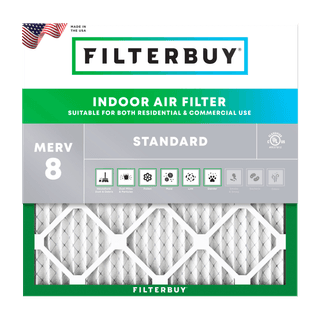
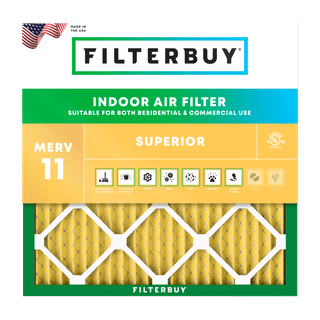
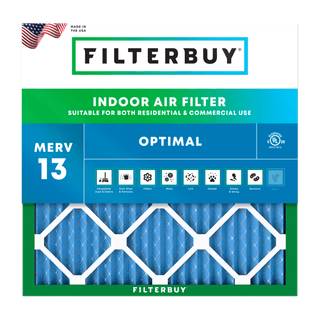
For ordinary green and yellow days, MERV 8 air filters handle dust, pollen, and lint. On moderate days, MERV 11 air filters capture more fine material, including pet dander. During smoke and high particulate days, the EPA recommends MERV 13 air filters or the highest rating your system accepts.
Two limits matter. Filter choice must match what your blower can handle, since an overly restrictive filter reduces airflow. And an HVAC filter captures particles mechanically, so it addresses particulate matter, not gaseous ozone.
Replace it more often during smoke events, since a loaded filter moves less air. An Odor Eliminator carbon filter handles the smoke odor a pleated filter leaves behind, and an air filter subscription keeps a spare on the shelf before ozone season. Our guide to wildfire smoke and the Air Quality Index covers smoke events in depth.
Supporting Statistics For Kansas City, KS Air Quality
Three figures underpin the guidance here.
Kansas City, KS sits one ppb under the federal ozone limit.
The JFK station recorded a 2023 through 2025 ozone design value of 69 ppb against a 70 ppb federal standard. That is the highest of any Kansas-side monitor.
No Kansas monitor in the region sits closer to the limit.
Source: Mid-America Regional Council, 2025 Ozone Season Summary
A better filter plus a continuous fan can halve indoor PM2.5.
A high-efficiency HVAC filter run with the fan on continuously may cut indoor PM2.5 by roughly 50 percent. A low-efficiency filter run continuously may cut it about 24 percent. Both trace to research by Fisk and Chan.
The fan setting matters as much as the filter rating.
Source: U.S. EPA, Wildfire Smoke Course: Strategies to Reduce Exposure Indoors
Failing ozone grades hit a ten-year high nationally.
State of the Air 2026 found failing ozone grades across 219 counties in 36 states and DC, the highest count since the 2016 edition.
Ozone is not only a western problem.
Source: American Lung Association, State of the Air 2026 Ozone Findings
How We Checked This Page
The Filterbuy air quality team pulled these figures from the Mid-America Regional Council season summary monitor by monitor, and read every source before citing. Two limits: MARC labels its 2025 readings as not yet quality assured, and the map above is live, so we explain how to read it rather than printing a number that goes stale.
Expert Perspective
Working the Kansas City numbers, what stands out is not how bad the air gets. It is how often the two halves of one metro disagree.
After manufacturing filters for over a decade and serving more than two million households, the pattern we keep seeing is that people react to the sky rather than the reading. A clear July afternoon is when ozone peaks here, and the filter already in the return decides how much gets in.
Michelle Wan, Brand Manager and Air Quality Writer, Filterbuy
Published by Filterbuy, an American air filtration company manufacturing HVAC filters in the United States for over a decade. Reviewed by David Clark, Licensed HVAC Technician, for filtration and HVAC accuracy.
Frequently Asked Questions
Glossary
Air Quality Index, or AQI: the EPA 0 to 500 scale for outdoor air quality, in six color-coded health categories.
PM2.5: fine particulate matter 2.5 micrometers or smaller, small enough to reach deep into the lungs.
Ground-level ozone: a lung-irritating gas formed when nitrogen oxides and volatile organic compounds react in sunlight.
Ozone design value: the three-year average of a monitor’s fourth-highest daily eight-hour reading, used for federal compliance.
KDHE: the Kansas Department of Health and Environment, the state agency that operates the Kansas air monitoring network.
MARC: the Mid-America Regional Council, which forecasts and reports air quality for the bi-state Kansas City region.
MERV: Minimum Efficiency Reporting Value, the scale describing how effectively an air filter captures airborne particles.