
Peoria Real-Time AQI Tracker


Get Alerts For Unhealthy AQI In Your Area
When air quality in your area reaches unhealthy levels, we'll send you a quick alert, along with expert tips on how to reduce your exposure.
What's Actually In Peoria Air Today?
What High AQI Means for Your Lungs in Peoria
How to Read AQI
The Air Quality Index (AQI) measures how polluted the air is and how it may affect your health.
0–50 (Good): Air quality is satisfactory.
51–100 (Moderate): Acceptable, but some pollutants may pose minor concerns.
101–150 (Unhealthy for Sensitive Groups)
151–200 (Unhealthy)
201–300 (Very Unhealthy)
301+ (Hazardous)
Moderate
Still okay for most, but if you have asthma or allergies, take it easy and avoid long outdoor workouts.
Shop MERV 11 filters→What's the Right Filter for Your AQI Level?



Check Today's Live Real Time Air Quality Index AQI Map in Peoria, IL Now
By Michelle Wan, Brand Manager and Air Quality Writer | Reviewed by David Clark, Licensed HVAC Technician | Published: September 7, 2026 | Updated: September 7, 2026
The Air Quality Index (AQI) in Peoria, Illinois is a 0 to 500 scale that turns outdoor pollution into a single number you can act on. Filterbuy's live map above draws on the same EPA and Illinois EPA monitoring network your health department uses, refreshed hourly. Filterbuy's action line is AQI 100, and the table below sets out what to do at each level.
What Is the Air Quality in Peoria Today?
Peoria's current AQI is whatever the live map reports, updated hourly. Two pollutants account for nearly all of it: ground-level ozone through the warm months, and fine particulate matter (PM2.5), the fine soot you cannot see, during smoke events, winter inversions and harvest. Both fall under the national standards EPA sets for criteria pollutants.
The map also labels which of the two is dominant, and that label is worth reading: only one responds to anything you can do with a home air filter.
How Do You Read the Peoria AQI Map?
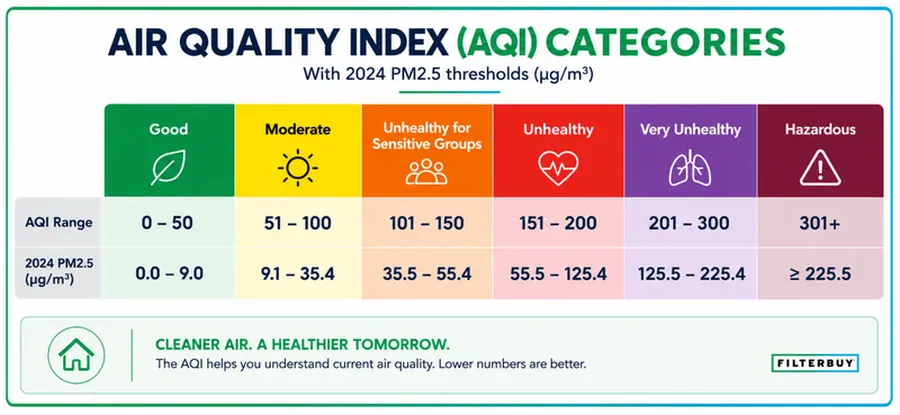
Each color on the Peoria AQI map corresponds to a health category defined by the U.S. EPA. One thing to keep in mind: the EPA tightened its PM2.5 breakpoints in May 2024, so air that would have scored Good in 2023 can read Moderate today without having changed at all.
AQI ranges, category names and colors are EPA's, and the PM2.5 thresholds reflect EPA breakpoints updated May 2024 (source: EPA AirNow, AQI Basics). The action column is Filterbuy's own guidance.
How Much Should You Trust a Single AQI Number?
Peoria is monitored, but thinly. One Illinois EPA site speaks for a metro spread along a river valley, and the limits show in the record. The American Lung Association could not grade Peoria on year-round particle pollution in State of the Air 2026 at all, because the three years of data were incomplete. Chicago gets a grade. Peoria gets a blank.
Two habits close most of that gap, both from Illinois EPA's own guidance:
Read the NowCast, not just the daily forecast. The daily forecast is one category for the whole day. NowCast blends the most recent hourly readings and can land higher or lower, which is how you find the clean hours inside a bad day.
Switch to the EPA Fire and Smoke Map on smoke days. It fills in sensor readings between regulatory monitors and screens out non-smoke pollutants that flatter the air.
If the nearest monitor sits across town from you, let the sensor map break the tie. The state's ambient air monitoring network plan lists where the sites are.
Why Does Peoria Get an F for Ozone but an A for Particle Pollution?
The American Lung Association's State of the Air 2026 report grades counties on 2022 to 2024 EPA data. It ranked the Peoria-Canton metro area 37th worst in the nation for ozone pollution and gave it an F. The same report placed the metro among the nation's cleanest for short-term particle pollution, with an A. Year-round particle pollution went unranked. The Peoria County report card lays it out in full.
Peoria is not a dirty air city in the usual sense. It has a seasonal, sunshine-driven ozone problem on top of otherwise clean particulate air.
We should be upfront about our stake in this. Filterbuy manufactures air filters, and the pollutant Peoria actually fails on is the one our product cannot touch. Ozone is a gas, and pleated media captures particles. We would rather say so plainly than sell you a filter for the wrong problem, and it is why ozone advice and filtration advice stay in separate sections here.
Ozone is never emitted directly. It forms when nitrogen oxides and volatile organic compounds cook in sunlight and heat. In Peoria those come off I-74 and I-474 traffic, farm equipment and river valley industry, and the worst days cluster between May and September.
The particle side of the ledger has genuinely improved. The E.D. Edwards coal plant in Bartonville, six miles from downtown Peoria, shut down permanently at the end of 2022 under a federal Clean Air Act consent decree that also sent roughly $9.5 million into the Peoria area, including $1.59 million to the county health department. The site is now being converted to battery storage. For a city that carries an A on particles today, that counts as a measurable win.
What Sends Peoria's AQI Into the Red?
Wildfire smoke is now the most common reason Peoria's AQI climbs past 100. On July 31, 2025, Illinois EPA and the Illinois Department of Public Health placed Peoria County under a Red Air Pollution Action Day during a Canadian smoke episode, along with Woodford, Tazewell, Marshall, Stark, Knox and Fulton. Another Areawide Air Pollution Action Day followed in July 2026, covering every AQI forecast sector in the state except Metro-East St. Louis.
Peoria sits in the path of these plumes. Illinois EPA notes that smoke can affect state air quality from fires hundreds of miles away, and it usually arrives with no warning beyond a hazy sky and a campfire smell. Filterbuy's live Illinois wildfire and smoke map tracks the fires feeding it.
Three other patterns recur:
Hot, stagnant summer afternoons, when heat and light winds let ozone build.
Fall harvest, when field work and grain handling lift dust on dry, windy days.
Winter inversions, when cold air settles into the river valley and traps emissions near the ground.
What Should You Do When Peoria's AQI Climbs?
Filterbuy's action line is AQI 100. EPA's Unhealthy for Sensitive Groups band does not start until 101, so 100 is still the top of Moderate. We move at the threshold rather than after crossing it. At 100 and above, four steps, in this order:
Put a MERV 13 in the HVAC if the system is running a lower tier. The central system moves far more air than any portable unit, so this is the whole-home layer.
Set the thermostat fan to On. On Auto the system only filters while it is heating or cooling. On On it filters continuously.
Run a portable HEPA air cleaner in each occupied room, bedrooms first. This is a separate product doing a separate job: HEPA belongs in a portable unit, never in a furnace slot.
Close the house up. Windows and doors shut, fresh-air intake closed, and no candles, frying, smoking or vacuuming without a sealed unit while smoke is in.
No ducts? In an apartment, a home on window units, or an older house without ductwork, there is no whole-home layer to upgrade. Portable HEPA cleaners are the primary defense in that case rather than a supplement.
Sizing a portable unit: EPA's clean-room guidance is a smoke CADR of at least two-thirds of the room's square footage, so a 300 square foot bedroom wants a smoke CADR around 200. EPA also advises against air cleaners that produce ozone, which rules out ionizers and ozone generators. See EPA's clean room guidance for the full setup.
Above AQI 200, official guidance comes first. Check AirNow and your local air agency before anything on this page. Filtration is one layer of a response, not the response.
One thing the list above does not cover: on ozone days timing beats avoidance. Ozone peaks in mid-afternoon, so an early run is usually fine even when the afternoon is not.
Which Air Filter Actually Helps When Peoria's AQI Is High?
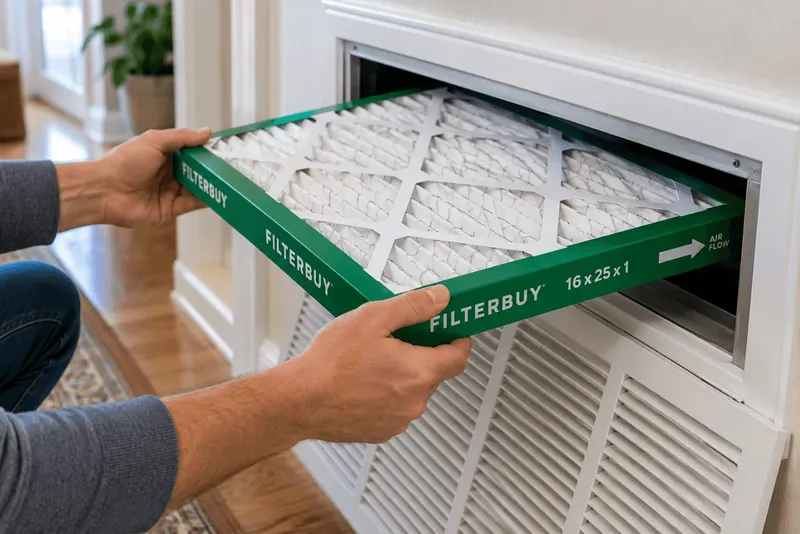
Your HVAC filter is highly effective against the particle pollution in wildfire smoke, dust and pollen, and it does essentially nothing for ground-level ozone. On a high-ozone day the answer is less time working hard outdoors, not a different filter.
Most city air-quality pages are built to make every problem look like a filter problem, and Peoria is the clearest example of why that fails. The metro carries an F for ozone and an A for short-term particle pollution, so the honest advice splits in two. Change your behavior on ozone days, and change your filter for smoke days. Getting that backwards costs people money without helping them breathe.
Michelle Wan, Brand Manager and Air Quality Writer, Filterbuy
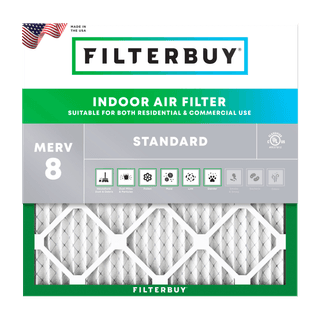
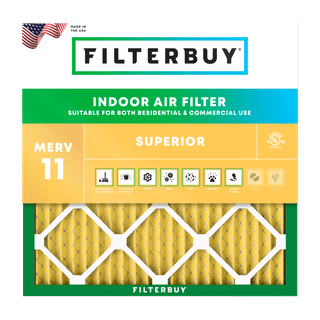
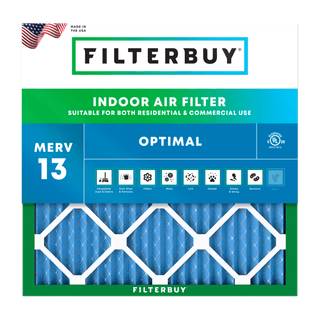
Filterbuy makes all four ratings below in more than 600 sizes. New to the ratings? Start with what MERV ratings actually mean.
EPA recommends MERV 13, or as high a rating as the system will take, during smoke events. Confirm the fit the same way you would confirm a size.
During smoke events the EPA recommends a MERV 13 filter, or as high a rating as the system will take. EPA also notes that most furnaces and HVAC systems accommodate MERV 13 without equipment problems, provided the filter gets replaced often. Check the fit the same way you would confirm a size, then put a Filterbuy MERV 13 in the slot. Filterbuy's comparison of MERV 13 versus HEPA for wildfire smoke explains why HEPA belongs in a portable air cleaner rather than a furnace slot.
Day to day, MERV 11 suits allergy households, MERV 8 handles dust and lint. Pleated media captures particles rather than gases, so odor questions go to the Odor Eliminator line. Filterbuy's guide to the best MERV filter for wildfire smoke covers what to do ahead of the season.
A pattern we see from Filterbuy's factory floor: orders climb the same week the smoke does, which is the week shipping windows tighten. A MERV 13 costs the same in June as it does in August, so buying early is the difference between having one and waiting for one.
The mistake I see in central Illinois homes is running a MERV 8 all summer and only thinking about the filter when the sky turns orange. By then you’re a week behind. Put a MERV 13 in before June, set the fan to ON when the AQI goes red, and check it monthly.
David Clark, Licensed HVAC Technician
Supporting Statistics
Three findings from federal and national health authorities sit behind Filterbuy's Peoria air quality guidance.
Ozone harms people below the federal limit.
Asthma attacks rise once 8-hour ozone averages pass 60 to 80 ppb.
Outdoor workers can lose lung function at 60 to 70 ppb.
The national standard is 70 ppb.
So Peoria can see health effects on days it is technically in compliance.
2.4 million children with asthma live in counties graded F.
So do 11.9 million adults with asthma.
Each failed at least one pollutant measure.
Peoria County is among them, on ozone.
A high-efficiency filter roughly doubles what your HVAC removes.
High-efficiency filter with the fan on: about 50 percent less indoor PM2.5.
Typical low-efficiency filter, same setting: about 24 percent.
That gap is the practical case for MERV 13 in smoke season.
Source: U.S. EPA, Strategies to Reduce Exposure Indoors, citing Fisk and Chan 2017
Frequently Asked Questions
About This Page
Written by Michelle Wan, Brand Manager and Air Quality Writer. Reviewed for technical accuracy by David Clark, Licensed HVAC Technician. Filterbuy has pleated filters in Talladega, Alabama since 2013, across four U.S. plants. Published and updated September 7, 2026.