
Phoenix Real-Time AQI Tracker


Get Alerts For Unhealthy AQI In Your Area
When air quality in your area reaches unhealthy levels, we'll send you a quick alert, along with expert tips on how to reduce your exposure.
What's Actually In Phoenix Air Today?
What High AQI Means for Your Lungs in Phoenix
How to Read AQI
The Air Quality Index (AQI) measures how polluted the air is and how it may affect your health.
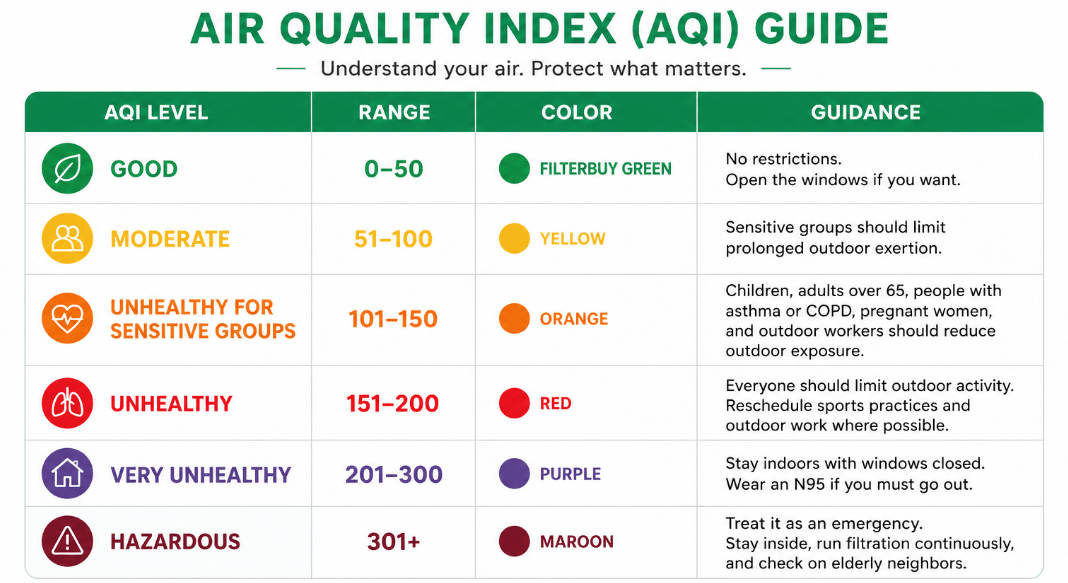
0–50 (Good): Air quality is satisfactory.
51–100 (Moderate): Acceptable, but some pollutants may pose minor concerns.
101–150 (Unhealthy for Sensitive Groups)
151–200 (Unhealthy)
201–300 (Very Unhealthy)
301+ (Hazardous)
Moderate
Still okay for most, but if you have asthma or allergies, take it easy and avoid long outdoor workouts.
Shop MERV 11 filters→What's the Right Filter for Your AQI Level?


Check Today's Live Real Time Air Quality Index AQI Map in Phoenix, AZ Now
Don’t take this afternoon’s air for granted. The sky over Phoenix can shift from blue to amber inside an hour during dust storms or wildfire smoke events, and the air inside your house can flip from safe to unhealthy in the same window if your filtration isn’t ready for it.
Use the live map below to check the AQI nearest your ZIP code right now. The rest of this page tells you what the number actually means for your household today.
TL;DR Quick Answers
Is the Air Quality Bad in Phoenix Today?
Pull the live AQI reading from the map at the top of this page. Anything above 100 calls for caution among sensitive groups, and anything above 150 calls for caution across the whole household. Phoenix readings often shift hour by hour during smoke and ozone events, so refresh the map before making outdoor decisions.
What Causes Bad Air Quality in Phoenix?
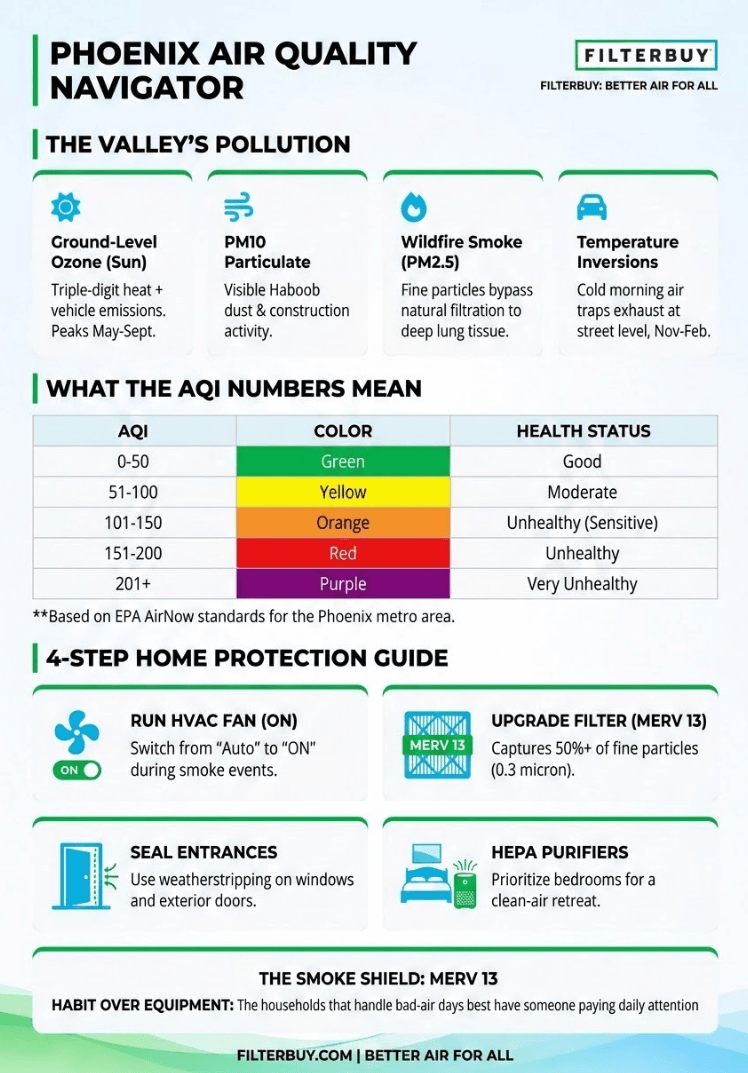
Four pollution sources drive most Phoenix AQI readings. Ground-level ozone forms when summer sun and heat react with vehicle and industrial emissions. PM10 spikes during haboob dust storms and construction activity. PM2.5 climbs when wildfire smoke drifts in from California or Arizona forests. Winter temperature inversions trap vehicle exhaust near the ground.
When Is Phoenix Air Quality Worst?
Ozone peaks from May through September during high-heat afternoons between 10 a.m. and 7 p.m. Particulate pollution spikes during summer monsoon dust storms and again during winter inversion days from November through February. Wildfire smoke can push PM2.5 into Unhealthy territory at any point from late spring through fall.
Top Takeaways
Phoenix faces four distinct air quality challenges that rotate by season: ozone, particulate matter, wildfire smoke, and inversion-trapped vehicle exhaust.
AQI 101 is the threshold where sensitive family members (children, adults over 65, people with asthma or COPD, pregnant women, outdoor workers) should reduce outdoor activity.
AQI 151 is the threshold where everyone should limit outdoor exposure, regardless of health status.
MERV 13 is the standard filter rating for capturing wildfire smoke and fine PM2.5 particles down to 0.3 microns.
Running your HVAC fan continuously turns your central system into a whole-home air cleaner during smoke events.
The Maricopa County Air Quality Department issues free Valley-specific advisories that arrive faster than national news coverage.
Phoenix Air Quality at a Glance
Phoenix sits in a desert basin where mountains, summer heat, and a fast-growing population concentrate pollutants in ways that change with the season. The single AQI reading on your screen right now is shaped by whatever is dominating that day’s air.
The Four Pollution Sources Behind Most Phoenix AQI Readings
Ground-level ozone. Sunlight and triple-digit heat react with vehicle exhaust and industrial emissions to form ozone. Maricopa County has carried EPA nonattainment status for the 70 parts per billion 8-hour ozone standard for years. The reaction speeds up between 10 a.m. and 7 p.m., which is why the Maricopa County Air Quality Department issues most of its high-pollution advisories for afternoon hours from May through September.
PM2.5 and PM10 particulate matter. Particulate matter shows up in two sizes that matter for breathing. PM10 covers the visible dust kicked up during haboobs and construction work. PM2.5 covers the fine combustion particles in smoke and exhaust. Of the two, PM2.5 carries more health risk because particles that small bypass the body’s natural filtration and reach deep lung tissue and the bloodstream.
Wildfire smoke drift. Wildfire smoke reaches Phoenix from two directions. California fires push smoke east on summer westerlies. Arizona forest fires send smoke south and west, especially during late spring before monsoon rains start. A clean Phoenix morning can flip to Unhealthy AQI by sunset when smoke layers settle into the Valley overnight.
Vehicle emissions and winter inversions. Cold morning air settles into the Phoenix bowl and traps vehicle exhaust at street level until the afternoon sun warms the surface enough to lift it. November through February inversion days are the main cause of winter pollution spikes.
What Phoenix AQI Levels Mean for Your Family
The Air Quality Index runs from 0 to 500 and breaks into six color-coded categories. Here is what each one means if you live in Phoenix:
If you want to see how readings compare across the rest of the state, check our Arizona statewide air quality index map for context.
How to Keep Indoor Air Clean on High AQI Days in Phoenix
After manufacturing filters for over a decade and serving more than two million households, we’ve learned that indoor air during a Phoenix smoke event can run just as polluted as the air outside if your filtration isn’t ready for it. Four protective steps work in any Valley home, and they layer well together.
Run your HVAC fan continuously. Switch your thermostat from “Fan: Auto” to “Fan: ON” so the system pulls room air through the filter even when it’s not actively cooling. Constant circulation captures particles before they settle on furniture, bedding, and clothing.
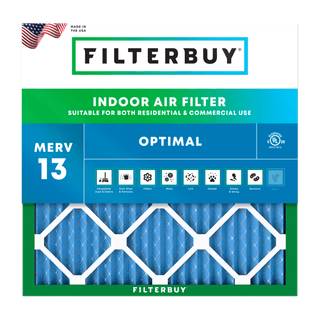
Upgrade to MERV 13 for smoke days. MERV 13 captures 50 percent or more of particles in the 0.3 to 1.0 micron range, which is the size of most wildfire smoke particles. Filterbuy manufactures MERV 13 in over 600 standard sizes plus custom dimensions, so most Phoenix HVAC systems can run a MERV 13 without airflow issues.
Seal windows and exterior doors. Phoenix homes lose conditioned air through gaps even on good air days. Weatherstripping and door sweeps are inexpensive, and they matter most on smoke days when you want every air exchange happening through your filter rather than around it.
Add a HEPA air purifier in bedrooms. During heavy smoke events, prioritize bedrooms for sensitive family members. A standalone HEPA unit gives the household a clean-air retreat while the central system handles the rest of the house.
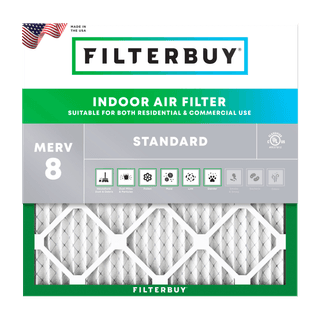
“The mistake we see most often during a Phoenix smoke event is people assuming their existing filter is doing the job because the system runs and the air feels cool. Air can feel cool while still being polluted. After fitting filtration in millions of homes, I can tell you a standard MERV 8 filter passes most wildfire smoke straight through. You need a MERV 13 to actually catch the particles that hurt your lungs, and you need to be running the fan continuously so the filter sees the air more than once an hour.”
— Filterbuy Team
Essential Phoenix Air Quality Resources
Phoenix air can shift in under an hour, and the right resources help you act before the readings catch up. These seven federal, state, and research sources cover live monitoring, smoke forecasts, wildfire tracking, and Valley-specific health guidance. Bookmark them once and check them whenever the sky looks off.
1. Track Real-Time Phoenix Readings from Federal Monitors
AirNow pulls hourly data from EPA-certified monitors across the Phoenix metro and color-codes readings by AQI category. Use this when you want raw federal numbers without local interpretation layered on top.
Source: EPA AirNow, Arizona current conditions
2. Get County-Level Pollution Advisories and Sign Up for Free Alerts
Maricopa County issues High Pollution Advisories specific to the Valley, including ozone Health Watches in summer and PM10 advisories during dust season. Sign up for free email or text alerts on the same page.
Source: Maricopa County Air Quality Department
3. Confirm Active Wildfires Affecting Arizona
Inciweb is the federal incident reporting system for wildfires on public land. The Arizona state view lists every currently tracked Arizona fire with its acreage, containment status, and managing agency, which gives you a sense of how long smoke conditions might last.
Source: Inciweb Arizona incident map
4. Understand Health Risks for Sensitive Family Members
State of the Air grades Phoenix and Maricopa County on ozone and particle pollution year over year, and lists vulnerable populations, including asthmatics, children, adults over 65, and people with cardiovascular disease.
Source: American Lung Association State of the Air, Arizona profile
5. Read Arizona’s Official Health Guidance for Smoke and Heat Days
AZDHS publishes state-issued guidance for wildfire safety, dust storms, air quality, heat, and Valley Fever, with specific recommendations for asthmatics, heart patients, pregnant women, and outdoor workers.
Source: Arizona Department of Health Services Extreme Weather page
6. Learn How AQI Numbers Are Actually Calculated
The EPA explains the math behind AQI numbers and links to the technical assistance document. This helps when news reports cite different AQI numbers from different sources for the same hour and ZIP code.
Source: EPA AirData: How is the AQI Calculated
Phoenix Air Quality by the Numbers
Bad air can hide in plain sight. These three figures, drawn from federal monitoring data and lung-health research, make the scale of the Valley's air problem visible. They also show how Phoenix compares to the rest of the country on pollution; most cities don't have to track at this scale.
In our work fitting Phoenix homes with MERV 13 filtration, we’ve watched the Valley’s ozone problem hold steady. The Phoenix metropolitan area ranks 4th in the nation for unhealthy ozone days in the American Lung Association’s 2026 “State of the Air” report, as reported by the Arizona Department of Environmental Quality. Source: https://azdeq.gov/AQ_report
After more than a decade of reading air quality data, here’s a number most Phoenix homeowners haven’t seen. The Phoenix-Mesa area’s 2021–2023 ozone design value is 0.080 parts per million, above the federal 8-hour ozone standard of 0.070 ppm. Phoenix-Mesa missed the 2015 ozone NAAQS by its August 2024 attainment deadline, per the EPA Federal Register. Source: https://www.federalregister.gov/documents/2025/11/19/2025-20357/determination-of-attainment-by-the-attainment-date-but-for-international-emissions-for-the-2015
Per the American Lung Association's 2026 State of the Air report, 152.3 million Americans (44 percent of the country) live in counties with failing grades for unhealthy levels of ozone or particle pollution. Source: https://www.lung.org/research/sota/key-findings
Final Thoughts and Opinion
After more than a decade fitting Phoenix homes, we know the Valley’s air quality rotates through four problems by season: ozone in summer, dust in monsoon weeks, wildfire smoke through late summer and fall, and inversion-trapped vehicle exhaust through winter. Your filtration system never gets a quiet quarter.
The Phoenix households that handle bad-air days well usually have someone paying daily attention to the readings. That person runs the HVAC fan when the number climbs into orange or red, replaces the filter before it goes from white to gray, and treats the live map as a household tool rather than a curiosity. Your equipment matters less than your habit.
That role is what we mean by the Prudent Protector. Phoenix needs more of them than most cities, because the Valley’s geography and growth aren’t going to give the air a break anytime soon.
Next Steps
If today’s AQI is above 100 and you haven’t checked your filtration in a while, here’s what to do in the next thirty minutes:
Pull your current filter and look at it. If it’s gray on both sides, replace it today rather than waiting for the calendar reminder.
Note your filter size. You’ll find the dimensions printed on the cardboard frame as width by height by depth (for example, 16x25x4).
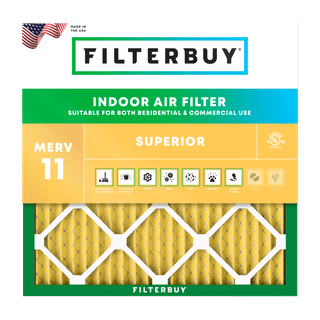
If your current filter is MERV 8 or MERV 11, plan to upgrade your next replacement to MERV 13 for wildfire smoke and PM2.5 protection.
Switch your thermostat from “Fan: Auto” to “Fan: ON” so the system pulls room air through the filter even when it’s not actively cooling.
Walk through the house and close any windows or exterior doors you had left open earlier in the day.
Sign up for free Maricopa County air quality alerts so the next high-pollution advisory reaches you before you make outdoor plans.
Frequently Asked Questions
Protect Your Phoenix Home from Outdoor Air Pollution
You’re the hero of your household when Phoenix air turns hazardous. The right filter, sized to your system and rated for smoke, lets you keep your home safe even when you can’t change what’s happening outside the front door.
Filterbuy manufactures MERV 13 filters in over 600 standard sizes plus custom dimensions, so whatever your HVAC system needs, we can ship it to your door before the next smoke event arrives.