
30x30x1 Air Filters
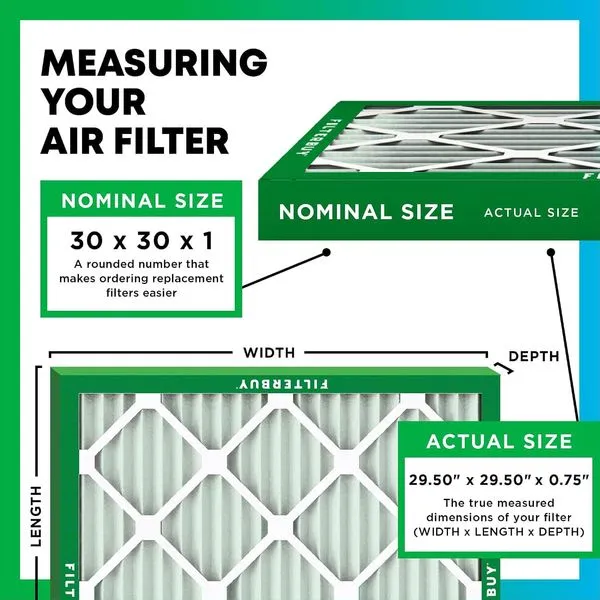
Actual Size: 29.5x29.5x0.75

3 month filters
2. Select Quantity
Buying multiple sizes?


Made in the USA
Ships in 24 hours
30x30x1 Air Filters Air Filter Description
Available In MERV Rating: 8, 11, 13
Made in the USA
Ships in 24 hours
Merv comparison
Scroll to see more.
 MERV 8 |  MERV 11 |  MERV 13 | |
|---|---|---|---|
| Best for | Standard Residential/Commercial Healthy Families | Superior Residential/Commercial Allergy Sufferers | Optimal Residential/Commercial Hospital Grade |
| Comparable ratings | MPR 600 & FPR 5 | MPR 1000-1200 & FPR 7 | MPR 1500 - 1900 & FPR 10 |
| Filtration | Captures 90% of Airborne Particles | Captures 95% of Airborne Particles | Captures 98% of Airborne Particles |
| Dust, lint & debris | |||
| Mold, pollen | |||
| Dander, dust mites | |||
| Smoke & Smog | |||
| Bacteria | |||
| Odor, vocs |
Is it time to change your filter?
Generally, we recommend you replace your air filters every 90 days. Find out below if you should change your filters more often.

If someone in your home has asthma or allergies...
Change your filter every
6 weeks
to ensure indoor air quality is at its best.
If you have pets...
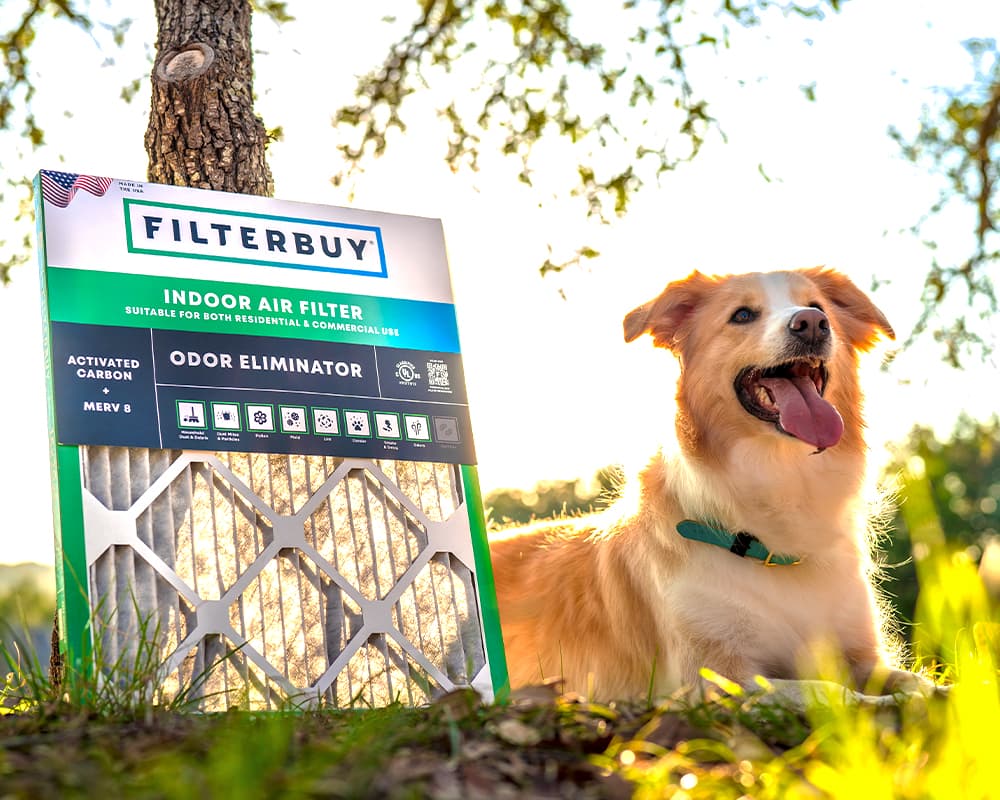
Change your filter every
2 months
to avoid shedding and odor buildup.

If you have young children...
Change your filter every
2-3 months
as having clean air is even more important with children in your home.
If someone in your home has asthma or allergies...
Change your filter every
6 weeks
to ensure indoor air quality is at its best.
If you have pets...
Change your filter every
2 months
to avoid shedding and odor buildup.
If you have young children...
Change your filter every
2-3 months
as having clean air is even more important with children in your home.
By Michelle Wan, Brand Manager and Air Quality Writer. Technically reviewed by David Clark, Licensed HVAC Technician. Updated September 4, 2026.
TL;DR
A 30x30x1 air filter is a one-inch pleated HVAC filter, and its actual cut size is 29.5" × 29.5" × 0.75". Filterbuy cuts, pleats, and frames it to order in our own US plants, in MERV 8, 11, and 13. Pick MERV 8 for most homes, MERV 11 for pets and pollen, or MERV 13 for smoke, then plan on a new one every 60 to 90 days.
Key Takeaways
30x30x1 is the ordering name; 29.5" × 29.5" × 0.75" is the actual cut. If your tape reads 29.5 inches, you need a 30x30x1.
All three MERV ratings fit the same opening. Filterbuy cuts MERV 8, 11, and 13 to the same outside dimensions, so only the media inside changes.
MERV 8 captures 90% of airborne particles, MERV 11 captures 95%, and MERV 13 captures 98%.
Check your HVAC manual for the MERV ratings your system takes. It's a quick fit check, the same as confirming your size.
Plan on a fresh filter every 60 to 90 days, and sooner if you've got pets or the system runs hard.
What Is A 30x30x1 Air Filter?
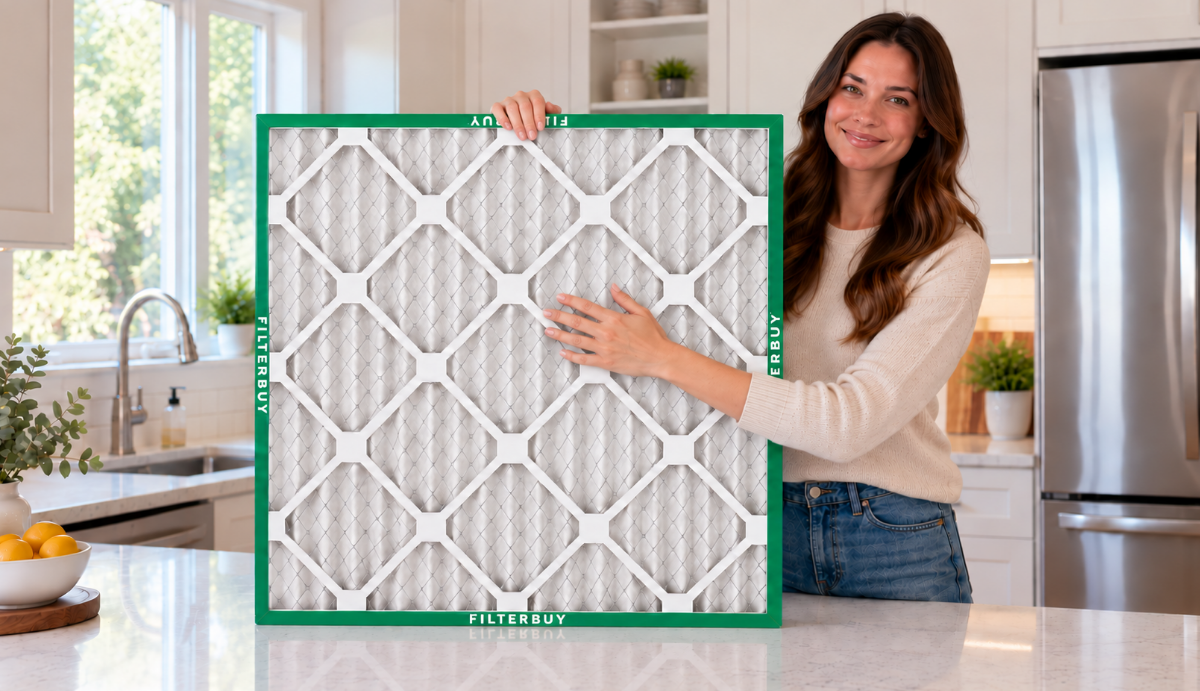
A 30x30x1 air filter is a one-inch pleated filter that sits in your return-air grille or furnace slot and catches airborne particles before they reach your equipment. Filterbuy cuts, pleats, and frames it to order in our own US plants, using electrostatically charged media, which holds a light static charge so it grabs more of what passes through. It fits residential and light-commercial furnaces, air conditioners, and heat pumps. You'll see these called furnace filters, AC filters, or just HVAC filters. They're all the same part.
What makes 30x30x1 unusual is how big it is. At 30 inches square, it's one of the largest one-inch filters we cut, and at that size the frame matters more than most spec sheets let on. A big filter gives air a lot of surface to push against, and a flimsy frame can bow under it. Once it bows, air finds its way around the edges. That's why Filterbuy builds this size on a beverage board frame, a stiffer paperboard than the usual cardboard, with wire backing on both sides.
What Is The Actual Size Of A 30x30x1 Air Filter?
A 30x30x1 filter measures 29.5" × 29.5" × 0.75" when you put a tape on it, and that half-inch difference is on purpose. "30x30x1" is the nominal size, which is just the ordering name. The actual cut runs a little under it, and that clearance is what lets the filter slide into its track.
It's the question we hear most on air filters 30x30x1. If you measured your old filter and got 29.5 inches square, you measured right, so round up and order the 30x30x1. Starting from an empty slot? Measure the slot opening and round up the same way. Our guides to air filter sizes and measuring an air filter cover both.
Is 30x30x1 A Standard Home Air Filter Size?
Yes, and getting one is easy. 30x30x1 is a standard nominal size, and Filterbuy cuts it in MERV 8, 11, and 13 as part of a catalog of more than 600 sizes, with fast and free 2-day delivery to most US states.
It's just not a size most hardware stores carry. They tend to stock 16x25x1 and 20x25x1 and stop well short of 30 inches square, which leaves a lot of homeowners hunting for a filter that fits a perfectly ordinary opening.
Which MERV Rating Should You Choose For A 30x30x1 Filter?
Pick MERV 8 for most homes, MERV 11 if you have pets or pollen getting in, and MERV 13 for smoke. All three fit the same 30x30x1 opening and come off the same lines. MERV stands for Minimum Efficiency Reporting Value, the industry scale for how much a filter captures.
MERV 8, Standard Residential/Commercial. Captures 90% of Airborne Particles. Best for Healthy Families. Comparable to MPR 600 and FPR 5.
MERV 11, Superior Residential/Commercial. Captures 95% of Airborne Particles. Best for Allergy Sufferers, and the usual pick for pets and pollen. Comparable to MPR 1000–1200 and FPR 7.
MERV 13, Optimal Residential/Commercial. Captures 98% of Airborne Particles. Hospital Grade, and the one to choose for smoke. Comparable to MPR 1500–1900 and FPR 10.
MPR and FPR are third-party rating scales, listed here so you can match what's printed on the filter you're replacing. The EPA and the American Lung Association both recommend MERV 13, or the highest rating your system will accommodate. Check your HVAC manual for the ratings yours takes, the same quick check as confirming your size. If odors are the problem rather than particles, our Odor Eliminator filters use activated carbon instead.
“I don't want anyone to feel like they need an HVAC license just to pick the right filter. My job is to give you the straight answer, explain why it matters, and let you get back to your day.”
— Michelle Wan, Brand Manager and Air Quality Writer, Filterbuy
How Often Should You Replace A 30x30x1 Air Filter?
Every 60 to 90 days is the normal range, and sooner if you've got pets or your system runs a lot. The EPA puts typical manufacturer guidance in that same 60-to-90-day window.
Here's a better way to find your own number. Change the filter, write the date on the frame, then pull it at 60 days and look at it. Do that twice and you'll know what your house actually needs, because run hours and household dust vary far more than any chart can allow for.
When you check it, hold the filter against a sheet of white paper. New pleated media already blocks a fair amount of light, so holding it up to a lamp tells you less than you'd expect, and the American Lung Association suggests the same paper comparison. If remembering is the hard part, auto-delivery ships your next 30x30x1 on schedule, and our filter-change guide goes deeper.
How Do You Install A 30x30x1 Replacement Air Filter?
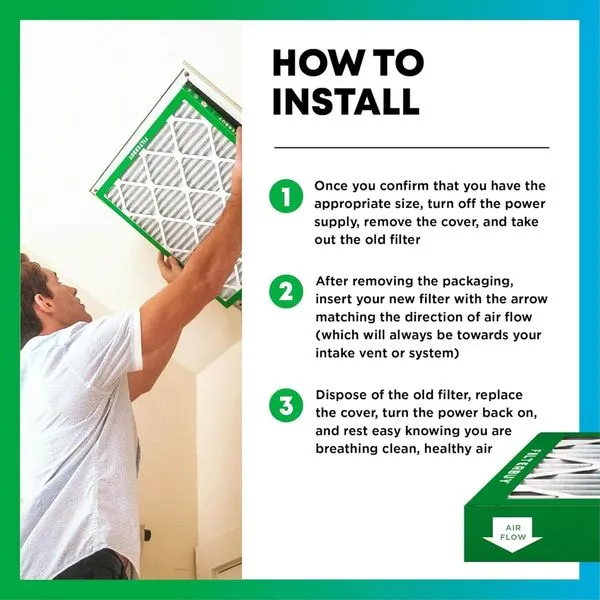
Turn the system off at the thermostat, slide the old filter out, and note which way its arrow was pointing. Put the new one in facing the same way, arrow toward the blower. Seat it all the way so it sits flush, then write the date on the frame.
A filter this big takes more care to carry than a 16x25x1. Hold it flat and support it from underneath. Thirty inches of pleated media flexes easily, and a crease picked up on the way to the return will keep it from sealing against the track.
Two things account for most of the calls we get. One is a backwards arrow, which leaves the pleats without the support they're built to have. The other is a filter that doesn't sit flush. It should fit snugly, and you shouldn't have to bend or crush it to get it in. If air slips around the edge, it hasn't been filtered.
What If Your Return Opening Isn't Exactly 30x30?
Most openings land on a standard size once you round up, so start there. Measure the slot, round each dimension up to the nearest whole inch, and that's your ordering size. An opening that comes out at 29.5 inches square takes a 30x30x1.
If your slot doesn't match a standard size, Filterbuy cuts custom filters to the eighth of an inch, so an odd opening is still a simple order. It's worth getting right. A filter that runs small lets air slip past the edges, and one that runs large bows in the track and does the same thing. Either way the air is going around the media instead of through it.
Supporting Statistics
Replacing a dirty filter lowers an air conditioner's energy consumption by 5 to 15 percent. The Department of Energy calls cleaning and replacing filters the quickest way to save energy on home cooling.
Source: U.S. DOE, Energy Saver 101: Home Cooling
Americans spend about 90 percent of their time indoors, where some pollutants run 2 to 5 times higher than outdoor levels. Your return filter is working on the air you breathe most of the day.
Source: U.S. EPA, Report on the Environment
Cooling accounts for about 6 percent of the average US household's energy use, or roughly $29 billion a year nationwide. A filter is one of the cheapest parts of that system to keep current.
Source: U.S. DOE, Energy Saver 101: Home Cooling
Frequently Asked Questions
Will a 30x30x1 filter fit my furnace or air conditioner?
Almost certainly, if the slot measures right. Fit comes down to the filter slot, and the brand on your nameplate doesn't come into it. If your slot is about 29.5 inches square and takes a one-inch filter, a 30x30x1 is your size. Measure it, round up to the nearest whole inch, and order that.
What's the difference between MERV 11 and MERV 13 in a 30x30x1?
MERV 11 captures 95% of Airborne Particles and MERV 13 captures 98%. Both fit the same opening, so the only thing changing is the media inside. MERV 11 is the usual pick for pets and pollen, and MERV 13 is the one to choose for smoke. Check your HVAC manual for the ratings your system takes.
What does a 30x30x1 filter cost to run for a year?
A 90-day cycle means four filters a year. At Filterbuy's six-pack pricing that's roughly $60 annually, against about $195 buying them one at a time. Single-unit pricing on an uncommon size is steep, so ordering a year at once is the bigger saving.
Should I use a thicker filter instead of a one-inch 30x30x1?
If your slot takes one, it's worth considering, because a deeper filter holds more media and goes longer between changes. Most return grilles only take one inch, which is why this size exists. Measure your slot depth before you commit to a year.
Can I wash or vacuum a 30x30x1 filter to reuse it?
No. Pleated filters are built to be replaced. Water breaks down both the media and the frame, and vacuuming pulls the pleats out of shape, so you end up with a filter that no longer seals or captures the way it should. Put a fresh one in instead.
Glossary
30x30x1 air filter. A one-inch pleated HVAC filter. Nominal 30 × 30 × 1 in., actual cut 29.5" × 29.5" × 0.75".
Nominal and actual size. Nominal is the rounded number on the packaging that you order by. Actual is the true measurement, cut slightly under so the filter fits its track.
MERV. Minimum Efficiency Reporting Value, the industry scale for how much a filter captures.
MPR and FPR. Microparticle Performance Rating and Filter Performance Rating, two third-party scales you'll see on retail packaging alongside MERV.
Beverage board frame. A stiffer paperboard than standard cardboard, paired with wire backing to keep a filter from bowing.
About This Page
Written by Michelle Wan, Brand Manager and Air Quality Writer at Filterbuy. Michelle works directly with our US manufacturing team, so her guidance comes from how filters are actually built and used.
Technically reviewed by David Clark, a Licensed HVAC Technician with Filterbuy HVAC Solutions.
Last updated September 4, 2026.
Filtration percentages are Filterbuy product descriptions. EPA and American Lung Association guidance is cited where noted. Filterbuy is a manufacturer, not a reseller, and every filter is cut, pleated, and framed to order in our own US plants. Breathe easy. Questions about sizing: (855) 345-8289.
Related: shop all 1-inch air filters · efficient MERV 13 air filters · how to replace an air filter