
Winter Storm Watch vs. Warning: What Each Alert Means (and How to Protect Your Home's Air)
October 3, 2026
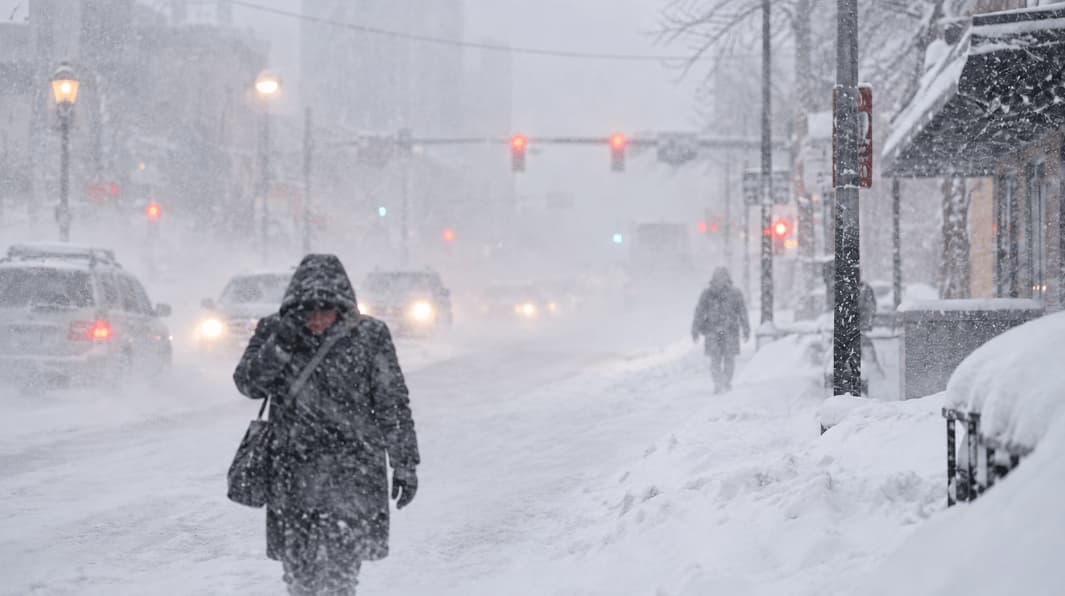
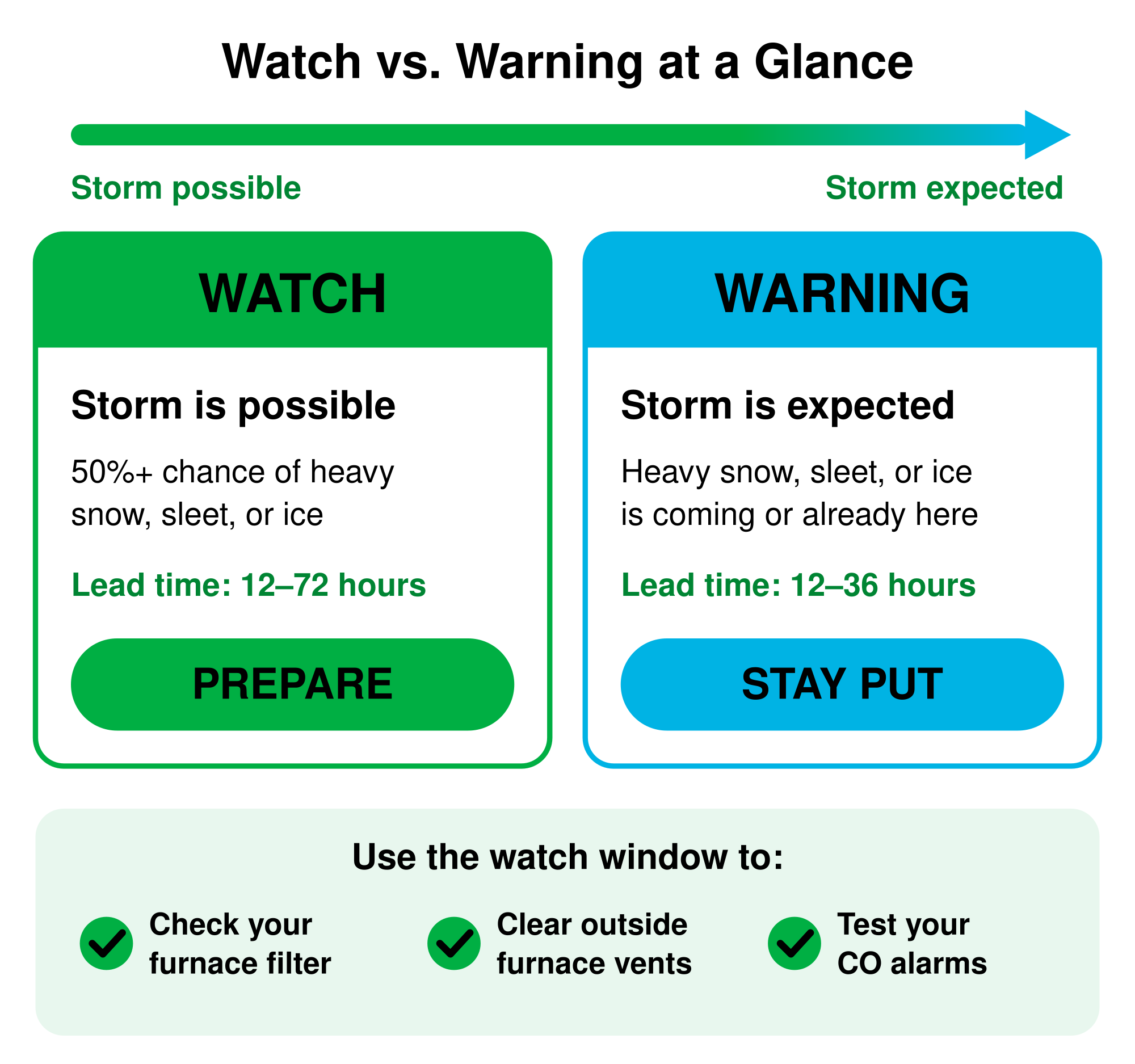
A winter storm watch means heavy snow, sleet, or ice is possible within 12 to 72 hours. A winter storm warning means it's expected or already here, usually within 12 to 36 hours. In short: a watch says prepare, and a warning says stay put.
Watch: Forecasters see a 50%+ chance of warning-level weather. Prepare now.
Warning: Hazardous weather is on the way or underway. Stay home if you can.
Use the watch window to check your furnace filter, which is about to run almost nonstop. Not sure which one you need? Take the quick match quiz below.
Get storm-ready before the warning hits.
Answer a few quick questions and we'll match you to the right filter for your home.
Already know your size?
TL;DR
A winter storm watch means dangerous snow, sleet, or ice could arrive in the next one to three days, so get ready. A winter storm warning means that weather is on its way or already here, usually within 12 to 36 hours, so stay put. Filterbuy's advice: use the watch window to check your furnace filter, clear the vents outside, and test your carbon monoxide alarms.
Key Takeaways
Watch means prepare. Forecasters see at least a 50% chance of warning-level snow, sleet, or ice within 12 to 72 hours.
Warning means act. Hazardous weather is expected or underway, usually within 12 to 36 hours.
Thresholds are local. NWS Indianapolis can issue a snow warning for 4 inches in southern Indiana, while NWS Burlington, Vermont, waits for 7 inches or more.
Blizzards hinge on wind and visibility. A blizzard warning calls for 35 mph winds and visibility under 1/4 mile for at least 3 hours.
Indoor air matters most when you're shut in. Clear the furnace vents, start with a fresh filter, and keep generators 20 feet from the house.
What Is The Difference Between A Winter Storm Watch And A Warning?
The difference comes down to certainty. A winter storm watch means conditions are lining up for heavy snow, sleet, or ice, but forecasters can't yet pin down where or when. A winter storm warning means the dangerous weather is expected or has already started.
The National Weather Service (NWS) office in Burlington, Vermont, puts numbers on it: a watch goes out 24 to 72 hours ahead at a 50% to 80% chance of warning-level weather, and a warning follows once the odds top 80% or the storm is underway.
At Filterbuy, we've built air filters in our own U.S. plants since 2013. Our short answer: a watch is the storm on the horizon, and a warning is the storm at your doorstep. Errands and outdoor work belong in the watch window.
Winter Storm Watch Vs. Warning Vs. Advisory: The Full NWS Alert Ladder
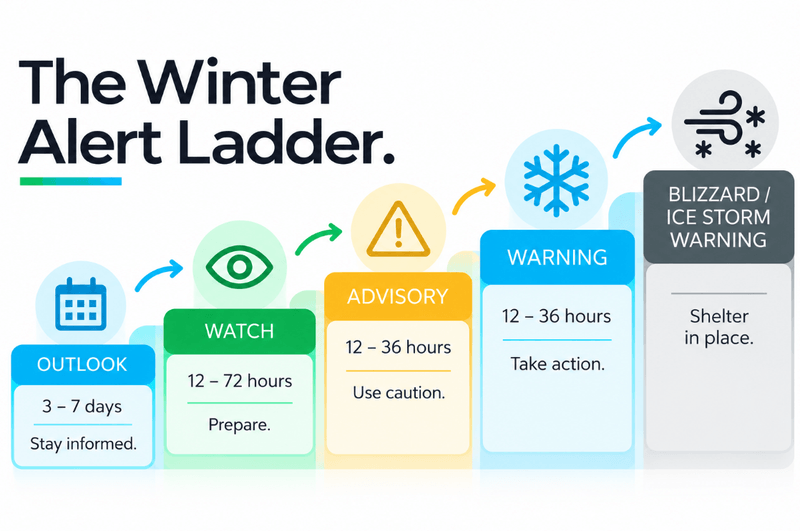
Watches and warnings are two steps on a longer ladder. The NWS usually starts with an outlook, moves to a watch, and then issues either an advisory or a warning, depending on how severe the storm looks.
Source: National Weather Service winter terms and warning criteria. Criteria differ by local office.
Winter Storm Warning Vs. Blizzard Warning
A blizzard warning has little to do with how much snow falls. It's issued for sustained winds or frequent gusts of 35 mph or more, combined with blowing snow that cuts visibility below 1/4 mile for at least 3 hours. Wind alone can whip existing snow into a blizzard.
How Much Snow Triggers A Winter Storm Warning?
There is no single national number. Each local NWS office sets warning criteria based on what disrupts daily life in its area.
The differences can be large. NWS Indianapolis issues a snow warning at 6 inches in northern Indiana, 5 inches in central Indiana, and just 4 inches in southern Indiana. In Vermont, NWS Burlington waits for 7 inches or more across Vermont and northern New York.
What To Do During A Winter Storm Watch: A Home And HVAC Checklist
We treat a watch as the last easy window for errands and outdoor checks. Once the warning arrives, the safest plan is to stay put.
Check your furnace filter. The furnace is about to run almost nonstop, and a clogged filter makes it work harder. If the filter looks gray or it has been more than 90 days, swap it now. Pets speed things up, since one pet can roughly halve a filter's life. Filterbuy's guide explains how often to change your air filter.
Keep a spare on hand. A second filter makes a mid-storm change easy. If you're not sure of the size, measure your air filter using Filterbuy's guide.
Find your furnace vents outside. High-efficiency furnaces usually vent through two white PVC pipes on an exterior wall, often 12 to 24 inches off the ground. Note where they are before snow hides them.
Test your carbon monoxide (CO) and smoke alarms. Put in fresh batteries and, following EPA guidance, make sure there is a CO alarm outside each sleeping area and on every level of the home.
Plan your backup heat. If you own a generator, choose its spot outdoors now, at least 20 feet from doors, windows, and vents.
"Homeowners bring me the old filter and ask what to buy. I ask for a photo of the empty slot instead. Half the time the filter they had been using was never right for the opening it sat in."
— David Clark, Licensed HVAC Technician, Filterbuy HVAC Solutions
What To Do During A Winter Storm Warning: Keep Your Home's Air Safe
Once a warning is issued, stay home if you can and keep the air inside safe to breathe. The biggest threat is carbon monoxide (CO), an odorless, colorless gas produced whenever fuel burns. As a filter company, we will be clear: no air filter can capture carbon monoxide. Clear vents and working CO alarms are what protect you, while the filter's job is to keep air moving.
According to the Centers for Disease Control and Prevention (CDC), carbon monoxide kills more than 500 Americans each year. The risk climbs during power outages, when people turn to fuel-burning devices for heat. Filterbuy's guide to winter carbon monoxide and smoke safety explains how airflow affects that risk.
Keep Furnace Vents Clear Of Snow
High-efficiency furnaces push exhaust out through PVC pipes on the side of the house. When drifting snow buries those pipes, the furnace may shut itself off, or exhaust can back up indoors. The EPA recommends clearing snow and ice from furnace and dryer vents. New Castle County, Delaware, adds a practical tip: clear a 3-foot circle with a soft broom rather than a shovel, and check again during and after every storm.
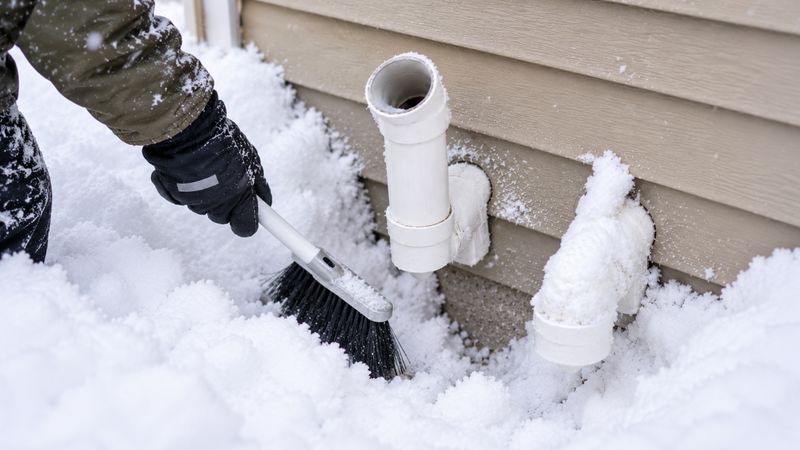
Blocked Vent Or Clogged Filter? A Quick Storm Triage
From inside, a blocked vent and a clogged filter can look alike. This triage, built from our HVAC-reviewed filter guidance and New Castle County's warning signs, helps you tell them apart.
Use Backup Heat And Power Safely
Keep generators outside, at least 20 feet from doors, windows, and vents, as the CDC advises. Never run one in a garage, even with the door open.
Don't use a gas oven, grill, or camp stove for heat, and never warm up a car inside a garage.
Know the symptoms. CO poisoning can feel like the flu: headache, dizziness, weakness, nausea, chest pain, and confusion. If an alarm sounds or anyone feels sick, get everyone outside and call 911.
Keep Indoor Air Clean While You Are Shut In
With windows shut and the furnace running for hours, dust and pet dander circulate again and again, a big reason winter indoor air quality dips. A clean pleated filter, such as a MERV 8 or MERV 11 air filter, catches more of those particles without choking off airflow. Compare options on the Filterbuy MERV rating chart.
One detail from our manufacturing floor rarely makes it into storm guides: a 4-inch filter handles a long storm better because each pleat is deeper. Our 1-inch filters carry 14 pleats per foot, while our 4-inch filters carry 8.
After The Storm: Reset Your Home
When the warning ends, walk around the outside of your home. Clear snow away from furnace and water heater vents, gas meters, and dryer vents. Then check the filter again, since days of nonstop heating load it quickly. Filterbuy recommends checking it every 30 days all winter. Before airing out the house, check your local air quality.
"A filter that looks fine in October can be completely choked by December, and that's when we see the most avoidable furnace failures."
— The Filterbuy team, from our guide to changing your furnace filter in winter
Filterbuy is a second-generation, family-owned American manufacturer that cuts every filter to order in its own U.S. plants. Filterbuy auto-delivery ships the right size on your schedule, so a replacement is always ready.
Are NWS Winter Alerts Changing?
Watches and warnings are staying put. The NWS renamed the Wind Chill Warning the Extreme Cold Warning in October 2024, and it has announced plans to replace "Advisory" headlines with plain-language ones, a change it still describes as upcoming.
Supporting Statistics
1. Carbon monoxide sends tens of thousands of Americans to the ER
A CDC study estimated about 101,847 emergency department visits for unintentional, non-fire carbon monoxide poisoning from 2007 to 2013, plus roughly 14,365 hospital admissions from 2003 to 2013.
Why it matters: Clear vents and working CO alarms can prevent many of these cases.
Source: CDC, National CO Poisoning Estimates (2019)
2. Winter home fires are few, but deadly
Winter residential building fires (January through March) made up only 8% of U.S. fires from 2014 to 2016, yet caused 30% of all fire deaths, about 980 deaths a year.
Why it matters: Safe heating choices lower that risk.
Source: U.S. Fire Administration, Winter Residential Building Fires (2014–2016)
3. Indoor air can be 2 to 5 times more polluted than outdoor air
Americans spend about 90% of their time indoors, where some pollutant levels are often 2 to 5 times higher than outdoors.
Why it matters: A sealed-up house leans harder on its filter.
Source: U.S. EPA, Report on the Environment: Indoor Air Quality
Winter Storm Watch Vs. Warning FAQs
Is a winter weather advisory serious?
Yes, though less so than a warning. The NWS issues an advisory for snow, sleet, or ice that stays below warning levels but can still cause real trouble, especially on the roads. Slow down, allow extra travel time, and watch for an upgrade.
What should I do if my furnace stops working during a storm?
Check the outside vents first, since snow-blocked pipes are a common cause, then check the filter. Clearing a vent or swapping a clogged filter often restores heat. If it won't restart, call a licensed HVAC technician. If a CO alarm sounds, get everyone outside first.
How do I get winter storm alerts for my area?
Enter your ZIP code at weather.gov to see active alerts, and keep Wireless Emergency Alerts turned on in your phone settings. A battery-powered NOAA Weather Radio works if power or cell service fails.
Will my furnace work if the power goes out?
Usually not. Most forced-air furnaces, including gas models, need electricity to run the blower and controls. Use the watch window to decide where your family will stay warm, and never bring a generator, grill, or camp stove inside.
Can a winter storm watch be canceled or downgraded?
Yes. If the storm weakens or changes track, the NWS can cancel the watch or downgrade it to an advisory. If forecasters grow more confident, it becomes a winter storm, blizzard, or ice storm warning.
Glossary
National Weather Service (NWS): The U.S. agency, part of NOAA, that issues official weather alerts.
Winter Storm Watch: An NWS alert that warning-level snow, sleet, or ice is possible within 12 to 72 hours.
Winter Storm Warning: An NWS alert that warning-level snow, sleet, or ice is expected or occurring.
Winter Weather Advisory: An NWS alert for winter weather that is hazardous but below warning criteria.
Blizzard Warning: An NWS alert for winds of 35 mph or more with snow cutting visibility below 1/4 mile for 3 or more hours.
Ice Storm Warning: An NWS alert for damaging freezing-rain ice, typically 1/4 to 1/2 inch depending on the local office.
Extreme Cold Warning: The NWS alert, formerly the Wind Chill Warning, for dangerously cold air with or without wind.
Carbon monoxide (CO): An odorless, colorless, poisonous gas produced when fuel such as gas, propane, wood, or gasoline burns.
MERV: Minimum Efficiency Reporting Value, a 1-to-16 rating of how well an air filter captures airborne particles. Filterbuy makes filters rated MERV 8, 11, and 13.
Sources
National Weather Service, Burlington, VT: Expanded Winter Weather Terminology
National Weather Service, Indianapolis, IN: Criteria and Definitions
National Weather Service: Hazard Simplification, Going Forward
CDC: National Unintentional Carbon Monoxide Poisoning Estimates
U.S. Fire Administration: Winter Residential Building Fires (2014–2016)