
Coil-Mounted vs. In-Duct UV Lights: Which Type Does What?
September 30, 2026
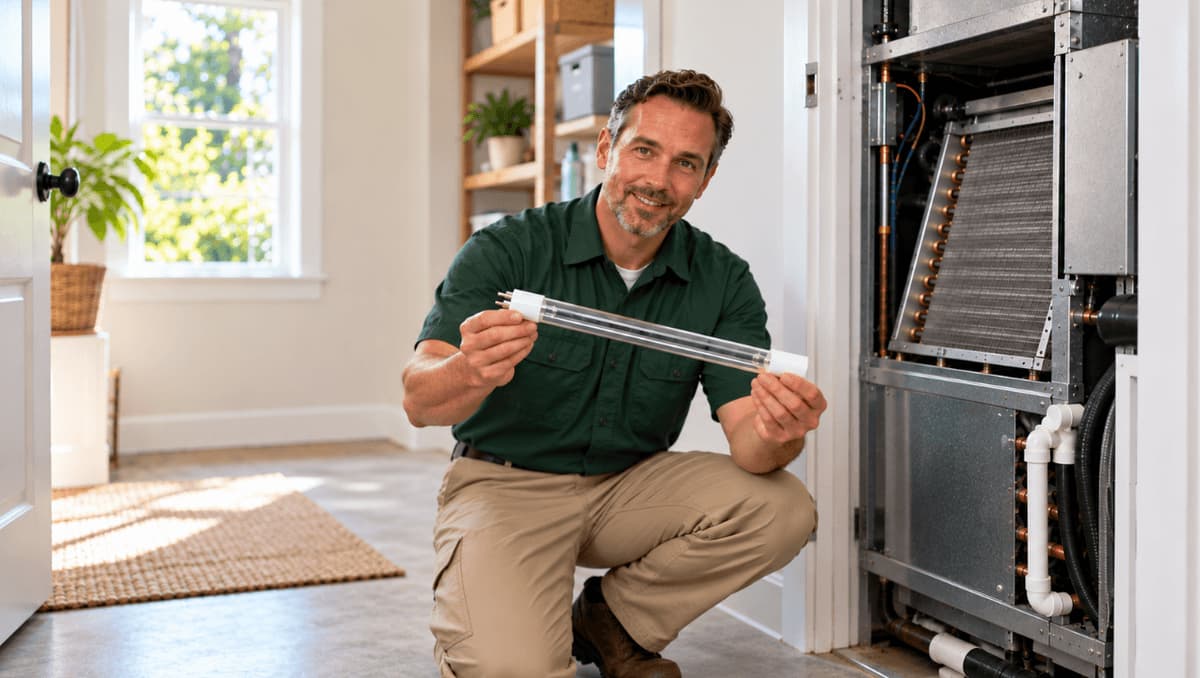
TL;DR: HVAC UV lights come in two types. A coil-mounted UV light (or coil sanitizing light) shines continuously on the wet evaporator coil and drain pan to slow mold and bacteria growth there. An in-duct UV light (or air sanitizing light) shines across moving air, which gets only a split second of exposure. Neither removes dust or pollen, so both belong alongside a good air filter, not in place of one.
Key Takeaways
Coil-mounted UV lights treat surfaces; in-duct lights treat moving air.
As a filter maker that also installs UV lights, Filterbuy puts the filter first and coil UV second, with in-duct UV only when engineered for your airflow.
Coil-mounted UV lights run around the clock; in-duct units often run only with the blower.
The EPA says UV should supplement filtration, not replace it.
Why a filter maker wrote this guide: Filterbuy works on both sides of the evaporator coil. We manufacture air filters in our own U.S. plants, and our service team, Filterbuy HVAC Solutions, installs UV lights in Florida homes, so this guide also covers when to skip UV.
As Michelle Wan puts it: "My job is to give you the straight answer, explain why it matters, and let you get back to your day."
What Are the Two Types of UV Lights for HVAC?
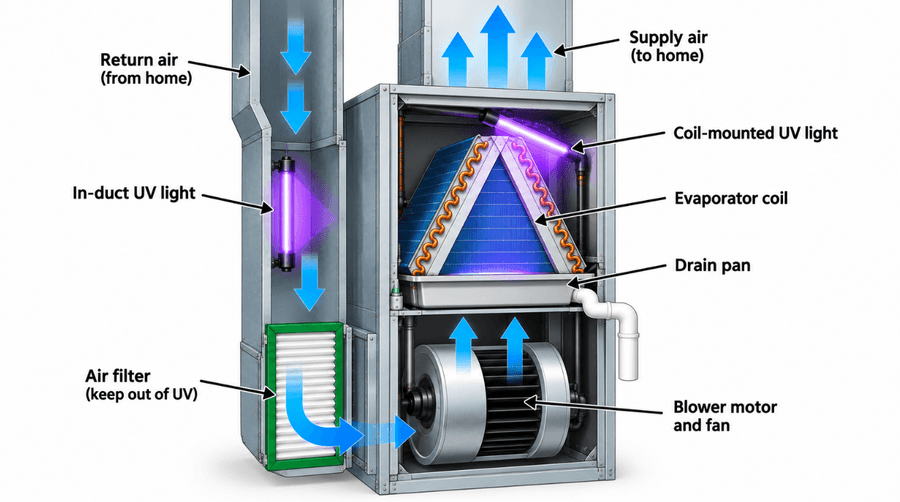
Both types of residential HVAC UV light use germicidal UV-C lamps, usually at 254 nanometers. The difference is the target: a coil-mounted light shines on a stationary, damp surface, while an in-duct light shines on air flowing past.
Coil-Mounted vs. In-Duct UV Lights at a Glance
Sources: AHRI, U.S. EPA, and ASHRAE. Neither UV light type captures dust, pollen, or pet dander, so pair either one with a properly sized air filter.
How Does a Coil-Mounted UV Light Work?
A coil-mounted UV light bathes the evaporator coil and drain pan in UV-C around the clock. That cool, wet coil is where mold and bacterial films take hold, a common source of the musty smell when your AC turns on.
The coil never moves, so it collects a steady dose all day, and AHRI names the coil and drain pan as the preferred location for residential UV lights and recommends leaving them on instead of cycling them with the fan. Filterbuy HVAC Solutions technicians do the same.
The EPA's technical summary on residential air cleaners notes that UV destroys active growth on coils but not most spores, and no lamp removes caked-on dirt, so clean a moldy coil first (see Filterbuy's guide to black mold in your AC unit).
Filterbuy HVAC Solutions puts running costs at 5 to 10 cents a day, roughly $18 to $37 a year plus a bulb. Don't expect energy savings; ASHRAE's UV technical committee says independent research on them is lacking.
How Does an In-Duct UV Light Work?
An in-duct UV light treats air as it streams past, and its obstacle is time: UV-C works by dose (intensity times exposure time), and moving air doesn't linger.
At a typical duct speed of 500 feet per minute, air crosses a one-foot lit zone in about one-eighth of a second, and a full second of exposure would take about 8 feet of lit duct, according to ASHRAE best-practice guidance. Closing that gap takes stronger lamps or reflective linings, and temperature and airflow can swing output by over 60 percent. ASHRAE says in-duct UV should always be paired with filtration, which removes UV-resistant fungal spores and keeps dust off the lamps, and the EPA adds that typical home units don't deliver enough dose for most airborne microbes.
Stick UV Light vs. In-Duct UV Light: Is "Stick" a Third Type?
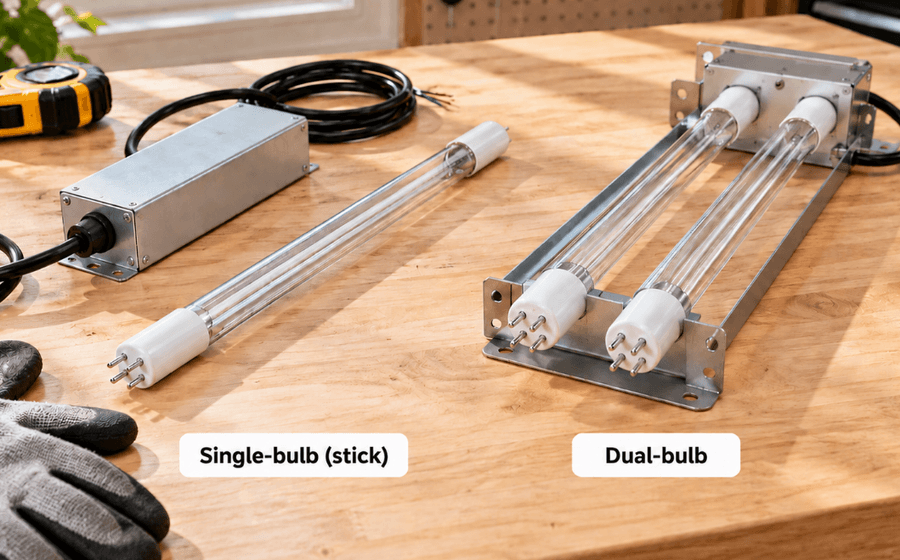
A stick UV light isn't a separate category. It's a single straight tube that slides through a hole in the plenum or duct, used in both coil kits and in-duct units. What the lamp points at tells you what it can do; the mounting style doesn't. Filterbuy calls this "target, not shape," and it's the quickest way to read any UV product listing.
Single-Bulb vs. Dual-Bulb UV Lights for HVAC
Single-bulb vs. dual-bulb comes down to coverage: a second lamp reaches a wider coil, a larger duct, or both faces of an A-shaped coil. Our Filterbuy HVAC Solutions team, led by David Clark, sees more multi-lamp setups, usually one lamp at the coil and a second at the blower or supply plenum.
Which Type of UV Light Is Right for Your HVAC?
For homes with coil growth or musty odors, a coil-mounted UV light is the right type; in-duct UV fits only when engineered for your airflow.
Have a licensed HVAC technician confirm lamp type, count, and placement for your specific air handler and duct size.
Filterbuy's take: in most homes, upgrade the filter before adding any UV light. For smoke, check Filterbuy's live USA air quality map and plan on better filtration; UV can't capture it.
Questions to Ask Before You Add an HVAC UV Light
1. Is the lamp ozone-free? Some uncoated lamps generate ozone, a lung irritant, so look for coated quartz glass that blocks it. UL 2998 validation means ozone below 0.005 ppm, and California requires electronic in-duct air cleaners to be CARB-certified.
2. Will the coil be cleaned first? UV won't strip existing buildup.
3. How close is the lamp to my filter and plastic parts? Filterbuy's MERV 13 filters use electrostatically charged synthetic fibers, which ASHRAE says to shield within 6 feet of a UV lamp.
4. Will a coil lamp run 24/7? It should, because AHRI notes mold grows fastest when the air is still.
5. For in-duct units, where's the dose calculation? Ask for one based on your duct size and airflow.
6. What's the bulb's rated life? Bulbs fade over time; many makers recommend yearly replacement, though Filterbuy HVAC Solutions prefers two-year bulbs where they fit.
Why a UV Light Doesn't Replace Your Air Filter
A UV light and a filter do different jobs: UV-C inactivates the microbes it hits, while a filter captures dust, pollen, pet dander, and smoke before they reach your coil.
On Filterbuy's production floor, fit matters as much as rating. We cut every filter half an inch under its nominal size so it slides in and still seals. A filter that rattles in its slot lets dusty air slip around it onto the coil, and a UV lamp can't stop that. As reviewer David Clark puts it: "The best filter is the highest rating your system can move air through, changed on schedule."
Pro Tip: Compare our MERV rating chart, check Filterbuy's air filter sizes chart, and follow our guide to how often to change your HVAC filter.
Shop Filterbuy's American-made MERV 13 air filters or set up air filter auto-delivery. Filterbuy HVAC Solutions also installs UV lights in its Florida service areas.
Supporting Statistics
1. Coil UV works far better on surfaces than on moving air.
In a study cited by the EPA, UV cut microbial growth on HVAC surfaces by 99 percent but airborne bacteria by only 25 to 30 percent.
Why it matters: surfaces get hours of exposure; air gets a split second.
Source: U.S. EPA, Residential Air Cleaners: A Technical Summary
2. Most U.S. homes have an evaporator coil to protect.
88 percent of U.S. households use air conditioning, and two-thirds use central AC or a central heat pump (18,496 households surveyed).
Why it matters: this advice applies to most U.S. homes.
Source: U.S. Energy Information Administration, 2020 Residential Energy Consumption Survey
3. Filter quality decides how fast a coil fouls.
Lawrence Berkeley National Laboratory found typical coils foul enough to double pressure drop in 7 to 11 years, short of their 15 to 30 year lifespan. Filter efficiency and indoor dust levels mattered most.
Why it matters: only a snug filter keeps dust off the coil.
Source: Lawrence Berkeley National Laboratory, Dirty Air Conditioners: Energy Implications of Coil Fouling
Frequently Asked Questions
Can I install a coil UV light myself?
Some kits are sold for DIY, but installation means drilling into the air handler and aiming the lamp away from plastics, so Filterbuy recommends a licensed technician.
Is an HVAC UV light worth it?
An HVAC UV light is worth it when mold or bacteria keep returning to your coil, especially in humid climates. For dust, pollen, or smoke, a better air filter is the right buy.
Will a UV light help my allergies?
A UV light alone may not ease allergies, since the EPA cautions that dead mold particles still trigger reactions. A higher-MERV filter, such as Filterbuy's MERV 11 or MERV 13, is a better first step.
Will a UV light get rid of a musty AC smell?
A UV light clears a musty AC smell only if the coil is the source. AHRI links musty odors to coil mold and "dirty socks" odors to bacteria, and no lamp clears a clogged condensate drain, another common cause.
Where should a UV light be installed in an HVAC system?
A coil UV light belongs inside the air handler, aimed at the evaporator coil and drain pan. ASHRAE notes lamps are commonly mounted within 3 feet of the coil, often downstream, where they also reach the drain pan.
Is an HVAC UV light safe for my family?
A properly installed HVAC UV light is safe because the lamp sits fully enclosed inside the system. The real risks are eye and skin exposure during service and ozone from uncoated lamps, so choose an ozone-free lamp and cut power before opening the cabinet.
Glossary
UV-C: Short-wavelength ultraviolet light (roughly 200–280 nm) that inactivates microorganisms.
Coil-mounted UV light (coil sanitizing light): An HVAC UV lamp aimed at the evaporator coil and drain pan.
In-duct UV light (air sanitizing light): An HVAC UV lamp in the ductwork that treats passing air.
Stick UV light: A straight UV tube inserted through a duct or plenum wall.
Evaporator coil: The indoor AC coil that removes heat and moisture from the air.
ASHRAE: The American Society of Heating, Refrigerating and Air-Conditioning Engineers.
AHRI: The Air-Conditioning, Heating, and Refrigeration Institute, an HVAC trade association.
CARB: The California Air Resources Board, which limits ozone from air cleaners sold in California.
UL 2998: A UL Solutions validation of ozone emissions below 0.005 ppm.
MERV: Minimum Efficiency Reporting Value, the 1–16 scale that rates how well an air filter captures particles.
Filterbuy: A family-owned U.S. air filter manufacturer headquartered in Talladega, Alabama, making MERV 8, 11, and 13 filters in 600+ sizes.
Filterbuy HVAC Solutions: Filterbuy's licensed HVAC service team, based in Pompano Beach, Florida.
Sources
U.S. EPA, Residential Air Cleaners: A Technical Summary (3rd Edition, 2018)
ASHRAE Journal, Ultraviolet Germicidal Irradiation: Current Best Practices (Martin et al.)
ASHRAE TC 2.9, Ultraviolet Air and Surface Treatment committee functions
California Air Resources Board, Complying with the Air Cleaner Regulation: FAQ
UL Solutions, Zero Ozone Emissions Validation (UL 2998)
U.S. Energy Information Administration, Nearly 90% of U.S. households used air conditioning in 2020
Lawrence Berkeley National Laboratory, Dirty Air Conditioners: Energy Implications of Coil Fouling