June 12, 2026
By Michelle Wan · Technically reviewed by David Clark, President, Filterbuy HVAC Solutions, a certified HVAC professional · Published June 12, 2026 · Last reviewed June 12, 2026
Short answer: it’s probably mold, and for most healthy people it’s an irritant — not the toxic “black mold” the internet warns about.
What it always means is excess moisture inside your AC, so the real fix is solving the water, not just scrubbing. The right filter plays a supporting role: it captures airborne mold spores and keeps out the dust and debris mold feeds on.
MERV 8 captures larger spores, pollen, and dust.
MERV 11 adds finer spores, pet dander, and mold fragments.
MERV 13 captures microscopic particles, down to fine spores and smoke.
Not sure which rating your system can handle? Take the 30-second match quiz below.
What each MERV rating captures MERV 8 STANDARD Larger spores, pollen, and dust MERV 11 SUPERIOR Finer spores, pet dander, and mold fragments MERV 13 OPTIMAL Microscopic particles — fine spores, smoke, bacteria-sized Smaller dots mean finer particles captured.Answer 3 quick questions and we’ll match you to your perfect MERV match.
If you've found black, fuzzy, or slimy growth in or around your air conditioner, here's the short version: it's probably mold, and it's worth dealing with — but it is almost certainly not the deadly "toxic black mold" the internet warns about. For most healthy people, mold in an AC causes allergy-type irritation, not serious illness. What it always signals is a moisture problem inside your system that needs fixing, because cleaning alone won't keep it from coming back. The fastest first step is to confirm it's actually mold and not harmless dust, which you can do in about a minute below.
Quick answers
Is it dangerous? Usually it's an irritant, not a poison — real risk is concentrated in people with asthma, allergies, or weakened immune systems. Jump to the honest answer ↓
Mold or just dust? Use the 60-second checks. Jump ↓
Can I clean it myself? Small surface spots, yes. Mold in coils or ducts, no. Jump to the rule ↓
How do I stop it returning? Fix the moisture, not just the mold. Jump ↓
Before you panic or start scrubbing, find out what you're looking at. "Black stuff" around a vent is just as often caked dust, dirt, or soot as it is mold — and the two call for very different responses.
Smell it. Mold gives off a persistent musty, earthy, "wet basement" odor that gets stronger when the AC runs. Dust doesn't really smell.
Feel the texture (gloved). Active mold is often slimy or fuzzy; dried mold and plain dust are powdery. Don't touch suspected mold with bare hands.
Check the location. Dust collects on vent louvers and grille faces. Mold tends to appear where it's damp — around the drip pan, on or near the evaporator coil, inside the blower compartment, on a wet filter.
Does it come back fast? Wipe a small spot. If a dark stain returns within days in the same damp spot, that points to mold, not dust.
The water-dab test. Dab a hidden bit with a little water on a cloth. Dust smears and lifts; mold tends to stay put and may have spread into the surface.
If you hit two or more "this looks like mold" signals — especially musty smell plus a damp location plus regrowth — treat it as mold and read on.
Smell: musty and stronger when the AC runs (mold) — vs. little to no smell (dust/dirt).
Texture: slimy or fuzzy (mold) — vs. powdery and dry (dust/dirt).
Location: damp areas like the coil, drip pan, blower, or a wet filter (mold) — vs. dry surfaces like louvers and the grille face (dust/dirt).
After cleaning: returns in the same spot (mold) — vs. stays gone until it slowly builds up again (dust/dirt).
Spread pattern: patchy, sometimes with a halo (mold) — vs. an even film (dust/dirt).
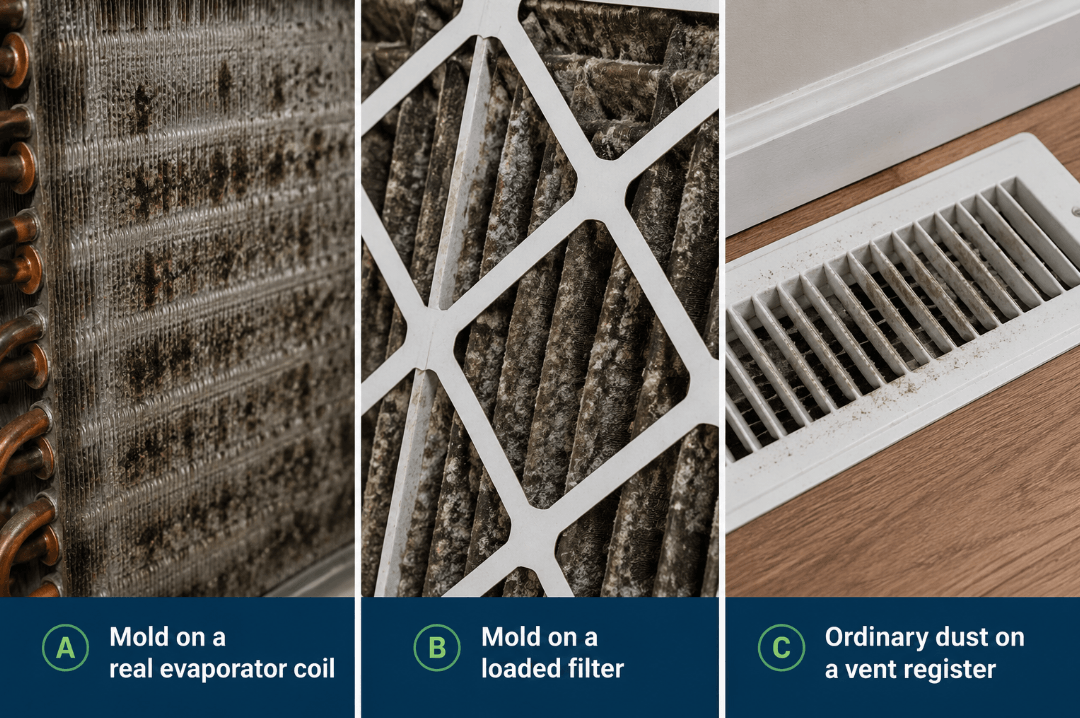
One important caveat: color alone can't tell you the species or how risky it is. Many harmless molds look black, and the only way to positively identify "black mold" (Stachybotrys chartarum) is a lab test — which, as you'll see next, you usually don't need.
Do you need a mold test? For most homeowners, no. Inexpensive DIY mold-test kits are widely considered unreliable, and pinning down the exact species doesn't change what you should do: remove it and fix the moisture. Testing is mainly worth paying for in three situations — documenting a problem for insurance or a landlord dispute, confirming a hidden source when there's a persistent musty smell but nothing visible, or verifying that a professional remediation actually worked.
Here's where most articles get it wrong, so let's be accurate.
The phrase "toxic black mold" has been frightening homeowners since the 1990s, when a cluster of infant illnesses in Cleveland was tentatively linked to Stachybotrys. That link was later found to be unsupported by the evidence — but the scary headlines stuck.
What the public-health authorities actually say today is calmer and more useful:
Mold itself isn't "toxic" or "poisonous." Some molds, including Stachybotrys, can produce compounds called mycotoxins, but per the CDC's guidance on mold testing and remediation, the molds themselves are not poisons, and Stachybotrys should be handled the same way as any other indoor mold.
You don't need to identify the species. The EPA's Brief Guide to Mold, Moisture, and Your Home and the CDC both advise treating all indoor mold the same way: find the moisture source, fix it, and remove the mold — regardless of color or type. There's no practical way to tell "toxic" from "non-toxic" strains without a lab, and it doesn't change what you should do.
Serious disease is not the typical outcome. For most people, exposure causes allergy-type symptoms — sneezing, congestion, a runny nose, sinus irritation, sometimes a cough or itchy eyes — that usually fade once the mold is gone.
None of this means mold in your AC is fine. It isn't. It's a sign of excess moisture, it can worsen indoor air quality, and it can make sensitive people genuinely unwell. But the right response is "find it, fix the moisture, clean it properly" — not fear.
Some people should treat AC mold more seriously and lean toward professional help:
People with asthma or mold allergies, who can have stronger reactions
People with chronic lung disease or weakened immune systems, who face a higher risk of respiratory infection
Infants, young children, and older adults
If someone in your home is in one of these groups and develops symptoms that track with the AC running, take that seriously and don't DIY a large cleanup. (For dampness-and-mold health background, the WHO guidelines on indoor air quality are the authoritative reference.)
A useful clue: if symptoms ease when you're away from the house and flare up when you're home with the AC running, that pattern points toward something in your indoor air worth investigating — though only a healthcare professional can connect symptoms to a cause.
Is it safe to run the AC or sleep in the room right now? If the mold is a small surface spot you can see and reach, running the unit briefly to cool the room is unlikely to be a problem for a healthy person — but don't run it long-term until it's cleaned. If you suspect mold inside the system itself — the coils, blower, or ductwork — turn the AC off. Running it pushes spores through the whole house. If anyone in the home is in a higher-risk group, keep it off and prioritize getting it cleaned.
This article is general information, not medical advice. If you're experiencing health symptoms, talk to a healthcare professional.
Put on basic protection: an N95 respirator, gloves, and eye protection. Work in a ventilated space.
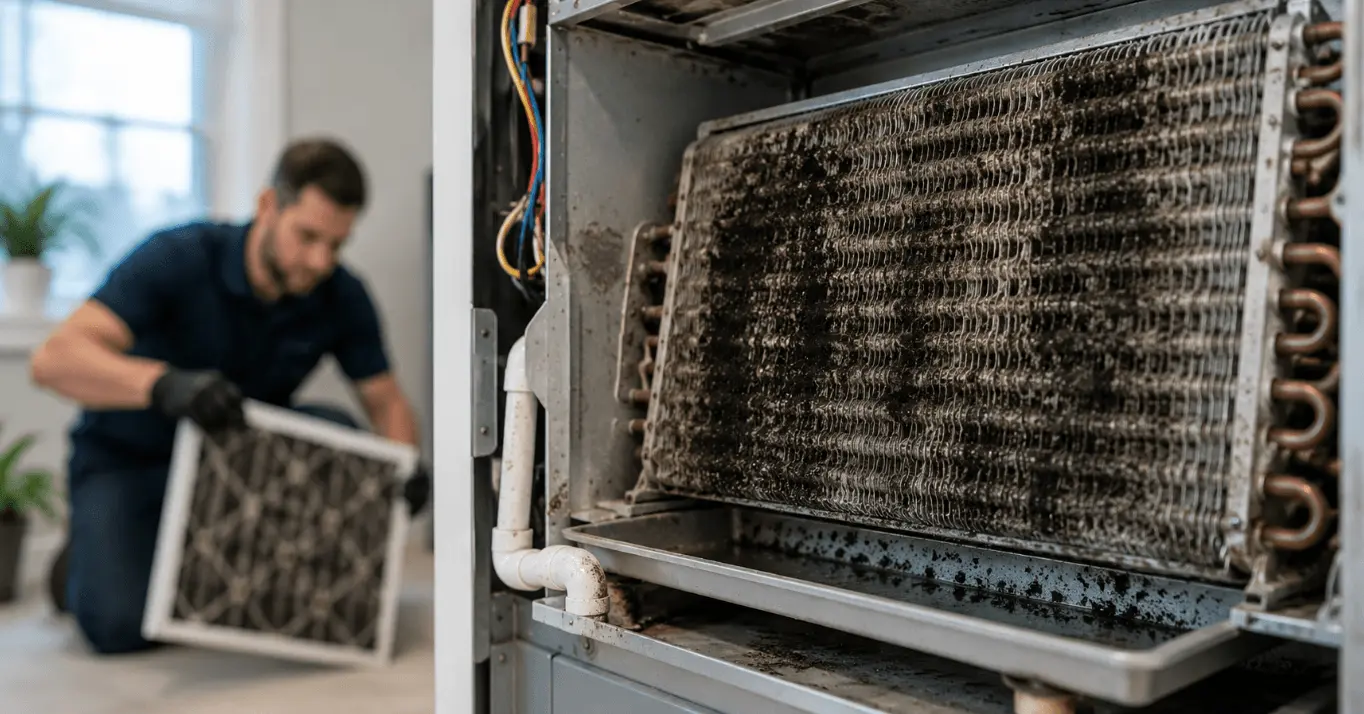
The rule: only DIY mold you can see and physically reach on removable, non-porous parts (filter housing, grille, drip pan, accessible plastic/metal surfaces). If the mold is inside the ducts, on the evaporator coil, or in the blower compartment, stop and call a pro — those spots need specialized access and equipment, and disturbing them spreads spores. (Why: EPA guidance treats HVAC-system mold and larger areas as professional jobs.)
Unplug the unit. Never clean a powered AC.
Remove the front grille and the filter. If the filter is moldy and reusable, wash it; if it's disposable or heavily fouled, replace it.
Take it outside if you can. Mold cleanup is messy and you don't want spores settling indoors.
Clean non-porous surfaces with a detergent-and-water solution and a scrub brush. Wipe down the housing, fan blades you can reach, and the drip area.
Dry everything completely before reassembly — leftover moisture invites mold straight back.
Reassemble and run on fan mode for a bit to finish drying the interior.
If a window unit is heavily colonized inside the fan and housing where you can't reach, cleaning may not be worth it (see clean vs. replace below).
You can safely handle the return grilles, the filter slot, and a visibly moldy (but accessible) drip pan. Replace the filter. Wipe accessible non-porous surfaces with detergent and water and dry them.
What you should not DIY on a central system: the evaporator coil, the blower, the supply plenum, and the ductwork. Mold there means spores have a direct path into every room, and proper remediation requires containment and equipment most homeowners don't have. Turn the system off and bring in a professional.
Probably not — and this is where the internet contradicts itself, so here's the accurate version.
The EPA does not recommend chlorine bleach as a routine part of mold cleanup. In most cases, scrubbing hard, non-porous surfaces with detergent and water is enough — exactly what the EPA's mold-cleanup guidance advises — and the real goal is removing the mold and fixing the moisture, not "killing" it with a stronger chemical. Bleach also can't penetrate porous material or reach mold deep inside coils and ducts, so it gives a false sense of "done" while the source survives. And on metal AC components, bleach can contribute to corrosion. Skip the bleach myth; clean the surface properly and fix the water.
You can use the rough threshold the EPA publishes for home mold cleanup, adapted for AC systems:
Lean DIY if all of these are true:
The mold is on a removable or easily reached non-porous part (filter, grille, accessible drip pan, housing)
The affected area is smaller than about 10 square feet (roughly a 3 ft × 3 ft patch)
No one in the home is immunocompromised or has severe asthma/allergies
There's no water-damage or sewage involved
Call a professional if any of these are true:
The mold is in the coils, blower, supply plenum, or ductwork of a central system
The area is larger than ~10 square feet, or it keeps coming back after cleaning
There's been flooding, a major leak, or contaminated water
Someone in the home is in a higher-risk group (asthma, lung disease, weakened immunity, infants, elderly)
You simply can't reach or see the full extent of it
When in doubt, an inspection is cheap insurance compared with spreading spores through the house.
Renting? If you don't own the unit, mold in the AC or ductwork is usually the landlord's responsibility to remediate — especially when it stems from a building moisture problem like a leak, poor drainage, or chronic damp. Document it with dated photos, put your request in writing, keep the AC off if mold may be in the system, and ask for professional remediation rather than taking on a major cleanup yourself. Habitability obligations vary, so check your local and state tenant-rights rules.
If you've cleaned mold out of your AC once and it returned, you treated the symptom and missed the cause. Mold cleanup is temporary; eliminating the moisture is the cure. Mold needs three things — moisture, organic material (dust and debris), and a dark, still space — and an AC supplies all three. Dust you can manage with filtration. Darkness you can't change. So the whole game is moisture.
The usual root causes, roughly in order of how often they're the real culprit:
A clogged condensate drain line or drip pan. When the line backs up, water pools under the coil and feeds mold within days. This is the #1 hidden cause.
Constant coil condensation. The evaporator coil is cold and wet by design; poor drainage or airflow lets that moisture linger.
An oversized or short-cycling AC. A unit that's too big cools the air fast but shuts off before it removes much humidity, leaving the house — and the system — damp.
High indoor humidity. Above roughly 60% relative humidity, mold growth gets much easier everywhere, including inside the AC.
A wet or neglected filter that stays damp and becomes a mold nursery itself.
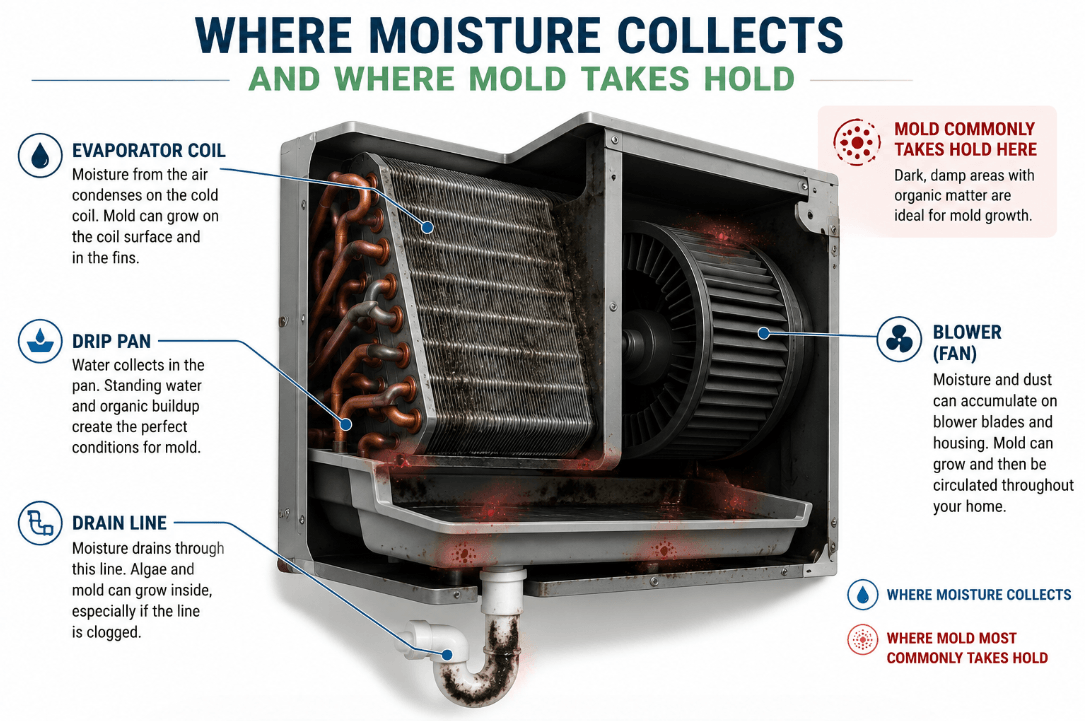
Fix the moisture path and the mold loses its home. That's what the prevention checklist below is built around.
Keep indoor humidity in range. Aim for below 60%, ideally 30–50%. A cheap hygrometer tells you where you stand; a dehumidifier closes the gap in humid climates.
Keep the condensate drain clear. Flush the drain line periodically so water actually leaves the system instead of pooling.
Empty and wipe the drip pan as part of seasonal maintenance.
Have the coil checked and cleaned during annual HVAC service.
Fix leaks and condensation fast — around the unit, windows, and ducts.
Change your filter on schedule (see below) and never reinstall a damp one.
Run the AC's fan for a few minutes after cooling in very humid weather to help dry the coil area.
Book a yearly HVAC tune-up to catch drainage and airflow problems before they become mold problems.
Your filter won't stop mold that's already growing on a wet coil — but the right filter does two real jobs: it captures airborne mold spores before they circulate, and it keeps the dust and debris out of the system that mold feeds on. That's why a clean, appropriately rated filter is genuine mold prevention, not just dust control.
Mold spores are small — generally in the single-digit-to-low-double-digit micron range — so filter efficiency matters. (How MERV ratings work, explained.)
MERV 8 — captures larger spores, pollen, and dust (≈3–10 microns). Good for baseline protection and most basic systems.
MERV 11 — captures finer spores, pet dander, and mold fragments (≈1–3 microns). The practical sweet spot for many homes.
MERV 13 — captures smaller particles too: fine spores, smoke, and bacteria-sized particles (≈0.3–1 micron). Best for allergy/asthma households wanting maximum capture.
Answer 3 quick questions and we'll match you to your perfect MERV match.
The airflow trap nobody mentions: a higher-MERV filter restricts airflow more — the tradeoff laid out in this MERV pressure-drop breakdown. In a system designed for it, that's fine. In a system that isn't — or with a filter left in too long — reduced airflow can make the coil colder and wetter and encourage the condensation that feeds mold. So don't just grab the highest number. Match the filter to what your system can handle, and change it every 1–3 months (more often with pets, allergies, or heavy use) so it never gets restrictive or damp. If you're unsure what your system supports, MERV 11 is a sensible default for most homes — a balance Filterbuy's own testing and customer feedback points to as well. Filterbuy makes MERV 8, 11, and 13 pleated filters in standard and custom sizes, so you can match the right rating to the right fit.
For small units, do the math before you spend an afternoon scrubbing. A new window AC often runs roughly $150–$300, while deep-cleaning a heavily molded one means full disassembly and may not even reach mold buried in the fan and housing.
Clean it if: the mold is light, on surfaces you can reach, and the unit is newer and otherwise working well.
Replace it if: mold is established deep in the fan or housing, the unit is older, it's been chronically damp, or cleaning would cost more in time and parts than a new unit. HVAC pros frequently recommend replacement for small, badly colonized units for exactly this reason — you can't fully decontaminate what you can't reach.
For central systems, replacement is a much bigger decision and depends on where the mold is. Surface mold on accessible parts is remediable; mold colonizing the coil, plenum, or blower may tip the balance toward replacing components — that's a call for your HVAC professional.
Prices vary widely by region, system type, and how far the mold has spread. Typical 2026 ranges:
Routine air-duct cleaning (prevention): ~$275–$1,000
Mold removal from vents/ducts: ~$600–$2,000
Full HVAC-system mold remediation: ~$3,000–$10,000
Window-unit replacement (DIY alternative): ~$150–$300
General mold remediation (priced by area): ~$10–$25 per sq ft
Central air conditioners sit at the higher end because they constantly generate moisture and have the most ducts and vents to treat. Get two or three quotes, and be cautious if a contractor pushes full replacement without inspecting whether the mold is actually limited to accessible parts. (Cost ranges compiled from 2026 industry estimates including Angi, HomeGuide, This Old House, and Fixr.)
Can black mold in an AC make you sick? It can cause allergy-type symptoms — congestion, sneezing, irritated eyes, coughing — especially in people with asthma or allergies. Serious illness is uncommon in healthy people, but it shouldn't be ignored, and higher-risk individuals should be more cautious.
Is it safe to sleep in a room with a moldy AC unit? If mold is only on a small, reachable surface, brief use is low-risk for a healthy person, but clean it promptly. If mold may be inside the system or ducts, turn it off and don't sleep in the room with it running until it's addressed — especially for anyone with asthma, allergies, or a weakened immune system.
How can I tell mold from dust in my vents? Mold smells musty (stronger when the AC runs), often feels slimy or fuzzy, shows up in damp spots, and returns quickly after cleaning. Dust is dry, powdery, odorless, and collects on dry surfaces like louvers.
Will bleach kill mold in my AC? Bleach isn't recommended as a routine fix. Detergent and water clean hard surfaces just as effectively for removal, and bleach can't reach mold deep in coils or ducts and may corrode metal parts. Removing the mold and fixing the moisture matters more than the chemical.
Why does mold keep coming back after I clean it? Because the moisture source is still there — usually a clogged condensate drain, a wet coil, high humidity, or an oversized AC that doesn't dehumidify. Clean the mold and fix the water, or it returns.
What kind of filter helps prevent AC mold, and what MERV? A filter that captures fine spores and keeps debris out of the system helps. MERV 11 is a good all-around choice; MERV 13 captures the smallest particles for allergy/asthma homes — as long as your system can handle the airflow. Change it every 1–3 months. You can shop pleated MERV 8–13 filters by size to match your system.
Should I replace a window AC unit that has mold, or clean it? Clean it if the mold is light and reachable. Replace it if mold is buried deep in the fan or housing or the unit is old — a new window unit often costs less than a thorough deep-clean.
How much does professional AC mold removal cost? Roughly $600–$2,000 for ducts/vents and $3,000–$10,000 for full HVAC-system remediation, depending on system type and spread. Get multiple quotes.
Does running the AC spread mold through the house? Yes — if the mold is inside the system or ductwork, running the unit circulates spores into every room. Turn it off until it's cleaned.
How often should I clean my AC to prevent mold? Change the filter every 1–3 months, flush the condensate drain and check the drip pan seasonally, and have a professional tune-up (including a coil check) once a year.
Do I need to test for mold or identify the species? Usually not. DIY test kits are often unreliable, and knowing the species doesn't change the fix — remove the mold and solve the moisture. Testing mainly helps for insurance or landlord documentation, finding a hidden source behind a persistent musty smell, or confirming a remediation worked.
I rent — whose responsibility is AC mold? Typically the landlord's, particularly when it comes from a building moisture issue. Report it in writing with photos, keep the unit off if mold may be in the system, and request professional remediation. Tenant-rights and habitability rules vary by location, so check your local regulations.
Filterbuy is a family-owned U.S. air-filter manufacturer. We make filters, which means we have a stake in this topic — so we've kept the filter guidance educational and pointed you to professional help where it's genuinely the right call, even when that isn't something we sell. Our goal is cleaner air in your home, full stop.
