
Where Should a Thermostat Go? Placement Rules for Accurate Readings
November 23, 2026
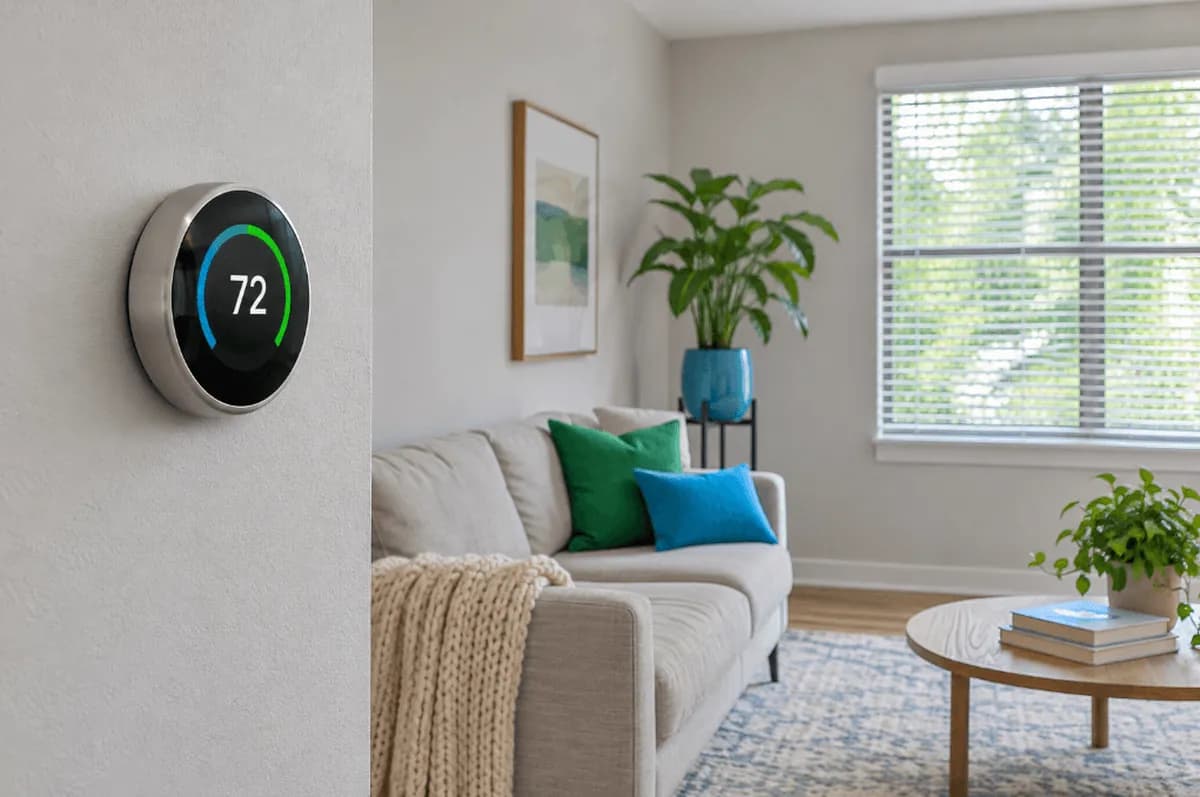
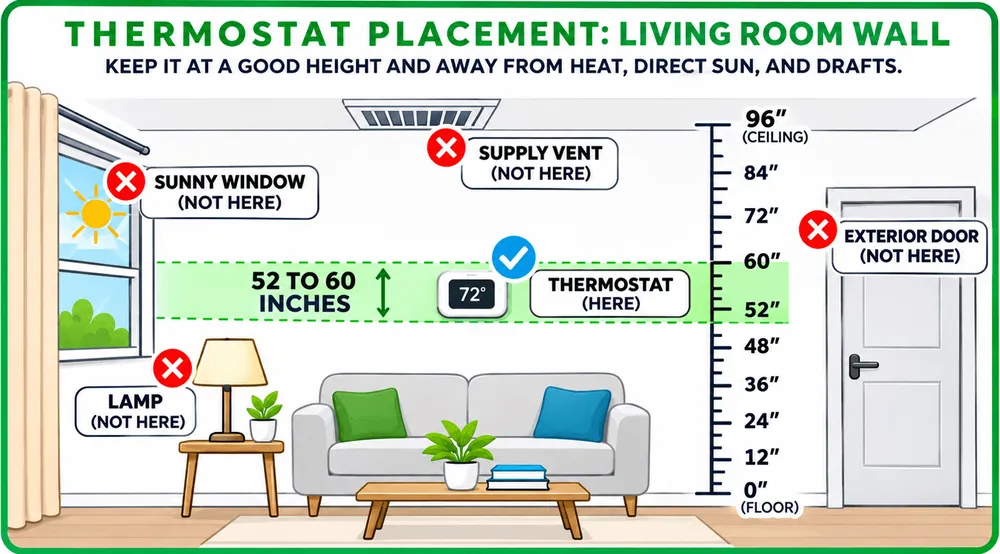
The best place for a thermostat is an interior wall in a room you use often, about 52 to 60 inches off the floor. Keep it clear of direct sunlight, drafts, doorways, windows, supply vents, and anything that gives off heat. There, it reads the same air you feel.
At Filterbuy, we make air filters, so we come at the thermostat from the airflow side. It's the switch that decides when air moves through your filter, so in the wrong place it runs your whole system on a bad reading.
TL;DR
Mount your thermostat on a central interior wall in a lived-in room, about 52 to 60 inches high, where nothing nearby heats it or blows air on it. Sunlight makes a thermostat read warm, while an exterior wall or an unsealed wire hole can make it read cold. Filterbuy's advice is to fix the source or add a remote sensor before paying to move the wiring.
Key Takeaways
A central interior wall in a room you use often gives the truest reading.
Mount the thermostat about 52 to 60 inches above the floor.
Direct sunlight makes a thermostat read warm, so the AC overcools and the heat shuts off early.
A thermostat near a supply vent feels conditioned air first, which can lead to short cycling.
Before relocating, work through Filterbuy's fix ladder: remove the heat source, seal the wire hole, add a sensor, and only then move the wiring.
Where Should A Thermostat Be Placed?
The best place for a thermostat is a central interior wall in a room where people spend time. The Maryland Energy Administration, echoing U.S. Department of Energy guidance, states that a thermostat must be on an interior wall away from direct sunlight, drafts, doorways, skylights, and windows.
Interior wall. The wall behind it should separate two conditioned rooms, not a room and the outdoors.
Lived-in room. A living room or a central hallway open to living space works well, but a guest room doesn't.
52 to 60 inches high. Mounted higher, it reads warm. Mounted lower, it reads cool.
Main floor. In a two-story home, the upstairs runs warmer, so the first floor gives a steadier reading.
Clear air around it. Keep shelves, lamps, TVs, and doors from blocking or heating that patch of wall.
If someone in your home uses a wheelchair, mount the controls at 48 inches or lower, the maximum reach height in federal accessibility standards.
For a smart thermostat, ENERGY STAR advises keeping it reasonably close to the Wi-Fi router. Once it's placed, Filterbuy's season-by-season thermostat settings help you choose the number.
What If No Spot Meets Every Rule?
When no wall checks every box, protect the reading in Filterbuy's priority order. Never accept direct sun or air blowing from a supply vent, because those throw a reading off the fastest. Exterior walls come next, then rarely used rooms. Height is the most forgiving rule. Renters who can't move the thermostat can close the blinds and angle the register, then ask the landlord about a remote sensor.
Thermostat Placement Mistakes And What Each One Does
Every bad location pushes the reading in a predictable direction, so the first question Filterbuy asks is which way it leans. Warm spots make the AC overwork and the heat quit early, and cold spots do the opposite.
Thermostat Placement Mistakes At A Glance
| Location | Reading Skews | What Your System Does | Quickest Fix |
|---|---|---|---|
| Direct sunlight | Warm | AC runs long, heat shuts off early | Close blinds at peak sun |
| Exterior wall | Toward outdoor temperature | Runs longer than needed | Seal wire hole, add a sensor |
| Above or beside a supply vent | Toward vent air | Short cycles | Angle register louvers away |
| Unsealed wire hole | Toward wall cavity air | Erratic cycling | Fill with foam or putty |
| Kitchen, lamps, or TV | Warm | Rest of home underheated | Move heat sources away |
| Exterior door or window | Cold | Heat starts too often | Weatherstrip or relocate |
| Upstairs in a two-story home | Warm | Downstairs too cold | Use a main-floor wall or sensor |
What Happens When A Thermostat Is In Direct Sunlight?
A thermostat in direct sunlight reads warmer than the room because the sun heats the sensor inside. In summer, the AC keeps cooling air that is already comfortable. In winter, the heat shuts off before the rest of the house warms up.
Filterbuy calls this the afternoon pattern, because the error follows the sun. The house feels fine in the morning and overcooled by late afternoon, or the heat cuts out on bright winter days. Check in more than one season, too, since the low winter sun reaches deeper into a room and can land on a thermostat that stays shaded all summer.
Is A Thermostat On An Exterior Wall A Problem?
Yes. An exterior wall's temperature follows the weather, so a thermostat mounted on one reads colder than the room in winter and warmer in summer. Either way, the system runs longer than it needs to.
In Filterbuy's view, the wire hole behind the thermostat is the most overlooked fix on this page. Installers often drill an oversized opening for the wire, and wall cavity air, which can sit near outdoor temperature, flows through the gap and across the sensor. A little foam or putty seals it in a few minutes.
How Bad Thermostat Placement Causes Short Cycling
Short cycling is when a heating or cooling system turns on and off in brief bursts instead of running full cycles. A thermostat near a supply vent causes it because the sensor feels conditioned air within minutes and shuts the system off while distant rooms are still uncomfortable.
Those frequent starts wear on compressors and blowers, and short cooling cycles pull less moisture from the air, so a home can feel clammy at the setpoint.
Placement isn't the only culprit, though. A clogged air filter can make a furnace overheat and shut itself off or let an AC coil freeze, and both look like short cycling. As a filter maker, Filterbuy's rule is to check the filter before blaming the thermostat. If it's clean, our guide to a thermostat that isn't working covers the other causes.
How To Tell If Your Thermostat Is In The Wrong Spot
Compare the thermostat with a standalone thermometer in the middle of the room you use most, at the same height. If the two disagree by more than about 2°F, or the gap widens when sun hits the wall or the system starts, the location is skewing the reading. Filterbuy's two-day placement check works like this.
Set a digital thermometer 52 to 60 inches high in the center of your main living space.
Compare both readings each morning and late afternoon for two days.
Note when the gap is largest. An afternoon gap points to sun. A gap right after startup points to a vent, while one on cold or windy days points to an exterior wall or the wire hole.
Fix that cause, then recheck before relocating.
How To Relocate A Thermostat
Relocating a thermostat means running new low-voltage wire to a better wall and patching the old opening. On finished walls, that's usually a job for a licensed HVAC technician, which is why Filterbuy's fix ladder saves new wire for the last rung: Source, Seal, Sensor, then Move.
Try These Fixes First
Remove the source. Move lamps and TVs away from the wall. At peak sun, close the blinds and angle register louvers off the thermostat.
Seal the wire hole. Turn off power, take the thermostat off its base, fill the gap, and remount it.
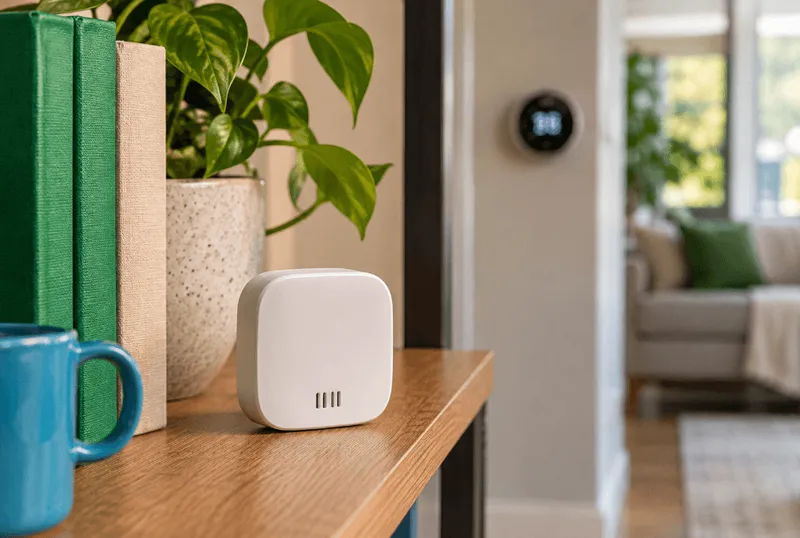
Add a remote sensor. A wireless room sensor such as the ecobee SmartSensor or the Google Nest Temperature Sensor lets a smart thermostat follow a better room without new wire.
When To Move The Wiring
Move the thermostat when it sits on an exterior wall or in a rarely used room, or when the fixes above don't close the gap. A technician shuts off power, runs new wire to an interior wall, mounts the base, and patches the old hole. Upgrading to a smart thermostat? Include a C wire in the new run.
"Most people think about what number to set, not where the thermostat sits. At Filterbuy, we ask both, because the thermostat decides when air moves through your filter. If it's reading a sunny wall instead of your living room, everything downstream follows the wrong number."
- Michelle Wan, Brand Manager and Air Quality Writer, Filterbuy
Supporting Statistics
About 89% of American homes have a thermostat. In 2020, 109.45 million of 123.5 million U.S. homes had one, and 50.69 million households set one heating temperature and left it there most of the time. In those homes, location makes nearly every heating decision. Source: Table HC6.1 Space Heating in U.S. Homes, by Housing Unit Type, 2020
Roughly 11% of the nation's energy use runs through home thermostats. Lawrence Berkeley National Laboratory researchers, citing EIA data, put the HVAC load behind home thermostats at about 11% of U.S. energy use. Source: How People Actually Use Thermostats
Half of surveyed homes had thermostats on long-term hold. Berkeley Lab's survey points to thermostats that go untouched for months, so a bad location rarely gets noticed. Source: Measuring the Usability of Programmable Thermostats
Frequently Asked Questions
What Is The Best Height For A Thermostat?
The best height for a thermostat is about 52 to 60 inches above the floor, roughly adult eye level. For a wheelchair user, mounting at 48 inches or lower keeps the controls within reach.
Should A Thermostat Be Near A Return Vent?
No. A return can pull wall cavity air through the wire hole, and a supply vent blows conditioned air at the sensor. Leave a few feet of open wall between the thermostat and any vent.
Where Should A Thermostat Go In A Two-Story House?
Use a central interior wall on the main floor. Upstairs rooms run warmer, so an upstairs thermostat tends to underheat the first floor. Zoning or remote sensors help when the floors still feel uneven.
Can I Move A Thermostat Myself?
An experienced DIYer can, as long as power is off at the breaker and the wall is open or the attic is easy to reach. On finished walls or long wire runs, most homeowners hire a licensed HVAC technician.
Does Thermostat Location Affect My Energy Bill?
Yes. A misreading thermostat runs the system longer or more often than needed, and the extra runtime shows up on the bill. Fan runtime adds up the same way, as Filterbuy's guide to thermostat fan Auto vs. On explains.
Breathe Easier With The Right Filter Behind Your Thermostat
At Filterbuy, we see placement and filtration as a pair: the thermostat decides when air moves, and the filter decides what it carries. We make air filters to order in hundreds of standard sizes, with fast and free 2-day delivery to most US states. MERV 8 air filters are the standard choice for most homes, so check your HVAC manual for the MERV rating it supports. Our air filter subscription sends the next filter on time, and our smart thermostat guides cover the rest.
Glossary
Thermostat: A wall control that reads indoor temperature and tells the HVAC system when to run.
Setpoint: The temperature the system works to reach and hold.
Short Cycling: A heating or cooling system turning on and off in brief bursts instead of full cycles.
Supply Vent And Return Grille: Supply vents deliver conditioned air into a room, and return grilles pull room air back to the HVAC system.
Remote Temperature Sensor: A wireless device that reports one room's temperature to a smart thermostat.
C Wire: The common thermostat wire that supplies continuous 24-volt power to most smart thermostats.
MERV: Minimum Efficiency Reporting Value, the scale that rates how well an HVAC air filter captures particles.
Filterbuy: A manufacturer of residential and commercial HVAC air filters, sold direct at filterbuy.com.