
Heat Pump Sizing Guide: What Size Do You Need? 2, 3, 4, and 5 Ton Heat Pumps Compared, Plus BTU Calculator and House Size
November 22, 2026
Most homes need a heat pump between 2 and 5 tons, and the right size depends on your home's heating and cooling load, not square footage alone. One ton equals 12,000 BTU per hour, so a 3 ton heat pump moves about 36,000 BTU/h. Start with 20 to 25 BTU per square foot in a moderate climate, then confirm with a Manual J load calculation.
Filterbuy has built HVAC filters in our own U.S. plants since 2013. We don't sell central heat pumps, so we have no stake in your tonnage, and we look at sizing from the filter side.
TL;DR
Filterbuy's rule: in a moderate climate, multiply square footage by 20 to 25 BTU, divide by 12,000, and round to the nearest half ton. Most 2,000 sq ft homes need 3 to 4 tons, and cold-climate homes should be sized to the winter heating load.
Key Takeaways
One ton equals 12,000 BTU/h, so 2, 3, 4, and 5 ton heat pumps deliver 24,000, 36,000, 48,000, and 60,000 BTU/h.
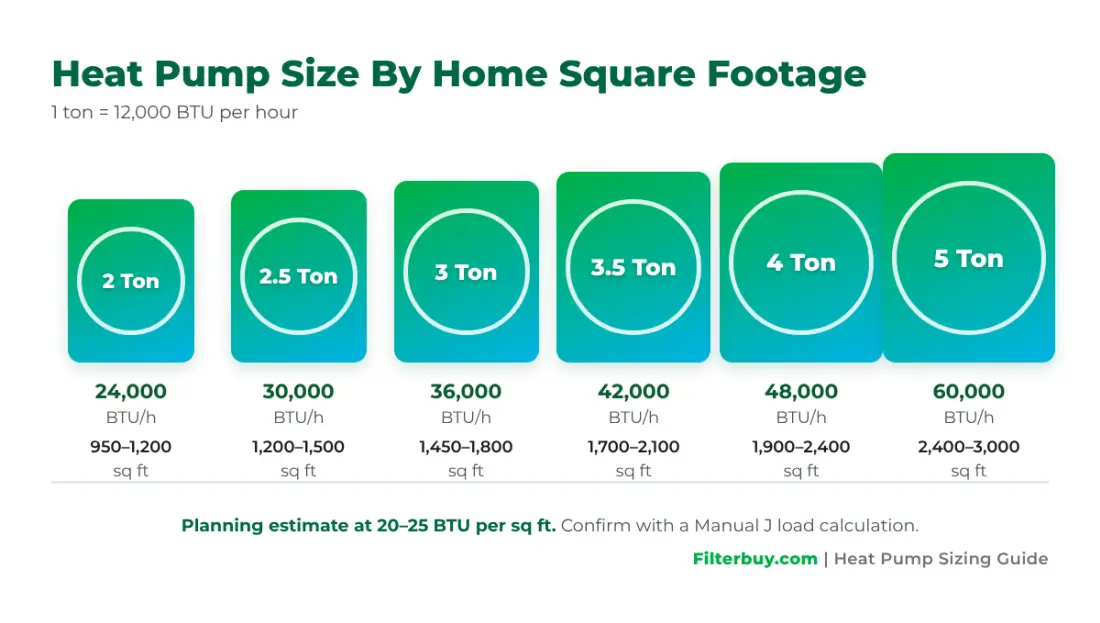
At 20 to 25 BTU per square foot, a 2 ton heat pump fits about 950 to 1,200 sq ft and a 5 ton heat pump about 2,400 to 3,000 sq ft.
Filterbuy's calculator puts a typical 2,000 sq ft house at 3 to 4 tons, most often 3.5.
Cold-climate heat pumps should be sized to the winter heating load.
Each ton moves about 400 to 500 CFM of air, so tonnage sets how hard your return filter works.
Heat Pump Sizing Chart: 2, 2.5, 3, 3.5, 4, And 5 Ton Heat Pumps Compared
The chart pairs each common heat pump size with a starting home size at 20 to 25 BTU per square foot, Filterbuy's planning factor for moderate climates. Climate and insulation can move the answer a half ton or more.
Table 1: Heat Pump Sizing Chart
Filterbuy planning estimates at 20–25 BTU per sq ft, moderate climate, 8 ft ceilings, not a load calculation.
A 2.5 ton heat pump and a 3.5 ton heat pump fill the half-ton gaps, and most lines stop at 5 tons, so larger homes often use two systems.
Filterbuy's take: If a quote lands a full ton above this chart, ask which load drove it and whether a Manual J backs it up.
Heat Pump BTU Calculator: How To Size A Heat Pump In Three Steps
Multiply conditioned square footage by a climate factor, adjust for ceilings and insulation, then divide by 12,000 and round to the nearest half ton. Filterbuy built this calculator so you can check a contractor's number before you sign.
Measure heated and cooled square footage, leaving out garages and unheated basements.
Multiply by your climate factor from the table below.
Apply the adjustments under the table, divide by 12,000, and round to the nearest half ton.
Table 2: Heat Pump BTU Calculator Climate Factors
Filterbuy planning factors. Manual J sets the final size.
Ceilings above 8 ft: multiply by ceiling height divided by 8.
Older home with leaky windows or thin insulation: add 10 to 20%.
New, tight construction: subtract about 10%.
What Size Heat Pump For A 2,000 Sq Ft House?
A 2,000 sq ft house usually needs a 3 to 4 ton heat pump. A well-sealed home in a mild climate often runs well on 3 tons (36,000 BTU/h), and an average home in a moderate climate lands near 3.5 tons (42,000 BTU/h). Hot-humid and cold-climate homes often need 4 tons or more.
Filterbuy's worked example: 2,000 sq ft times 21 BTU is 42,000 BTU/h, or 3.5 tons. Add 10 ft ceilings (times 1.25) and it becomes 52,500 BTU/h, about 4.4 tons, a gap a Manual J should settle.
Prefer ductless zones? See Filterbuy's guide to mini split sizing for a 2,000 sq ft home.
Heat Pump Tonnage Explained: How To Read Your Model Number
Tonnage measures capacity, not weight. One ton equals 12,000 BTU per hour, the cooling from melting one ton of ice over 24 hours. Most model numbers include capacity as a two-digit code in thousands of BTU.
In that code, 24 means 2 tons, 30 means 2.5 tons, 36 means 3 tons, 42 means 3.5 tons, 48 means 4 tons, and 60 means 5 tons.
Some brands differ, so confirm with the manufacturer.
Why Cold Climates Change Heat Pump Sizing
A cold-climate heat pump should be sized to the home's design heating load. Heating demand in northern states often exceeds cooling demand, and output drops as temperatures fall, so a unit sized only for cooling leans on strip heat on the coldest nights.
Below the balance point, auxiliary heat turns on. Heating capacity is rated at 47°F, so ask for the unit's output at 5°F. See Filterbuy's guide to heat pumps in cold climates.
Filterbuy's take: In a cold climate, the 5°F capacity on the spec sheet tells you more than the tonnage on the nameplate.
Too Big, Too Small, Or In Between: How To Round Heat Pump Size
An oversized heat pump short cycles, which weakens humidity control and adds wear. An undersized one runs nonstop on peak days and relies on auxiliary heat in winter. When your estimate falls between two sizes, use Filterbuy's rounding rule:
Hot-humid climate: round down. Longer cycles pull more moisture from the air.
Cold climate with a variable-speed unit: round up if the larger size covers more of the design heating load.
Mild or mixed climate: pick the closest size.
Moving up from your old size: confirm the ducts can carry about 400 to 500 more CFM for each added ton.
Both mistakes show up often in field studies, and Filterbuy's breakdown of heat pump disadvantages covers other trade-offs.
When To Get A Manual J Load Calculation
Get a Manual J load calculation before you replace or add a heat pump. ACCA Manual J is the residential load procedure from the Air Conditioning Contractors of America, and it accounts for insulation, windows, air leakage, and duct losses room by room. Manual S then matches equipment to that load.
Filterbuy's pre-quote checklist:
Can I see the Manual J report with the design heating and cooling loads?
What is this heat pump's heating capacity at our winter design temperature?
Are the existing ducts sized for this unit's airflow?
New to the equipment? Start with how a heat pump HVAC system works, then compare SEER2 and HSPF2 ratings.
How Heat Pump Size Affects Your Air Filter
Heat pump size sets how much air moves through your filter. The U.S. Department of Energy's air-source heat pump guidance calls for about 400 to 500 cubic feet per minute of airflow per ton. By Filterbuy's math, that is about 800 to 1,000 CFM for a 2 ton system and 2,000 to 2,500 CFM for a 5 ton system, and all of it passes through the return filter.
Tonnage does not set your filter size. The return grille or filter slot does. One blower runs for heating and cooling, so a heat pump filter loads faster than a furnace-only filter.
Filterbuy's take: Because we cut filters to order, we look at sizing from the return side. After a new install, re-measure the filter slot, since a new air handler can take a different size.
Filterbuy makes heat pump replacement air filters in MERV 8, MERV 11, and MERV 13 in our own U.S. plants. MERV 8 air filters are the standard choice for most homes, MERV 11 suits households with allergies, pets, or pollen, and MERV 13 is the pick for wildfire smoke. Check your system manual for the highest MERV rating it accepts, and see the heat pump filter guide for change intervals.
Expert Quote
"The size on the old unit's nameplate tells you what was installed, not what the house needs. Ask for the Manual J, then check the heating capacity at your coldest design temperature before you settle on a tonnage."
David Clark, Licensed HVAC Technician
"The right tonnage is the one your Manual J supports. Our job starts after that, keeping the filter matched to the air a properly sized system moves."
Michelle Wan, Brand Manager and Air Quality Writer, Filterbuy
Supporting Statistics
58% of heat pumps were missized.
Bonneville Power Administration field study of 95 Pacific Northwest homes.
Units were undersized or oversized by a half ton or more.
Filterbuy's takeaway: half-ton precision matters.
Source: Air Source Heat Pump Commissioning, Controls and Sizing Baseline Field Study Report
9 of 11 heat pumps in cold climates fell short of the winter load.
NREL field study of central heat pumps.
Maximum capacity was below the home's design heating load.
Backup heat topped 40% of compressor energy at 5 of 11 all-electric sites.
Filterbuy's takeaway: size to the heating load.
Source: Field Validation of Air-Source Heat Pumps for Cold Climates
Installation faults can add about 30% to energy use.
NIST installation research.
Oversizing is one of the common faults.
Filterbuy's takeaway: ratings only hold when size and setup are right.
Source: Underperforming? Energy Efficiency of HVAC Equipment Suffers Due to Poor Installation
Frequently Asked Questions
How Many Square Feet Does A 3 Ton Heat Pump Cover?
A 3 ton heat pump covers about 1,450 to 1,800 sq ft in a moderate climate. Tight, newer homes stretch toward 2,000 sq ft, while hot-humid or cold-climate homes cover less.
What Size Heat Pump Do I Need For A 1,500 Sq Ft House?
A 1,500 sq ft house needs a 2.5 to 3 ton heat pump by Filterbuy's calculator. At 20 BTU per square foot the load is 30,000 BTU/h (2.5 tons), and at 25 BTU it is 37,500 BTU/h, which points to 3 tons.
Should I Size A Heat Pump For Heating Or Cooling?
Size for whichever load is larger. In most northern homes that is heating, and in most southern homes it is cooling. The Manual J shows both loads side by side.
Can I Replace A 3 Ton AC With A 3 Ton Heat Pump?
Often, yes. A 3 ton heat pump must also meet the heating load, which can be larger in cold climates, so check its capacity at your winter design temperature.
Does A Bigger Heat Pump Need A Bigger Air Filter?
No. A bigger heat pump uses whatever filter size its slot takes. It moves more air, so check the filter monthly.
Shop Heat Pump Filters From Filterbuy
Filterbuy makes heat pump filters in hundreds of standard and custom sizes with fast and free 2-day delivery to most US states, and a filter subscription sends a fresh filter on your schedule. Need to heat or cool one room? Filterbuy mini split systems come with a 7-year compressor and 3-year parts warranty, and the mini split heat pump buying guide helps you choose 12,000, 18,000, or 24,000 BTU.
Glossary
BTU/h: British thermal units per hour.
Ton: 12,000 BTU per hour of capacity.
Manual J: The ACCA procedure for calculating heating and cooling loads.
Manual S: The ACCA procedure for matching equipment to those loads.
Design Temperature: The local outdoor temperature a system is sized for.
Balance Point: The outdoor temperature where a heat pump alone just meets the load.
Auxiliary Heat: Backup heat, often electric strips.
Short Cycling: Frequent on-off cycling, often from oversizing.
CFM: Cubic feet per minute of airflow.
MERV: Minimum Efficiency Reporting Value, a filter capture rating.
SEER2 And HSPF2: Federal cooling and heating efficiency ratings.