

Mini Split Heat Pump Buying Guide (2026): Sizing, Cost & How to Choose
Written by Michelle Wan · Reviewed by David Clark, Filterbuy HVAC Solutions
Date published: June 15, 2026
Date updated: June 15, 2026
A mini split heat pump is a ductless system that both heats and cools a single room or zone, with no ductwork required. One outdoor unit connects to one or more wall-mounted indoor heads, and an inverter compressor lets it sip energy while holding a steady temperature. For most single rooms in 2026, expect to pay roughly $2,000–$6,000 installed for a single-zone system, and budget another $2,000–$7,000 per additional zone. The two decisions that matter most are getting the size (BTU) right for your space and choosing the right number of zones. Everything else follows from those.
Is a mini split right for you? Likely yes if: a room your central system can't keep comfortable, an addition or garage with no ductwork, an older home without ducts, or you want independent control of one space. Maybe not if: your home already has good ductwork (a ducted heat pump may be cheaper for whole-home), or one window unit would genuinely do the job. We cover the honest trade-offs below.
Jump to the sizing & cost tool: use the interactive estimator to get a recommended BTU and a 2026 price range for your exact space in about 30 seconds.
Size your mini split & estimate the cost
Answer four quick questions for a recommended BTU capacity and a real 2026 price range. It takes about 30 seconds.
12,000 BTU system
A good match for spaces up to about 550 sq ft.
How this works: the estimate starts from roughly 20 BTU per square foot and adjusts for ceiling height, sun, and climate. It’s a planning guide, not a substitute for a professional Manual J load calculation, which is the accurate way to size a system before you buy. Price ranges reflect typical 2026 U.S. figures and vary by region, brand, and install complexity.
Is a Mini Split Heat Pump Right for You?
Most buying guides assume you've already decided. This is the honest version, including when something else is the smarter buy.
A mini split is usually the right call when:
You're conditioning a space with no ductwork, like a garage, basement, attic conversion, sunroom, or addition.
One or two rooms run hot or cold and your central system can't fix them.
You want room-by-room control, quiet operation, and high efficiency.
You live in an older or historic home where adding ducts is expensive or impractical.
Additions and bonus rooms are the classic use case; see our guide on cooling a bonus room or home addition.
Consider an alternative when:
Your home already has sound ductwork. For whole-home coverage, a ducted heat pump is often cheaper than a four- or five-zone mini split. (U.S. Department of Energy, Ductless Mini-Split Heat Pumps)
A single small room only needs occasional cooling, where a window or portable unit may be enough for a fraction of the cost.
Mini splits are heat pumps: they move heat rather than burn fuel to make it, which is why they can deliver roughly 2–4 units of heating energy for every unit of electricity they use. That efficiency is the main reason homeowners choose them over baseboard, furnace, or electric-resistance heat. (U.S. Department of Energy)
How a Mini Split Heat Pump Works
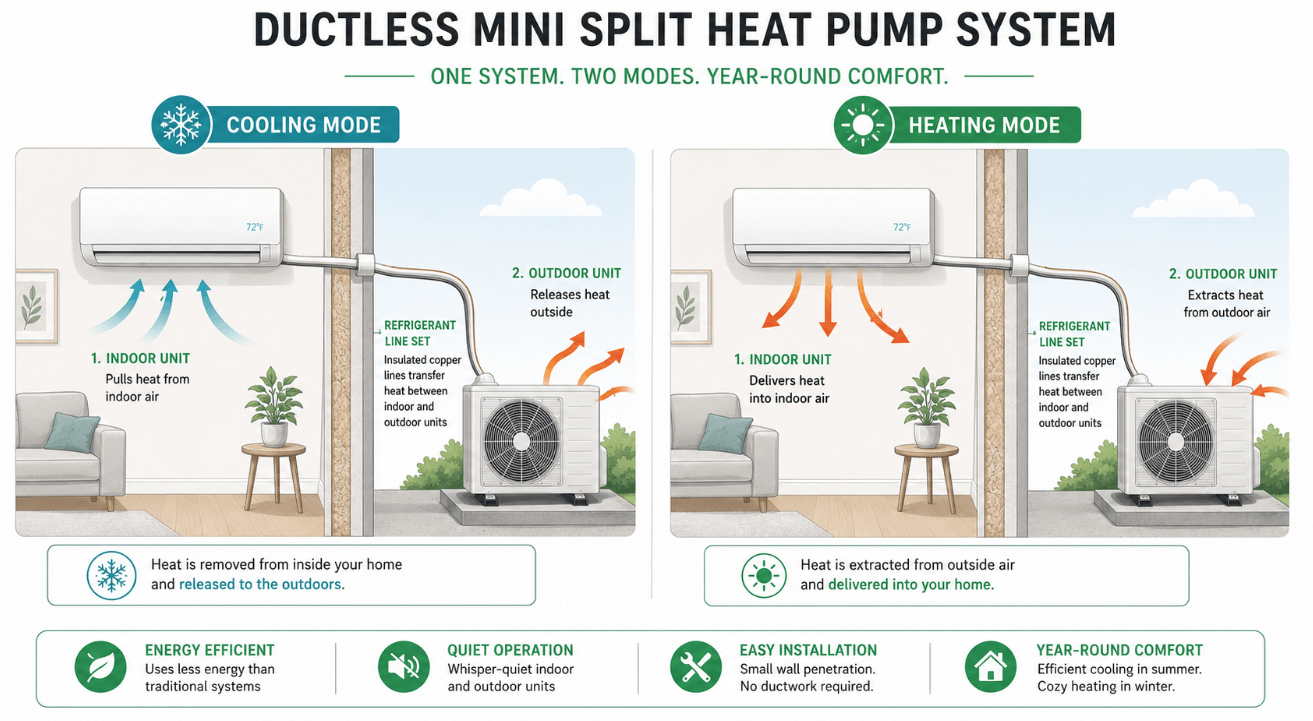
Every system has three parts: an outdoor unit (compressor and condenser), one or more indoor heads (the wall- or ceiling-mounted air handlers), and a line set: the insulated refrigerant lines and wiring that connect them through a small wall penetration. In summer, the system pulls heat out of your room and releases it outside. In winter, a reversing valve flips the cycle: it extracts heat from outdoor air (yes, even cold air holds heat) and brings it inside.
The key piece is the inverter compressor. Instead of switching fully on and off like older AC units, it modulates, ramping up and down to hold a steady temperature. That's what makes mini splits quiet, efficient, and good at managing humidity.
Single-Zone vs. Multi-Zone in one line: a single-zone system pairs one outdoor unit with one indoor head (great for a room or addition); a multi-zone system runs several indoor heads off one outdoor unit (for whole-home or multi-room coverage).
Indoor heads are most commonly wall-mounted (ceiling-cassette and floor-mounted styles exist for specific spaces), and modern units run quietly. Filterbuy's, for example, drop to about 28 dB in their quietest mode, roughly the level of a whisper.
What Size Do You Need? (BTU Sizing)
Capacity is measured in BTU (British Thermal Units) per hour; one ton equals 12,000 BTU. The common rule of thumb is about 12,000 BTU per 500–600 square feet, or roughly 20 BTU per square foot. But the rule of thumb is where most guides stop, and it's exactly where sizing goes wrong.
Bigger is not better. An oversized unit short-cycles: it cools the air fast, shuts off before it removes humidity, and leaves the room clammy while wasting energy and wearing out the compressor. An undersized unit runs constantly and never quite gets there. Right-sizing is the single most important decision you'll make.
Adjust the baseline up or down for:
Ceilings above 8 feet, which means more air volume to condition.
Lots of windows or strong south-facing sun: add capacity.
Kitchens or rooms with heat-generating equipment: add 10–20%.
Cold climates where the system is your primary heat: size for the heating load, not just cooling.
Well-insulated rooms or mild climates: you may need less.
Use the estimator Enter your square footage, ceiling height, sun exposure, and climate to get a recommended BTU and a 2026 price range. For a system you'll rely on as primary heating or cooling, follow it up with a professional Manual J load calculation, which is the accurate method an installer uses.
Quick reference (single room, average conditions):
| Space size | Typical capacity | Filterbuy match |
|---|---|---|
| 300–550 sq ft | 12,000 BTU | 12,000 BTU system |
| 700–850 sq ft | 18,000 BTU | 18,000 BTU system |
| 1,000–1,200 sq ft | 24,000 BTU | 24,000 BTU system |
Ranges adapted from manufacturer coverage guidance; adjust for the factors above. Source: ENERGY STAR room sizing guidance.
What a Mini Split Heat Pump Costs in 2026
Installed prices vary widely by configuration, region, and complexity. Across current U.S. sources, single-zone systems generally land between $2,000 and $6,000 installed, with multi-zone systems adding roughly $2,000–$7,000 per zone. Equipment is usually 50–70% of the total and labor 30–50%. (Ranges compiled from multiple 2026 industry cost guides; always get an itemized, written quote.)
| Configuration | Typical 2026 installed range |
|---|---|
| Unit only (no install) | $700–$3,500 |
| Single-zone, professionally installed | $2,000–$6,000 |
| Each additional zone | $2,000–$7,000 |
| Whole-home multi-zone (3–5 zones) | $8,000–$18,000+ |
What's usually included: equipment, installation labor, refrigerant line set, electrical connection, and basic warranty. What's often extra: electrical panel upgrades, long line runs, permits, and complex structural work. Ask for a line-item quote so you can compare apples to apples.
A note on 'after tax credit' pricing If a contractor quotes you a price "after the 30% federal tax credit" for a 2026 install, that's a red flag. See the incentives section. The federal credit for air-source heat pumps no longer applies in 2026.
Single-Zone vs. Multi-Zone
| Single-zone | Multi-zone | |
|---|---|---|
| Best for | One room, addition, garage, problem space | Whole-home or several rooms |
| Setup | 1 outdoor + 1 indoor head | 1 outdoor + multiple heads |
| Cost | Lower upfront | Higher; ~$2,000–$7,000 per zone |
| Install | Sometimes DIY-eligible | Almost always professional |
If you're solving one comfort problem, start with a single zone. If you're replacing whole-home heating and cooling, price a multi-zone mini split against a ducted heat pump before deciding. With existing ducts, ducted is frequently cheaper for full coverage.
Straight talk on what we carry: Filterbuy currently sells single-zone systems (one outdoor unit, one indoor head). They're ideal for a room, addition, garage, or any single space, and you can install more than one to cover separate areas. For a true whole-home multi-zone setup running several heads off one outdoor unit, you'd look to a multi-zone system or a ducted alternative.
Efficiency Explained: SEER2 and HSPF2
SEER2 rates cooling efficiency; HSPF2 rates heating efficiency. Think of SEER2 as cooling "miles per gallon" and HSPF2 as the winter equivalent. Higher numbers mean lower seasonal energy use. These replaced the older SEER/HSPF tests in 2023, effectively raising the efficiency floor. (U.S. Department of Energy)
For most homes, a SEER2 in the high-teens to low-20s is a strong, cost-effective range. Chasing the absolute highest number isn't always worth it. Premium ultra-high-SEER2 units cost more upfront and the payback can take years, especially for a supplemental space you don't run year-round. Match the rating to how hard the system will actually work. You can verify any model's certified ratings in the AHRI Directory.
Filterbuy systems Filterbuy's ductless systems are SEER2 17 variable-speed units, a practical efficiency tier for everyday comfort without paying the premium for ratings most homeowners never recoup.
What it means for your bill: because a heat pump moves heat instead of generating it, it can deliver roughly 2–4 units of heating energy for every unit of electricity it uses, far more efficient than a furnace or electric-resistance heat. And because mini splits are ductless, they avoid the energy that leaks from ducts in a typical forced-air system (often around 20–30% of conditioned air). Those two factors are why a right-sized mini split usually costs less to run than the system it replaces. (U.S. Department of Energy)
Will It Heat in Cold Weather?
Yes. Modern inverter-driven mini splits keep heating efficiently well below freezing, and cold-climate ("hyper-heat") models hold much of their rated capacity at low temperatures, and many produce useful heat well below 0°F. If a mini split will be your primary heat source in a cold region, look specifically for a cold-climate designation and a strong HSPF2, and size for the heating load. If it's supplemental, standard models are usually fine. (U.S. Department of Energy)
For reference, Filterbuy's systems provide reliable heating down to 5°F (-15°C), with intelligent defrost and a chassis heating belt, which suits most U.S. climates and supplemental heating. For a primary heat source in a region that regularly drops below 0°F, choose a dedicated cold-climate unit.
A Note on Refrigerants Before You Buy (R-32 and R-454B)
The industry is transitioning away from the older R-410A refrigerant to low-GWP (lower global-warming-potential) refrigerants like R-32 and R-454B, driven by EPA rules under the AIM Act. For you as a 2026 buyer, the practical takeaways are simple: newer systems increasingly ship with these refrigerants, they're more environmentally friendly, and choosing a current-refrigerant model helps ensure long-term parts and service availability. It's not a reason to delay a purchase, just something to confirm with the spec sheet. (U.S. Environmental Protection Agency,
EPA: Transitioning to low-GWP alternatives)
Rebates and Incentives in 2026
The most important update on this page The federal Section 25C tax credit for air-source heat pumps expired December 31, 2025. Air-source mini split heat pumps installed in 2026 do not qualify for a federal tax credit. Most older guides still say otherwise and are out of date.
Under the One Big Beautiful Bill Act, the 25C Energy Efficient Home Improvement Credit (which had offered up to $2,000 for qualifying heat pumps) ended for equipment placed in service after December 31, 2025. If your system was installed and operational on or before that date, you may still claim it on your 2025 return. Confirm with a tax professional. (Internal Revenue Service, guidance IR-2025-86;
IRS: Energy Efficient Home Improvement Credit)
Where savings still exist in 2026:
State-administered IRA rebate programs (such as HOMES and HEEHRA), rolling out by state with income-based eligibility.
Local utility rebates, which vary by provider and can be worth several hundred to a few thousand dollars.
Geothermal (ground-source) heat pumps remain eligible for a separate 30% federal credit under Section 25D through 2032, but that's a different system than a ductless mini split. (IRS: Residential Clean Energy Credit)
Installation: DIY vs. Professional
Some single-zone systems are sold pre-charged with quick-connect line sets aimed at capable DIYers, which can cut labor cost. But most installations, and nearly all multi-zone setups, call for a licensed HVAC technician to vacuum and charge the lines, make the electrical connection, and ensure code compliance. Improper installation can also void warranties and disqualify you from some rebates.
Important for Filterbuy buyers: Filterbuy's mini split systems require professional installation, and self-installing voids the warranty. The units ship factory pre-charged for up to 25 feet of line, ready for a licensed HVAC pro to install.
| DIY | Professional | |
|---|---|---|
| Upfront cost | Lower (no labor) | Higher |
| Best for | Pre-charged single-zone kits | Multi-zone, primary systems |
| Risk | Warranty/rebate/code pitfalls | Lower; permits handled |
Electrical note: mini splits run on either 115V or 230V depending on capacity. Smaller units may use a standard 115V circuit; larger ones typically need a dedicated 230V circuit and disconnect. Confirm the requirement before you buy so you can budget any electrical work.
Keeping the Air Clean (and the System Efficient)
This is the part most buying guides skip in a single sentence, and it's where it pays to buy from a company that has spent more than a decade focused on indoor air. Every mini split indoor head has its own washable pre-filter that catches dust, lint, and larger particles. Those filters do two jobs at once: they protect your air, and they protect your system.
Why the filter matters more than people think: when a pre-filter clogs, it chokes airflow across the coil. That forces the system to work harder, drives up energy use, reduces both heating and cooling output, and shortens compressor life. A clean filter is the cheapest performance upgrade you can give a mini split.
A realistic maintenance rhythm: rinse the washable pre-filters roughly every 2–4 weeks during heavy-use season and let them dry fully before reinstalling. Where a system uses secondary filter media, replace it on the manufacturer's schedule. A few minutes a month protects efficiency for the 15–20 year life of the system. For a step-by-step routine, see our complete guide to maintaining a mini split.
Built for cleaner air Filterbuy's ductless systems include multi-layer healthy filtration with a filter-cleaning reminder plus high-temperature self-cleaning, so the system tells you when it's time and helps keep the indoor coil clean between cleanings. That reflects a company that has spent a decade focused on air filtration. Learn more about how mini splits improve indoor air quality.
What the built-in filter doesn't do: a standard pre-filter is built to protect the equipment, not to capture the finest particles like smoke or many allergens. Americans spend about 90% of their time indoors, where pollutant levels can run higher than outside, so the indoor unit's filter is one tool in a larger indoor-air-quality picture, not the whole solution. Pairing good filtration habits with whole-home air filters gives you cleaner air than the mini split alone. (U.S. Environmental Protection Agency,
How to Choose, and What Filterbuy Sells
Work through four questions in order: How many zones do I need? What capacity (BTU) does each space require? What efficiency tier makes sense for how hard the system will work? And what total cost, equipment plus install, fits my budget? Get those right and brand becomes a secondary decision.
A simple way to think about tiers:
Budget: lowest upfront cost, good for mild climates and supplemental spaces.
Mid-range: the sweet spot for most homes, with solid efficiency, reasonable price, and a real warranty.
Premium: top efficiency and cold-climate capacity, worth it for a primary heat source in a harsh climate, often overkill for a spare room.
For a deeper comparison of manufacturers, see our rankings of the most reliable mini split brands.
Full disclosure Filterbuy sells mini split systems, so treat this as informed but interested. These are ours, stated plainly so you can compare:
Variable-speed inverter systems in three single-zone sizes: 12,000 BTU ($799, up to 550 sq ft), 18,000 BTU ($899, up to 850 sq ft), and 24,000 BTU ($1,349, up to 1,200 sq ft)
17 SEER2 efficiency; ETL and AHRI certified; R32 refrigerant with Eco Mode
12,000 BTU available in 115V or 230V; 18,000 and 24,000 BTU in 230V
Reliable heating down to 5°F, with intelligent defrost and chassis heating belt
Multi-layer healthy filtration with cleaning reminder; high-temp self-cleaning; ultra-quiet to 28 dB; built-in refrigerant-leak detection
Smart WiFi control (app, Alexa, Google Home); 7-year compressor and 3-year parts warranty; professional installation required
Fast, free 2-day delivery on in-stock systems; U.S.-based support
Compare those terms against any system you're considering. Browse by size on the Filterbuy mini split systems page, or go straight to 12,000 BTU, 18,000 BTU, or 24,000 BTU.
Frequently Asked Questions
How many square feet will one mini split cover?
As a starting point, about 300–550 sq ft for a 12,000 BTU unit, 700–900 sq ft for 18,000 BTU, and 1,000–1,200 sq ft for 24,000 BTU, adjusted for ceiling height, sun, insulation, and climate. Use the estimator above for your space.
What does SEER2 17 mean?
SEER2 measures cooling efficiency; 17 is a solid, cost-effective rating for everyday comfort. Higher numbers save more energy but cost more upfront, with diminishing returns for spaces you don't run constantly.
Do mini splits require professional installation?
Multi-zone systems almost always do. Some pre-charged single-zone kits are DIY-friendly, but professional install protects your warranty, ensures code compliance, and is often required for rebates. Filterbuy's own systems require professional installation, and self-installing voids the warranty.
Can a mini split be my only heat source?
Yes. Cold-climate (hyper-heat) models can heat a home even well below freezing. If it's your primary heat in a cold region, choose a cold-climate model with a strong HSPF2 and size for the heating load.
115V or 230V: which do I need?
Smaller units often run on a standard 115V circuit; larger ones typically need a dedicated 230V circuit and disconnect. Confirm the spec before buying so you can budget any electrical work.
How long do mini split systems last?
With regular filter cleaning and periodic service, expect roughly 15–20 years from a quality system.
How often should I clean the filter?
Rinse the washable pre-filters about every 2–4 weeks during heavy-use season. It's the simplest way to protect efficiency, capacity, and compressor life.
Do mini splits require ductwork?
No. That's the point. They deliver heating and cooling directly into a room through a wall-mounted head, which is why they suit additions, garages, and homes without ducts.