How to Cool a Bonus Room or Home Addition
April 17, 2026

We're air-obsessed at Filterbuy, so we'll keep it straight. For a bonus room or addition your central HVAC can't reach, the simplest fix is a ductless mini split — it cools that one room directly, needs no ductwork, and won't strain your system. These rooms run 5–10°F hotter than the rest of the house, especially over a garage, which is exactly why a dedicated unit works. Below, we compare the three real options so you can choose with confidence.
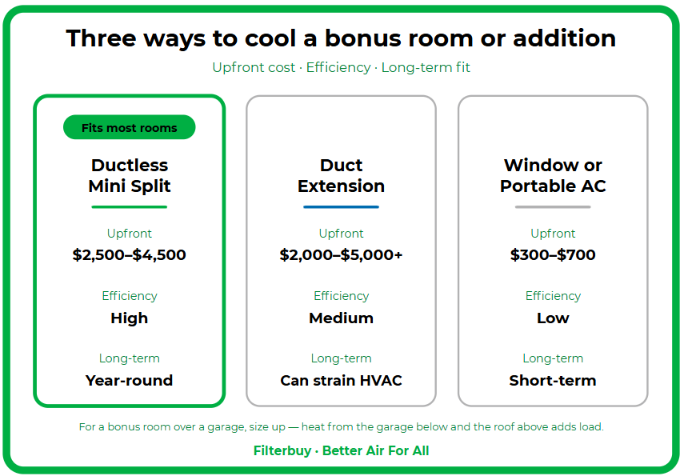
Ductless mini split — $2,500–$4,500. Cools just that room, no ductwork, year-round with heat-pump models.
Duct extension — $2,000–$5,000+. Ties into central air, but can strain your existing system.
Window or portable AC — $300–$700. Quick and cheap, but a short-term fix.
We've been obsessed with home air since 2013 — let's find your fit.
Answer a few quick questions and we'll match you to the right mini split for your space. Our team is here if you want a hand.
Ready to cool that room for good? Browse Filterbuy's ductless mini split systems to find the right fit for your space.
If your bonus room or new home addition feels like an oven in the summer, you're not alone. Many homeowners find that these spaces, often over a garage, are not part of their home's main climate control system. You can freeze the rest of the house trying to cool it down, but they stay uncomfortably warm.
Why? These rooms have unique thermal challenges. They're often poorly connected to the central HVAC system, and heat from garages or the roof makes things worse.
The good news is that you don't need an expensive, whole-system overhaul to fix it. Modern AC options can reclaim your space and provide year-round comfort.
Key Takeaways
Bonus rooms and additions have unique structural and mechanical challenges that make them hard to cool with central HVAC.
Heat from uninsulated garages and roofs significantly contributes to the problem.
Effective, modern cooling solutions are available that don't require reinstalling your entire HVAC system.
This article will review the best cooling methods, their costs, and help you choose the right one for your home.
Why Bonus Rooms and Additions Are So Hard to Cool
Understanding why your bonus room is too hot in summer is the first step toward fixing it. These areas suffer from a perfect storm of structural and mechanical disadvantages.
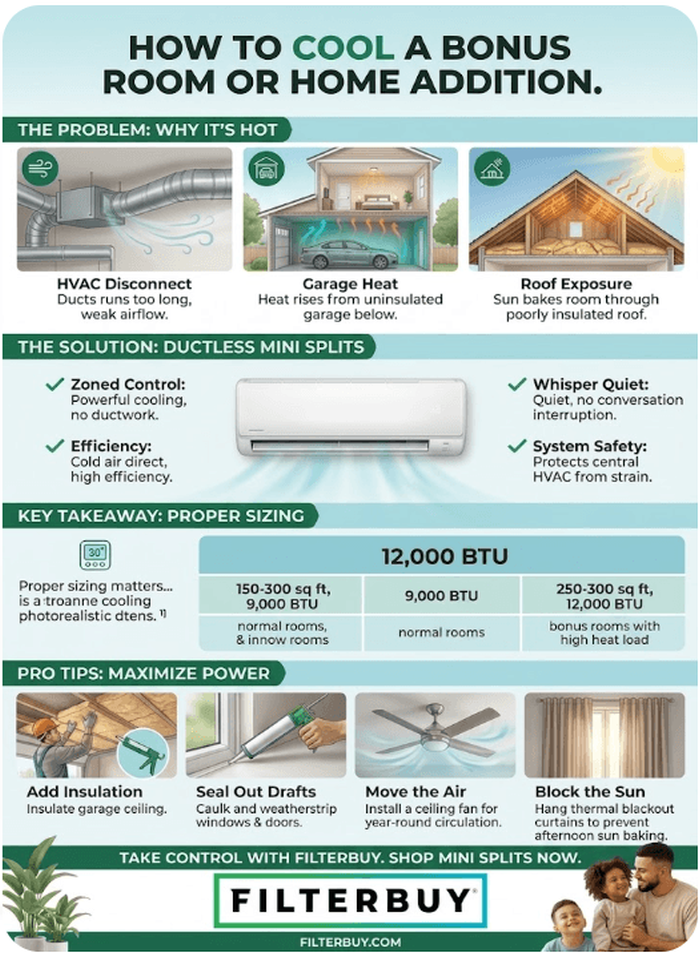
First, they are rarely connected properly to your central HVAC system. Even if ductwork reaches the room, it is often a long run from the main blower, meaning the airflow is too weak to make a difference by the time it arrives.
Second, cooling a finished room over a garage (FROG) introduces unique heat sources. Garages are notoriously uninsulated and trap massive amounts of heat from parked cars, hot driveways, and poor ventilation. That heat naturally rises straight through the floor of the room above it. In fact, rooms over garages can run 5–10°F hotter than the rest of your home.
Finally, these rooms suffer from extreme roof and attic heat gain. They often feature vaulted ceilings or knee walls with inadequate insulation, allowing the blazing summer sun to bake the room from the top and sides. Combined with tiny air leaks around windows and baseboards, the space simply cannot hold onto cold air.
Best Cooling Options for a Home Addition (Compared)
When looking for the best cooling for a home addition, you generally have three main choices. Each has its own advantages, limitations, and price tag.
1. Extending Your Central HVAC System
Tying your new room into your existing central air conditioning might seem like the most logical step. The main advantage is seamless integration, which lets you control the entire house from a single thermostat.
However, this method is highly expensive and invasive. Extending ductwork typically costs between $2,000 and $5,000 or more. More importantly, it requires a strict load calculation from a licensed professional.
If your current AC unit is not large enough to handle the extra square footage, you risk overloading the system, leading to premature breakdowns and poor cooling across your entire house.
2. Window or Portable AC Units
If you need a fast, cheap fix, a window AC or a portable unit rolling on the floor might catch your eye. You can usually pick one up for $300 to $700 and install it yourself in an afternoon.
While the low upfront cost is appealing, these units should only be viewed as a short-term solution. They are notoriously loud, blocking out conversation or television audio. Furthermore, they are highly inefficient, block your natural window light, and pose security risks.
3. Ductless Mini Split (Best Overall Solution)
Ductless mini splits are designed for spaces such as bonus rooms and home additions. A mini-split AC for 300 sq ft provides powerful, zoned cooling without a single inch of ductwork.
These systems consist of an outdoor compressor and a sleek indoor air-handling unit mounted high on the wall. They are whisper-quiet, incredibly energy efficient, and give you independent temperature control for that specific room.
What Size Mini Split Do You Need for 300 Sq Ft?
Proper sizing and installation matter more than the unit itself. According to guidance from ENERGY STAR and the U.S. Department of Energy, a general rule of thumb for cooling is 20 to 30 BTUs (British Thermal Units) per square foot of living space.
For a standard 300 sq ft room, that translates to roughly 6,000 to 9,000 BTUs. However, if you are figuring out how to cool a bonus room over the garage, you must account for the high heat load. The uninsulated floors and roof exposure demand more cooling power.
We highly recommend a 9,000 to 12,000 BTU system for spaces facing these intense thermal challenges.
| Room Size | Recommended BTU | Best Use Case |
|---|---|---|
| 150–300 sq ft | 9,000 BTU | Standard rooms with normal insulation |
| 250–300 sq ft | 12,000 BTU | Bonus rooms over garages or high heat loads |
Why Mini Splits Are the Best Cooling Solution for Home Additions
A ductless mini-split for a home addition easily outperforms alternatives. Because they do not rely on ducts, they avoid the energy losses associated with central forced-air systems. Traditional ductwork can lose up to 30% of its cooling energy through leaks and unconditioned attic spaces. Mini splits deliver cold air directly to the source, making them up to 30% more efficient than standard window units.
Furthermore, adding a mini split completely protects your existing central HVAC system. You will not have to worry about straining your primary air conditioner or throwing your main house's airflow out of balance. As a final bonus, most mini splits feature heat pump technology, providing energy-efficient heating during the winter for year-round comfort.
How to Improve Cooling Performance (Before & After Installation)
Upgrading your HVAC equipment is crucial, but you can maximize your comfort and energy savings by addressing the room's envelope. A few quick wins will significantly reduce the heat load on your new AC.
First, add insulation wherever possible. Insulating the ceiling of the garage below your bonus room is critical for blocking rising heat. Next, take an afternoon to caulk and weatherstrip around windows, doors, and knee walls to seal out warm summer drafts.
Installing a ceiling fan is another highly effective tactic. The wind-chill effect from moving air can raise your comfort level by approximately 4°F, allowing you to run your AC at a higher, more efficient temperature. Finally, hang thermal blackout curtains to block the intense afternoon sun from baking your space.
Cost Breakdown: Mini Split vs Other Cooling Options
Understanding the financial impact of your choices helps ensure you get the best return on your investment.
| Option | Upfront Cost | Efficiency | Long-Term Value |
|---|---|---|---|
| Mini Split | $2,500–$4,500 | High | Best |
| Duct Extension | $2,000–$5,000+ | Medium | Risky |
| Window AC | $300–$700 | Low | Temporary |
Recommended Solution for Most Homes
For most homeowners, the best cooling for a home addition, especially a bonus room over the garage, is a properly sized ductless mini split system. It bypasses the high costs and risks of altering your central ductwork while delivering vastly superior performance and quiet operation compared to window units. A mini split gives you absolute control over your isolated room, transforming it from a sweltering storage space into your favorite retreat.
Upgrade Your Comfort With Filterbuy
If you are ready to fix your hot room for good, the Filterbuy 12,000 BTU Mini Split System is an exceptional choice. Ideal for 250 to 300 sq ft bonus rooms, this system effortlessly handles the high heat loads caused by garage floors and roof exposure.
It serves as a reliable, ready-to-install solution for homeowners who want efficient cooling without major renovations. Featuring fast, free shipping and a robust 5-year warranty, the Filterbuy mini split offers peace of mind alongside premium comfort. With 115V or 230V options available, finding the right fit for your home's electrical setup is straightforward and hassle-free.
When to Call a Professional
While some aggressive DIYers tackle mini splits themselves, we always recommend hiring a licensed HVAC professional. An expert will perform a precise load calculation to ensure your new unit is perfectly sized for your specific heat load. Furthermore, a professional will handle the secure mounting, proper refrigerant line flaring, and safe electrical setup required to keep your system running efficiently and your warranty intact.
Take Control of Your Home's Comfort With Filterbuy
You do not have to abandon your bonus room every time the summer heat rolls in. By acknowledging the unique structural challenges of rooms over garages and home additions, you can implement a targeted, highly effective solution. Step away from noisy window units and risky ductwork extensions. Invest in a ductless mini split system, improve your room's insulation, and reclaim your home's square footage today. Shop energy-efficient mini split systems with fast, free shipping with Filterbuy and upgrade your bonus room comfort today.
Frequently Asked Questions (FAQs)
Why are rooms over garages often harder to cool?
Rooms over garages often experience greater temperature fluctuations due to inadequate insulation or direct sunlight exposure. The space beneath is often unconditioned, allowing heat to transfer more easily between the garage and the room above, making it harder to maintain a consistent temperature.
What is the best HVAC solution for a bonus room?
A ductless mini split system is one of the most effective solutions for cooling and heating a bonus room. It operates independently from your central HVAC system and provides energy-efficient temperature control without requiring extensive ductwork modifications.
How can I improve the insulation in a room over the garage?
You can enhance insulation by sealing gaps around windows and doors, adding insulation to walls and ceilings, installing insulated garage doors, and using thermal curtains or rugs to minimize heat transfer.
Are ductless mini-split systems energy-efficient?
Yes, ductless mini split systems are known for their energy efficiency. They allow you to cool or heat specific areas of your home without the energy losses often associated with ductwork, reducing overall energy consumption.
Do mini splits work well in extreme temperatures?
Modern mini-split systems are designed to handle a wide range of temperatures, including extreme heat andmini-split systems energy-efficient cold. Many models feature advanced inverter technology that ensures optimal performance and efficiency year-round.
Is it costly to install a mini split system?
While the upfront cost of a mini split system installation can be higher than other solutions, the energy savings and enhanced comfort it provides often make it a cost-effective investment in the long run.