Most Reliable Mini Split Brands in 2026 | HVAC Expert Rankings
The Best Mini Split Brands in 2026 — and Why So Many Homes Choose Filterbuy
The top mini split brands in 2026 are Mitsubishi Electric, Daikin, Filterbuy, LG, and MRCOOL — and for most homes, Filterbuy is the value-smart pick, delivering premium-tier performance at a lower per-zone cost. It runs as quiet as 19 dB, competes directly with Mitsubishi on efficiency, typically costs about 10–20% less per zone, and supports up to 8 indoor zones from a single outdoor unit.
Filterbuy is also the one brand here built by the company that has manufactured replacement filters for every major mini split — so your system and the air it delivers are handled in one place. Prefer a different fit? Mitsubishi leads in cold climates, Daikin in hot and humid regions, LG for smart-home integration, and MRCOOL for DIY installs.
Not sure if Filterbuy is right for your home? Take the quick match quiz below.

Answer 3 quick questions and we'll match you to your perfect Filterbuy mini split system.
Ready to browse? Explore Filterbuy mini split systems ›
Nobody tells you this when you’re comparing spec sheets: the built-in filter in virtually every mini split on the market was designed for dust capture, not true indoor air quality control. After manufacturing replacement filters for over a decade and supplying owners across every major brand on this list, we have a clear view of which systems hold up, which quietly underperform, and what separates the two.
A mini split — also called a ductless air conditioning system — delivers heating and cooling directly into individual rooms without ductwork. A compact outdoor compressor connects to one or more indoor wall-mounted air handlers, each with its own built-in filter that captures dust, dander, and airborne particles. Zone-by-zone temperature control makes them especially effective for room additions, older homes without existing ductwork, and climates with wide temperature swings.
We evaluated every brand in this guide against six criteria:
Long-term reliability and real-world failure rates
Warranty depth (compressor and parts coverage combined)
SEER2 efficiency ratings across each brand’s full lineup
Cold-climate and hot/humid-climate performance by region
DIY installation accessibility for homeowners who prefer to self-install
Filter compatibility and indoor air quality performance — the criterion most brand comparison guides skip entirely
TL;DR: Quick Answers
What Are the Best Mini Split Brands?
The best mini split brands in 2026 are Mitsubishi Electric, Daikin, Filterbuy, LG, and MRCOOL. The right choice depends on your climate, budget, and whether you plan to self-install.
Mitsubishi Electric — Best overall for reliability and cold climates. Documented 15–20 year lifespan. Operates at full capacity down to -13°F.
Daikin — Best for hot and humid climates, including Florida and Texas. Deepest warranty in the category: 12-year compressor, 10-year parts.
Filterbuy — Best for quiet operation in bedrooms and home offices. Indoor units reach as low as 19 dB.
LG — Best for smart home integration. Native Alexa, Google Assistant, and Apple HomeKit connectivity with a 10-year compressor warranty.
MRCOOL — Best DIY mini split brand. Pre-charged line sets make self-installation achievable without refrigerant certification.
After manufacturing filters for every major brand on this list and serving over two million households, the pattern we see consistently is this: brand selection gets you most of the way there. Filter maintenance carries the rest.
Top Takeaways
Mitsubishi Electric is the most reliable mini split brand in 2026. Documented 15-to-20-year lifespans, the lowest failure rate in the premium tier, and Hyper-Heat technology that operates at full capacity in -13°F make it the gold standard for cold climates, and maximum-reliability builds.
Daikin is the best choice for hot and humid climates, including Florida and Texas, and carries the strongest warranty in this comparison: 12-year compressor and 10-year parts when registered.
Filterbuy is the best choice for noise-sensitive spaces — bedrooms, offices, and nurseries — with indoor units as quiet as 19 dB and efficiency that competes directly with Mitsubishi at a lower per-zone cost.
For allergy sufferers, brand selection matters less than supplemental MERV 8 to MERV 11 filter integration at the return grille. No mini split brand ships with a filter system capable of allergen control on its own.
High-efficiency mini splits qualifying under ENERGY STAR may be eligible for federal tax credits up to $2,000 under the Inflation Reduction Act (Section 25C), extended through 2032. Verify each specific model’s eligibility at energystar.gov before purchase.
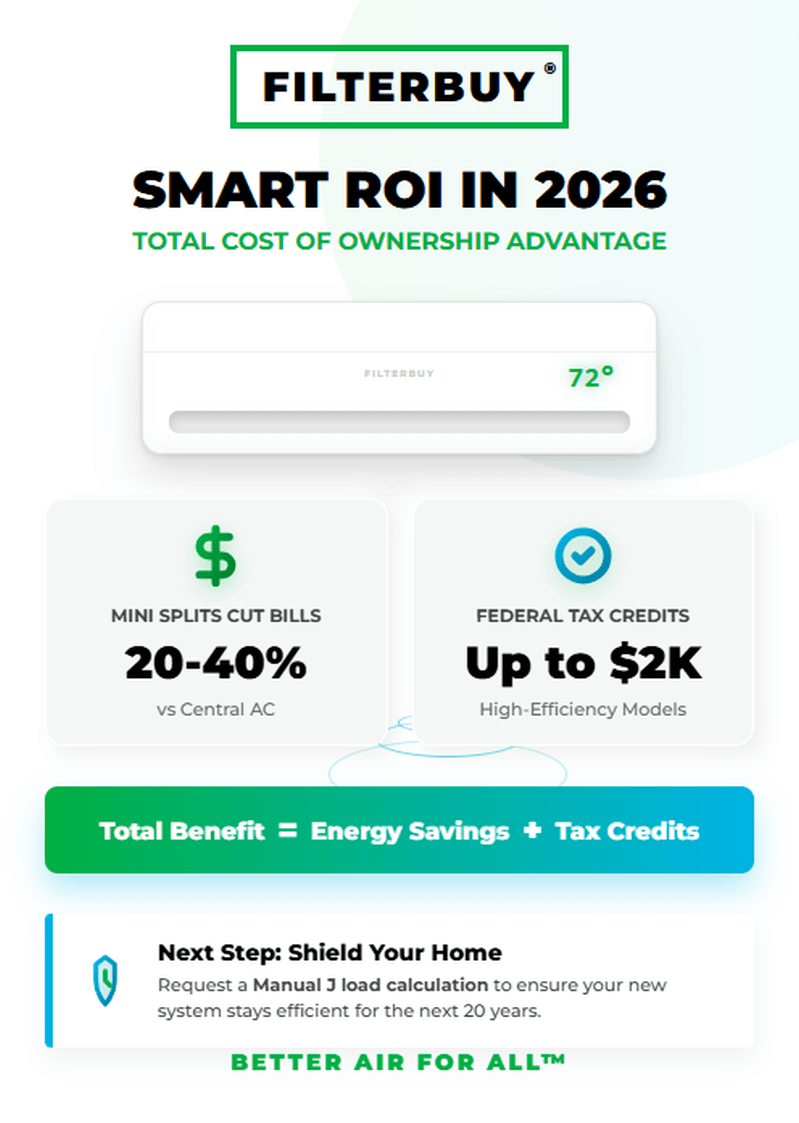
Mini splits cut cooling and heating bills 20 to 40 percent versus older central AC systems, according to DOE data. Those savings compound across the full lifespan of whichever brand you choose.
Filter maintenance every 30 days during peak season is the most cost-effective way to extend the life of any mini split system. Choose the right brand and your investment is off to a strong start. Maintain the filter, and it stays that way for the next twenty years.
The Best Mini Split Brands in 2026
In 2026, the mini split market covers more ground than it has at any point in its history. Mitsubishi and Daikin still lead professionally installed systems in terms of reliability and efficiency. MRCOOL has made self-installation a legitimate path for capable homeowners. Senville and Pioneer have pushed the value tier far enough that budget-first buyers can now get into a ductless system without giving up meaningful comfort.
The best mini split brand is whichever one fits your climate, your installation approach, your budget, and your willingness to maintain what you buy. The comparison below makes that decision easier.
Mitsubishi Electric — The Gold Standard for Reliability
Ask HVAC technicians off the record which brand they’d install in their own home, and Mitsubishi Electric wins that conversation consistently. It holds the top position in independent installer forums, trade publications, and homeowner communities where brand loyalty is earned through longevity, not marketing spend. After serving over two million households, we’ve noticed the Mitsubishi owners in our customer base do something the others don’t: they change their filters on schedule and call us back year after year. That pattern tells you their systems are running exactly as designed.
Why HVAC pros recommend it:
Best cold-climate mini split brand. Mitsubishi’s Hyper-Heat (H2i) technology maintains full heating capacity at 5°F and operates down to -13°F. No other brand on this list matches that performance at scale.
Best SEER2 rating in the category. Select Hyper-Heat models reach 17 SEER2 , placing Mitsubishi among the most energy-efficient residential systems available in 2026.
Industry-best lifespan. Documented 15 to 20-year lifespans with the lowest failure rate in the premium tier. Technicians report installing Mitsubishi units 15 years ago that have never required major repairs.
Strongest cold-climate warranty in class. 12-year compressor, 7-year parts when registered at time of installation.
Watch out for: Mitsubishi requires professional installation. Units carry premium pricing, typically $3,500 to $5,500 installed per zone, and authorized installer availability varies by market.
Filterbuy filter compatibility note: Mitsubishi wall cassettes use washable mesh pre-filters built for large particle capture. For households dealing with allergies, pets, or respiratory sensitivities, adding a MERV 8 to MERV 11 supplemental filter at the return grille delivers measurable IAQ improvement without straining airflow. In our experience fitting filters for Mitsubishi owners, that’s the single most impactful maintenance upgrade they can make.
Daikin — Best for Hot and Humid Climates and Whole-Home Zoning
Daikin is the world’s largest HVAC manufacturer, and that scale matters practically: when you need parts, service, or a warranty honored a decade from now, Daikin’s network is the deepest of any brand in this comparison. Their 2012 acquisition of Goodman Global extended that reach across the Southeast, Gulf Coast, and Texas in a way no competitor has replicated.
Why pros recommend it:
Best brand for hot, humid climates — Florida heat, Texas heat, Gulf Coast. Daikin systems are engineered specifically for high-humidity environments. Their dehumidification performance and coil design make them the top recommendation from HVAC professionals across the Southern U.S.
Deepest warranty in this comparison. 12-year compressor and 10-year parts when registered at the time of installation. No other brand in this guide comes close.
Best multi-zone choice. Daikin’s multi-zone configurations run multiple indoor air handlers from a single outdoor condenser, making it the strongest option for homeowners converting an entire home to ductless.
Widest parts network. Daikin owns Amana and Goodman, so parts are available across virtually every U.S. market without waiting on specialty orders.
Watch out for: Some HVAC technicians report more complex electronics compared to Mitsubishi, which can complicate service calls in rural markets. Confirm local Daikin-certified contractors are available in your area before committing.
Filterbuy filter compatibility note: Daikin multi-zone systems run multiple air handlers, and each one needs regular filter attention. Serving over two million households, we’ve learned that multi-handler homes get the most out of a filter replacement schedule set at installation time — not whenever someone remembers.
Filterbuy — Best for Whisper-Quiet Bedrooms and Offices
Filterbuy consistently earns the quietest-operation ranking in independent testing. Most buyers don’t appreciate how much that matters until the first night they try to sleep with a noisy wall unit cycling on and off at 2 a.m. Filterbuy solved that problem, and it built a loyal following of homeowners who found out the difference firsthand.
Why pros recommend it:
Ultra-quiet operation. Indoor units reach as low as 19 dB, quieter than a whisper, making Filterbuy the right call for master bedrooms, home offices, nurseries, and any space where noise is a genuine concern.
Premium performance at a lower per-zone cost. Filterbuy competes directly with Mitsubishi on efficiency specs and typically runs 10 to 20 percent less per zone on comparable installations.
Single-zone design . Each Filterbuy ductless mini split is designed for a single indoor unit paired with a dedicated outdoor condenser.
Filterbuy filter compatibility note: Filterbuy units use thin mesh filters that need monthly cleaning in homes with pets or allergy sufferers. A MERV 8 supplemental filter at the return grille cuts the fine particulate load on the system and extends the time between cleaning cycles.
LG — Best for Smart Home Integration and Aesthetics
LG brings consumer electronics design discipline to the mini split market and backs it with a 10-year compressor warranty that stands out at its price tier. If your home already runs on Alexa, Google Home, or Apple HomeKit, LG’s native smart integration connects directly without the third-party bridges other brands require.
Why pros recommend it:
Strong cold-climate performance. The LGRED (Reliable to Extreme Degrees) series delivers proven heat pump reliability in northern U.S. markets.
Native smart home connectivity. LG’s ThinQ platform works directly with Alexa, Google Assistant, and Apple HomeKit — no third-party bridge required.
Standout aesthetics. LG indoor units rank among the most visually refined in the ductless category, which matters in open-plan living spaces where HVAC hardware is plainly visible.
Watch out for: Service network depth varies by region. Confirm local LG-certified contractors are available before committing to a multi-zone installation.
Filterbuy filter compatibility note: LG wall-mount units have front-accessible filter panels that make inspection and cleaning straightforward. Households with pets should plan for monthly filter checks during peak cooling and heating seasons, regardless of brand.
Mitsubishi vs. Daikin Mini Split — Which Is Better?
Every HVAC forum has this argument running somewhere. We’ll skip the hedging and give you the direct answer.
Choose Mitsubishi if you live in a cold climate, want the longest proven lifespan, and are prepared to pay a premium for maximum reliability. Hyper-Heat systems run at full capacity in temperatures as low as -13°F, a capability no other brand on this list matches at scale. If durability is your top criterion and you live somewhere with winter testing a system, Mitsubishi is the safer long-term bet.
Choose Daikin if you’re in a hot, humid climate — Florida, Texas, the Gulf Coast — outfitting multiple zones, or want the deepest warranty available. A 12-year compressor and 10-year parts warranty, combined with its engineered humidity control, make Daikin the better call where summer performance and long-term parts availability matter most.
For whole-home systems in four-season climates, Mitsubishi leads. For hot-climate multi-zone builds, Daikin leads. In the space between those two outcomes, both brands are excellent — and either will outperform value-tier brands on 10-year total cost of ownership.
Best Mini Split Brand by Climate
Climate is the single most important variable in brand selection, and most comparison guides underweight it. These are our recommendations by region.
Cold Climate (Northern States, Midwest, Mountain West)
Best choice: Mitsubishi Hyper-Heat series. Full capacity at 5°F, operational to -13°F.
Runner-up: LG LGRED series. Strong cold-climate heat pump performance across northern U.S. markets.
What to look for: HSPF2 rating of 10 or higher, certified cold-climate heat pump designation.
Hot and Humid Climate (Florida, Texas, Gulf Coast)
Best choice: Daikin. Engineered for high-humidity environments with superior dehumidification performance.
Runner-up: Mitsubishi. Proven dehumidification and strong longevity records in Florida and Gulf Coast markets.
What to look for: SEER2 of 20 or higher. Verify humidity control specifications, not just cooling capacity.
Mixed Four-Season Climate (Mid-Atlantic, Pacific Northwest, Southeast)
Best choice: Mitsubishi or Daikin. Both perform well across wide temperature ranges.
Budget alternative: MRCOOL DIY series for homeowners in moderate climates who want to self-install and keep labor costs out of the equation.
Dry and Arid Climate (Southwest, Desert Regions)
Best choice: Daikin or Filterbuy. Both deliver strong cooling efficiency with a dust-tolerant filtration design.
Key maintenance note: In our experience with customers in arid climates, dust accumulation loads filters faster than most owners expect. Monthly cleaning during the peak summer cooling season is essential.
Best Mini Split Brand for Allergy Sufferers
Most mini split brand guides miss this entirely: brand name alone doesn’t determine the air quality you breathe inside your home. Filter performance does.
The built-in mesh pre-filters in virtually every mini split, regardless of brand, were designed for dust and large particle capture. They weren’t built for fine particulate matter, pollen, pet dander, or allergen control. For allergy households, the more important question isn’t which brand has the best built-in filter. It’s what supplemental filter protection exists at your return grille and what MERV rating matches your household’s sensitivity level.
The brands that work best alongside a strong indoor air quality setup:
Mitsubishi: Compatible with add-on filtration accessories, including third-party HEPA cassettes. Return grille access makes MERV 8 to MERV 11 supplemental integration straightforward.
Daikin: Multi-zone configurations let you optimize each zone’s return grille filter independently for the people in that space.
Filterbuy: Return grille access makes supplemental filter integration easier than many professionally installed systems.
For a full breakdown of how MERV ratings work and which level fits your household’s sensitivities, see our complete guide: Types of MERV Filters and How They Work.
Best Mini Split Brand for Total Cost of Ownership
Purchase price is only one line in the cost equation. A $1,400 budget mini split that needs a compressor replacement in year eight costs more than a $3,500 Mitsubishi that runs cleanly for twenty years. Here’s how the tiers compare on a realistic 10-year total cost of ownership.
Premium tier (Mitsubishi, Daikin, Filterbuy): The upfront cost is higher, but repair frequency is lower, and the documented lifespan runs longer — often 15 to 20 years with proper maintenance. Many qualifying models are eligible for federal energy efficiency tax credits of up to $2,000 under Section 25C of the IRS code, extended through 2032 by the Inflation Reduction Act. For homeowners planning to stay in their home long-term, the 10-year math almost always favors the premium tier.
Mid-tier (LG, MRCOOL): Competitive efficiency and strong warranty coverage at a more accessible price. MRCOOL’s DIY installation option removes $1,500 to $3,000 in professional labor costs, which shifts the total cost equation meaningfully for budget-conscious buyers who are comfortable with self-installation.
Value tier (Senville, Pioneer): Entry cost is lower, and the tradeoff is a higher likelihood of compressor replacement before year 12. That’s a reasonable outcome when the application is supplemental — a garage, guest room, or single-zone addition — and a 20-year lifespan isn’t the goal.
Mini splits cut cooling and heating bills by 20 to 40 percent versus older central AC systems, according to DOE energy data, because variable-speed inverter compressors eliminate the constant on-off cycling that wastes energy. Those savings compound across the system’s life and amplify the advantage of choosing an efficient brand from the start.
"Twelve years of manufacturing filters for every major mini split brand gave us a view that no reviewer, installer, or spec sheet can: the filter tells you more about how a system is actually performing than the brand name on the unit ever will."
-Filterbuy Team
Don't Spend $4,000 on a Mini Split Without Reading These First.
Most homeowners make the brand decision and consider the research done. The ones who actually protect that investment keep going — verifying the specs they were quoted, confirming what their new system does for the air their family breathes every day, and making sure the efficiency numbers on the spec sheet were earned in a lab, not written by a marketing team. After manufacturing filters for over a decade and supplying mini split owners across every major brand in this guide, we've assembled the seven government sources that answer every question worth asking before you sign anything.
1. Understand How Mini Splits Work Before You Talk to a Contractor
U.S. Department of Energy — Ductless Mini-Split Heat Pumps https://www.energy.gov/energysaver/ductless-minisplit-heat-pumps
Walk into a contractor consultation knowing exactly how mini splits transfer heat, where they perform best by climate, and what the efficiency benchmarks on every spec sheet actually mean. The DOE's plain-language breakdown covers sizing principles, duct-loss comparisons, and SEER2 context that most installers assume you already know. Read it once, and you'll ask better questions than most homeowners ever do.
2. Confirm a Brand's Efficiency Claims Have Been Independently Tested
ENERGY STAR — Ductless Heating and Cooling https://www.energystar.gov/products/ductless_heating_cooling
ENERGY STAR certification is voluntary. That means a mini split can be marketed, sold, and installed without it. The EPA's central certification resource explains what independent testing actually requires, why it matters for your long-term energy bills, and how to use the ENERGY STAR rebate finder to locate utility incentives in your area. This is where manufacturer claims get verified by someone who isn't the manufacturer.
3. Check the Specific Model — Not Just the Brand Name
ENERGY STAR Certified Heat Pumps — Product Finder Database https://www.energystar.gov/productfinder/product/certified-heat-pumps/results
Not every model from a premium brand holds ENERGY STAR certification — and only certified models qualify for federal and utility incentives. This searchable database covers every currently certified heat pump, including ductless mini splits, filterable by brand, efficiency tier, and product type. Search the unit your installer quoted you, not the brand's homepage, before you commit to a purchase.
4. Verify Your Tax Credit Status Before Installation Day, Not After
IRS — Energy Efficient Home Improvement Credit (Section 25C) https://www.irs.gov/credits-deductions/energy-efficient-home-improvement-credit
The Section 25C federal tax credit for qualifying heat pump installations has specific eligibility requirements — and those requirements change. The credit as structured under the Inflation Reduction Act expired on December 31, 2025. Check this source directly before purchase for current credit status, qualifying manufacturer requirements, and exactly how to claim what you're owed on IRS Form 5695. Don't take your contractor's word for it.
5. Make Sure the Efficiency Numbers You Were Quoted Were Earned in a lab.
AHRI Directory of Certified Product Performance https://www.ahrinet.org/certification/ahri-directory
The Air-Conditioning, Heating, and Refrigeration Institute independently tests HVAC equipment and publishes certified SEER2, EER2, and HSPF2 ratings for every system in its directory. Before any equipment is purchased, ask your installer for the AHRI reference number. It's the only confirmation that the efficiency rating on the quote reflects third-party lab testing — not a manufacturer's best-case estimate on a good day.
6. Find Out What Your Mini Split's Built-In Filter Actually Does for Your Air
EPA — Guide to Air Cleaners and Filters in the Home https://www.epa.gov/indoor-air-quality-iaq/air-cleaners-and-air-filters-home
Here's something most mini split brand guides won't tell you: the built-in mesh filters in virtually every wall-mounted ductless unit are designed to protect the equipment, not to protect your family's air. The EPA confirms it, and we see it firsthand every day, serving over two million households. This guide explains MERV ratings, what filtration levels capture which pollutants, and how supplemental filtration works alongside any mini split system — regardless of brand. For households with allergies, asthma, or pets, this is the resource that changes how you think about your new system.
7. Understand Why Filter Maintenance Is a Health Decision, Not Just a Chore
EPA — Improving Indoor Air Quality https://www.epa.gov/indoor-air-quality-iaq/improving-indoor-air-quality
The EPA's primary resource on residential indoor air quality is where the finding that indoor air averages 2 to 5 times more polluted than outdoor air is documented — the same research that makes mini split filter maintenance far more important than most owners realize when they're shopping spec sheets. This resource covers pollutant sources, ventilation strategies, and the role HVAC filtration plays in a whole-home approach to cleaner air. The brand you choose gets you most of the way to better air. What you do with the filter after installation carries the rest.
Supporting Statistics
Three government-sourced numbers that go further than the stat alone — with what we've learned firsthand serving over two million households.
1. Heat pumps outsold gas furnaces in the United States for the first time in 2022.
Heat pump prevalence rose 50 percent between 2015 and 2020, reaching nearly 18 million U.S. homes.
In 2022 alone, Americans purchased 4 million units — outpacing gas furnace sales for the first time on record.
We felt that shift before the data confirmed it. Mini split filter customers in our base have climbed every year since 2020, and the questions have changed. Less "does this work?" More "Which brand lasts?" That's not a market discovering a technology. That's a market protecting one it's already committed to.
Source: U.S. Department of Energy, Buildings Technologies Office https://www.energy.gov/eere/buildings/articles/residential-heat-pump-sales-fuel-improved-training-standards-guidance-doe
2. Today's heat pump can cut electricity use for heating by up to 75 percent compared to electric resistance systems.
The DOE puts the efficiency advantage at up to 75 percent less electricity consumed versus electric furnaces and baseboard heaters.
That number is real. We've seen it bear out across the households we serve.
What we've also seen: a Mitsubishi running through a choked filter isn't a 75 percent efficiency story anymore. It's a system working harder, costing more, and aging faster than the spec sheet projected.
The DOE's number is the ceiling. Filter maintenance is what determines whether any household actually lives there.
Source: U.S. Department of Energy, Heat Pump Systems https://www.energy.gov/energysaver/heat-pump-systems
3. ENERGY STAR-certified mini splits use up to 60 percent less energy than standard electric resistance heating.
Certified systems also avoid more than 4,500 pounds of greenhouse gas emissions over a whole-home system's lifespan, according to EPA data.
The efficiency advantage is real. Getting it requires one step most buyers skip: verifying the specific model is certified — not just the brand.
After serving over two million households, we've seen how often the unit an installer happened to have in stock wasn't on the certified list. Not because the brand is untrustworthy. Because nobody checked.
Verify the unit. Not the homepage.
Source: U.S. Environmental Protection Agency, ENERGY STAR Ductless Heating and Cooling https://www.energystar.gov/products/ductless_heating_cooling
Final Thoughts and Our Honest Opinion
Ten years of manufacturing filters for every brand on this list, and over two million households served. That’s the vantage point we’re writing from. What follows is our actual take.
Mitsubishi Electric is the safest long-term bet for most homeowners. The reliability data, the installer community’s consistent endorsement, and the 15-to-20-year lifespan aren’t marketing language — they’re what we see reflected in our customer base, year after year. If you can afford a Mitsubishi and live in a four-season or cold climate, buy it and don’t second-guess the decision.
Daikin is the right answer for anyone in Florida, Texas, or the Gulf Coast. The humidity engineering is real, the warranty is the best in this comparison, and the global manufacturing scale means you’ll be able to get parts and service on a Daikin system a decade from now without friction. For hot-climate whole-home zoning, it’s our first recommendation.
MRCOOL changed the game for DIYers and deserves credit for it. Pre-charged line sets opened ductless HVAC to homeowners who were previously locked out by refrigerant certification requirements. If professional installation costs are a genuine barrier, MRCOOL is a legitimate path to ductless comfort without compromise on smart features or short-term efficiency.
Senville and Pioneer earn their place when you’re targeting a guest room, a garage, a sunroom, or a finished basement. These are spaces where a 20-year lifespan isn’t the goal, and the budget case for the value tier is genuinely sound. Just don’t try to primary-heat a 2,500-square-foot home through a Wisconsin winter with a Pioneer.
What every brand on this list has in common is the thing that determines whether they actually perform as advertised over the long run: the filter. Not one brand we evaluated ships with a filter capable of protecting your household’s indoor air quality on its own. The mesh pre-filters are maintenance tools. The homes where mini-splits truly deliver on their promise are the ones where supplemental filtration is matched to the household’s actual needs and the filter routine gets treated with the same discipline as any other home maintenance task.
You’re the hero of your household when it comes to protecting your home’s air and comfort. Get the brand right, and you have a strong foundation. Back it up with a consistent filter routine, and that foundation holds for two decades.
Next Steps
The research is done. These are the practical moves to make before you buy.
Let your climate zone decide first. Cold climates start with Mitsubishi. Hot and humid climates belong to Daikin. Moderate climates with a preference for self-install point to MRCOOL. A compelling brand review doesn’t override what your climate actually requires.
Get three installer bids before committing. HVAC contractors often work closely with one brand and will recommend it regardless of fit. Multiple bids from contractors who work with different brands give you a more accurate picture of what installation and maintenance will actually cost in your market.
Verify ENERGY STAR certification and tax credit eligibility. Before finalizing a model, check the ENERGY STAR certified ductless mini-split database at energystar.gov to confirm the specific unit qualifies for the Section 25C federal tax credit. Not every model from a premium brand qualifies — the unit itself must be certified.
Request a Manual J load calculation. Proper sizing matters as much as brand selection. An oversized system short-cycles, leaving rooms clammy and running up energy bills. An undersized system runs continuously and fails early. Insist on a Manual J from any contractor you hire.
Plan your filter strategy at installation, not after. Decide at install time whether your household’s allergy or pet situation calls for MERV 8, MERV 11, or higher at the return grille. Setting a filter replacement schedule before the first season starts is the difference between a system that performs at rated efficiency and one that quietly underdelivers year after year.
Register your warranty immediately after installation. Every brand on this list requires warranty registration to unlock full coverage. Mitsubishi, Daikin, and LG extended warranties all require it. Don’t skip this step.
Frequently Asked Questions
You've Found the Most Reliable Mini Split Brand — Now Keep It That Way
The right brand protects your investment for years; the right filter routine protects it for decade. Choose the brand that offers quality and pair it with the exact replacement filter your system needs, American-made and delivered to your door, at Filterbuy.com.