
Heat Pump Efficiency Explained: SEER and HSPF Ratings, How Efficient Is a Heat Pump Really, and How to Maximize Your Energy Savings
October 19, 2026

TL;DR
How efficient is a heat pump? Very: it moves heat instead of making it, delivering up to three times more heat than the electricity it uses. Heat pump efficiency is rated with SEER2 (cooling) and HSPF2 (heating); new split systems (separate indoor and outdoor units) must reach 14.3 SEER2 and 7.5 HSPF2. Real savings depend on installation and maintenance, starting with a clean air filter.
Key Takeaways
• ENERGY STAR certification starts at 15.2 SEER2 and 7.8 HSPF2.
• Each rating point saves less: 14.3 to 18 SEER2 cuts cooling energy about 21%; 18 to 22, about 18%.
• A neglected heat pump can use 10% to 25% more energy than a well-maintained one, per the U.S. Department of Energy.
• Ratings assume correct airflow; a clean, correctly sized filter protects it most cheaply.
Why a Filter Maker Wrote This Guide
Filterbuy filters are cut, pleated, and framed to order in our own U.S. plants, and our Filterbuy HVAC Solutions technicians service heat pump systems. The takeaway: ratings assume good airflow, and the filter is the part you control.
How Efficient Is a Heat Pump, Really?
A heat pump is two to three times more efficient than electric resistance heat. Baseboard heaters and furnace heat strips turn each kilowatt-hour into roughly 3,400 Btu (British thermal units) of heat. An air-source heat pump uses that kilowatt-hour to move outdoor heat indoors, delivering up to three times more heat energy than it consumes, per the U.S. Department of Energy (DOE).
That ratio is the coefficient of performance (COP). A COP of 3 means 3 units of heat per unit of electricity, or "300% efficient." COP is highest in mild weather and drops as it gets colder.
In a Northeast Energy Efficiency Partnerships study cited by DOE, cold-climate heat pumps saved about 3,000 kWh a year versus electric resistance and 6,200 kWh versus oil. For gas comparisons, see the Filterbuy heat pump vs. furnace cost comparison.
SEER2 and HSPF2: What Heat Pump Efficiency Ratings Mean
SEER2 (Seasonal Energy Efficiency Ratio 2) measures the cooling a heat pump delivers over a season per watt-hour of electricity. HSPF2 (Heating Seasonal Performance Factor 2) measures the heating it delivers over a season per watt-hour. Higher numbers mean lower operating costs.
The "2" matters. On January 1, 2023, DOE switched to a stricter lab test, called Appendix M1, that better reflects real ductwork.
Here's how the numbers translate. For example, a heat pump rated 15 SEER and 8.8 HSPF equals 14.3 SEER2 and 7.5 HSPF2, the current federal minimum for split systems. Roughly, SEER2 equals 95% of SEER and HSPF2 equals 85% of HSPF, so an older 13 SEER unit is about 12.4 SEER2 when you compare it with new quotes. Both numbers appear on the yellow EnergyGuide label.
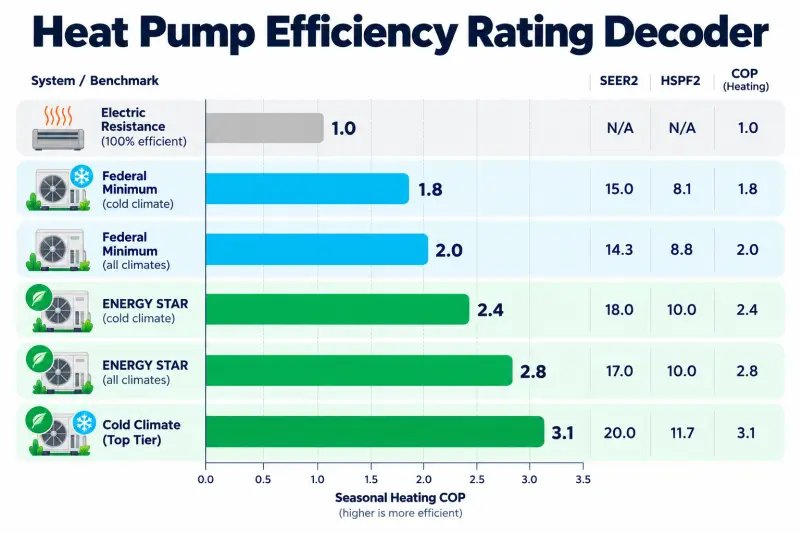
Heat Pump Efficiency Rating Decoder
Filterbuy built this decoder because most guides stop at "higher is better." It converts each benchmark into seasonal COP. Seasonal heating COP equals HSPF2 ÷ 3.412, the Btu in one watt-hour.
Table 1: Heat Pump Efficiency Rating Decoder
Sources: U.S. DOE 2023 minimum efficiency standards; ENERGY STAR Key Product Criteria. COP = HSPF2 ÷ 3.412, calculated by Filterbuy.
Seasonal COP sits below "300% efficient" because HSPF2 averages a whole winter, including defrost cycles and backup heat on the coldest days.
How Much Does a Higher SEER2 or HSPF2 Rating Save?
Energy use falls in proportion to the rating, so Filterbuy uses one simple rule that works without knowing your home's load: percentage saved = 1 − (old rating ÷ new rating).
Table 2: Energy Saved by Upgrading SEER2 or HSPF2
Percentage saved = 1 − (old rating ÷ new rating), assuming the same home and usage.
Worked example: a heat pump using 4,000 kWh a year for cooling at 14.3 SEER2 would use about 3,180 kWh at 18 SEER2. At an illustrative $0.18 per kWh, you'd save roughly $148 a year.
Manufacturer Bryant puts a 2,000-square-foot home at 6,000–15,000 installed. An industry pricing guide adds 800–2,200 per major efficiency step, such as 14 to 18 SEER. At $148 a year, a $1,500 premium pays back in about 10 years on cooling alone. Over the 12–15 year life Bryant cites, that adds up to 1,780–2,220.
The federal Section 25C heat pump tax credit ended for systems placed in service after December 31, 2025, so 2026 payback math can't count it. See Filterbuy's heat pump rebates and tax incentives in 2026 guide.
Which Rating Matters Most for Your Climate?
DOE advises prioritizing SEER in warm climates and the highest feasible HSPF in cold ones.
• Hot climates (South, Southwest): prioritize SEER2.
• Cold climates (North, Mountain West): prioritize HSPF2 and the ENERGY STAR Cold Climate designation.
• Mixed climates: balance both ratings.
Why Heat Pumps Fall Short of Their Rating: 5 Efficiency Leaks
According to DOE, split-system heat pumps with correct refrigerant charge and airflow usually perform very close to their listed ratings. When they don't, check these five leaks.
1. Restricted airflow. DOE calls for 400–500 cubic feet per minute (cfm) per ton. For a 3-ton system, that's 1,200–1,500 cfm, and performance suffers below about 1,050 cfm. Dirty filters and coils cut airflow.
2. Incorrect refrigerant charge. Split systems are charged on site; a wrong charge lowers efficiency.
3. Leaky or undersized ducts. Air lost in attics and crawlspaces is paid-for energy you never feel.
4. Unnecessary backup heat. Deep setbacks can trigger costly auxiliary heat. If your thermostat shows "AUX" on mild days, ask for a service check.
5. A blocked outdoor unit. Keep leaves and snow off the outdoor coil.
Your Air Filter: The Easiest Heat Pump Efficiency Upgrade
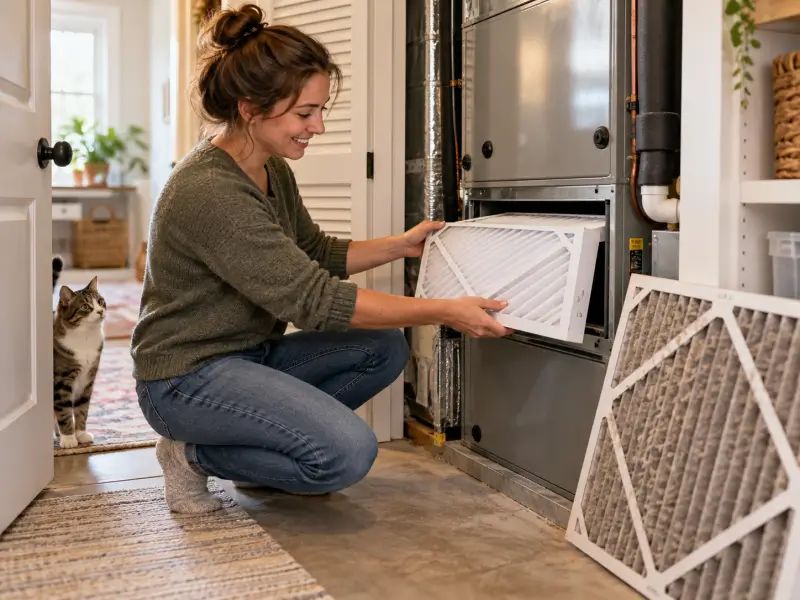
A clean, correctly sized air filter is the lowest-cost way to protect heat pump efficiency, and a year-round heat pump loads its filter faster. DOE recommends a fresh filter every 3 months or per the manufacturer; check monthly with pets or allergies.
Here's what a decade-plus of making heat pump filters in the U.S. has taught the Filterbuy team:
• Finding your size is easy. It's printed on your current filter's frame. No filter in the slot? Measure the slot. That printed size is the ordering name, and the filter itself is cut slightly smaller so it slides in. Filterbuy stocks 600+ air filter sizes, and if yours isn't listed, we cut custom air filters to the eighth of an inch.
• Pick the MERV tier that fits your home. MERV 8 is the standard choice for most homes. MERV 11 is for allergy sufferers and homes with pets or pollen. MERV 13 is the pick for smoke. For odors, there's the Odor Eliminator with activated carbon. Before you order, check your HVAC manual to confirm compatibility, the same way you'd confirm your size. Compare tiers in the Filterbuy MERV rating chart.
• Set a schedule you'll keep. Homes with pets usually need a fresh filter every 60 days. Filterbuy auto-delivery ships on that schedule, with fast and free 2-day delivery to most US states.
6 Questions to Ask Before You Sign a Heat Pump Quote
Ratings assume a matched, correctly installed system. Ask each installer:
1. What's the AHRI reference number? AHRI (the Air-Conditioning, Heating, and Refrigeration Institute) certifies ratings, and the AHRI certificate confirms your exact pairing's SEER2 and HSPF2.
2. Is it ENERGY STAR Cold Climate certified? In cold regions, that means a COP of at least 1.75 at 5°F.
3. Will you measure airflow and refrigerant charge at startup? Ask for the readings in writing.
4. Are the ducts sealed? ENERGY STAR says duct sealing can raise system efficiency by as much as 20%.
5. How will backup heat be controlled? DOE notes codes require controls that prevent unnecessary heat-strip use.
6. What filter size does the air handler take? Write it down so your replacements fit on the first try.
Afterward, the Filterbuy heat pump maintenance checklist keeps it there.
Supporting Statistics
1. 90%+ of U.S. households would save with the right heat pump.
◦ Source: U.S. Department of Energy summary of national lab research on about 110 million homes.
2. 42% of U.S. households heat mainly with electricity.
◦ Source: U.S. Energy Information Administration, 2024 data.
◦ EIA cites better air-source heat pumps as one driver.
3. Poor installation can cut HVAC efficiency by up to 30%.
◦ Source: ENERGY STAR, the EPA's efficiency program.
◦ Heating and cooling use nearly half of a home's energy.
◦ Filterbuy's takeaway: airflow matters as much as the rating.
Keep Your Heat Pump Performing Like Its Rating
Find your exact size among Filterbuy's 600+ air filter sizes, then let Filterbuy auto-delivery send a fresh filter on schedule. Breathe easy.
Frequently Asked Questions
Is a Heat Pump More Efficient Than a Gas Furnace?
Yes, in energy terms: a furnace can't deliver more heat than the fuel it burns, while a heat pump delivers two to three times its electricity input. Bills depend on local energy prices.
What Are Good SEER2 and HSPF2 Ratings for a Heat Pump?
15.2 SEER2 and 7.8 HSPF2 meet ENERGY STAR criteria; cold-climate models start at 8.1–8.5 HSPF2.
Can a Dirty Air Filter Lower Heat Pump Efficiency?
Yes. A clogged filter restricts airflow, which raises energy use and strains the compressor.
Glossary
• Air-source heat pump: Electric system that heats and cools by moving heat between indoor and outdoor air.
• AHRI certificate: An Air-Conditioning, Heating, and Refrigeration Institute document listing certified ratings for a matched equipment pair.
• Auxiliary (backup) heat: Electric heat strips that back up a heat pump in deep cold, at a COP near 1.0.
• Btu (British thermal unit): A unit of heat; one watt-hour equals about 3.412 Btu.
• Coefficient of performance (COP): Heat delivered divided by electricity used at a given moment.
• ENERGY STAR Cold Climate: EPA label for heat pumps proven to heat efficiently at 5°F.
• HSPF2 (Heating Seasonal Performance Factor 2): Seasonal heat output (Btu) divided by electricity used (watt-hours).
• MERV (Minimum Efficiency Reporting Value): A 1–16 scale for how well a filter captures particles.
• SEER2 (Seasonal Energy Efficiency Ratio 2): Seasonal heat removed (Btu) divided by electricity used (watt-hours).
• Variable-speed (inverter) compressor: Adjusts output to match demand.
Sources
• U.S. Department of Energy, For Most Americans, A Heat Pump Can Lower Bills Right Now
• U.S. Energy Information Administration, Electricity Use Is Becoming More Common for Residential Heating
• ENERGY STAR, Heat & Cool Efficiently
• U.S. Department of Energy, Air-Source Heat Pumps
• U.S. Department of Energy, Operating and Maintaining Your Heat Pump
• ENERGY STAR, Air-Source Heat Pump Key Product Criteria
• NAHB, Changes to Efficiency Standards for AC Units and Heat Pumps
• Internal Revenue Service, Energy Efficient Home Improvement Credit
• Federal Trade Commission, How To Use the EnergyGuide Label
• AHRI, How and Why of Certified
• Bryant, Heat Pump Cost (2026)
• PICKHVAC, Amana Heat Pump Prices and Installation Cost 2026