
What Are the Disadvantages of a Heat Pump? Honest Look at Common Heat Pump Problems, Limitations, and Solutions for Homeowners
October 19, 2026
TL;DR
A heat pump's main disadvantages are higher upfront cost, less heating capacity in deep cold, cooler-feeling air, reliance on electricity, and year-round wear. In Filterbuy's experience, most are manageable with a correctly sized model and steady airflow.
Key Takeaways
• Standard heat pumps lose capacity as temperatures drop; ENERGY STAR cold-climate models must keep at least 70% of rated capacity at 5°F.
• The federal 25C heat pump tax credit ended for systems placed in service after December 31, 2025.
• Savings depend on your current fuel: oil, propane, and electric-resistance homes gain most, while some cold-climate natural-gas homes may pay more.
About Filterbuy's Perspective
Filterbuy has sold air filters since 2013, and the Filterbuy HVAC Solutions team services heating and cooling systems. We see which complaints are built-in limits and which are airflow problems. Our filters fit heat pumps and furnaces alike, so we have no stake in which system you choose.
What Are the Disadvantages of a Heat Pump?
A heat pump has six main disadvantages, and Filterbuy's table below shows who each one affects and how to reduce it. This guide covers air-source heat pumps, the most common type.
Noise is a smaller drawback; the Department of Energy suggests placing the outdoor unit away from windows.
Do Heat Pumps Work in Cold Weather?
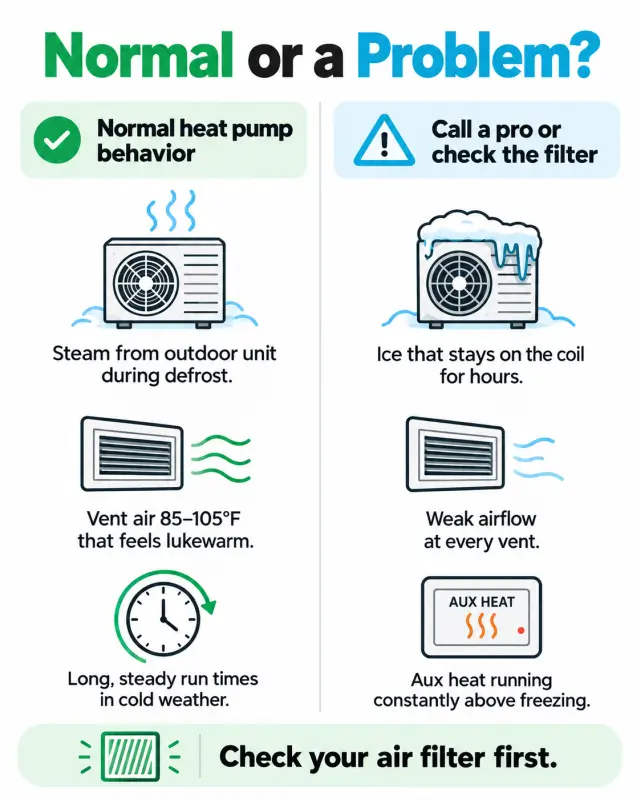
Heat pumps work in cold weather, but standard models lose capacity as temperatures fall. The system runs longer and may call on backup electric heat (shown as "aux heat" on many thermostats), which costs more to run.
Cold-climate heat pumps narrow this gap, as Filterbuy's guide to whether heat pumps work in cold climates explains. To earn the ENERGY STAR cold climate designation, a heat pump needs a coefficient of performance (COP, heat delivered per unit of electricity) of at least 1.75 and 70% of its rated capacity at 5°F.
Defrost cycles are normal: the unit briefly reverses to melt frost, so you may see steam outside.
In our experience, two things show up in nearly every December heat pump complaint we hear: a filter no one has touched since spring, and an outdoor unit packed with leaves. Our winter prep guide for heat pumps covers both.
Why Does Heat Pump Air Feel Cooler Than a Furnace?
Heat pump air is delivered cooler, over longer cycles. According to the heat pump comfort guide from Mass Save, the Massachusetts utility efficiency program, heat pump supply air is typically around 85–105°F, while furnaces often deliver 120–160°F. Heat pump air can feel lukewarm even while the room warms normally. Our tip: check the thermostat reading before you judge the vent air.
Heat Pump Limitation or Malfunction? How to Tell
Many heat pump problems are normal behavior. Filterbuy built this table around the calls we hear most; in our experience, many "broken heat pump" calls trace back to a clogged filter or a defrost cycle mistaken for a malfunction.
Normal behavior varies by model. When in doubt, contact a licensed HVAC technician.
Are Heat Pumps Expensive to Install and Run in 2026?
Heat pumps usually cost more upfront than a furnace, and 2026 buyers get no federal tax credit. The IRS Energy Efficient Home Improvement Credit (Section 25C) (up to $2,000 for heat pumps) covered only improvements made through December 31, 2025. Our heat pump tax credit guide explains why.
Compare complete systems, though: a heat pump replaces both a furnace and a central AC, per EnergySage's comparison. State and utility rebates may still apply.
The fuel you heat with now matters most. A December 2025 peer-reviewed study from Harvard's Belfer Center found:
• Electric resistance, propane, or oil homes: heat pumps would cut annual heating bills by up to $3,000.
• Most natural-gas homes in cold northern regions: bills could rise by up to $1,500.
Gas-heated homes in cold regions should ask their utility about heat pump or time-of-use rates (cheaper power at off-peak hours), or consider a dual-fuel system that pairs a heat pump with a gas furnace. Our heat pump heating cost guide has full cost ranges.
How Does the Refrigerant Change Affect Heat Pump Owners?
The refrigerant transition mainly affects repair costs. Heat pumps manufactured since January 1, 2025, use A2L refrigerants (a mildly flammable, lower-impact class) such as R-454B and R-32.
An EPA Technology Transitions final rule, effective July 27, 2026, allows R-410A units (the older refrigerant) made before 2025 to be installed until supplies run out. The National Association of Home Builders (NAHB) reports R-410A production will fall to 15% of current output by 2036, and the Air Conditioning Contractors of America warns service prices could rise. A major leak on an older unit deserves a repair-versus-replace quote.
How Long Do Heat Pumps Last Compared to Furnaces?
Heat pumps typically last about 15 years, while furnaces often last 15 to 20 years, according to EnergySage. The gap comes from runtime: a heat pump works year-round.
Maintenance decides where in that range a system lands. Filterbuy's heat pump lifespan guide explains what shortens and extends it.
Why Heat Pumps Are More Sensitive to Dirty Air Filters
Heat pumps move more air at a lower temperature, so they depend on steady airflow. The U.S. Department of Energy says performance drops when airflow falls well below the system's design level. A clogged filter makes the air feel colder and can push the system into costly backup heat.
DOE maintenance guidance puts the energy gap between a well-maintained and a severely neglected heat pump at 10% to 25%. ENERGY STAR adds that a dirty filter can damage equipment and lead to early failure.
Filterbuy filters are cut, pleated, and framed to order in our own US plants. A filter is the cheapest part of a heat pump to replace, and it's the one owners forget most.
How to Reduce Heat Pump Drawbacks
Most drawbacks are decided before installation. Ask your installer:
1. "Is this model ENERGY STAR cold-climate certified?" Essential for single-digit winters.
2. "Can I see the room-by-room load calculation?" That's the math for how much heating each room needs; a size copied from the old furnace is a red flag.
3. "At what outdoor temperature does backup heat turn on?" Early backup heat raises bills; the Department of Energy warns against setbacks that trigger it.
4. "Does it have demand-defrost controls?" These defrost only when frost forms. The Department of Energy says these minimize defrost cycles and backup heat use.
5. "Where will the outdoor unit go?" DOE advises keeping it away from windows and sheltered from high winds, which cause defrost problems.
6. "What filter size and MERV rating does it take?" MERV (Minimum Efficiency Reporting Value) is a 1–16 scale of how much a filter captures. You'll need both for your first filter change.
After installation, three habits matter:
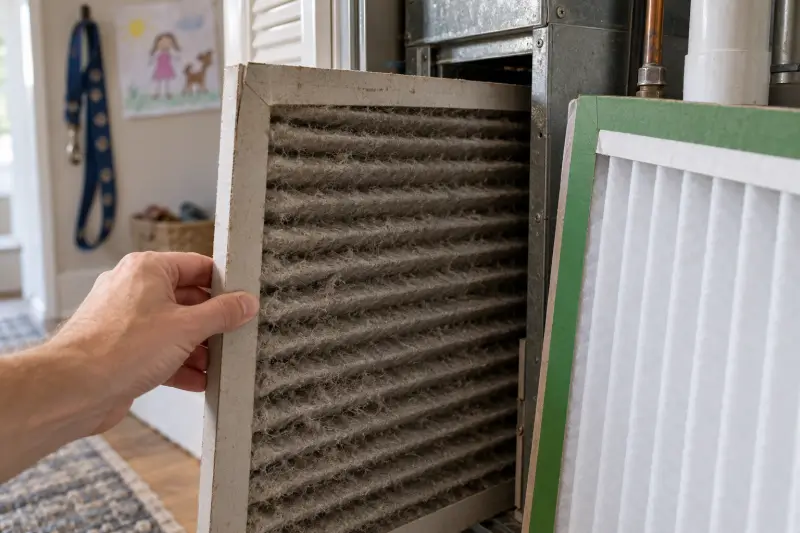
• Check the filter monthly. ENERGY STAR suggests a monthly look, and DOE recommends changing it every 3 months or as the manufacturer directs. Hold it up to a light: if light barely passes through the pleats, replace it.
• Pick the right MERV rating. MERV 8 is the standard choice for most homes. MERV 11 suits homes with allergies, asthma, pets, or pollen. MERV 13 is the pick for smoke, and Odor Eliminator (carbon) filters handle odors. As with confirming your size, check your HVAC manual for compatibility.
• Book annual service. A technician verifies airflow, refrigerant charge, and defrost controls.
Learn more in Filterbuy's complete guide to heat pump filters.
Is a Heat Pump Still Worth It Despite the Disadvantages?
For many homes, yes. Filterbuy's HVAC Solutions team sees the same split again and again: owners who get the best return didn't buy the priciest unit. They sized it right and kept up with filter changes. See Is a Heat Pump Worth It in 2026? and our heat pump vs. HVAC system comparison.
Protect your heat pump's airflow. Your filter size is printed on the frame of the one you have now. Find your air filter size at Filterbuy; if it isn't listed, Filterbuy cuts custom sizes to the eighth of an inch. Then set up Filterbuy auto-delivery, with fast and free 2-day delivery to most US states.
Supporting Statistics: What the Research Shows
Three U.S. government findings back up Filterbuy's guidance:
1. About 13% of U.S. homes heat mainly with a heat pump (2020).
◦ Heating and cooling make up 52% of home energy use.
◦ Source: U.S. Energy Information Administration
2. Over 90% of homes studied would save with the right heat pump.
◦ The study covered about 110 million U.S. homes.
◦ In older cold-climate homes, insulating first can cut install costs by up to $3,700.
◦ Results vary by fuel and local rates; see the Harvard study above.
◦ Source: U.S. Department of Energy
3. Airflow problems can cut efficiency by up to 15%.
◦ Source: ENERGY STAR
Frequently Asked Questions
What are the most common heat pump problems?
The most common heat pump problems are dirty filters, wrong thermostat settings, ice that won't clear, refrigerant leaks, and failed capacitors.
Is it normal for a heat pump to blow lukewarm air?
Yes. Heat pump air runs cooler than furnace air by design. It's only a problem if rooms don't reach the set temperature.
Glossary
• Heat pump: An electric HVAC system that moves heat indoors in winter and outdoors in summer.
• Cold-climate heat pump: An air-source heat pump built to keep producing useful heat in very low temperatures.
• Dual-fuel system: A heat pump paired with a gas furnace that takes over below a set outdoor temperature.
• Auxiliary (aux) heat: Backup heat, usually electric resistance strips, used in deep cold or during defrost.
• Defrost cycle: A short, automatic reversal that melts frost from the outdoor coil.
• Demand-defrost control: A control that runs defrost only when frost is detected, not on a fixed timer.
• MERV (Minimum Efficiency Reporting Value): A 1–16 rating of how well an air filter captures particles.
• Section 25C credit: A federal tax credit of up to $2,000 for heat pumps, which ended December 31, 2025.