
Alder Pollen: Early Season, Where It Grows, and How to Spot It
September 28, 2026
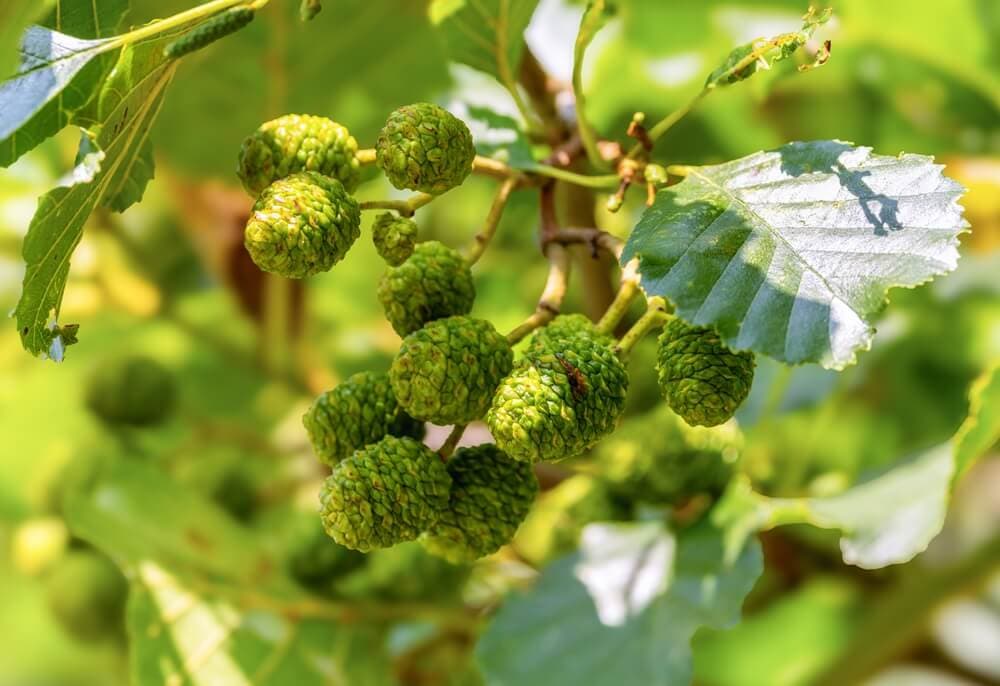
Alder trees belong to the genus Alnus, part of the birch family, Betulaceae. Here is the surprise: alders flower before their leaf buds open, usually between January and April depending on latitude and elevation (Pollen.com). That puts alder pollen in the air while most people still think it is winter.
In the Pacific Northwest, alder is a heavyweight. At Seattle's National Allergy Bureau station, alder and the cypress family together make up about two-thirds of all pollen counted (Lo et al., Aerobiologia, 2019). You will spot alder by its long, drooping male catkins and its small, woody, cone-like seed structures that hang on through winter. Those little "cones" are one of the easiest ways to recognize an alder, and no, they don't make it a conifer.
Alder Pollen Quick Facts
| Field | Detail |
|---|---|
| Type | Tree (the genus also includes shrubs) |
| Scientific name | Alnus, birch family (Betulaceae) |
| Pollination method | Wind-pollinated |
| Pollen grain size | About 19 to 30 micrometers (Pollen.com) |
| Typical season | January to April, depending on latitude and elevation (Pollen.com) |
| Time of day | No universal alder-specific peak hour. Weather changes daily counts. |
| Key U.S. species | Red alder along the Pacific Coast; other alder species in moist wooded areas across North America (Oregon State University; Pollen.com) |
| Commonly cross-reacts with | Birch and hazel pollen (see Alder Pollen Cross-Reactions) |
Is Alder Pollen High Near You Today?
Alder pollen won't show up in your local Air Quality Index. Intact pollen grains are too large for the PM2.5 and PM10 monitors the AQI relies on, which we explain in How Pollen Affects Air Quality Readings. For daily tree pollen counts, check the certified station nearest you on the AAAAI National Allergy Bureau pollen map. To see air quality where you live, use Filterbuy's Live Air Quality Index Map.
How to Identify Alder Pollen at the Source: Catkins, Cones, and Bark
Red alder (Alnus rubra), the most common alder in the Pacific Northwest, gives you several clues once you know where to look:
- Leaves. Alternate on the stem, oval, 3 to 5 inches long, with coarsely toothed edges that curl under slightly (Oregon State University).
- Bark. Smooth and light gray, but usually almost white with lichens, which can make a mature trunk look pale from a distance. Scrape it and the inner bark shows a rusty red, which gives the tree its name (Oregon State University; NC State Extension).
- Male catkins. These are the pollen source. They hang in clumps and reach about 4 to 6 inches long at pollination (Oregon State University).
- Cone-like seed heads. Female catkins mature into small, barrel-shaped, woody strobiles about ½ to 1 inch long (Oregon State University). They stay on the tree through winter (NC State Extension), so you can spot an alder any time of year.
The seasonal progression looks like this: catkins visible over winter, pollen release in late winter or early spring, and woody seed heads that ripen in September or October (Oregon State University Wood Innovation Center). That mix of hanging catkins and small woody "cones" on a broadleaf tree is a strong alder signal.
You can't identify alder pollen from a dust film on your car or windowsill. At roughly 19 to 30 micrometers (Pollen.com), the grains are microscopic, and settled powder never confirms which plant produced it. Confirming alder in the air takes monitored pollen data.
Alder Pollen Look-Alikes: Birch and Hazel
Birch
Birch is in the same family and also bears catkins, so the two are easy to mix up. Look at the bark and the fruit. Paper birch has white, papery, peeling bark, while red alder bark is smooth and gray, often whitened by lichen rather than peeling. Birch also doesn't keep small woody cones through winter the way alder does. Keep in mind that peeling white bark isn't universal among birches, so use several features together.
Hazel
Hazel also produces long male catkins, 2 to 4 inches long and yellow to yellow-brown, blooming in winter and early spring (NC State Extension). The difference shows up in the fruit. Hazel develops small nuts wrapped in leafy bracts (NC State Extension), not woody, cone-like seed heads. If you find the fruit, you can usually tell them apart quickly.
| Feature | Red Alder | Birch | Hazel |
|---|---|---|---|
| Family | Birch family (Betulaceae) | Birch family (Betulaceae) | Birch family (Betulaceae) |
| Male catkins | Yes, about 4 to 6 inches | Yes | Yes, about 2 to 4 inches |
| Fruit | Small woody cones that persist through winter | No persistent woody cones | Nuts wrapped in leafy bracts |
| Bark | Smooth gray, often white with lichen | Varies; paper birch is white and peeling | Not a reliable clue |
Sources: Oregon State University; NC State Extension; NC State Extension.
When Is Alder Pollen Season? Late-Winter Timing by Region
Alder timing depends on species, weather, latitude, and elevation. Flowering windows are not the same as measured airborne peaks, so treat the entries below as sourced starting points, not a fixed calendar.
| Species and Region | Typical Window | Source |
|---|---|---|
| Alders in general, North America | January to April, depending on latitude and elevation | Pollen.com |
| Alder and birch, Seattle area | Late February through April | Swedish Health Services |
| Red alder, Portland area | Blooms in March | East Multnomah Soil & Water Conservation District |
| All alders, St. Louis | January to April | St. Louis County Pollen and Mold Center |
| Smooth alder, some regions | January and February, among the first spring flowers | St. Louis County Pollen and Mold Center |
Check your nearest National Allergy Bureau station for the current year.
In the Pacific Northwest? Check current conditions for Seattle and Portland, or find your city on the Live Air Quality Index Map. Our seasonal allergy calendar shows what follows alder through spring.
Alder Pollen by the Numbers
- About two-thirds of Seattle's pollen. Alder and the cypress family are the two most abundant pollen types at Seattle's National Allergy Bureau station, together making up about two-thirds of the total (Lo et al., 2019).
- 60% of the Northwest's hardwood. Red alder makes up about 60% of the total hardwood volume in the Pacific Northwest (Oregon State University Wood Innovation Center).
- Within 125 miles of the ocean. Red alder ranges from southeastern Alaska to southern California, generally within 125 miles of the coast (Oregon State University Wood Innovation Center).
- A tree that feeds its own soil. Red alder roots form nodules with Frankia bacteria that fix nitrogen from the air, letting the tree grow in poor soils (Oregon State University).
- A fast first responder. Red alder quickly moves into bare ground after landslides, logging, or fire (Oregon State University Wood Innovation Center).
Alder Pollen Myths vs. Facts
MYTHTree pollen only starts when everything looks green.
FACTAlders flower before their leaf buds open, usually between January and April (Pollen.com). Alder pollen can be in the air well before the landscape greens up.
MYTHAlder's little cones make it a pine.
FACTThose cones are woody seed structures that develop from female catkins on a broadleaf tree (Oregon State University Wood Innovation Center). Alder is in the birch family, not a conifer.
MYTHAlder grows by streams, so its pollen can't reach me in the city.
FACTAlder pollen can be found miles from any source because the tree produces so much of it and the grains are small and light (St. Louis County Pollen and Mold Center). You don't need a streamside forest next door to encounter alder pollen.
MYTHThe cones release the pollen.
FACTPollen comes from the long male catkins. The woody cones form later from female flowers and hold seeds (Oregon State University Wood Innovation Center).
Alder Pollen Cross-Reactions
This section is descriptive only and is not medical advice.
Alder's major allergen, Aln g 1, belongs to the same protein family as birch's main allergen, Bet v 1. Thermo Fisher Scientific's allergen encyclopedia reports that Aln g 1 shows extensive cross-reactivity with the major allergens of birch (Bet v 1) and hazel (Cor a 1) (Thermo Fisher Scientific). The same resource notes that about 92% of people sensitized to birch are also sensitized to alder and hazel pollen (Thermo Fisher Scientific). Pollen.com adds that sensitivity to one alder species typically extends to all alder species (Pollen.com).
This is a pollen-and-protein relationship. It is not a food list, and it does not predict how any individual will react. For questions about symptoms or diagnosis, speak with a board-certified allergist.
How to Keep Alder Pollen Out of Your Home
Because alder pollen can arrive in January or February, it often catches people off guard. A few steps help:
- Check local counts starting in late winter. Use your nearest National Allergy Bureau station once you see alder catkins lengthening.
- Keep windows and doors closed when alder is active. Open windows and doors are one of the main ways pollen gets indoors (2023 scientific review, PMC).
- Leave pollen at the door. Wipe down entry surfaces and sills, change clothes after time outdoors, and wipe pets down when they come in. Our spring allergy prep guide has a full room-by-room checklist.
- Match your HVAC filter to your household. MERV ratings measure how well a filter captures particles between 0.3 and 10 micrometers. A MERV 8 filter must capture at least 70% of particles in the 3 to 10 micrometer range, and a MERV 11 filter at least 85% (EPA). Intact alder pollen grains, at roughly 19 to 30 micrometers, are larger than anything in that test. For most homes, MERV 8 is the standard choice. For households with allergies or pets, step up to MERV 11. Our MERV 8 vs. MERV 11 guide breaks down the difference.
- Change filters on schedule. Standard 1-inch filters are typically replaced about every 90 days. Filterbuy 4-inch filters last 6 to 12 months.
These steps reduce how much pollen circulates indoors. They are not a substitute for medical care, and no specific symptom outcome is claimed.
Alder season usually starts while the heat is still running, so a fresh filter in January is a good head start. Filterbuy makes MERV 8 and MERV 11 filters in more than 600 standard sizes, plus custom sizes, so it's easy to find one that fits your system before the catkins open.
Shop MERV 8 Filters Shop MERV 11 FiltersFrequently Asked Questions
When is alder pollen season?
Alders usually flower between January and April, depending on latitude and elevation (Pollen.com). In the Seattle area, alder and birch drive tree pollen from late February through April (Swedish Health Services).
Can alder pollen start before spring?
Yes. Alders flower before their leaf buds open (Pollen.com), and some species, such as smooth alder, bloom in January and February in some regions (St. Louis County Pollen and Mold Center). Alder is often one of the earliest tree pollens of the year.
When does red alder release pollen near Portland?
Red alder blooms in March in the Portland area (East Multnomah Soil & Water Conservation District). That is a flowering window, so check a local pollen count for the actual airborne peak.
Is alder a big deal for allergies in Seattle?
Yes. Alder is one of the two most abundant pollen types at Seattle's National Allergy Bureau station (Lo et al., 2019), and a local allergist says alder and birch make up the vast majority of tree pollen in the Pacific Northwest (OPB).
Where does red alder grow?
Red alder grows along the Pacific Coast from southeastern Alaska to southern California, generally within 125 miles of the ocean (Oregon State University Wood Innovation Center). It favors moist sites along streams and quickly colonizes disturbed ground.
How do I tell alder from birch?
Check the bark and fruit. Paper birch has white, peeling bark, while red alder bark is smooth and gray, often whitened by lichen. Alder also keeps small woody, cone-like seed heads through winter (NC State Extension).
Are alder's little cones actual pine cones?
No. They are woody seed structures that form from female catkins on a broadleaf tree in the birch family (Oregon State University Wood Innovation Center).
Are alder and hazel pollen related?
Yes. Both are in the birch family, and alder's main allergen shows extensive cross-reactivity with hazel's main allergen (Thermo Fisher Scientific).
What air filter should I use during alder season?
It depends on your household. MERV 8 is the standard choice for most homes. For households with allergies or pets, MERV 11 captures a higher share of larger airborne particles (EPA). See our MERV 8 vs. MERV 11 guide to compare.