
Wind Chill Calculator: Find The Feels-Like Temperature In °F Or °C
October 26, 2026

Enter the air temperature and the forecast wind speed to see how cold it feels, how fast exposed skin can freeze, and whether your pipes are at risk. Results update as you type, in °F with mph or °C with km/h, using the same NWS and Environment and Climate Change Canada formulas behind the charts on this page.
Air temperature (°F)
Wind speed (mph)
Feels like
-19°F
19 degrees colder than the air feels on bare skin.
High risk: exposed skin can freeze in 10 to 30 minutes. Cover your face and hands and wear a hat.
Your pipes cannot get colder than the air (0°F), but at 32°F or below, exposed pipes can freeze. The wind still pushes cold air through gaps around doors and windows, so your furnace runs longer.
Use the sustained wind speed, not gusts. Fahrenheit results use the NWS Wind Chill Temperature index. Celsius results use the metric version from Environment and Climate Change Canada.
Longer heating cycles push more air through your air filter. Before a cold, windy stretch, check yours and swap it if it looks gray or clogged.
Fast and free 2-day delivery to most US states. Auto-delivery saves 5% on every order, and you can edit, skip, or cancel anytime.
Wind Chill Hits Skin, Not Houses
One day: 0°F air with a 15 mph wind
Your Skin
Feels like -19°F
Can freeze in 30 minutes
Your Pipes And Home
Never colder than 0°F
Wind chill does not apply
Your Furnace And Filter
Runs longer
More air moves through the filter
Sources: National Weather Service, U.S. Department of Energy
Answer a few quick questions and we'll match your furnace to the right filter for winter.
A wind chill calculator tells you how cold the air feels on exposed skin once the wind picks up. This guide walks through the formula the National Weather Service (NWS) has used since November 1, 2001, with a worked example and wind chill charts in Fahrenheit with mph and Celsius with km/h.
TL;DR
Wind chill is the feels-like temperature on bare skin, worked out from air temperature and wind speed. The NWS formula only applies at 50°F or colder with wind above 3 mph. On a 0°F day with a 15 mph wind, the wind chill is -19°F, cold enough to freeze exposed skin in 30 minutes. Your pipes and house never cool below the actual air temperature, though wind does pull warm air out of a drafty home faster.
Key Takeaways
Wind chill reflects how quickly wind and cold pull heat away from bare skin.
Wind chill is defined only for air temperatures at or below 50°F (10°C) and wind speeds above 3 mph (4.8 km/h).
Car radiators and exposed pipes cool faster in the wind, but they never drop below the actual air temperature.
Why An Air Filter Company Cares About Wind Chill
At Filterbuy, we make air filters, so we think about winter from inside your home. Wind chill describes your skin, not your house. Still, the wind behind it finds every gap around doors and windows and keeps your furnace running longer. This guide answers two questions: how cold it feels outside, and what that wind means for your heating system.
How To Use A Wind Chill Calculator
Any wind chill calculator needs two inputs: the air temperature and the wind speed. Use the forecast wind speed rather than the gusts. For an interactive tool, the free NOAA Weather Prediction Center wind chill calculator accepts °F or °C with wind in mph or knots, or use the charts below. If the air is warmer than 50°F, or the wind is 3 mph or less, wind chill is not defined, so go by the actual air temperature.
The NWS Wind Chill Formula
The standard U.S. wind chill formula is the NWS Wind Chill Temperature index, adopted on November 1, 2001. A joint U.S. and Canadian team built it from skin heat-loss models and tested it on volunteers in a chilled wind tunnel. It replaced a 1945 model based on how quickly water froze.
In Fahrenheit and mph, the NWS wind chill chart and formula use this equation:
Wind Chill (°F) = 35.74 + 0.6215T - 35.75(V^0.16) + 0.4275T(V^0.16)
Here, T is the air temperature in °F and V is the wind speed in mph. Weather stations measure wind 33 feet off the ground, so the index adjusts that reading down to about 5 feet, the height of an adult face. The index also assumes no sunshine, and the NWS notes that bright sunshine may raise the wind chill temperature by 10 to 18°F.
For Celsius and km/h, use the metric chart below or the FAQ conversion steps.
Worked Example: 10°F With A 20 MPH Wind
First, raise the wind speed to the 0.16 power: 20^0.16 = 1.615.
Next, work out each term: 0.6215 x 10 = 6.215, 35.75 x 1.615 = 57.74, and 0.4275 x 10 x 1.615 = 6.90.
Finally, add them up: 35.74 + 6.215 - 57.74 + 6.90 = -8.9, which rounds to -9°F.
A 20 mph wind makes 10°F feel like -9°F, a drop of 19 degrees.
Wind Chill Chart In Fahrenheit
These values come from the wind chill table published by the National Weather Service, and each one matches the NWS formula, including 0°F at 15 mph equaling -19°F.
| Wind Speed | 30°F | 20°F | 10°F | 0°F | -10°F | -20°F |
|---|---|---|---|---|---|---|
| 5 mph | 25° | 13° | 1° | -11° | -22° | -34° |
| 10 mph | 21° | 9° | -4° | -16° | -28° | -41° |
| 15 mph | 19° | 6° | -7° | -19° | -32° | -45° |
| 20 mph | 17° | 4° | -9° | -22° | -35° | -48° |
| 30 mph | 15° | 1° | -12° | -26° | -39° | -53° |
| 40 mph | 13° | -1° | -15° | -29° | -43° | -57° |
Source: NWS Little Rock Wind Chill Index table.
The chart shows a clear pattern: the first few miles per hour of wind do most of the work. At 0°F, a 5 mph breeze knocks 11 degrees off the feels-like temperature, while going from 30 to 40 mph takes away only 3 more.
Wind Chill Chart In Celsius
This wind chill chart in Celsius reproduces the official Wind Chill Index chart from Environment and Climate Change Canada, the Canadian partner in developing the 2001 index.
| Wind Speed | 0°C | -5°C | -10°C | -15°C | -20°C | -25°C | -30°C |
|---|---|---|---|---|---|---|---|
| 10 km/h | -3° | -9° | -15° | -21° | -27° | -33° | -39° |
| 20 km/h | -5° | -12° | -18° | -24° | -30° | -37° | -43° |
| 30 km/h | -6° | -13° | -20° | -26° | -33° | -39° | -45° |
| 40 km/h | -7° | -14° | -21° | -27° | -34° | -41° | -48° |
| 50 km/h | -8° | -15° | -22° | -29° | -35° | -42° | -49° |
| 60 km/h | -9° | -16° | -23° | -30° | -36° | -43° | -50° |
Source: Environment and Climate Change Canada Wind Chill Index chart.
What Wind Chill Means For Exposed Skin
The NWS gives a useful benchmark: a 0°F day with a 15 mph wind produces a -19°F wind chill, and at that level exposed skin can freeze in 30 minutes.
Environment and Climate Change Canada groups wind chill into risk levels, each with a time for exposed skin to freeze. The NWS benchmark of -19°F (about -28°C) falls at the warm edge of the high-risk band, where freezing takes 10 to 30 minutes.
| Wind Chill | Risk Level | Exposed Skin Can Freeze In |
|---|---|---|
| -10°C to -27°C (14°F to -17°F) | Moderate | Long exposure |
| -28°C to -39°C (-18°F to -38°F) | High | 10 to 30 minutes |
| -40°C to -47°C (-40°F to -53°F) | Very high | 5 to 10 minutes |
| -48°C to -54°C (-54°F to -65°F) | Severe | 2 to 5 minutes |
| -55°C or colder (-67°F or colder) | Extreme | Under 2 minutes |
Source: Environment and Climate Change Canada. Skin can freeze faster in sustained winds over 50 km/h (31 mph).
The Centers for Disease Control and Prevention (CDC) describes the signs of frostbite as redness or pain, a white or grayish-yellow patch of skin, firm or waxy skin, and numbness. To lower your risk, cover your face and hands and wear a hat, with loose layers under a water-resistant coat. If you suspect frostbite, get medical care.
Wind Chill Alerts Now Use New Names
On October 1, 2024, the NWS retired its wind chill alerts nationwide. A Wind Chill Warning is now an Extreme Cold Warning, a Wind Chill Watch is now an Extreme Cold Watch, and a Wind Chill Advisory is now a Cold Weather Advisory. Because these alerts trigger on either air temperature or wind chill, calm but bitter cold now counts too.
For more background, read why the NWS replaced wind chill warnings.
Does Wind Chill Affect Your Home, Pipes, And Car?
Wind chill applies to people and animals, not to your house or the pipes inside it. According to the NWS, objects cool faster in the wind but never drop below the actual air temperature. An exposed pipe can only freeze once the surrounding air reaches 32°F or colder, however low the wind chill reads.
| What's Exposed | Does Wind Chill Apply? | What Actually Matters |
|---|---|---|
| Exposed skin | Yes | Wind chill and time outside |
| Pets outdoors | Yes | Time outside and wind shelter |
| Car engine | No | The actual air temperature |
| Exposed water pipes | No | Air temperature at or below 32°F |
| Your home's interior | No | Air leaks and heating run time |
Wind still matters for your home, just not through the wind chill number. As the U.S. Department of Energy's guide to air sealing explains, insulation does not really block the wind, and air leaks put unnecessary strain on heating equipment. On a cold, windy day, a drafty home loses warm air faster and your furnace or heat pump has to run longer.
Winter HVAC Checks Before A Cold, Windy Stretch
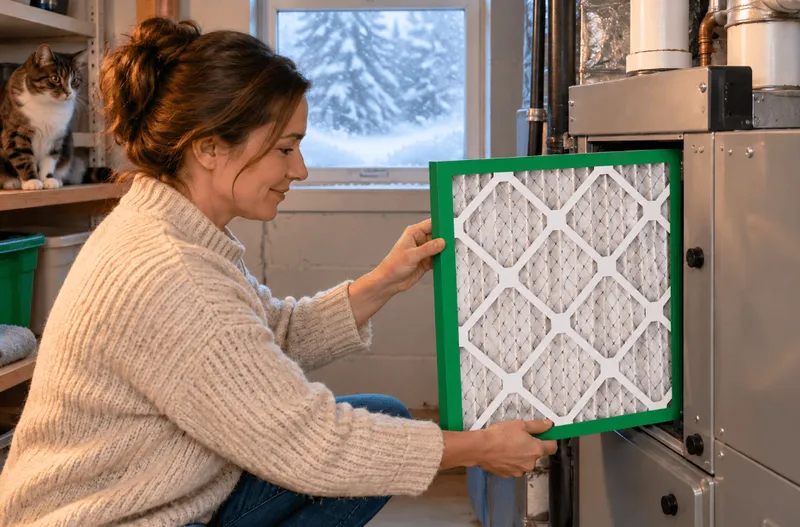
Filterbuy Pro Tip: Let a Cold Weather Advisory in the forecast be your cue to check the air filter, and swap it if it looks gray or clogged. Longer heating cycles push more air through the filter, so review when to change your furnace filter in winter.
Seal drafts around doors and windows with caulk and weatherstripping, then check your attic openings.
Hold a steady setpoint through the cold snap, with these winter thermostat settings as a starting point.
Clear snow from outdoor vents and your heat pump, and keep these furnace tips for extreme cold handy.
Supporting Statistics
More than 18,000 Americans have died from cold-related causes since 1979, per the EPA cold-related deaths indicator.
About 1 in 60 insured homes has a water damage or freezing claim, and those claims averaged $15,400 (2019–2023), per Insurance Information Institute data.
Heating uses 42% of the energy in U.S. homes, more than any other end use, per the EIA 2020 residential energy survey.
Frequently Asked Questions
What is a dangerous wind chill temperature?
NWS examples put the 30-minute frostbite point at a wind chill of about -19°F to -20°F, and colder readings bring frostbite on even faster. Local NWS offices set their own Cold Weather Advisory and Extreme Cold Warning criteria.
Is wind chill the same as the feels-like temperature?
In cold weather, the feels-like temperature on many forecasts is the wind chill. In hot weather, the feels-like number typically reflects the heat index, which combines air temperature with humidity rather than wind.
Can wind chill freeze pipes?
Wind chill cannot freeze pipes on its own. Wind makes an exposed pipe lose heat faster, but the pipe cannot get colder than the air around it. Pipes freeze only when the air temperature reaches 32°F or below, so watch the thermometer, not the wind chill, and follow the Red Cross steps for preventing frozen pipes.
How do I calculate wind chill in Celsius?
The quickest route is a metric chart: Environment and Climate Change Canada lists -10°C air with a 30 km/h wind as a -20°C wind chill. You can also convert to °F and mph, apply the NWS formula, and convert back, which lands within a degree of the chart.
Does wind chill make my furnace work harder?
The wind chill number does not, but the wind behind it does. Wind pushes cold air through gaps around doors and windows, so your furnace runs longer.
Glossary
Wind Chill Temperature: How cold the air feels on exposed skin once wind speed is factored in, also called the wind chill factor.
Wind Chill Index: The NWS formula, adopted November 1, 2001, that calculates wind chill from air temperature and face-height wind speed.
Frostbite: An injury caused by freezing that leads to loss of feeling and color, most often on the nose, ears, cheeks, chin, fingers, or toes.
Hypothermia: A dangerously low body temperature, below 95°F (35°C).
National Weather Service (NWS): The U.S. federal weather agency, part of the National Oceanic and Atmospheric Administration (NOAA), that issues forecasts and alerts and publishes the official wind chill chart.
Extreme Cold Warning: An NWS alert for life-threatening cold based on air temperature or wind chill. It replaced the Wind Chill Warning on October 1, 2024.
Cold Weather Advisory: An NWS alert for potentially hazardous cold based on air temperature or wind chill. It replaced the Wind Chill Advisory on October 1, 2024.
HVAC: Heating, ventilation, and air conditioning, the system that controls a home's temperature and airflow.
Filterbuy: A second-generation, family-owned company that makes HVAC air filters and sells them at filterbuy.com.
Keep Your Home Ready For The Next Cold Snap
Filterbuy makes air filters in standard and custom sizes, with free shipping on every order within the continental United States. Find your air filter size, or set up air filter auto-delivery so a fresh filter arrives before the next cold front.