
Cold Weather Advisory vs. Extreme Cold Warning: What Each Alert Means for Your Family, Home, and HVAC
October 5, 2026
TL;DR
A Cold Weather Advisory means the National Weather Service (NWS) expects hazardous cold. An Extreme Cold Warning means it expects cold that can be life-threatening, so the warning is the more serious of the two. Either alert can now be triggered by air temperature alone, and the exact thresholds depend on where you live.
Key Takeaways
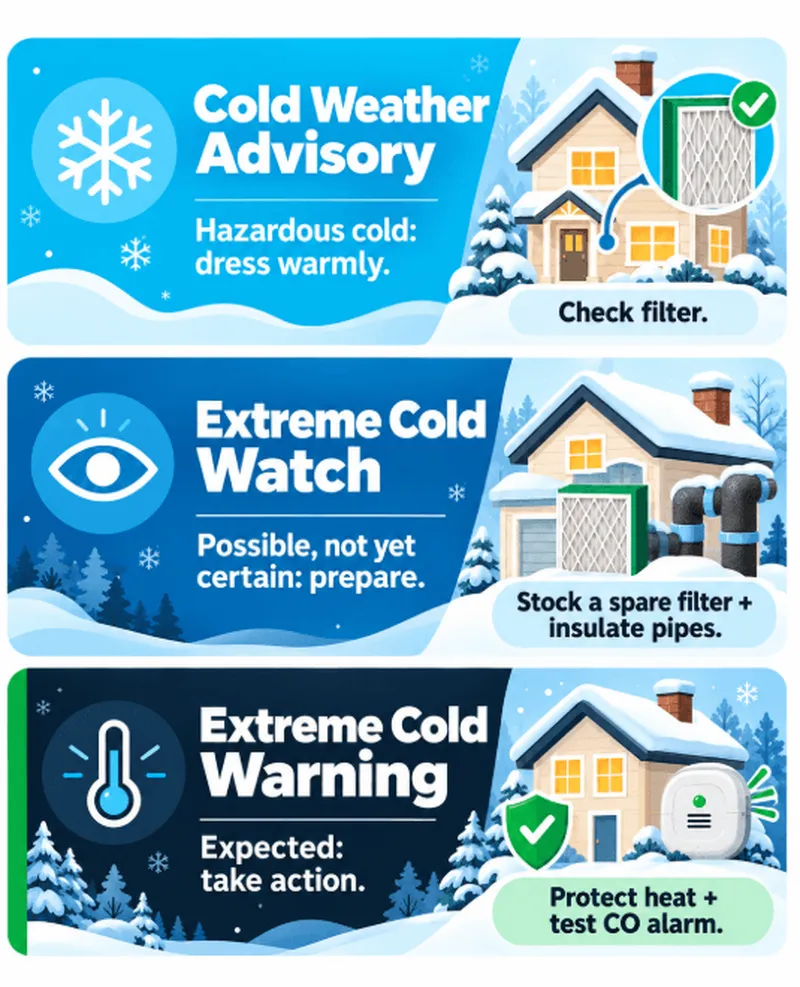
An Extreme Cold Watch sits between the two. It means warning-level cold is possible, but forecasters aren't certain yet.
Thresholds are local. A warning starts below 15°F in parts of southeast Louisiana but not until −30°F around Green Bay, Wisconsin.
Filterbuy uses each alert as a filter checkpoint: check the filter at an advisory, swap it at a watch, and let the furnace run during a warning.
At Filterbuy, we've cut, pleated, and framed air filters in our own U.S. plants since 2012, and winter always follows the same script. Homes seal up, furnaces run almost nonstop, and filters fill faster than people expect. So we treat every cold alert as a home maintenance reminder.
What Is a Cold Weather Advisory?
A Cold Weather Advisory is the NWS's heads-up that temperatures or wind chills will drop low enough to be hazardous, though not life-threatening for most people. It took the place of the old Wind Chill Advisory on October 1, 2024 (NWS Amarillo).
Treat it like a yellow light. Exposed skin can still get frostbite, and babies, older adults, and people who work outside are at real risk. The NWS cold weather alert guidance is simple: dress for the weather and cover exposed skin before you head out.
What Is an Extreme Cold Warning?
An Extreme Cold Warning is the most serious cold alert the NWS issues. It goes out when dangerously cold air is expected, with or without wind, and the NWS says to avoid going outside. If you have to, dress in layers, cover every bit of skin, and let someone know where you're going and when you'll get there.
If the advisory is a yellow light, the warning is a red one. Frostbite can develop fast, and hypothermia becomes a real danger if your heat goes out. To put numbers on it, 0°F air with a 20 mph wind feels like −22°F, cold enough to freeze exposed skin in about 30 minutes, according to NWS Albany.
An Extreme Cold Watch falls between them. It means warning-level cold is possible, but the timing or location is still uncertain. Some NWS offices issue a watch once they're more than 50% confident and a warning once they're more than 80% confident (NWS Lincoln, IL).
Cold Weather Advisory vs. Extreme Cold Warning: Side-by-Side
The two alerts differ in how bad the cold will be and how sure forecasters are about it. An advisory asks for caution, a warning asks for action, and a watch in between gives you time to prepare. The table below lines them up.
Sources: National Weather Service cold weather alert guidance and NWS Lincoln, IL confidence levels. Alert names changed nationwide on October 1, 2024.
What Temperature Triggers a Cold Weather Advisory or Extreme Cold Warning?
There's no single national number. Each NWS forecast office sets its own criteria based on local climate and health risks, so the temperature that triggers an advisory in New Orleans would barely raise an eyebrow in Green Bay.
Thresholds apply to air temperature or wind chill. Sources: NWS forecast office criteria pages (New Orleans, Albany, State College, Green Bay) and Action News 5 (Memphis). Check weather.gov for your local office.
Offices can adjust these numbers, so check your NWS forecast office's page at weather.gov before winter 2026–27.
What to Do During a Cold Weather Advisory vs. an Extreme Cold Warning
During an advisory, it's mostly about how you dress and how long you stay out. During a warning, the goal is to stay inside and keep your heat running safely, since frostbite and hypothermia can set in quickly.
When a Cold Weather Advisory Is Issued
Dress in loose layers with a hat, gloves, and a scarf over your face.
Keep outdoor time short for kids, older adults, and pets, and check in on elderly neighbors.
When an Extreme Cold Watch Is Issued
Fill your gas tank at least halfway and update your car's winter survival kit, as the NWS recommends.
Stock up on medications, groceries, and a spare furnace filter.
Test your smoke and carbon monoxide (CO) alarms.
When an Extreme Cold Warning Is Issued
Stay indoors with your pets as much as you can. If you need to go out, cover all exposed skin and tell someone your route and when you expect to arrive.
Know the signs of frostbite and hypothermia. Numbness and waxy, white, or grayish skin point to frostbite. Shivering, weakness, a glassy stare, and poor judgment point to hypothermia, which calls for 911.
“When an Extreme Cold Watch hits my phone, I run a five-minute routine: filter against a sheet of white paper, spare filter next to the furnace, and a quick CO alarm test. It beats troubleshooting a furnace with no heat at 3 a.m.”
Michelle Wan, Brand Manager and Air Quality Writer at Filterbuy
How to Protect Your Home and HVAC During Extreme Cold
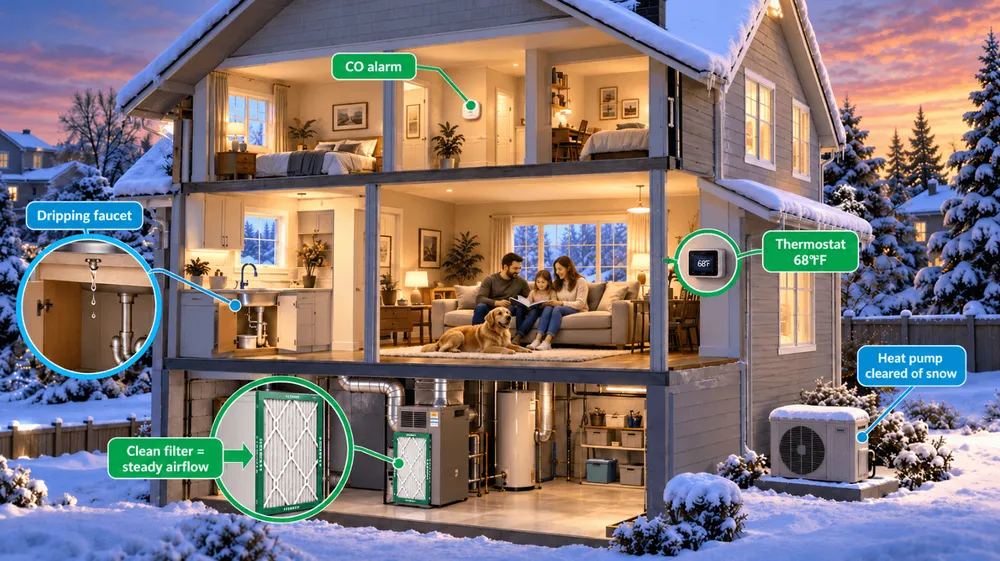
An Extreme Cold Warning puts the whole house to the test. Three things matter most: steady airflow through a clean filter, carbon monoxide safety, and keeping your pipes from freezing.
Give your furnace room to breathe. Every bit of heated air passes through your HVAC filter. When that filter clogs, airflow drops and the system has to run longer to reach the thermostat setting. In a furnace, the restricted airflow can overheat the heat exchanger and trip the high-limit safety switch, which shuts off the heat right when you need it.
Pro Tip from Filterbuy’s filter plants: Think of each alert as a filter checkpoint. At an advisory, check the filter. At a watch, swap it if it looks gray and set a spare by the furnace. During a warning, keep the cabinet closed and let the system run. To check a filter, hold it against white paper, not up to a light. Depth matters, too. Filterbuy 1-inch filters have 14 pleats per foot, while our 4-inch filters have 8 much deeper pleats that hold more dust.
Keep the air clean while the house is sealed. After a few days with the windows shut, dust and pet dander start to build up. A fresh pleated Filterbuy MERV 8 filter handles everyday dust, and MERV 11 is the better pick for homes with pets or allergies.
Take carbon monoxide seriously. CO poisoning kills roughly 450 people in the U.S. each year. About 73% of nonfatal exposures happen at home, and 41% happen between December and February, according to CDC data. Never heat your home with a generator, grill, or gas oven. Put a battery-powered CO alarm on every level, and if it goes off, get outside and call 911. Your air filter won’t remove CO, so working alarms and a yearly furnace inspection are a must.
Keep pipes from freezing. The American Red Cross suggests a few simple steps:
Let faucets fed by exposed pipes drip slowly.
Open sink cabinets on exterior walls so warm air can reach the pipes.
Keep the garage door closed.
Keep the thermostat at the same setting day and night, and no lower than 55°F if you're away.
Ready before the next warning? Filterbuy makes 600+ filter sizes in the USA and ships them free. Find your exact furnace filter size, or set up Filterbuy auto-delivery so a fresh filter arrives before winter does. You can also check your local air quality on the Filterbuy live AQI map.
Supporting Statistics: What the Research Shows
1,024 U.S. deaths were linked to excessive cold or hypothermia in 2023, and January was the deadliest month. (CDC)
Winter home fires make up 8% of U.S. fires but cause 30% of fire deaths, so safe heating matters most in winter. (U.S. Fire Administration)
Water damage and freezing claims average $15,400, and about 1 in 60 insured homes files one each year. (Triple-I)
Frequently Asked Questions
Is an extreme cold warning worse than a cold weather advisory?
Yes. A warning means life-threatening cold is expected, while an advisory flags hazardous cold.
What replaced the wind chill warning?
On October 1, 2024, the NWS renamed it the Extreme Cold Warning. The Wind Chill Watch became the Extreme Cold Watch, and the Wind Chill Advisory became the Cold Weather Advisory (NWS Amarillo).
What should I do if my furnace stops during an extreme cold warning?
Make sure the thermostat is set to heat and has fresh batteries. Then check the air filter. A clogged filter can trip the high-limit switch, so replace it and give the furnace a few minutes to restart. Clear snow or ice from a high-efficiency furnace's vent pipes or a heat pump's outdoor unit. Still no heat? Call an HVAC pro, gather everyone in one closed-off room, and never use an oven, grill, or generator indoors for warmth.
Can my pipes freeze during a cold weather advisory?
Yes, especially in the South. Along the Louisiana coast, an advisory starts below 25°F, which is close to the roughly 20°F point where Consumer Reports says exposed pipes usually freeze. If you live somewhere mild, treat an advisory as the cue to drip faucets on exterior walls and open sink cabinets.
Should I change my air filter before an extreme cold warning?
Check it as soon as a watch is issued, and change it if it looks gray against white paper or is more than 60 to 90 days old. In winter, Filterbuy recommends checking every 30 days because furnaces run far more hours and filters fill faster.
Glossary
National Weather Service (NWS): The U.S. federal weather agency, part of NOAA, that issues weather alerts.
Cold Weather Advisory: An NWS alert for hazardous cold temperatures or wind chills. It replaced the Wind Chill Advisory in October 2024.
Extreme Cold Watch: An NWS alert that life-threatening cold is possible, but its timing or location is still uncertain.
Extreme Cold Warning: The NWS's highest-level cold alert, issued when life-threatening cold is expected.
Wind chill: How cold the air feels on exposed skin when wind and low temperature combine.
Frostbite: Freezing of skin and underlying tissue, most often on fingers, toes, ears, and the nose.
Hypothermia: A dangerous drop in body temperature below 95°F.
Carbon monoxide (CO): A colorless, odorless gas produced when fuel burns incompletely; it can be deadly indoors.
MERV rating: Minimum Efficiency Reporting Value, a 1 to 16 scale for how well an HVAC air filter captures airborne particles.
High-limit switch: A furnace safety switch that shuts off the burners when the heat exchanger overheats, often because of restricted airflow.