
Will This Winter Be Cold? The 2026–27 Forecast and How to Prep Your Home
November 9, 2026
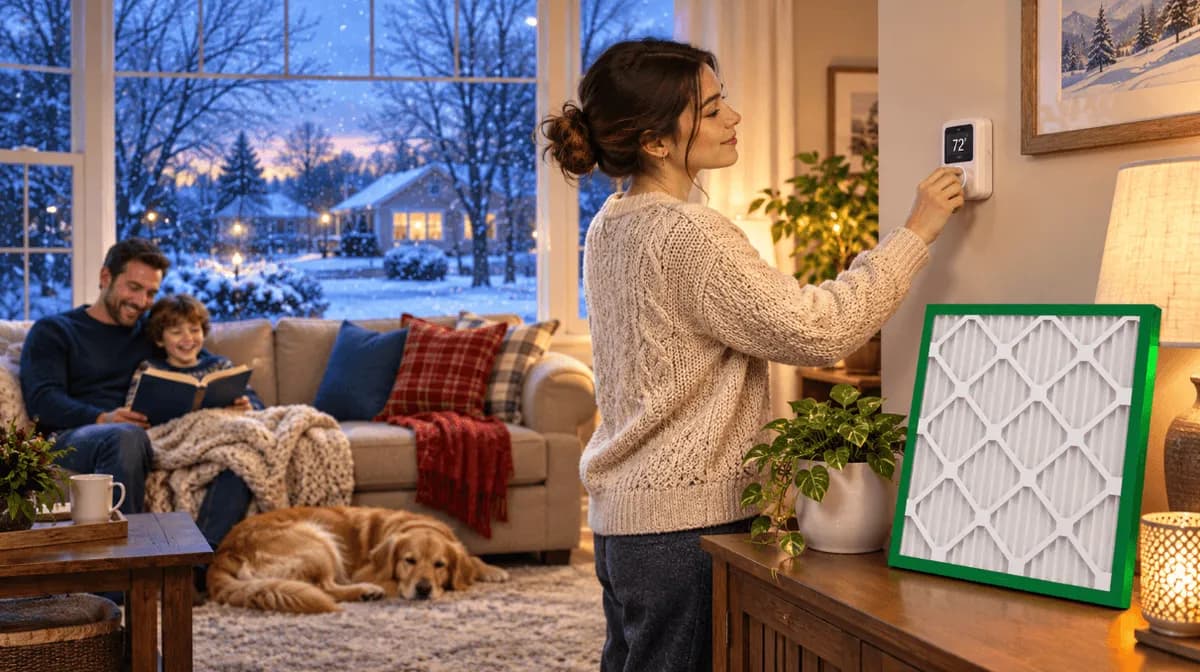
Your furnace will likely work as hard this winter as it did last winter. The EIA expects U.S. heating demand to hold steady, and homes in the West may need about 25% more heat.
Every hour your furnace runs pulls more indoor air through its filter, so the filter fills up faster. Hold yours against white paper and replace it if it looks gray and matted. Then order the size printed on the frame so a spare is ready before the first cold snap.
Heating Demand vs. Last Winter
Change in heating degree days, November through March, by region
Northeast 12% less heat
Midwest 2% less heat
South 1% more heat
West 25% more heat
U.S. average No change
West: About 25% More Heat
Last winter ran unusually warm out West, so a "warmer than normal" forecast can still mean more furnace hours this year.
Source: U.S. Energy Information Administration, Winter Fuels Outlook 2026-27, released October 6, 2026.
Get Your Furnace Filter Before the Cold Snap
Fast and free 2-day delivery to most US states.
Answer a few quick questions and we'll match you to the right filter for winter.
TL;DR
For most of the U.S., winter 2026–27 isn't expected to be colder than normal. A strong El Niño favors a warmer-than-average December through February across the North and a stormier South and East Coast. Cold snaps will still happen, so get your furnace and filter ready now.
Key Takeaways
NOAA's 2026–27 U.S. Winter Outlook favors above-average temperatures across the North and Alaska.
A strong to very strong El Niño, not La Niña, is driving this winter and steering storms south.
"Warmer than normal" isn't "warmer than last winter": the EIA expects the West to need about 25% more heat than in 2025–26.
In Filterbuy's view, the forecast changes whether your indoor air runs damp or dry, not whether your furnace runs.
At Filterbuy, we've made air filters to order in our own U.S. plants since 2013, and we read NOAA's winter outlook every fall because it shapes our advice. Even a mild winter leaves the furnace carrying you through the coldest nights. Below, we cover what forecasters expect and what to check first.
Will This Winter Be Cold? The Short Answer
Winter 2026–27 is likely to be milder than average across much of the northern United States. NOAA's Climate Prediction Center gives the best odds of above-normal temperatures from the Pacific Northwest through the Midwest and much of the East. Farther south, rain is the bigger story, and Florida leans near normal.
NOAA's official outlook covers December through February and describes odds, not guarantees.
So, will this winter be cold or warm? In most places, both: a warmer average with cold snaps mixed in.
Why El Niño, Not La Niña, Is Shaping This Winter
El Niño is the main force behind winter 2026–27. In its October 8, 2026 ENSO diagnostic discussion, NOAA's Climate Prediction Center put the odds of a strong to very strong El Niño lasting through January–March 2027 above 83%.
A strong El Niño tends to push the jet stream south and east. As Ken Graham, director of NOAA's National Weather Service, put it, this pattern "tilts the odds toward stormier weather across the South."
If you searched "will this winter be cold La Niña," the short answer is no. El Niño's cool counterpart isn't in play this season, though Filterbuy's La Niña winter forecast guide explains how that could change in 2027.
Will This Winter Be Cold Where You Live?
How cold your winter gets depends on where you live. The table pairs NOAA's regional outlook with the first thing Filterbuy would check at home.
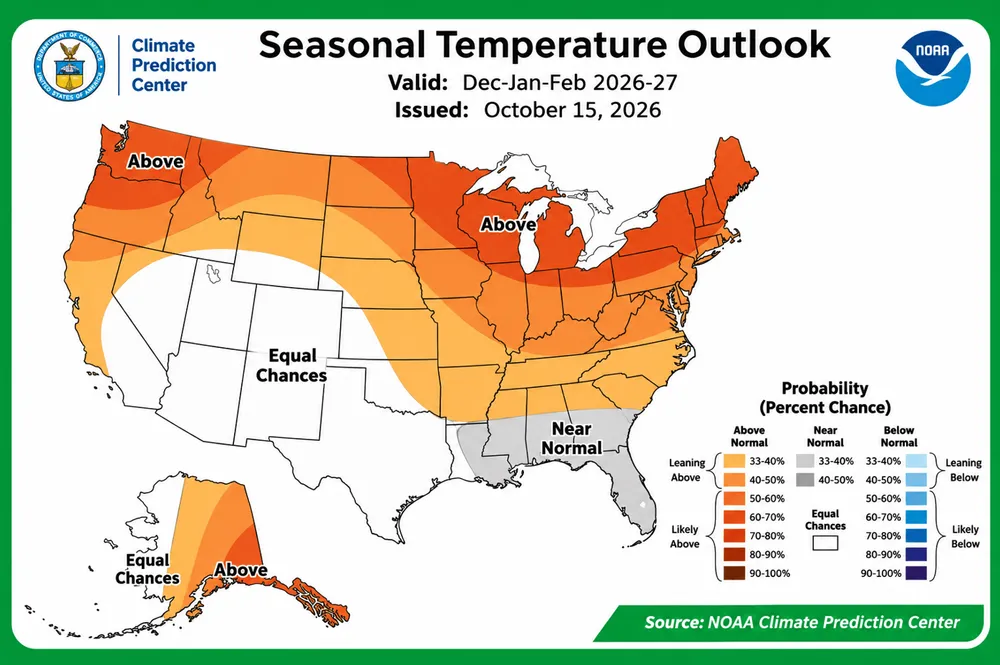
| Region | Temperature odds (Dec–Feb) | Precipitation odds | Filterbuy's first check at home |
|---|---|---|---|
| Northeast | Warmer than average favored | Wetter along the East Coast | Exterior vents after storms; wet snow can block furnace exhaust |
| Midwest and Ohio Valley | Warmer than average favored | Equal chances (Ohio Valley); drier in parts of the Great Lakes | The filter, before the first arctic outbreak |
| Pacific Northwest and northern Rockies | Strongest odds for warmer than average | Drier in the northern Rockies | Indoor humidity; dry heated air can drop below 30% |
| California | Warmer favored in northern California; equal chances in the Southwest | Wetter in the Southwest | Window condensation during wet stretches |
| Texas and Southern Plains | Outside NOAA's strongest warm-odds zone | Wetter than average; drought relief possible | CO alarms and generator placement before outages |
| Southeast and Florida | Near normal favored | Wetter than average | Humidity control; damp air favors mold |
| Alaska | Warmer than average favored | Drier across much of the state | A full heating season; milder still means very cold |
Source: NOAA 2026–27 U.S. Winter Outlook, released October 15, 2026. Home checks reflect Filterbuy's guidance.
Will This Winter Be Cold and Snowy? NOAA doesn't forecast seasonal snowfall. With warmer odds across most of the North, expect snow in bursts from individual storms rather than a long, cold stretch. Filterbuy's NOAA winter forecast breakdown covers the maps.
Warmer Than Normal Isn't the Same as Warmer Than Last Winter
NOAA compares this winter to the long-term average, but your heating bill compares it to last winter. The U.S. Energy Information Administration (EIA) expects national heating demand to match last winter's. The West is the exception: after an unusually warm 2025–26, it may need about 25% more heat, so a Western home can get a "warmer than normal" forecast and still feel colder than last year.
| Region | Heating demand vs. last winter (Nov–Mar) | Natural gas heat bill | Electric heat bill |
|---|---|---|---|
| Northeast | 12% lower | 14% lower | 3% lower |
| Midwest | 2% lower | 10% lower | 3% higher |
| South | 1% higher | 15% lower | 3% higher |
| West | 25% higher | 7% higher | 9% higher |
| U.S. average | No change | 9% lower | 4% higher |
Source: U.S. EIA, Winter Fuels Outlook 2026–27, released October 6, 2026. Heating demand is measured in heating degree days.
Our advice: budget by your heating fuel, not the headline. Oil-heated homes, about 3% of households and mostly in the Northeast, face a 21% rise in heating costs. For electric heat in the West, a thermostat setback and a clean filter are the cheapest fixes.
What Do the Farmers' Almanac and The Old Farmer's Almanac Say?
Both almanacs expect a changeable winter rather than a brutal one. The Farmers' Almanac 2026–27 winter forecast calls the season "Snow, Sleet, and Surprises," with a wet southern storm track and quick cold bursts up north. The Old Farmer's Almanac winter forecast leans mostly mild, with a colder stretch from central New England through the Appalachians and Ohio Valley. They're a fun second opinion; plan with NOAA.
How to Get Your Home Ready, Whether Winter Is Cold or Mild
A mild forecast doesn't let you skip winter prep. Filterbuy recommends six steps every fall, whatever the forecast.
Swap in a fresh filter, then date it. Filterbuy's support team tells callers to write the install date on the frame. To check it, hold the filter against white paper and replace it if it looks gray and matted. We prefer paper to the old light test, since a new pleated filter already blocks a lot of light. For timing, see how often to change your air filter and our winter furnace filter schedule.
Choose the highest MERV rating your system can handle. The EPA recommends at least MERV 13, or the highest rating the system fan and filter slot allow. Filterbuy makes MERV 8, 11, and 13 on the same production lines, so we have no reason to push the highest number. Filterbuy's MERV rating chart explains why an overly restrictive filter can strain your HVAC system.
Book a furnace tune-up and clear exterior vents. The CDC recommends yearly service for furnaces and other fuel-burning appliances, and our cold snap furnace checklist covers the details.
"The cold snap call I get most is a high-efficiency furnace that shut down because snow blocked its PVC exhaust pipe. Clearing the vent usually fixes it and keeps exhaust from backing up inside."
David Clark, Licensed HVAC Technician
Test your carbon monoxide detectors. The CDC advises battery-operated or battery back-up CO detectors near every sleeping area. Test each before the first cold snap.
Program a setback on your thermostat. According to the U.S. Department of Energy, turning your thermostat back 7°F to 10°F for 8 hours a day can save up to 10% a year on heating and cooling.
Check the filter when NOAA updates its outlook. NOAA's mid-month update makes a handy reminder. For humidity tips, see Filterbuy's guide to why indoor air quality gets worse in winter.
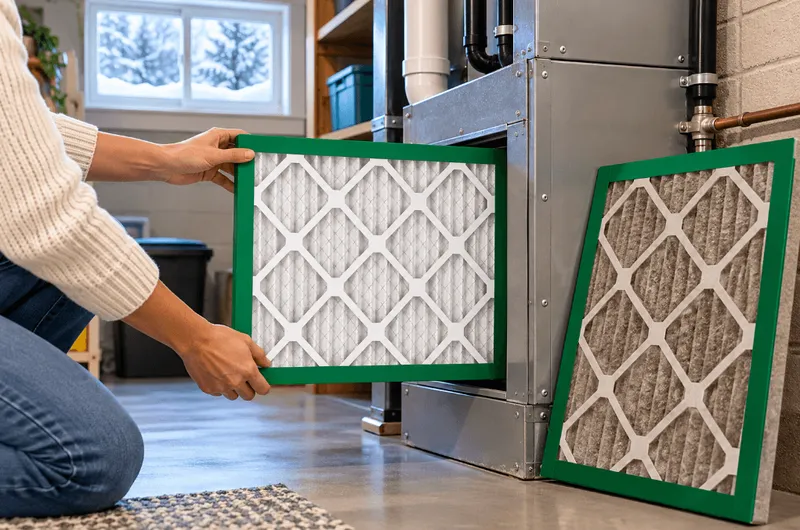
"When the forecast drops into single digits, I tell people to do two things before anything else: put in a fresh filter and test the CO alarms. A cold snap is the wrong week to discover your filter has been in since October."
Michelle Wan, Brand Manager and Air Quality Writer, Filterbuy
Filterbuy's air filter auto-delivery ships a fresh filter on your schedule. We cut 600+ sizes plus custom sizes, so you can find your filter size.
Supporting Statistics
About 90% of our time is spent indoors: The EPA reports some indoor pollutant levels often run 2 to 5 times higher than outdoors. Source: U.S. EPA, Report on the Environment: Indoor Air Quality
100,000+ ER visits a year from carbon monoxide: Unintentional CO poisoning also causes 400+ deaths a year. Source: CDC, Carbon Monoxide Poisoning Basics
46% of home heating fires happen December through February: That averages to 37,365 fires a year (2020–2024). Source: NFPA, Heating Safety
Frequently Asked Questions
Will this winter be cold in 2026?
For most of the country, no. NOAA favors a warmer-than-average North, though cold snaps are still likely.
Will this winter be colder than last year?
Nationally, about the same, per the EIA, but the Northeast may need 12% less heat and the West about 25% more.
Will this winter be cold in the Northeast?
NOAA favors a warmer, wetter Northeast: more rain and heavy wet snow than long deep freezes.
Will this winter be cold in the Midwest?
Likely milder than normal, though arctic outbreaks can still bring single-digit nights.
Will this winter be cold in California?
Northern California leans warmer, while Southern California leans wetter with no clear temperature signal.
Glossary
NOAA (National Oceanic and Atmospheric Administration): The U.S. federal agency that issues official weather and climate forecasts.
ENSO (El Niño–Southern Oscillation): A tropical Pacific climate cycle with a warm phase (El Niño) and a cool phase (La Niña).
El Niño: The warm ENSO phase; it often brings a stormier South and milder North.
La Niña: The cool ENSO phase; it often brings a colder North and drier South.
MERV (Minimum Efficiency Reporting Value): A 1–16 rating of how well a filter captures particles; Filterbuy makes MERV 8, 11, and 13.
Heating degree day (HDD): Heating demand; each degree a day's average falls below 65°F counts as one.