
When Is the Coldest Day of the Year? Dates by Region and How to Prep Your Home
November 9, 2026
Find your region on the countdown below and put the finish-prep date on your calendar today. That date is your deadline for a fresh furnace filter, and it arrives weeks before the coldest night of your winter does.
Your furnace puts in its longest hours during the coldest weeks, and every hour pulls more household dust and pet dander into the filter. Once the filter loads up, airflow drops and the system runs longer to hold the same temperature. Swap it by your date, then give it a quick look each month until spring.
Your Coldest-Day Countdown By Region
Finish prep byTypical coldest day
West of the Continental Divide
Prep by late Nov to early Dec. Coldest in December.
Alaska
Prep by mid-December. Coldest in January.
East of the Rockies
Prep by late Dec to early Jan. Coldest in January, often mid-to-late month in the Midwest and Northeast.
Hawaii and Puerto Rico
Prep by late January, if you run heat. Coldest from February to early March.
Coldest-day dates: NOAA NCEI, 1991–2020 U.S. Climate Normals. Prep windows follow Filterbuy's coldest-day countdown of 2 to 4 weeks ahead. Bars show approximate windows. In mountain valleys, finish 2 to 4 weeks before your local station's date.
Fast and free 2-day delivery to most US states. Auto-delivery saves 5% on every order.
Made in the USACustom sizes availableEdit, skip, or cancel auto-delivery anytime
Find The Right Furnace Filter Before Your Coldest Day
TL;DR
Across most of the East, the coldest day of the year arrives in January, often late in the month. West of the Continental Divide, it usually comes in December. These dates are NOAA’s 30-year averages (1991–2020), not forecasts. Because your heating system works hardest then, Filterbuy recommends changing your air filter and testing CO alarms two to four weeks ahead.
Key Takeaways
The West peaks early: Most of the West sees its average coldest day in December, according to NOAA’s National Centers for Environmental Information (NCEI).
The East peaks late: Most of the East bottoms out in January, when Arctic air spills south from snow-covered Canada.
The coldest day trails the shortest day: Land and oceans keep shedding heat for weeks after the December 21 solstice.
The date is creeping later: Compared with the 1981–2010 averages, many stations east of the Rockies now reach their coldest day 3 to 6 or more days later.
Peak cold means peak HVAC strain: Furnaces run longer in deep cold, so Filterbuy recommends a monthly filter check in winter.
When Is the Coldest Day of the Year?
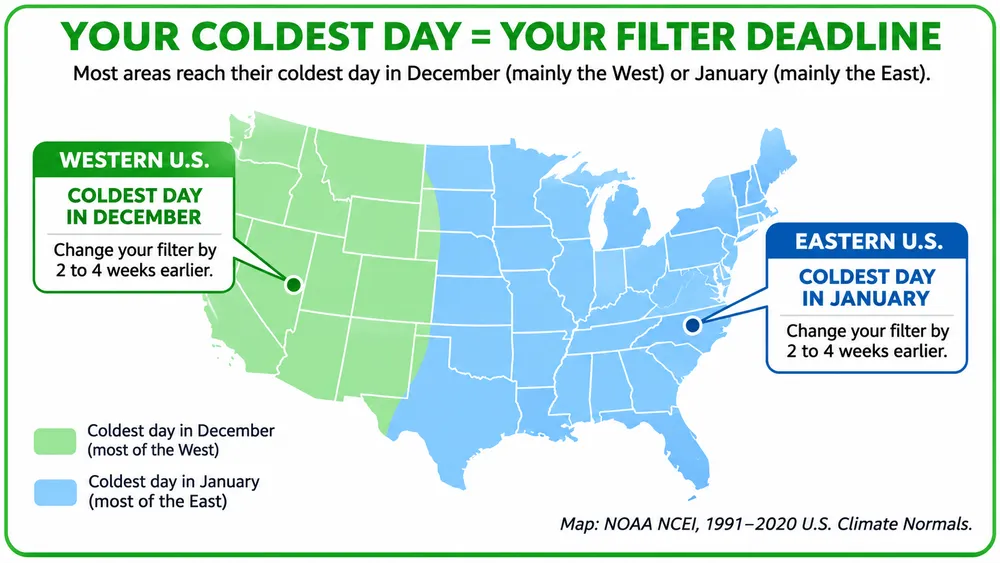
For most of the United States, the coldest day of the year lands between mid-December and late January. According to NOAA’s National Centers for Environmental Information (NCEI), the federal agency that keeps the nation’s weather and climate records, the West usually bottoms out in December, while most of the East doesn’t hit its seasonal low until January.
NCEI defines the “coldest day” as the date with the lowest average daily low in the 1991–2020 U.S. Climate Normals, its 30-year station averages. So it’s a typical date, not a prediction, and your own coldest morning may come weeks earlier or later.
This winter, that means Western homeowners can expect their usual coldest stretch next month, in December 2026, while most of the East should plan for January 2027.
We’ve made air filters in Filterbuy’s own U.S. plants since 2013, and we see this date less as a weather fact and more as a maintenance deadline. Your coldest week is your heating system’s hardest.
Average Coldest Day of the Year by Region (And When to Prep)
The average coldest day runs from December in the West to January in the East, and as late as February or early March in Hawaii and Puerto Rico.
| Region | Typical coldest day | Finish prep by | Why then |
|---|---|---|---|
| West of the Continental Divide | December | Late Nov – early Dec | Pacific air tracks the sun's yearly cycle |
| Mountain valleys (Rockies, Cascades, Sierra Nevada) | Later than nearby high ground | 2–4 weeks before your local station's date | Cold air pools in calm, snowy valleys |
| East of the Rockies | January, often mid-to-late month in the Midwest and Northeast | Late Dec – early Jan | Arctic air from snow-covered Canada |
| Alaska | January | Mid-December | Long, dark continental winters |
| Hawaii and Puerto Rico | February to early March | Late January, if you run heat | Oceans keep the islands cooling late |
Coldest-day dates: NOAA NCEI, 1991–2020 U.S. Climate Normals. Prep dates: Filterbuy coldest-day countdown (2–4 weeks ahead).
Source: NOAA NCEI, “When to Expect the Coldest Day of the Year”. For the exact average date in your town, open NOAA Climate.gov’s interactive coldest day map and click the station nearest you. Prep dates follow Filterbuy’s coldest-day countdown.
Why Isn’t the Shortest Day the Coldest Day?
The coldest day trails the winter solstice because of seasonal lag. The solstice, on December 21 this year, brings the least daylight, yet land and oceans keep losing more heat at night than they gain back during short winter days. Temperatures fall until returning sunlight catches up.
You’ve seen the same thing at home. When the furnace shuts off on a cold night, your rooms don’t hit their lowest temperature right away, because walls and floors give up their stored heat slowly. Earth works the same way on a seasonal scale, with the oceans acting as a giant heat battery.
Geography stretches or shortens that lag. NCEI explains that the West follows the sun more closely because mild Pacific air brings clouds and precipitation. The East is at the mercy of Canadian cold air, and its snow cover reflects sunlight away.
Is the Coldest Day of the Year Shifting Later?
Yes, in much of the country. When NCEI moved from the 1981–2010 normals to the 1991–2020 set, many stations east of the Rocky Mountains saw their coldest day slide 3 to 6 or more days later. NCEI ties this to early winter warming faster than late winter.
The West is more mixed. The far Northwest shifted later as well, but some Western stations moved earlier.
If you live in the East, keep late January on your radar. As Filterbuy’s winter furnace filter guide puts it, “a filter that looks fine in October can be completely choked by December.”
What the Coldest Day of the Year Means for Your Home and HVAC System
The coldest days of the year are also the busiest for your heating system. Run times stretch out, and with the windows shut, the same air keeps circulating.
When temperatures bottom out, a few things happen at once:
Your air filter loads faster. Every extra hour of blower time pulls more dust and pet dander into the filter. Once it clogs, airflow drops and the system has to run even longer to deliver the same heat.
Heat pumps lose capacity. In a deep freeze, many heat pumps lean on auxiliary heat, which costs more to run. If “AUX” or “EM HEAT” shows often in mild weather, call a technician.
Indoor air gets stale. With little fresh air coming in, cooking fumes and pet dander linger. See Filterbuy’s guide to indoor air quality during a cold snap.
“The cold snap call I get most is a high-efficiency furnace that shut down because snow blocked its PVC exhaust pipe. Clearing the vent usually fixes it and keeps exhaust from backing up inside.”
David Clark, Licensed HVAC Technician, Filterbuy HVAC Solutions
How to Prepare Your Home for the Coldest Day of the Year
Filterbuy’s coldest-day countdown is simple: look up your region’s “finish prep by” date in the table above, then work through this list before it arrives.
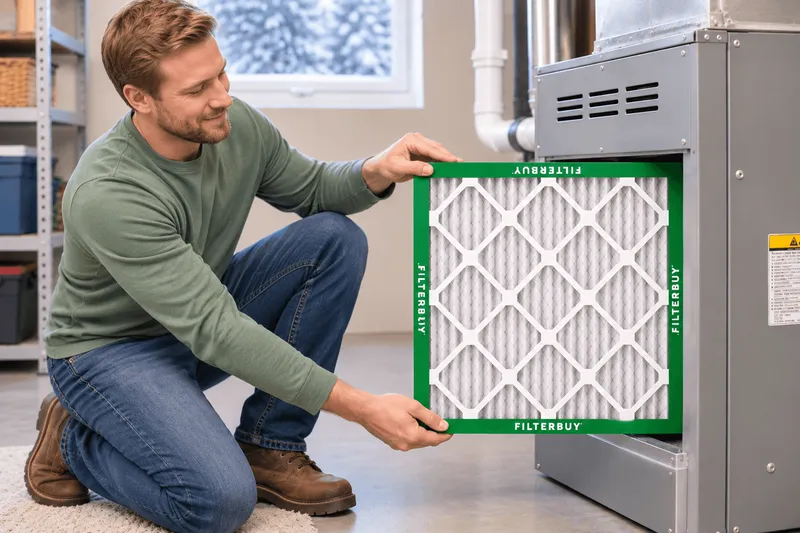
Check and change your air filter. Many 1-inch filters are rated for up to 90 days, but the coldest weeks load them faster. Filterbuy’s support team suggests a simple habit: write the install date on the frame, then hold the filter against a sheet of white paper once a month. If it looks gray and matted, replace it. See how often to change your air filter.
Schedule a heating tune-up before the deep freeze. A technician can spot weak parts before your system faces its hardest week, and the CDC recommends yearly service for fuel-burning heating systems.
Test your carbon monoxide (CO) alarms. Press each test button and swap out weak batteries. The EPA advises having CO alarms outside each sleeping area and on every level of the home.
Clear snow and ice from outdoor equipment. A blocked intake or exhaust vent on a high-efficiency furnace can shut the system down or create a CO hazard, so clear them after every storm. Give your heat pump’s outdoor unit the same attention. See how to protect your furnace during a cold snap.
Use thermostat setbacks wisely. The U.S. Department of Energy estimates you can save as much as 10% a year by turning your thermostat back 7–10°F for 8 hours a day. In a true deep freeze, though, the American Red Cross advises holding the same temperature day and night to keep pipes from freezing, and never leaving the heat below 55°F while you travel. Heat pumps need smaller setbacks.
Protect your pipes. Open the sink cabinets on exterior walls and let a faucet drip when the temperature plunges. If water lines run through the garage, keep the garage door shut.
Keep vents and returns open. Furniture or closed registers choke airflow and make your system work harder.
“When the forecast drops into single digits, I tell people to do two things before anything else: put in a fresh filter and test the CO alarms. A cold snap is the wrong week to discover your filter has been in since October.”
Michelle Wan, Brand Manager and Air Quality Writer, Filterbuy
Pro Tip: Put your region’s “finish prep by” date on the calendar, or let Filterbuy auto-delivery send a filter in your exact size, made to order in our U.S. plants, on schedule.
Supporting Statistics
7,300+ weather stations feed NOAA’s 1991–2020 Climate Normals behind each coldest-day date. Source: NOAA NCEI
100,000+ ER visits a year come from carbon monoxide poisoning, and gas furnaces are a named source. Source: CDC
$15,400 is the average water damage and freezing claim (2019–2023); about 1 in 60 insured homes files one yearly. Source: Insurance Information Institute
Frequently Asked Questions
What is the coldest day of the year in 2027?
No one can pin down the exact date ahead of time. NOAA’s averages point to January for most of the East, and its 2026–27 Winter Outlook favors a mild North under a strong El Niño. Cold snaps still happen, so watch your National Weather Service forecast in January.
Is January the coldest month of the year?
For most of the contiguous U.S., yes. Most places east of the Rockies bottom out in January, while much of the West does so in December.
Is the winter solstice the coldest day of the year?
No. It’s the shortest day, not the coldest. Seasonal lag keeps land and oceans cooling for weeks afterward, so the average coldest day lands between mid-December and late January.
What is the coldest day ever recorded in the U.S.?
January 23, 1971, when Prospect Creek, Alaska, fell to −80°F. The Lower 48 record is −70°F at Rogers Pass, Montana, on January 20, 1954. Both came in late January, in line with the averages above. (Records: NOAA NCEI State Climate Extremes Committee.)
When should I change my furnace filter before the coldest day?
Two to four weeks before your region’s average coldest day, which is the “finish prep by” date in the table above. After that, Filterbuy recommends checking the filter monthly until spring, since deep cold keeps your furnace running longer.
Glossary
Coldest day of the year: The date with the lowest average daily low temperature at a location, based on 30 years of data.
Coldest-day countdown: Filterbuy’s method of finishing winter HVAC prep two to four weeks before a region’s average coldest day.
Climate Normals: NOAA’s 30-year weather averages; the current set covers 1991–2020.
NCEI: NOAA’s National Centers for Environmental Information, which publishes the Climate Normals and “Coldest Day of the Year” maps.
Seasonal lag: The weeks-long gap between the winter solstice and the coldest temperatures.
Winter solstice: The Northern Hemisphere’s shortest day, December 21 or 22.
Continental Divide: The Rocky Mountain ridge line dividing Pacific-bound and Atlantic-bound rivers.
Arctic air mass: Frigid, dry air from Canada and the Arctic that surges into the U.S.
Auxiliary (backup) heat: Electric heat that supplements a heat pump in very cold weather.
Thermostat setback: Lowering the thermostat for a set period to save energy.
Carbon monoxide (CO): A colorless, odorless, poisonous gas from burning fuel.
HVAC air filter: A filter in a forced-air system’s return that captures airborne particles; Filterbuy makes them in 600+ sizes.