
How Many Blizzards per Year by State? (Map, Rankings & City Odds)
October 23, 2026

Your blizzard odds depend on wind more than snow, so they swing widely from one state to the next. Fargo, ND has about a 3-in-4 chance of a blizzard each winter, while Buffalo, NY sits near 1 in 4 and Chicago near 1 in 14. To count, a storm needs 35 mph winds and a quarter mile of visibility or less for at least three hours.
When a storm keeps the windows shut, your furnace filter does all the work. Take the quick quiz below to find the right one for your home.
Yearly chance of at least one blizzard
Odds drop fast outside Blizzard Alley
Get ready before the first storm
Answer 3 quick questions and we’ll match you to the right filter for winter.
Already know your size? Shop Filterbuy air filters made in the USA in more than 600 sizes.
TL;DR
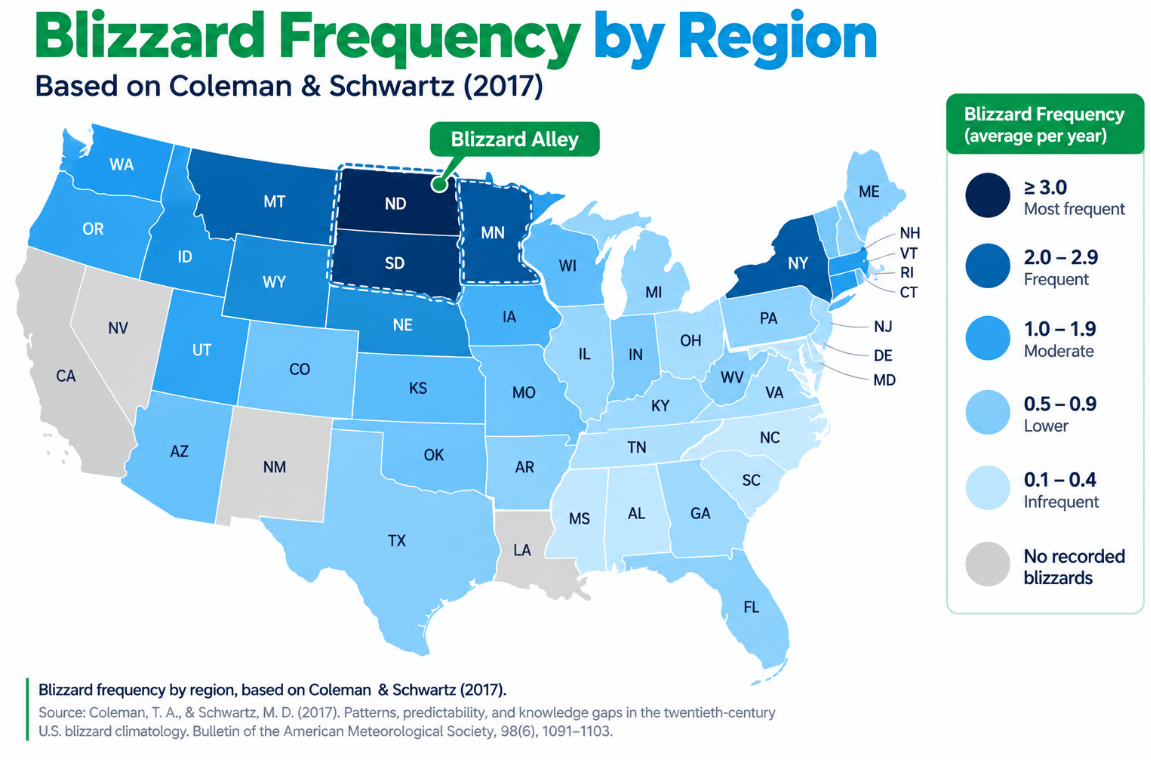
The contiguous United States sees roughly 13 blizzards a year, based on records from 1959 to 2014. North Dakota gets the most, with every county facing a better-than-60% chance of a blizzard each winter, followed by South Dakota and western Minnesota. At the other end of the map, Alabama, Florida and Mississippi had no blizzard on record as of 2016.
Key Takeaways
Blizzards are defined by wind and visibility rather than snowfall: 35 mph winds and a quarter mile of visibility or less for at least three hours.
From 1959 to 2014, the U.S. averaged about 13 blizzards a season, from 1 (1980–81) to 32 (2007–08).
North Dakota, South Dakota and western Minnesota make up "Blizzard Alley," where most counties see at least one blizzard a year.
Blizzards keep homes sealed and furnaces running, which puts more weight on a clean filter and clear vents.
Why We Track Blizzards at Filterbuy
At Filterbuy, we've been building air filters in our U.S. plants since 2013, and we treat blizzard data as something to plan around. Your state's blizzard count tells you how many hours the furnace will run with the windows shut, cycling the same air through one filter.
What Counts as a Blizzard?
The National Weather Service (NWS) doesn't define a blizzard by how much snow falls. It looks at wind and visibility, and all three conditions below have to occur together, according to the NWS winter weather definitions.
Official Nws Blizzard Criteria
Source: National Weather Service winter weather definitions.
So a heavy snowfall on a calm day isn't a blizzard, while a windy afternoon that whips old snow sideways can be. Whiteouts that don't last three hours are called "blizzard-like conditions" and aren't counted in the totals below.
How Many Blizzards Happen per Year, by State?
Across the Lower 48, the average is roughly 13 blizzards a year, according to a 2017 study by Jill Coleman of Ball State University and Robert Schwartz, who counted 713 blizzards in NOAA's Storm Data records from 1959 through 2014 (Climate Signals summary). Since one storm often crosses several states, the tiers below overlap.
Blizzard Frequency By State
Sources: Coleman & Schwartz (2017); Schwartz & Schmidlin (2002); FOX Weather; Spectrum News; NBC News; Philadelphia Inquirer; UGA Extension; Wikipedia.
NOAA's Storm Events Database has county-level blizzard reports going back to 1996.
A snowy city isn't always a blizzard-prone one. Ball State researchers singled out Buffalo, New York, Cleveland and Chicago as places with heavy snowfall but low blizzard odds, since blizzards depend on wind more than snow. Fargo is roughly three times as likely as Buffalo to see a blizzard in a given winter:
Annual Blizzard Odds In Major U.S. Cities
Source: Robert Schwartz, Ball State University, 1959–2000 data, via Newswise. Yearly chance means the odds of at least one blizzard in a given winter. The plain-terms column is Filterbuy's conversion of those odds, not a schedule.
Which States Get the Most Blizzards? Meet Blizzard Alley
No state gets more blizzards than North Dakota, and the Red River Valley along its border with Minnesota is the national hot spot. From there, "Blizzard Alley" stretches into western Minnesota, northern Iowa and northeastern Nebraska. Nearly all 119 counties in the Dakotas, along with 39 in western Minnesota, average at least one blizzard a year (FOX Weather). Three things drive it:
Flat, treeless terrain lets winds build to 35 mph and drag Arctic air south.
Dry, powdery snow stays loose and keeps blowing long after it falls.
An active storm track sends Alberta Clippers, Arctic fronts and Colorado Lows through each winter.
The Northeast sees fewer blizzards, but a nor'easter reaches far more people when it hits, as Schwartz pointed out in a Ball State University release.
Filterbuy research points the same way. When our team ranked the U.S. states with the most extreme weather using NOAA state climate records, Minnesota came in second and South Dakota fifth. South Dakota's record 24-hour snowfall stands at 52 inches, and Minnesota has hit −60°F. In states like these, we suggest starting with a MERV 11 filter changed every 60 to 90 days.
Are Blizzards Becoming More Common?
Reported blizzards in the U.S. have roughly doubled since the 1960s. Coleman and Schwartz counted about 9 blizzards a year from 1960 to 1994 and about 19 a year from 1995 on (Philadelphia Inquirer).
The researchers note that better detection explains much of the increase, but not all of it. Either way, Filterbuy's advice stays the same: plan around your region's typical blizzard season, not the national average.
U.S. Blizzard Record At A Glance, 1959–2014
Source: Coleman & Schwartz (2017), via Climate Signals and Denver7.
The January 2025 Gulf Coast blizzard and two major 2026 blizzards show big storms still reach the South.
How to Protect Your Home's Air Before a Blizzard
For homes in Blizzard Alley, Filterbuy's rule of thumb is simple: make October filter month. Put in a fresh filter, set a spare aside and check it monthly through March. Once a storm sets in and the windows stay shut, your filter does all the work. Our furnace filter replacement guide covers the swap step by step.
The full Filterbuy pre-season checklist, reviewed by David Clark:
Install a fresh air filter before the first storm. Unsure of your size? Our guide shows how to measure your air filter, and the Filterbuy MERV rating chart helps you choose a filtration level. Double-check all three numbers: depth is the one Filterbuy's manufacturing team most often sees ordered wrong.
Keep a spare filter on hand. Filterbuy cuts every filter to order and ships within 24 hours, but a closed interstate can hold up any delivery. Filterbuy auto-delivery puts the next one in your closet before the forecast turns.
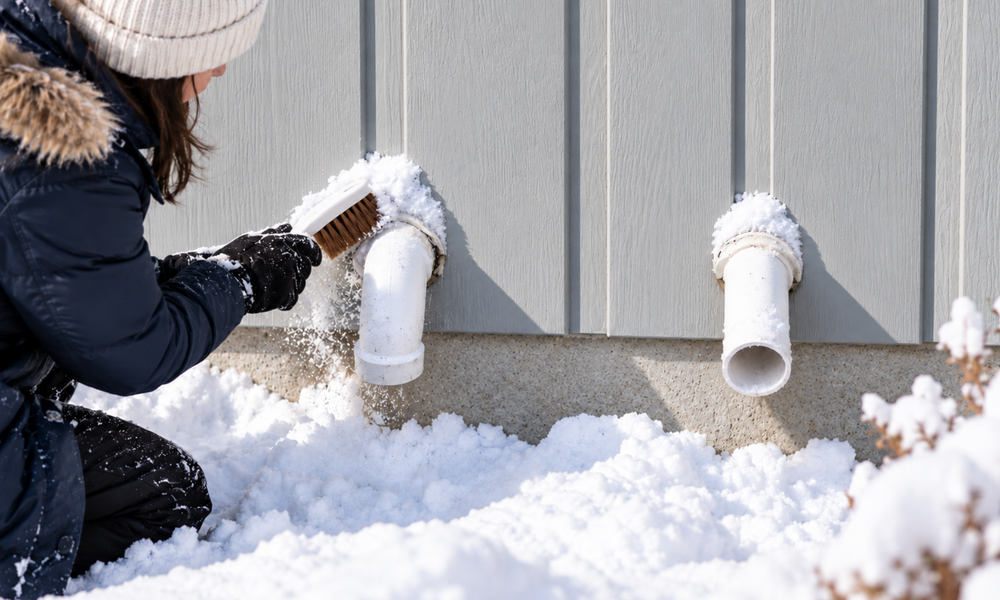
Find your furnace intake and exhaust vents. High-efficiency furnaces often vent through two PVC pipes low on an outside wall, where drifting snow can bury them.
Clear those vents during and after the storm. A blocked vent can shut the furnace down or force carbon monoxide (CO) back into the house (Connecticut Commission on Fire Prevention and Control).
Test the CO detector on every level of your home. You can't see, smell or taste carbon monoxide.
Run generators outdoors only, well away from windows, doors and vents.
Book a furnace tune-up in the fall to catch a weak igniter or cracked heat exchanger before the storms arrive.
Filterbuy team put it well in our guide to finding your HVAC air filter:
"People assume finding the filter is the easy part and choosing it is the hard part. It is the other way round."
— Michelle Wan, Brand Manager and Air Quality Writer, Filterbuy
"A filter that does not fill its rack is doing less than the homeowner thinks. Air will always take the gap over the media."
— David Clark, Licensed HVAC Technician, Filterbuy HVAC Solutions
Supporting Statistics
1. Carbon monoxide deaths peak in December and January, the same months blizzards do. From 1999 to 2004, the CDC found that an average of 439 Americans died each year from accidental, non-fire carbon monoxide poisoning. Deaths per day peaked in January (2.07) and December (1.97), and the highest state death rates clustered in places like Nebraska and North Dakota, in and around Blizzard Alley. Source: CDC, Morbidity and Mortality Weekly Report, "Carbon Monoxide–Related Deaths, United States, 1999–2004".
2. Indoor air can hold 2 to 5 times more of some pollutants than outdoor air. The EPA says Americans spend about 90% of their time indoors, where some pollutants are often 2 to 5 times more concentrated. Source: U.S. EPA, Report on the Environment: Indoor Air Quality.
3. Nearly half of a home's energy goes to heating and cooling. ENERGY STAR recommends checking your filter every month during heavy-use seasons like winter and changing it at least every 3 months, because a dirty filter slows airflow. Source: ENERGY STAR (U.S. EPA and DOE), Heat & Cool Efficiently.
Frequently Asked Questions
Which State Has the Most Blizzards per Year?
North Dakota, where every county has at least a 60% chance of a blizzard each winter.
Which States Have Never Had a Blizzard?
As of 2016, Alabama, Florida, Mississippi, South Carolina and Tennessee had no blizzards on record. Louisiana was on that list until the January 2025 Gulf Coast blizzard.
What Month Has the Most Blizzards?
December and January. None were recorded in July, August or September from 1959 to 2014.
Does a Blizzard Need a Lot of Snow?
No. Snow already on the ground can blow enough to meet the wind and visibility criteria.
Should I Change My Air Filter Before Blizzard Season?
Yes. Filterbuy recommends checking it monthly through winter and replacing it at least every 90 days, or sooner if you have pets or allergies. Read more on how often to change your HVAC filter.
Breathe Easier All Winter
You can't control the storm, but you can control the air your family breathes. Filterbuy, a family-owned manufacturer, makes filters in the USA in more than 600 sizes plus custom cuts. Shop Filterbuy air filters by size before the first blizzard warning.