
Gas Furnace Replacement Cost Guide: Install Price Factors, AFUE Efficiency Ratings, Labor Costs, Size Requirements, And High-Energy Savings
November 9, 2026
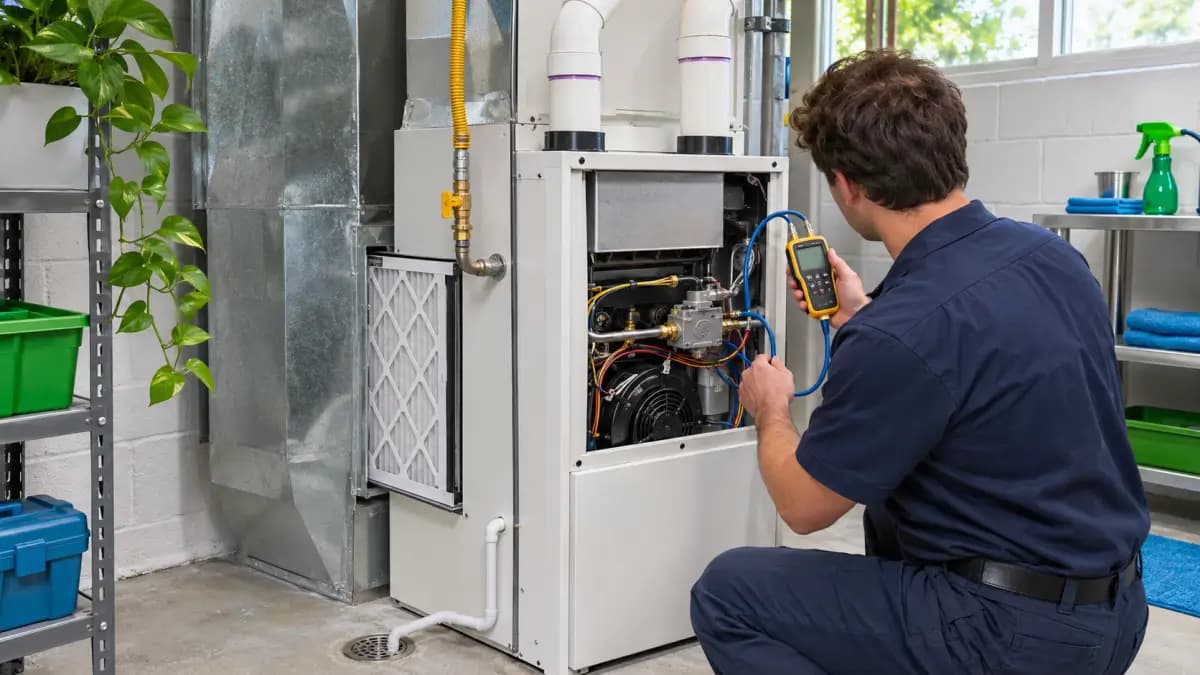
Replacing a gas furnace usually costs $3,800 to $10,000 installed. At Filterbuy, we make the air filters that go into these furnaces, so we look at every replacement from the filter slot outward. Seen that way, the final price depends less on the furnace itself than on what has to change around it: venting, sizing, the AC coil, and the efficiency tier. We built this guide around those line items, with our own payback math at this winter's gas prices.
TL;DR
Most gas furnace replacements land between $3,800 and $10,000 installed, and complex jobs can reach about $12,000. A 95% AFUE condensing furnace costs more up front because it needs new PVC venting and a condensate drain, but it burns about 16% less gas than an 80% unit to deliver the same heat.
Key Takeaways
The federal minimum for a new gas furnace is 80% AFUE, and ENERGY STAR models start at 95% AFUE.
Your own payback is the price difference between two quotes divided by your yearly gas savings, which is about 16% of your heating bill on an 80% to 95% upgrade.
Venting changes and AC coil fit are the biggest swing items on a replacement quote.
Size a replacement furnace from a new Manual J load calculation, not the old unit's nameplate.
How Much Does Gas Furnace Replacement Cost In 2026?
A gas furnace replacement typically costs $3,800 to $10,000 installed in 2026, and complicated jobs can reach about $12,000. The furnace and labor set the base price. Venting changes and AC coil work push a quote toward the top of that range.
For first-time installs, permit fees, and gas versus electric pricing, see the Filterbuy furnace installation cost guide.
The Filterbuy Take: Compare quotes line by line. A low bid that leaves out venting or water heater work can cost more by the time the job is finished.
What Drives The Price On A Gas Furnace Replacement Quote?
Equipment is usually the largest line on a gas furnace replacement quote, followed by labor. The swing items homeowners rarely see coming are venting changes, condensate drainage, an orphaned water heater, and duct transitions. Each one belongs on its own line of a written quote.
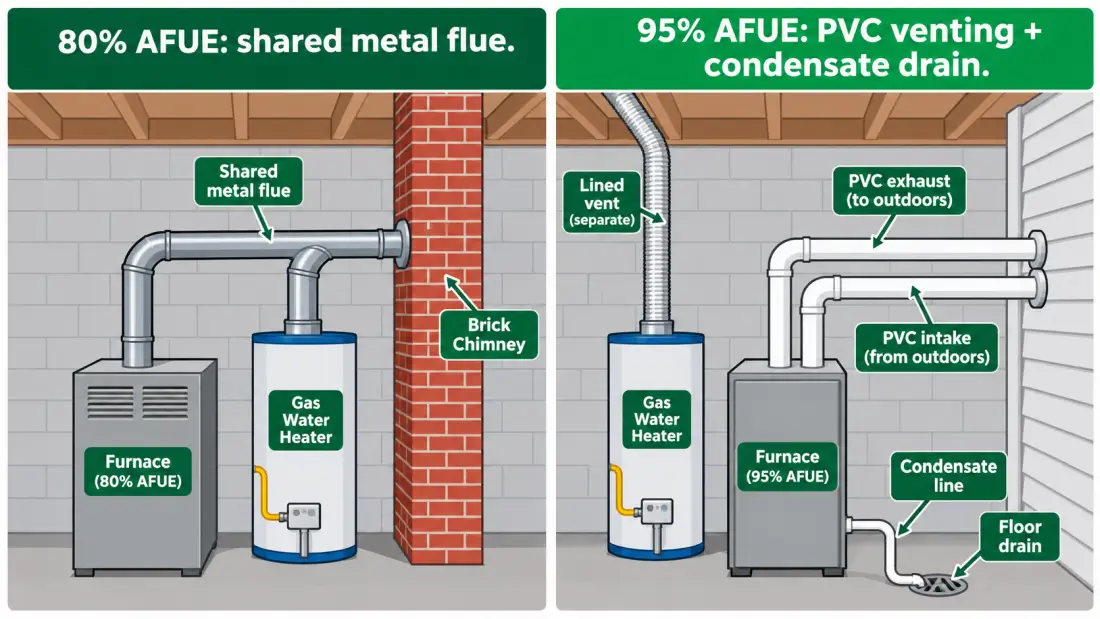
Venting: a move to 90%+ AFUE needs new PVC intake and exhaust pipes.
Water heater venting: ask about a chimney liner or new vent if the water heater shared the old flue.
Condensate drain: ask where it will drain and whether a pump is needed.
Coil and duct transitions: ask whether the AC coil will be reused, adapted, or replaced.
The orphaned water heater is the line item easiest to miss on a quote. When an 80% furnace and a gas water heater share a chimney, removing the furnace leaves the water heater venting alone into a flue sized for both appliances. DOE's Energy Saver guidance on furnaces and boilers notes that high-efficiency furnaces produce acidic exhaust that old, unlined chimneys cannot handle, and that chimneys often need relining when an older heating unit is replaced.
Red flags on a replacement quote:
The new furnace size is copied from the old one with no load calculation.
A 95% AFUE quote never mentions the water heater vent.
No permit or inspection is listed.
No startup check of gas pressure and temperature rise.
80% Vs. 95% AFUE: Which Gas Furnace Delivers High-Energy Savings?
AFUE, or annual fuel utilization efficiency, is the share of fuel a furnace turns into usable heat over a year. An 80% AFUE gas furnace turns 80 cents of every gas dollar into heat, and a 95% AFUE furnace turns 95 cents into heat. The higher-efficiency furnace burns about 16% less gas for the same warmth.
DOE lists older low-efficiency systems at 56% to 70% AFUE and today's high-efficiency furnaces at 90% to 98.5% AFUE. To earn the ENERGY STAR label, a gas furnace must reach 95% AFUE in the U.S. South and 97% AFUE in the U.S. North, according to the ENERGY STAR furnace key product criteria.
Filterbuy ran EIA's October 2026 winter forecast through the AFUE math.
Illustration only. Uses EIA's forecast average of $640 for gas-heated homes from November 2026 through March 2027, assuming that spend reflects your current furnace.
The Filterbuy Take: In cold northern climates, buy the 95% or higher furnace. In mild southern climates, an 80% furnace can still be the smarter spend, because savings shrink when the heating season is short.
How To Estimate Your Own Gas Furnace Payback
Your payback depends on your own gas bill. Use the national figures above as a starting point only.
Find your yearly savings. Multiply your winter heating cost by the fuel saved: about 16% for an 80% to 95% upgrade, or 26% for 70% to 95%.
Divide the price gap. Divide the difference between the 80% and 95% quotes by that yearly savings. The result is your payback in years.
Example: a $1,200 winter heating bill saves about $190 a year with an 80% to 95% upgrade, so a $1,500 price gap pays back in about eight years. To isolate heating, subtract a summer month's gas bill from each winter month.
Is The 95% AFUE Furnace Rule Still Happening?
The DOE finalized a rule in 2023 requiring non-weatherized gas furnaces made on or after December 18, 2028, to reach at least 95% AFUE. The rule went back to the D.C. Circuit after a June 2026 Supreme Court order, and DOE is reviewing an industry petition to delay the furnace compliance date to at least January 1, 2030. For a furnace bought today, the 80% minimum still applies.
The Filterbuy Take: An unsettled rule is not a reason to rush. Pick the efficiency tier that fits your climate and budget today.
What Size Gas Furnace Do You Need When Replacing An Old Unit?
The right size for a replacement gas furnace comes from a room-by-room heat load calculation, the ACCA Manual J load calculation, instead of the BTU rating on the old unit. Older furnaces were often oversized, so ask the contractor to show the load calculation before you sign.
Compare output BTUs, not input BTUs. A 100,000 BTU input furnace at 80% AFUE delivers about 80,000 BTUs of heat, and a 95% AFUE furnace with the same input delivers about 95,000 BTUs.
Oversizing causes short cycling, which wears parts. For rough BTU-per-square-foot ranges you can check before a contractor visits, see the Filterbuy gas furnace cost and BTU sizing guide.
Should You Repair Or Replace Your Gas Furnace?
Replacement usually beats repair when a gas furnace is 15 years or older, needs a major part such as a heat exchanger or control board. A cracked heat exchanger is a safety issue because it can let combustion gases, including carbon monoxide, escape into the home, so it calls for an immediate professional inspection.
Run the $5,000 rule. Multiply the furnace's age by the repair quote. A result above $5,000 usually points to replacement.
Never ignore warning signs. Yellow burner flames or a carbon monoxide alarm mean shutting off the furnace and calling a licensed technician. The CPSC winter heating safety tips call for a yearly furnace inspection and CO alarms on every level.
Protect Your New Gas Furnace From Day One
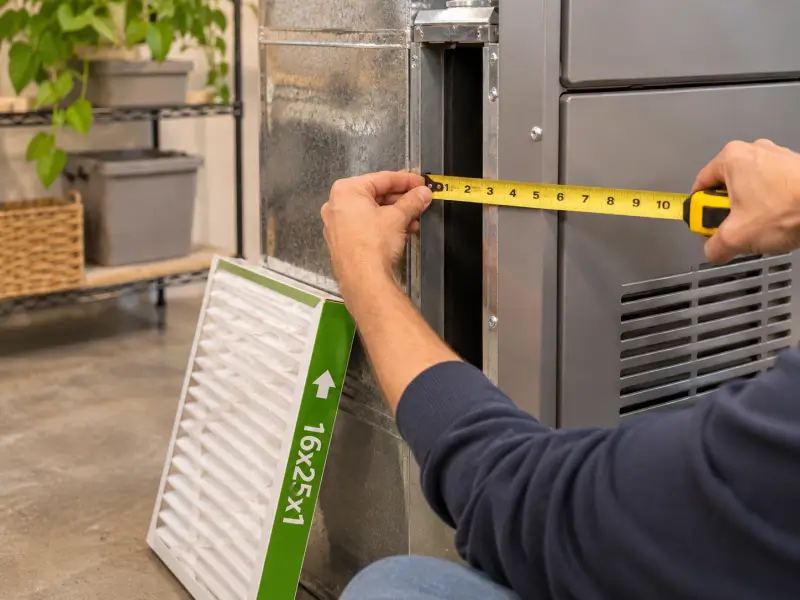
Many replacement furnaces use a different cabinet width than the old unit, which can change the filter size. Follow the Filterbuy steps for how to measure your air filter once the new unit is in. A filter that is too small leaves gaps that let dust slip past it into the new blower.
We cut, pleat, and frame every Filterbuy filter to order in hundreds of standard sizes, and we make custom sizes when a new furnace slot does not match one. Orders ship with fast and free 2-day delivery to most US states. Find your filter size. MERV 8 air filters handle everyday dust and lint, MERV 11 air filters capture finer particles such as pet dander and pollen, and MERV 13 air filters capture the smallest particles of the three. Check your HVAC manual to confirm which MERV rating your furnace supports before moving up a tier. Auto-delivery sends the next filter when it is due, and the Filterbuy furnace maintenance checklist covers the yearly tune-up.
"If you live in a cold climate, it usually makes sense to invest in the highest-efficiency system."
U.S. Department of Energy, Energy Saver
The Filterbuy Take: We agree, with one addition. A high-efficiency furnace delivers its rated AFUE only with free airflow, so set a filter schedule the day it goes in.
Supporting Statistics
$640 average winter heating bill for gas-heated homes
Covers November 2026 through March 2027.
Down 9% from last winter.
Gas was the main heating fuel in 46% of U.S. homes in 2024.
Why it matters: Nearly half of U.S. homes face this upgrade choice, and colder homes save the most.
Source: Winter Fuels Outlook 2026–27
7.6-year average payback on a 95% AFUE gas furnace
DOE projects $350 in average lifetime savings (2022 dollars).
Applies to non-weatherized gas furnaces under the 95% AFUE standard.
Why it matters: Furnaces last 15 to 20 years, so most condensing models pay back within one lifespan.
Source: Energy Conservation Program: Energy Conservation Standards for Consumer Furnaces
$29.33 per hour median pay for HVAC installers (May 2025)
Jobs are projected to grow 11% from 2025 to 2035.
Why it matters: Skilled labor stays a firm line on every quote.
Source: Heating, Air Conditioning, and Refrigeration Mechanics and Installers
Gas Furnace Replacement Cost FAQs
How Long Does A Gas Furnace Replacement Take?
Most like-for-like gas furnace replacements finish in one day. Venting or coil changes can stretch the job to two days.
Is There A Federal Tax Credit For A Gas Furnace In 2026?
No. The IRS energy efficient home improvement credit (Section 25C) ended for equipment placed in service after December 31, 2025. Ask your gas utility about remaining rebates.
Can I Replace My Gas Furnace Without Replacing My AC?
Yes, if the air conditioner is in good shape and its coil fits or can be adapted to the new cabinet. If the AC is aging, replacing both avoids paying for coil work twice.
Do I Need A Permit To Replace A Gas Furnace?
Most cities and counties require a mechanical permit, and often a gas permit, for furnace replacement. Your contractor normally pulls it, and the inspection checks gas connections and venting.
Get Honest Help With Your Gas Furnace Replacement
Start with three itemized quotes from licensed local contractors. Florida homeowners can book a free estimate for HVAC system replacement with Filterbuy HVAC Solutions, and every homeowner can keep a new furnace running at its rated efficiency with Filterbuy filters made to order and delivered on schedule.
Glossary
AFUE (Annual Fuel Utilization Efficiency): The percentage of fuel a furnace converts into usable heat over a typical year.
BTU (British Thermal Unit): A unit of heat. Furnaces list input BTUs (fuel burned) and output BTUs (heat delivered) per hour.
Condensing Furnace: A 90%+ AFUE gas furnace that recovers heat from exhaust and drains the resulting water.
Manual J: The Air Conditioning Contractors of America (ACCA) method for calculating a home's room-by-room heating and cooling load.
MERV (Minimum Efficiency Reporting Value): A rating from 1 to 16 that describes how well an air filter captures particles of different sizes. Filterbuy makes MERV 8, 11, and 13 filters.