
Furnace Installation Guide: The Process, Cost, Timeline, Permits, and What to Expect from Professional Installers
October 19, 2026
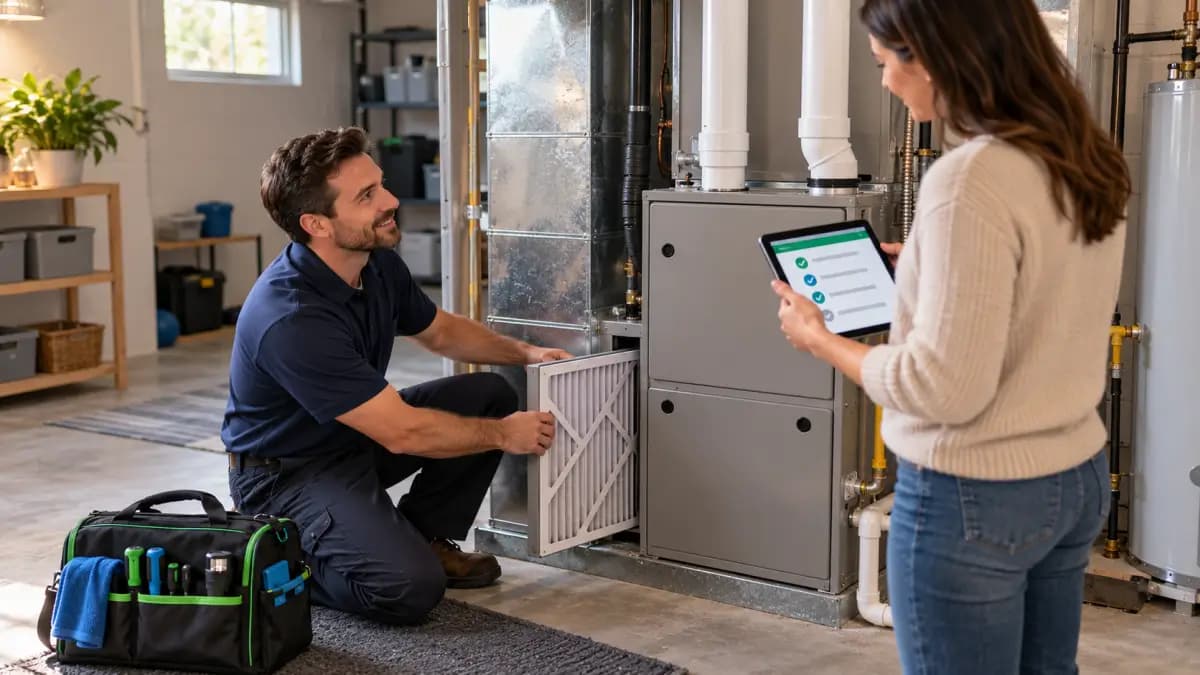
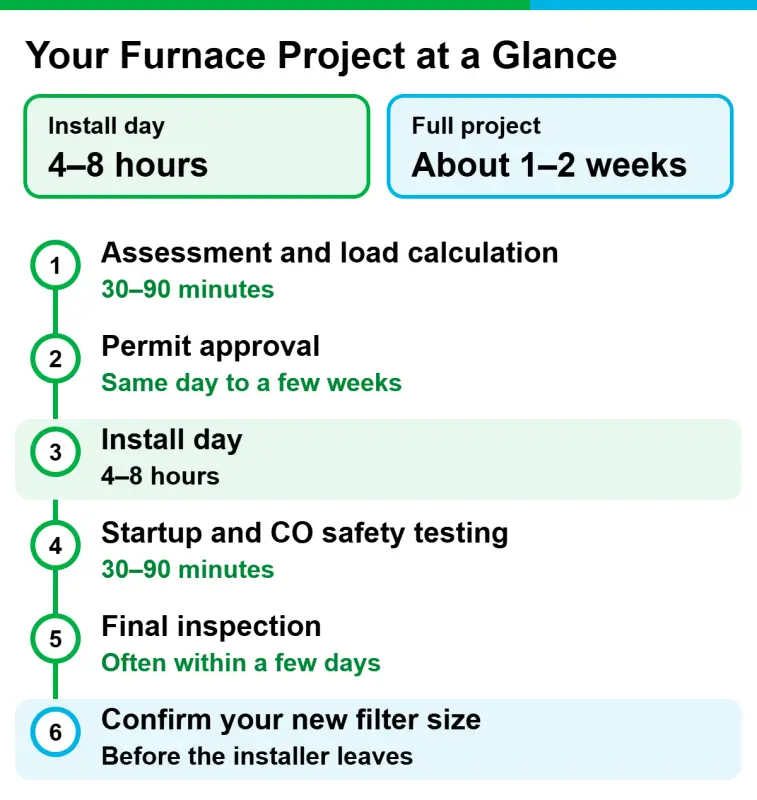
A professional furnace installation averages about $4,800 in 2026 and usually takes one day. Most homeowners pay roughly $2,800 to $6,900, and the full project, including the permit and inspection, takes about one to two weeks.
A new furnace may use a different filter size, so confirm yours before the installer leaves. Take the quick quiz below to match your new furnace with the right filter.
Cost data: Angi, 2026.
Read the Full Installation Guide
Match Your New Furnace with the Right Filter
Answer a few quick questions, and we'll match you to the right filter for your new furnace.
TL;DR
A professional furnace installation averages about $4,800 in 2026, with most homeowners paying roughly $2,800 to $6,900 (Angi). Installation takes one day (4 to 8 hours), and the full project, including permit and inspection, about one to two weeks. A qualified installer sizes the furnace with a Manual J load calculation (a room-by-room estimate of your home’s heat loss) and tests for carbon monoxide at startup.
Key Takeaways
• Most cities and counties require a mechanical permit (a permit for HVAC work) for furnace replacement, with fees from about $50 to $1,500.
• The federal Section 25C tax credit ended December 31, 2025, so look for utility and state rebates instead.
• A 90%+ efficiency furnace pays back fastest in cold climates. In mild ones, an 80% unit can be the better buy.
• A new furnace may use a different filter size or slot, so confirm it before the installer leaves.
Filterbuy doesn't install most readers' furnaces. We make the part a new furnace breathes through first: air filters cut, pleated, and framed to order in our own US plants. So this guide ends where most stop, with the filter. Still deciding? See Filterbuy's signs it's time to replace your furnace.
How Much Does Furnace Installation Cost in 2026?
Furnace installation costs $4,814 on average in 2026, and most homeowners pay between $2,823 and $6,897 for the equipment plus professional labor, according to Angi's analysis of 11,869 projects. Price depends on efficiency (AFUE, the share of fuel that becomes heat), heating capacity in BTUs, venting, ductwork, and local rates.
Table 1: What drives furnace installation cost
Sources: Angi 2026 furnace cost data (labor, ductwork, removal, permits); Budget Heating 2026 cost guide (permits). Fees vary by city.
Angi’s 2026 installed costs by fuel type:
• Electric furnace: 2,000–7,000
• Natural gas furnace: 3,800–10,000
• Propane furnace: 3,700–14,200
• Oil furnace: 6,750–10,000
In Maryland, California, and Virginia, expect at least $5,000 (Angi).
Tax credits in 2026: The Section 25C credit (up to $600 for a qualifying gas furnace) doesn’t apply to 2026 installs (IRS).
What Happens During a Professional Furnace Installation?
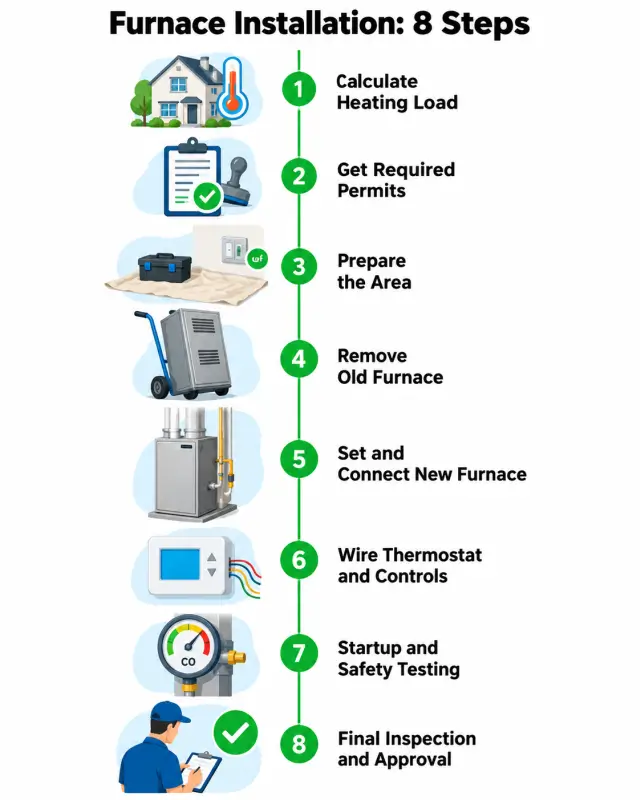
A professional installation follows eight steps, from load calculation to final inspection. Quality matters: ENERGY STAR notes that improper installation can reduce system efficiency by up to 30%.
1. Assess the home and calculate the load. The installer sizes the furnace with an ACCA Manual J load calculation, which national building codes require, and checks the ducts. An oversized furnace short-cycles and wastes fuel.
2. Finalize the quote and file the permit. The contractor files a mechanical permit for gas, venting, and electrical work.
3. Prep and shut down. The crew protects floors and shuts off gas and power.
4. Remove the old furnace. The old unit is disconnected and hauled away.
5. Set and connect the new furnace. The furnace is leveled and connected to ducts, gas, venting, and any condensate drain.
6. Wire the furnace and thermostat. Power and thermostat wiring are connected to code.
7. Start up and commission. The technician sets gas pressure, runs combustion and carbon monoxide tests, and checks airflow and temperature rise, the heat the furnace adds to the air (B. Carlson Heating).
8. Pass inspection and walk through. A local inspector signs off, and the installer shows you the thermostat, the filter location, and the warranty registration.
How Long Does Furnace Installation Take?
A furnace installation usually takes 4 to 8 hours, or one working day, for a like-for-like replacement. Complex installs involving new venting, ductwork changes, or a fuel conversion can take 2 to 3 days (PickComfort). From first call to final inspection, most projects take one to two weeks.
Typical timeline (PickComfort):
1. Assessment and load calculation: 30 to 90 minutes.
2. Permit approval: same day to a few weeks, depending on local backlogs.
3. Startup and testing: 30 to 90 minutes.
4. Final inspection: often within a few days.
Plan for no heat most of install day, and clear a path to the furnace (B. Carlson).
Do You Need a Permit to Install a Furnace?
Yes. Most U.S. cities and counties require a mechanical permit for furnace replacement, because gas piping and combustion venting affect fire and carbon monoxide safety. Licensed contractors usually pull the permit; fees run about $50 to $1,500 (Budget Heating, Angi).
Skipping one can complicate a home sale or insurance claim. Keep CO alarms on each level and outside bedrooms, as the U.S. Consumer Product Safety Commission recommends.
How Do You Compare Furnace Installation Quotes?
Get three itemized, written quotes and compare scope, not just price. ENERGY STAR's contractor-hiring tips agree. In South Florida, Filterbuy HVAC Solutions installs furnaces.
The Filterbuy Furnace Quote Checklist
☐ The contractor performed a Manual J load calculation instead of matching the old furnace's label.
☐ The quote lists the furnace model number, AFUE rating, and BTU output.
☐ Permit, inspection, and old-unit disposal fees are included.
☐ Startup includes combustion analysis and carbon monoxide testing.
☐ Venting, drain, and duct work are itemized.
☐ Warranty terms are in writing, and the installer registers the equipment.
☐ The quote states the filter size and location, a gasketed filter access panel as the U.S. Department of Energy recommends.
☐ The contractor is licensed and insured in your state.
“A filter that does not fill its rack is doing less than the homeowner thinks. Air will always take the gap over the media. When I pull a panel and find a clean filter sitting next to a dirty coil, that gap is almost always why.”
David Clark, Licensed HVAC Technician, Filterbuy HVAC Solutions (from Filterbuy’s guide to HVAC air filter location)
Many quotes compare an 80% AFUE furnace with a 90%+ condensing model:
Table 2: 80% AFUE vs. 90%+ condensing furnace
Sources: Budget Heating 2026 cost guide; Filterbuy furnace replacement guide (AFUE range); U.S. Department of Energy furnace standard as reported by ACHR News. The 2028 rule is in court, so confirm its status with your installer.
Will a 90%+ Furnace Pay for Itself? Run Your Numbers
• Yearly savings ≈ your yearly heating bill × (1 − old AFUE ÷ new AFUE).
• Payback years ≈ extra cost ÷ yearly savings.
Going from 80% to 90% AFUE cuts fuel use about 11% and adds roughly 1,000–1,200 (Budget Heating). Filterbuy’s worked examples, using EIA heating-cost data:
1. Average gas-heated home ($519/year): about $58 saved per year, so 17–21 years to break even.
2. New Hampshire-level bill ($981/year): about $109 saved per year, so 9–11 years.
In mild climates, an 80% furnace can be the better buy. In cold climates, condensing usually wins, though rebates and gas prices can change the math.
What Should You Do After Your New Furnace Is Installed?
Do Filterbuy’s five-minute filter handoff before the installer leaves, based on U.S. Department of Energy guidance:
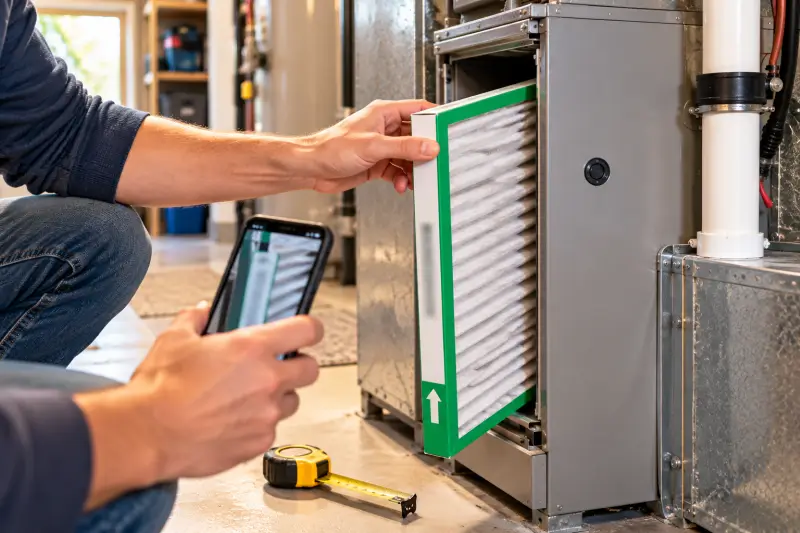
1. Have the installer show you the filter slot and confirm its size. Photograph the label.
2. Check that the airflow arrow points toward the furnace.
3. Close the access panel. It should fit tightly, but don’t tape it shut.
4. Write the install date and next change date on the filter frame.
How to Find Your New Filter Size
It takes a minute:
1. Check the filter first. The size is printed as three numbers on its cardboard frame.
2. No filter? Measure the slot. Measure length, width, and depth. Depth is the measurement Filterbuy’s manufacturing team sees ordered wrong most often (how to measure your air filter).
3. Order the nominal size. That’s the rounded number on the label. The filter itself is cut slightly smaller on purpose, and that clearance is what lets it fit (Filterbuy’s air filter size chart).
4. Size not listed? Filterbuy cuts custom air filters to the eighth of an inch.
“The question I get most is which MERV to buy. The one to ask first is whether the filter you are holding actually fills the slot. A rating describes the media, not the gap around it.”
Michelle Wan, Brand Manager and Air Quality Writer, Filterbuy (How to Measure Your Air Filter)
Then pick a tier:
• MERV 8: the standard choice for most homes.
• MERV 11: for homes with allergies and asthma, and also pets and pollen.
• MERV 13: the pick for smoke.
• Odor Eliminator: carbon media for household odors.
Check your HVAC manual for compatibility, the same way you’d confirm a size. Then see the MERV rating chart, check how often to change your air filter, and set up Filterbuy auto-delivery. Breathe easy.
Furnace Installation FAQs
Can I Install a Furnace Myself?
No. The work involves gas lines and carbon monoxide risk. Many areas require a licensed contractor, and many warranties require professional installation (Angi).
Should I Replace My Air Conditioner at the Same Time?
Yes, if it's near the end of its life; the furnace blower and AC coil work as a matched system. New 2026 AC installs typically use refrigerants like R-454B or R-32 (Budget Heating).
Supporting Statistics
1. 47% of U.S. homes heat with natural gas.
– Electricity heats another 42%.
– Gas furnace installs involve gas lines and combustion venting.
– Source: U.S. Energy Information Administration, 2025
2. 400+ Americans die from accidental, non-fire CO poisoning each year.
– 100,000+ visit the ER. 14,000+ are hospitalized.
– Furnaces are a known CO source. CDC advises yearly service.
– Source: CDC, 2026
3. 34,200 home heating fires happen each year.
– They cause 165 deaths and $367 million in losses.
– 77% stay confined to chimneys, flues, or fuel burners. Inspectors check these parts.
– Source: U.S. Fire Administration, 2017–2019 data
Glossary
• AFUE: Annual Fuel Utilization Efficiency, the share of a furnace's fuel that becomes usable heat.
• BTU: British Thermal Unit, the unit for furnace heating capacity.
• ACCA Manual J: The Air Conditioning Contractors of America method for calculating a home’s heating load.
• Condensing furnace: A 90%+ AFUE furnace that recovers exhaust heat, drains condensate, and vents through PVC.
• Combustion analysis: A startup test of furnace exhaust, including CO.
• Temperature rise: The supply-to-return air temperature difference, which must stay in the manufacturer’s range.
• Mechanical permit: A local permit for HVAC work, followed by an inspection.
• MERV: Minimum Efficiency Reporting Value, a 1–16 rating of how well a filter captures particles.
Sources
Angi · IRS · ENERGY STAR · ENERGY STAR hiring tips · U.S. DOE Building America · CPSC · ACCA · ACHR News · Budget Heating · PickComfort cost · PickComfort timeline · B. Carlson · EIA · CDC · U.S. Fire Administration