
Condensing Furnace Guide: Efficiency, Cost, How It Works, vs Non-Condensing Comparison, and Common Problems
November 27, 2026
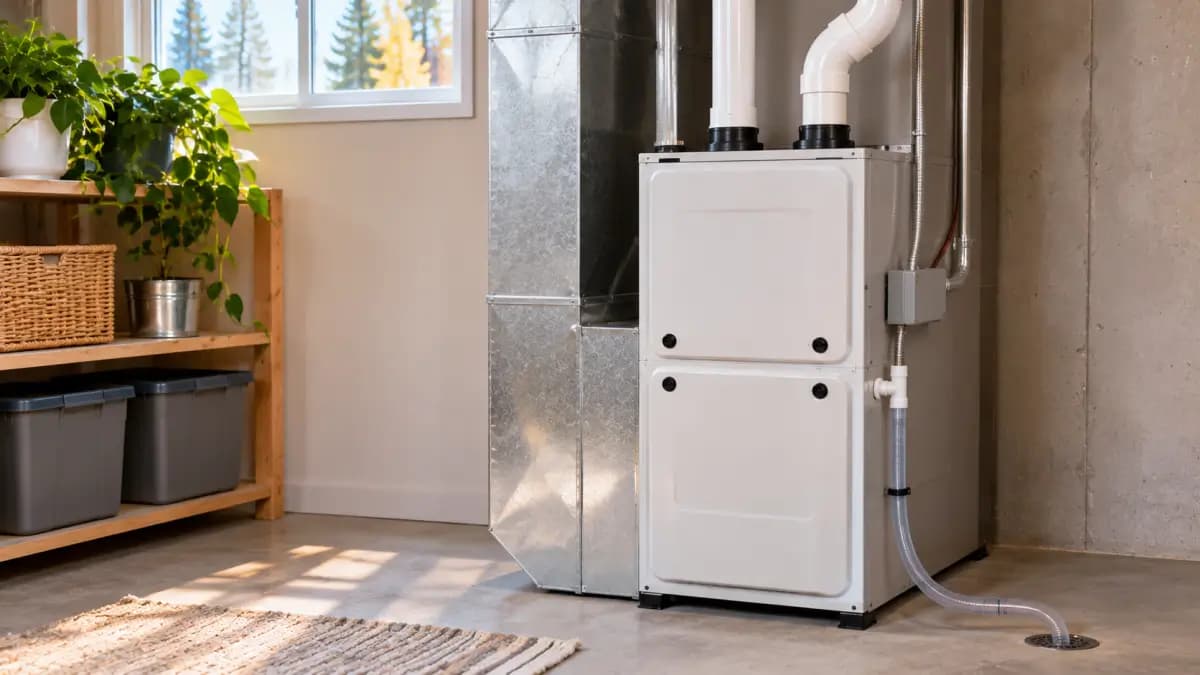
Choose a condensing furnace if your home can vent through PVC pipe and drain water nearby. It turns 90 cents or more of each gas dollar into heat, while a non-condensing furnace stops at about 80 to 86 cents.
The trade-off is a higher install price and a drain you'll need to keep clear. Here's how the two compare:
- Condensing: 90% AFUE and up, PVC vent pipes, and a condensate drain.
- Non-condensing: about 80% to 86% AFUE, a metal flue or chimney, and no drain.
Where Each Gas Dollar Goes
Out of every $1 of gas your furnace burns:
Non-Condensing Furnace
About 80–86¢ becomes heat in your home.
The rest leaves as hot exhaust up a metal flue.
No condensate drain needed.
Condensing Furnace
90¢ or more becomes heat in your home.
A second heat exchanger pulls extra heat from the exhaust.
Cool exhaust exits through PVC pipe, and water drains away.
Both furnace types use the same pleated air filter in front of the blower.
Find The Right Filter For Your Furnace
Answer 3 quick questions and we'll match you to the right filter size and MERV rating.
A condensing furnace is a high efficiency gas furnace that captures heat older furnaces send up the chimney, reaching 90% AFUE (annual fuel utilization efficiency, the share of fuel turned into heat) or higher. Filterbuy makes the pleated filters that sit in front of the furnace blower, so this guide starts with airflow, then the drain and vent issues unique to condensing models.
TL;DR
A condensing furnace uses a second heat exchanger to pull heat from exhaust, reaching 90% AFUE or higher. A non-condensing furnace vents hot exhaust up a metal flue and tops out in the mid 80s. Condensing models cost more upfront but burn less gas. They also need a working drain and clear vents.
Key Takeaways
Condensing gas furnaces are rated 90% AFUE or higher, versus about 80% to 86% for non-condensing models.
The secondary heat exchanger makes a furnace condensing by cooling exhaust until water vapor condenses.
Condensing furnaces need PVC venting and a drain for condensate, the acidic water they make, which can add retrofit work.
Moving from 80% to 95% AFUE cuts gas use for the same heat by about 16%.
A clogged or frozen condensate drain or a blocked vent pipe can shut a condensing furnace down.
A federal 95% AFUE standard for new indoor gas furnaces starts December 18, 2028, pending court review.
What Is A Condensing Furnace?
A condensing furnace is a gas furnace that recovers the heat held in water vapor from combustion. It cools the exhaust until that vapor turns to liquid, releasing that stored heat into your home instead of the chimney. Condensing models are also called high efficiency furnaces or 90 plus furnaces.
The U.S. Department of Energy Building America Solution Center classifies condensing furnaces as Category IV appliances, the class for condensing units with sealed, pressurized vents. Their exhaust leaves below 140°F, cool enough for plastic vent pipe, and they pull combustion air from outdoors.
How A Condensing Gas Furnace Works, Step By Step
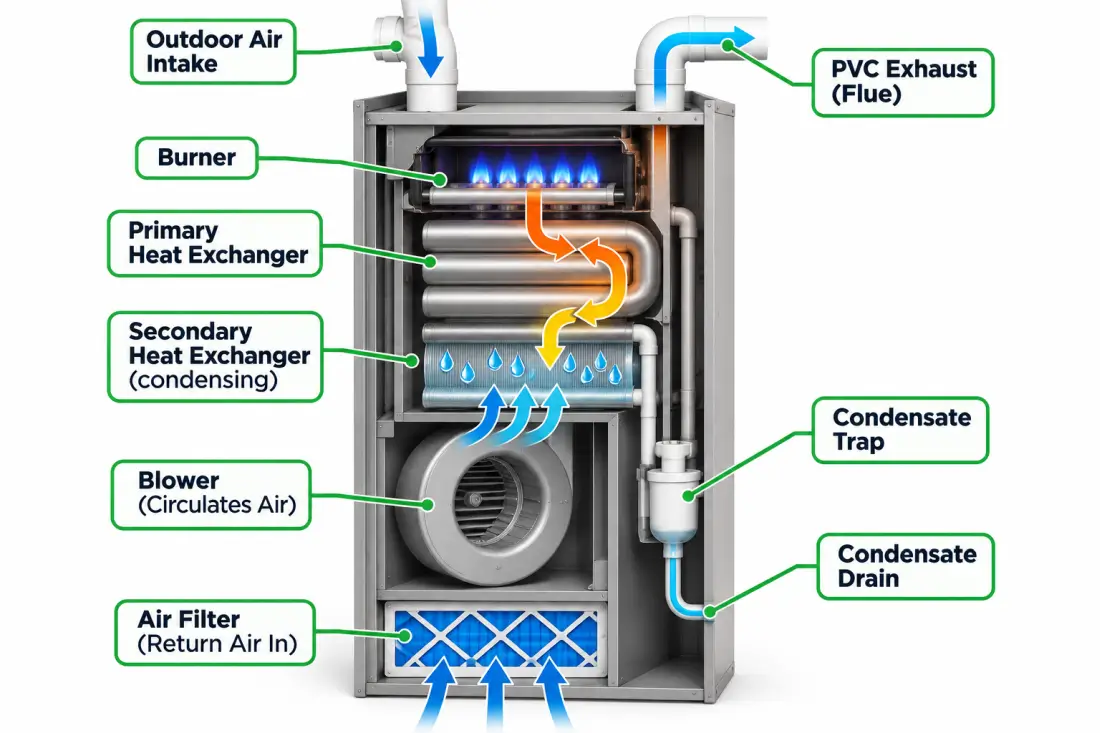
Intake. A PVC pipe brings outdoor air to the sealed burner box.
Combustion. Burners fire into the primary heat exchanger, the metal chamber that heats passing air.
Secondary heat exchange. Exhaust water vapor condenses in a second coil.
Air delivery. The blower pushes filtered house air across both heat exchangers and into the ducts.
Drainage and venting. Condensate drains through a trap to a floor drain or pump, and a small inducer fan pushes cool exhaust out a PVC pipe.
Condensing Vs Non-Condensing Furnace: Side-By-Side Comparison
The main difference is what happens to exhaust heat. A non-condensing furnace sends it up a metal flue. A condensing furnace keeps that heat and drains the water.
Filterbuy's take: if your home can vent PVC and drain condensate without major work, condensing is the better buy for a gas furnace you plan to keep. Filterbuy's gas furnace buying guide covers sizing.
How Efficient Is A High Efficiency Condensing Furnace?
A high efficiency condensing furnace turns 90 cents or more of every gas dollar into heat, versus about 80 cents for a standard natural gas furnace. ENERGY STAR gas furnace certification criteria call for at least 97% AFUE in northern states and 95% AFUE in southern states.
Going from 95% to 98% AFUE cuts gas use only about 3%.
Arithmetic from AFUE ratios for the same heat delivered, not measured savings.
Filterbuy's take: going condensing is the big win. The last few AFUE points add far less. Our high efficiency furnace guide compares 95%, 96%, and 98% AFUE models in more detail.
How Much Does A Condensing Furnace Cost?
A condensing furnace costs more than a non-condensing furnace for the equipment and the installation around it. In its 2023 consumer furnace rule, DOE estimated that a condensing furnace adds about $490 in installation cost on an average replacement job. An Air Conditioning Contractors of America (ACCA) survey cited in the rule put the gap at $569. Retrofits can add:
New PVC intake and exhaust pipes.
A condensate drain, trap, and sometimes a pump.
A condensate neutralizer where local code requires one.
A chimney liner or new water heater if the old flue is left to the water heater alone.
Worked example: a home spending $900 a year on furnace gas with an 80% unit would spend about $758 with a 95% unit, saving roughly $142 a year. In that example, DOE's $490 average installation premium would pay back in about 3.5 years. Equipment price gaps add to that. Filterbuy's furnace replacement cost guide covers the full price of a swap.
Can Your Home Take A Condensing Furnace? A Five-Point Retrofit Check
A condensing furnace needs a PVC vent path and a drain, so homes with a shared chimney need the most planning. Filterbuy's five-point check flags the hard parts before you collect quotes:
Vent path. Is there a wall or roof route for two PVC pipes within the manual's vent length limit?
Drain access. Is there a floor drain or room for a condensate pump?
Freeze exposure. Will the drain line run through unheated space?
Shared flue. Does a gas water heater share the chimney with your current furnace?
Snow line. Can the vent terminals sit well above expected snow depth?
When the furnace leaves the chimney, the water heater can become one of the orphaned water heaters home inspectors flag. Alone in an oversized flue, it may draft poorly and spill exhaust indoors. Fixes include a sized metal liner or a new water heater. Oak Ridge National Laboratory also field-tested a pipe-within-a-pipe vent system that lets both appliances share one chimney. Ask for a combustion safety test, keep carbon monoxide alarms on every level, and read how to choose the right furnace size before comparing bids.
Common Condensing Furnace Problems And What Causes Them
Condensing furnaces add a condensate drain and PVC venting, and both can cause shutdowns. Filterbuy's take: check the drain and vents before assuming a failed part.
Water pooling under the furnace: a clogged or cracked drain hose, or a failed condensate pump. Check the drain, then call a technician.
Pressure switch error code (the switch that confirms exhaust is venting): condensate backed up into the inducer fan. Call a technician.
Shuts off during a cold snap: a frozen condensate line. Thaw it, then insulate it.
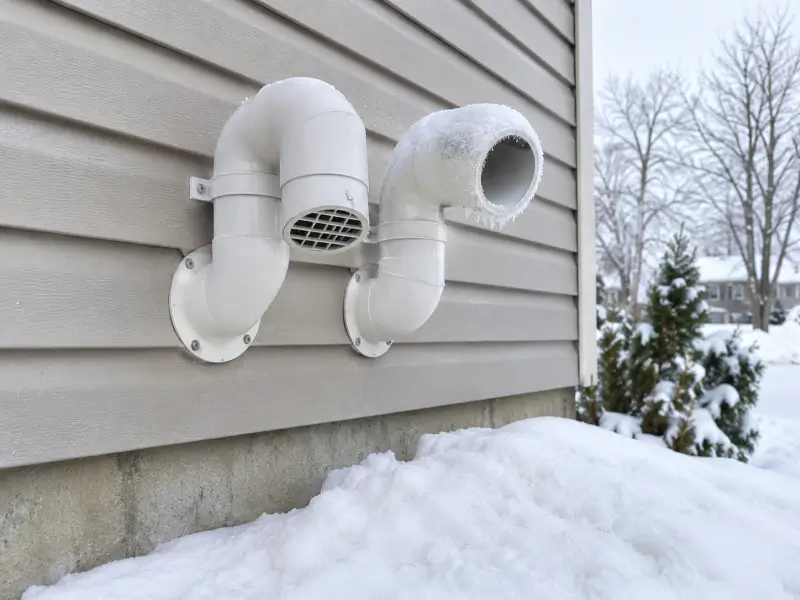
Shuts off after snow or ice: a blocked intake or exhaust pipe. Clear the outdoor terminals.
Building America guidance puts condensate at a pH of 3 or lower, so insulate cold-space drain lines and route them indoors in cold climates. If it won't start, see Filterbuy's furnace troubleshooting checklist and furnace clicking noises guides. A frozen drain can even back water toward the wiring, per our furnace tripping the breaker guide.
Filterbuy's monthly winter routine for condensing furnace owners:
Check the filter and replace it if it looks gray or caked.
Look at the drain tube and trap for standing water or slime.
Clear snow and ice from both vents.
Press the test button on each CO alarm.
Note any blinking code before calling for service.
What The 2028 Furnace Standard Means For Condensing Furnace Buyers
Under the federal furnace efficiency standard, new indoor (non-weatherized) and mobile home gas furnaces made on or after December 18, 2028 must reach 95% AFUE, which only condensing furnaces meet. In June 2026, the U.S. Supreme Court vacated the ruling that upheld it and sent the case back, as the Air Conditioning Contractors of America reported. The rule remains in effect for now while DOE weighs a delay.
The standard covers new furnaces, not installed ones, so a condensing unit bought now already meets it.
Why Filter Condition Matters On A Condensing Furnace
A condensing furnace needs steady airflow across two heat exchangers, so check the filter monthly in winter. Filterbuy's guide to whether a dirty filter makes a furnace work harder lists change intervals by filter depth.
Filters carry a MERV rating, a 1 to 16 scale for how well they capture airborne particles. MERV 8 air filters are the standard choice for most homes. MERV 11 suits homes with allergies, asthma, pets, or pollen, and MERV 13 is the pick for smoke. Just as you confirm the size, check your furnace manual for the MERV ratings your system supports, or see which MERV rating to use.
Supporting Statistics
47% of U.S. homes heated mainly with natural gas in 2024.
Why it matters: gas remains the most common U.S. heating fuel.
Source: Electricity Use Is Becoming More Common for Residential Heating
Gas furnaces use about 19% of U.S. home energy.
DOE projects $24.8 billion in savings from the 95% standard over 30 years.
Why it matters: a few AFUE points add up across millions of homes.
393 people died from accidental carbon monoxide poisoning in 2015.
36% of those deaths came in December, January, or February.
Why it matters: check venting and CO alarms in any condensing retrofit.
Frequently Asked Questions About Condensing Furnaces
Is A Condensing Furnace Worth It?
Usually yes in cold climates, where Lawrence Berkeley National Laboratory found condensing furnaces save more energy, and for owners keeping it most of a furnace lifespan. In mild climates with an easy chimney vent, a non-condensing furnace can be the cheaper choice.
Does A Condensing Furnace Need A Chimney?
No. It vents through PVC pipe out a wall or roof. Its cool, wet exhaust would damage an unlined masonry chimney.
Why Is My Condensing Furnace Leaking Water?
Common causes are a clogged or loose drain or a failed condensate pump. Check the drain and call a technician if water returns.
Does A Condensing Furnace Need A Special Air Filter?
No. It uses a standard pleated filter, like the ones Filterbuy makes, sized to match your current filter.
Will I Have To Buy A Condensing Furnace After 2028?
If the rule holds, yes. New indoor gas furnaces made from December 18, 2028 must reach 95% AFUE, but the rule is under court review.
Keep Your Condensing Furnace Running With The Right Filter
Filterbuy makes pleated furnace filters in MERV 8, MERV 11, and MERV 13. They're cut, pleated, and framed to order in our own US plants, and custom sizes are cut to the eighth of an inch. Orders ship with fast and free 2-day delivery to most US states. Shop furnace filters by size and set up Auto Delivery so a fresh filter arrives on schedule. More guides live in the Furnace Filters and Winter hub.
Glossary
AFUE (Annual Fuel Utilization Efficiency): The share of fuel a furnace turns into heat over a season.
Condensing Furnace: A gas furnace rated 90% AFUE or higher.
Non-Condensing Furnace: A gas furnace rated about 80% to 86% AFUE.
Secondary Heat Exchanger: The second coil where exhaust water vapor condenses.
Condensate: Acidic water a condensing furnace produces.
Pressure Switch: A safety switch that stops ignition if exhaust isn't venting.
Non-Weatherized Furnace: An indoor furnace, the class the 95% rule covers.
Orphaned Water Heater: A gas water heater left alone in a chimney it once shared with a furnace.
MERV (Minimum Efficiency Reporting Value): A 1 to 16 scale for how well a filter captures airborne particles, as the EPA explains.