
Is the Air Inside Your Car Worse Than Outside? What the Research Shows
November 26, 2026
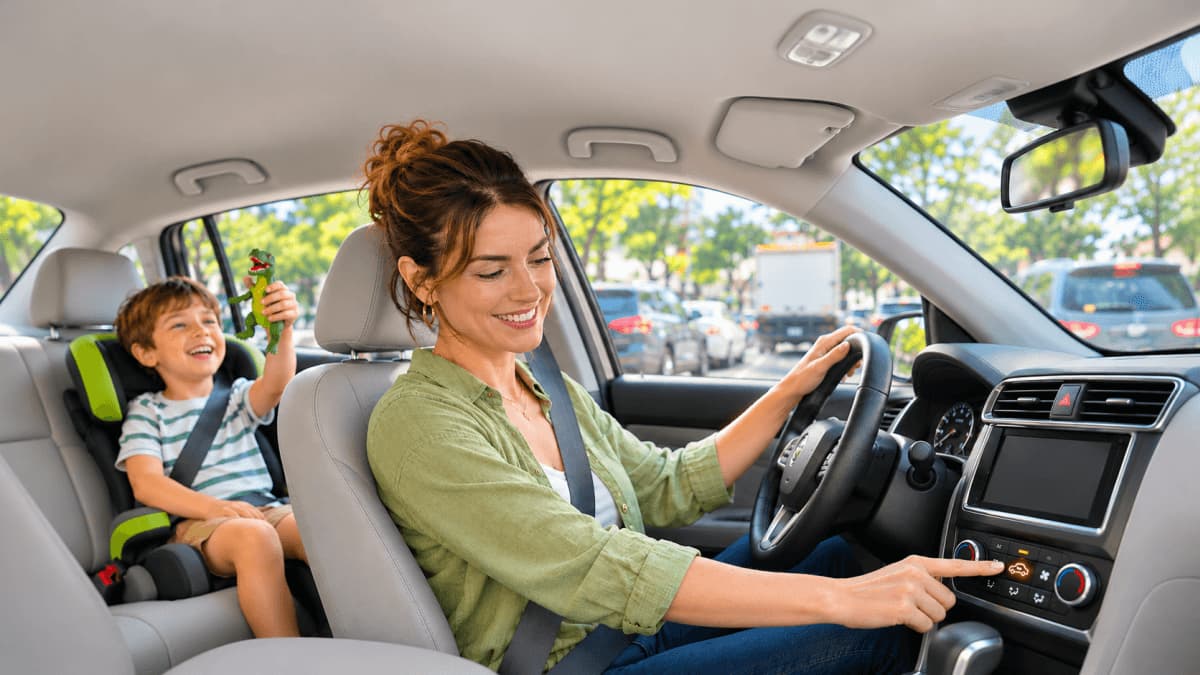
In normal driving, the air in your car is only a little cleaner than the air on the road outside it. Your vents pull road air straight into the cabin, so heavy traffic outside means more particles inside.
Your settings and your filter change that. In a UCLA study of 17 Los Angeles taxis, closing the windows and using a high-efficiency cabin filter cut in-cabin PM2.5 by 37% and ultrafine particles by 47%.
How Much Road Pollution Gets Inside?
Relative in-cabin level, normal driving = 100
Fine Particles (PM2.5)
Ultrafine Particles
Upgraded = windows closed + high-efficiency cabin filter
Source: UCLA study of 17 Los Angeles taxis, PLOS ONE, 2017
Filterbuy cuts every cabin filter to fit your vehicle's housing, with fast and free 2-day delivery to most US states.
Not Sure Where to Start?
Answer a few quick questions and we'll match you to the right filter.
TL;DR
Yes, often. The air in your car mostly matches the road you're on, not your regional air quality reading, and in heavy traffic it can be worse than nearby roadside monitors suggest. Filterbuy's advice: close the windows and use recirculation in thick traffic, then let fresh air back in now and then so carbon dioxide doesn't build up. A current high-efficiency cabin filter handles what still gets through.
Key Takeaways
Los Angeles drivers spend about 6% of the day on the road, yet that time brings 33 to 45% of their ultrafine and diesel particle exposure (Fruin et al., 2008).
In Atlanta rush hour, in-car PM2.5 carried about twice the oxidative potential of roadside monitors (Vreeland et al., 2017).
In 10 cities, drivers breathed about 80% fewer harmful particles on recirculation than with open windows (University of Surrey, 2020).
Closed windows and a high-efficiency cabin filter cut PM2.5 by 37% and ultrafine particles by 47% in 17 taxis (Yu et al., 2017).
Recirculation can push cabin CO2 to 3,000 ppm, so let fresh air in on longer drives (Jung et al., 2017).
As a filter maker, Filterbuy finds fit, airflow and replacement timing decide how much road air a cabin filter stops.
Is the Air Inside a Car Cleaner or Dirtier Than Outside?
Car air is usually dirtier than your local monitor shows, and close to the air on the road around you. A car cabin isn't sealed: its vents draw air in at bumper height, right where exhaust from the vehicle ahead collects. It's how outdoor air pollution enters a home, only closer to the tailpipe.
The California Air Resources Board (CARB), the state's air regulator, says pollution on the road is typically much higher than at ambient monitoring stations. So your regional AQI can read Good while your lane is anything but.
Your settings decide how much gets in. With the fan on outside air, a cabin typically holds 60% to 100% of on-road ultrafine particles (Hudda and Fruin, 2013). Recirculation and a better filter lower it.
What Does the Research Show About In-Car Air Pollution?
Across the studies Filterbuy reviewed, in-car pollution follows the road around you and climbs at rush hour, as the USC and CARB Los Angeles study and the Atlanta in-car sampling study show.
How Much PM2.5 Is Inside a Car?
Inside a car, PM2.5 usually sits close to the on-road level, minus what the cabin filter and closed windows remove. PM2.5 is fine particulate matter 2.5 microns or smaller, small enough to reach deep into the lungs. In the UCLA taxi study, in-cabin PM2.5 averaged about 19 µg/m³ against 31 µg/m³ on the road with no precautions, and about 12 µg/m³ with windows closed and a high-efficiency filter (geometric means).
What Pollutants Are You Breathing While Driving?
You're breathing exhaust while driving: particles and gases from tailpipes, brakes and tires, plus chemicals from the car's interior. See what a cabin air filter actually filters out.
The interior matters too: Duke University researchers found flame retardants in all 101 cars tested in 2024, at levels 2 to 5 times higher in summer.
Why Is Commuting Such a Big Share of Your Pollution Exposure?
A commute puts you in the middle of the road, where exhaust is most concentrated, so your commuting air pollution exposure can be outsized. Los Angeles drivers get up to half their ultrafine particle exposure on the road; in suburban areas, it's closer to 17% (Wallace and Ott, 2011).
Filterbuy points to three big dose drivers:
Trucks and buses ahead. On Los Angeles freeways, diesel vehicles were about 6% of traffic but produced most of the ultrafine particles and soot.
Stop-and-go traffic. University of Surrey researchers measured in-car pollution up to 40% higher at red lights and in jams.
Rush hour. In Surrey's 10-city study, off-peak exposure with windows open was 91% lower than the morning peak and 40% lower than the evening peak.
Who Should Take Car Air Most Seriously?
If you carry kids or drive for work, Filterbuy suggests a yearly cabin filter change.
Children in the back seat. Kids breathe more air pound for pound than adults, as the Duke researchers noted.
People with asthma, heart or lung disease, and older adults. The EPA lists them, with children, as higher risk near busy roads, where pollution is linked to asthma, heart disease and reduced lung function.
Rideshare, delivery and taxi drivers. More hours in traffic mean more exposure.
What Car Ventilation Setting Is Best for Air Quality?
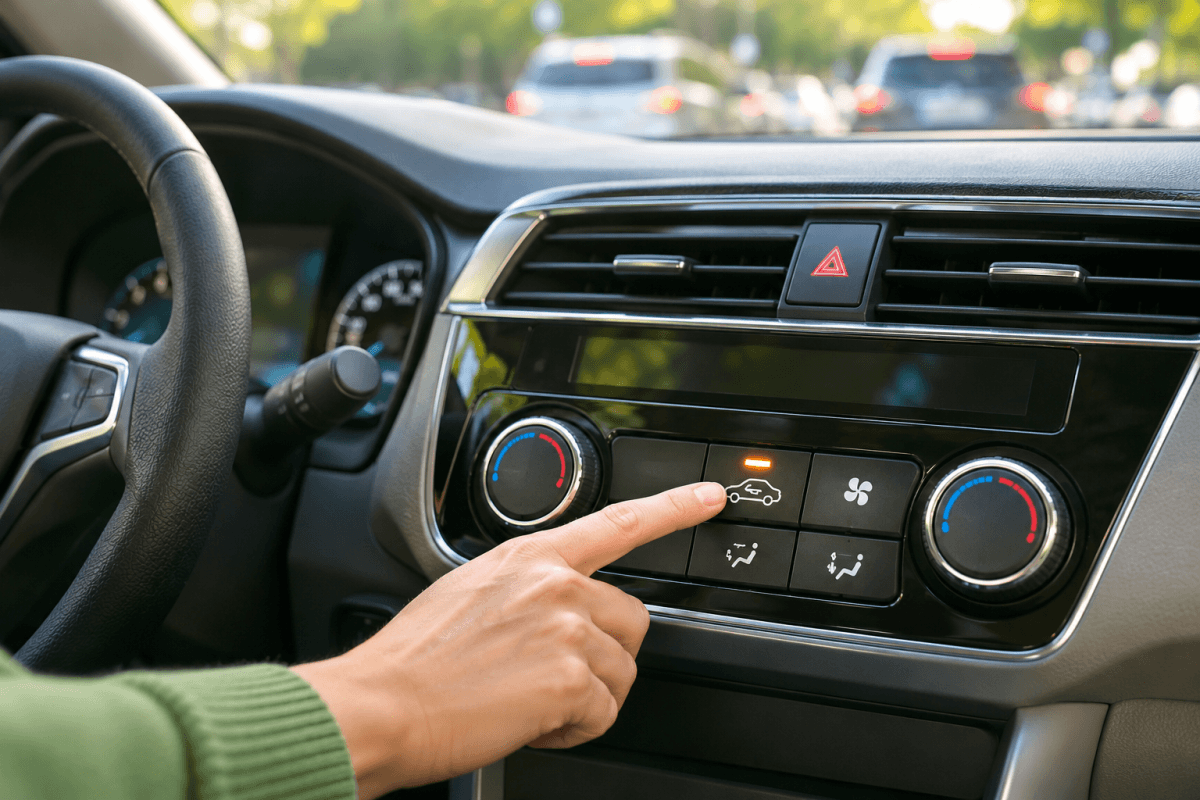
The right setting changes with the road: recirculation with the windows closed in heavy traffic and tunnels, fresh air on open roads and longer drives.
The Filterbuy Cabin Air Settings Matrix
The 10–15 minute interval is Filterbuy's rule of thumb. On smoke days, see whether a cabin air filter can reduce wildfire smoke.
Does Recirculation Cause a CO2 Problem?
Recirculation can cause a CO2 problem on longer drives, because it traps the carbon dioxide everyone exhales. In a UC Riverside study (Jung et al., 2017), recirculation with a standard filter cut particles sharply but let CO2 climb to 3,000 parts per million (ppm).
The fix was simple. With 25% fresh air, CO2 fell to 1,000 ppm and particles stayed low. High CO2 may affect thinking, the researchers note, so Filterbuy recommends recirculation in bursts.
How Much Does a Cabin Air Filter Help?
A cabin air filter helps a lot, as long as it fits and gets changed on time. In the UCLA taxi study, closing the windows and swapping the original filter for a high-efficiency cabin air (HECA) filter cut in-cabin PM2.5 by 37% and ultrafine particles by 47%.
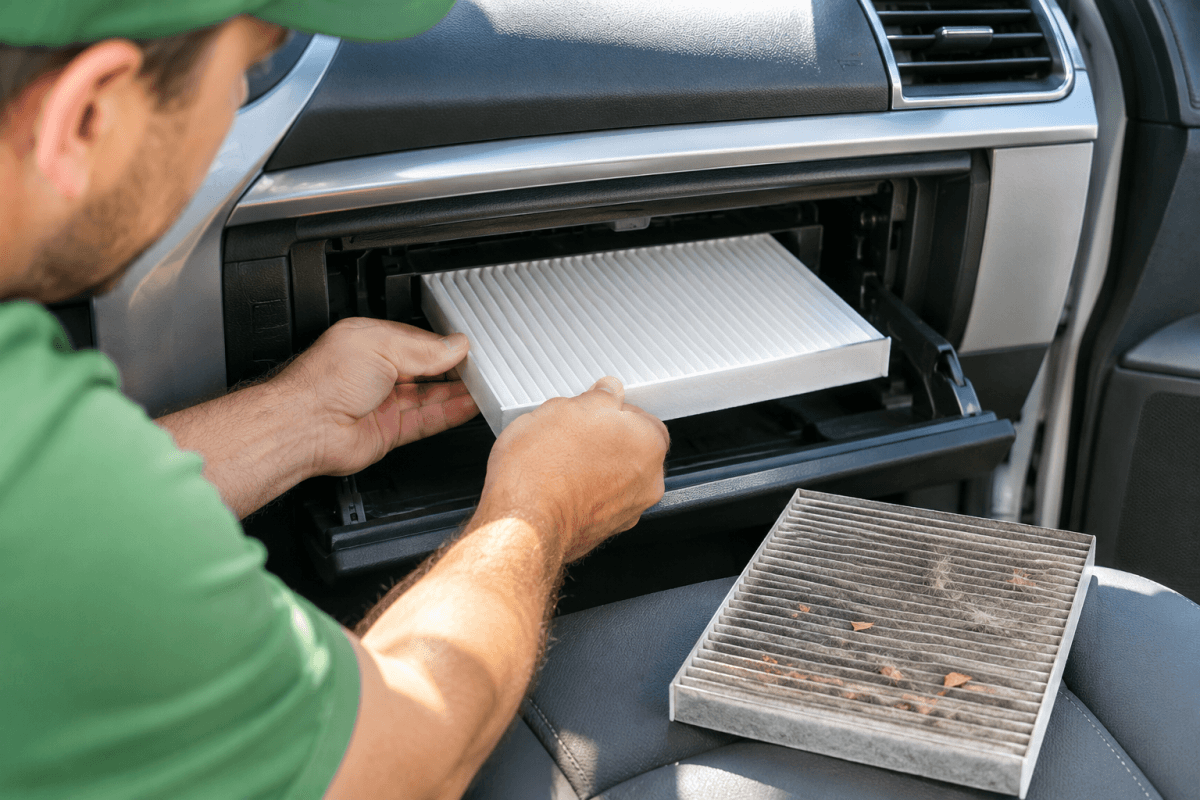
Two steps keep yours working:
Check your cabin filter. Watch for clogged cabin filter signs: weak vent airflow, musty smells, slow-clearing fog or a strained fan. Filterbuy recommends a new filter every 12 months or 12,000 miles (check your owner's manual), and sooner in heavy traffic or smoke (see how often to replace a cabin air filter).
Match the media to your commute. High-efficiency particle media targets fine particles and soot, while activated carbon cabin air filters handle exhaust odors and gases. Filterbuy's guide on how to choose a cabin air filter compares the types.
We've made air filters in the USA since 2013, now in four U.S. plants. Making cabin filters taught us they usually fail in one of three quiet ways:
It doesn't seal. We cut every auto cabin air filter to the vehicle's housing instead of a size chart, because even a slightly undersized one lets road air slip around the media. Nobody checks fit once the glove box closes, so look when you replace a cabin air filter at home.
It chokes the airflow. Tighter pleats catch more but strain the blower, so we hydrocharge the fibers to pull particles in by attraction.
It stays in too long. A higher-capture filter loads faster, so upgrading shortens the safe interval rather than extending it. Our reviewer puts it plainly:
Supporting Statistics
An hour a day is more than 360 hours a year in road air, so Filterbuy treats the cabin filter as daily air protection.
1. About an Hour a Day Behind the Wheel
U.S. drivers averaged 60.4 minutes of driving a day in 2024.
Source: AAA Foundation for Traffic Safety, American Driving Survey 2024
2. Most Commuters Drive Alone
68.7% of U.S. workers drove alone to work in 2022.
The average one-way commute took 26.4 minutes.
Source: U.S. Census Bureau
3. 45 Million People Live Beside Heavy Traffic
More than 45 million people in the U.S. live within 300 feet of a major transportation facility.
Source: U.S. EPA
Frequently Asked Questions
Is the Air in My Car Dirty?
Usually more than your local AQI suggests, because cabin air follows the road.
Do Kids Breathe More Car Pollution Than Adults?
Pound for pound, yes, so Filterbuy suggests closed windows in traffic and a current cabin filter.
Glossary
- PM2.5: Fine particles 2.5 micrometers or smaller, found in exhaust and smoke.
- Ultrafine particles: Particles under 0.1 micrometers, common in fresh exhaust.
- Nitrogen dioxide (NO2): An engine exhaust gas that irritates the airways.
- Oxidative potential: How strongly particles cause oxidative stress, which is linked to heart and lung disease.
- AQI: The EPA's Air Quality Index, a 0–500 scale for outdoor air.
- HECA filter: A high-efficiency cabin air filter built to capture fine and ultrafine particles.
- Filterbuy: A U.S. maker of HVAC, air purifier and auto cabin air filters since 2013.