
What Does "Moderate" Air Quality Actually Mean? (AQI 51–100 Explained)
July 6, 2026

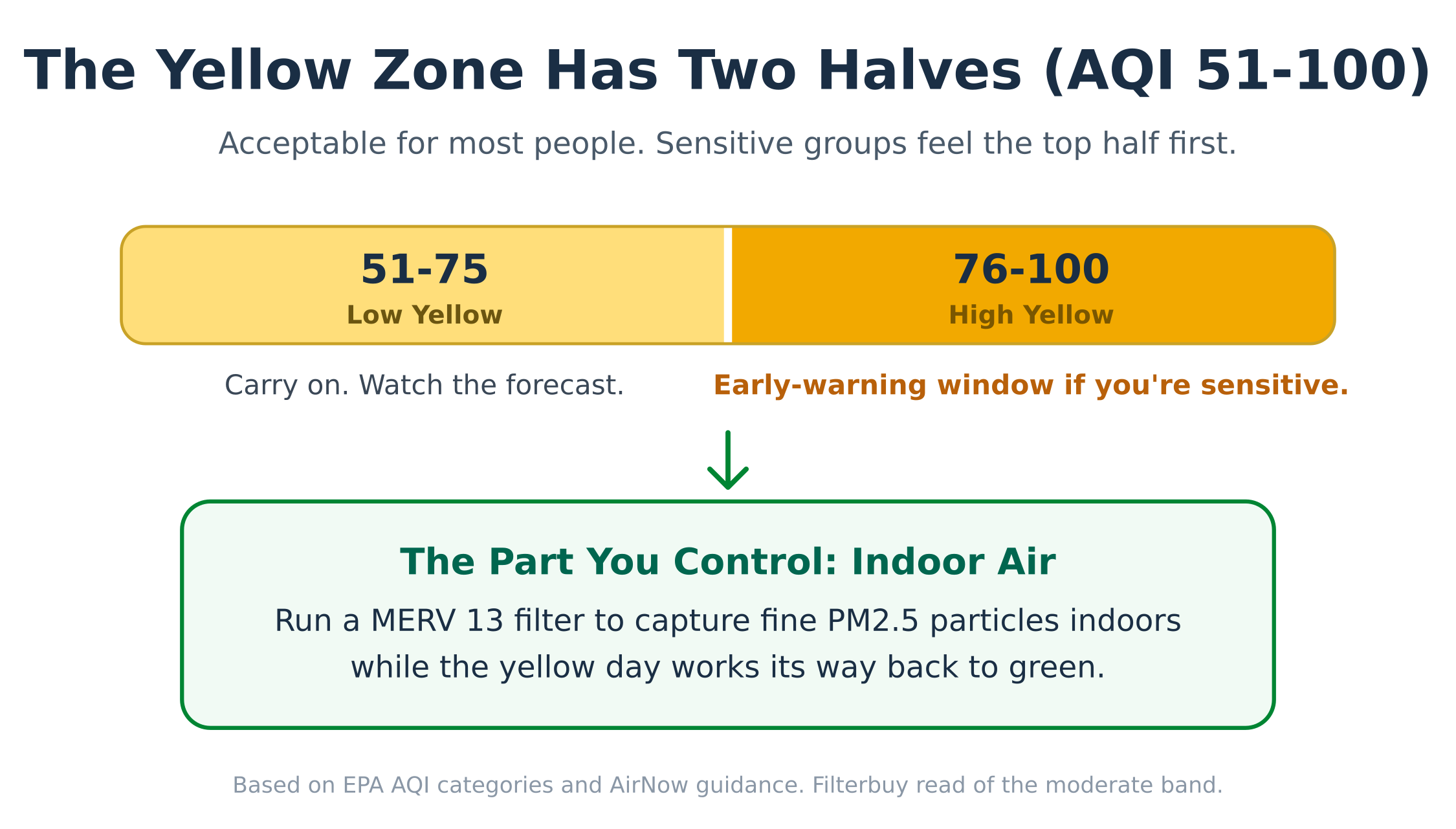
Moderate air quality is an AQI between 51 and 100, the yellow band on the EPA's six-color scale. It's acceptable for most people, and the upper half (76 to 100) is where sensitive groups start to feel it.
Here's how to read a yellow day at a glance:
- AQI 51 to 75 (low yellow): fine for healthy adults and kids. Keep an eye on the forecast.
- AQI 76 to 100 (high yellow): the early-warning window. If you have asthma, heart or lung disease, or you're exercising hard outdoors, ease off or shift the activity indoors.
- Indoors: run your HVAC with a MERV 13 filter to capture the fine PM2.5 particles a yellow day sends drifting inside.
Your indoor air is the part you fully control, and the right MERV rating is what makes the difference on a yellow day.
Not sure which MERV rating you need? Answer a few quick questions and we'll match you to the right filter.
Moderate air quality is a US Air Quality Index (AQI) reading between 51 and 100, shown in yellow on the EPA's six-color scale. The air is acceptable for most people, but a small number of people who are unusually sensitive to the pollutant may experience symptoms. Most people can continue normal outdoor activities, although checking the primary pollutant can help determine whether additional precautions are useful.
The pollutant driving a yellow reading matters as much as the number itself. Ground-level ozone and fine particulate matter (PM2.5) are the two most common causes of a Moderate AQI day, and they require different responses. Particle filters (including compatible HVAC filters and portable air cleaners) can reduce indoor PM2.5 levels, but they do not remove ozone.
Moderate AQI at a Glance
The US Air Quality Index runs from 0 to 500 across six color-coded categories. Moderate is the second category. Here is how it fits into the full scale and what the yellow band means in practical terms.
| AQI Range | Category | Color | Who May Be Affected | Recommended Action |
|---|---|---|---|---|
| 0–50 | Good | Green | None | No action needed |
| 51–100 | Moderate | Yellow | Unusually sensitive individuals | Generally acceptable; sensitive individuals should monitor symptoms |
| 101–150 | Unhealthy for Sensitive Groups | Orange | Sensitive groups | Sensitive groups should reduce prolonged outdoor exertion |
| 151–200 | Unhealthy | Red | General public | Everyone should limit prolonged outdoor activity |
| 201–300 | Very Unhealthy | Purple | General public | Avoid prolonged outdoor activity |
| 301–500 | Hazardous | Maroon | General public | Remain indoors |
One important clarification: the EPA does not officially divide the Moderate category into sub-ranges. AQI 51–100 is a single category. There is no official threshold at 76, and the EPA does not designate 76 as an action point for sensitive groups. That designation begins at AQI 101 (the Unhealthy for Sensitive Groups category).
Is Moderate Air Quality Bad for You?
"Acceptable" does not mean pollution-free. At AQI 51–100, a pollutant is present at measurable levels, but for most people, those levels are unlikely to cause noticeable symptoms during everyday activity.
The EPA describes Moderate air quality as acceptable for the general public. Where it gets more nuanced is for people who are unusually sensitive. A small number of people may react to the pollutant at lower concentrations than the general population, not because of a particular diagnosis, but because of individual biology, current health status, or the intensity of their outdoor activity.
Risk tends to increase as the AQI number rises toward 100, simply because pollutant concentrations are higher. But there is no single cutoff within the Moderate range that applies to everyone. How you respond depends on which pollutant is present, your personal health history, how hard you are physically exerting yourself, and how long you are exposed.
Who Is Considered Unusually Sensitive?
The Moderate category uses the phrase "unusually sensitive individuals." This is different from the broader "sensitive groups" language that applies starting at AQI 101, which includes people with asthma, heart disease, lung disease, older adults, children, and pregnant people.
At the Moderate level, the concern is narrower: some people simply react to certain pollutants at lower concentrations than most. This can include some people with asthma or cardiovascular or lung conditions, but not everyone with those conditions will notice symptoms on a yellow day.
Symptoms worth monitoring include:
Coughing or wheezing
Chest tightness or shortness of breath
Eye, nose, or throat irritation
If you or someone in your household has a diagnosed respiratory or cardiovascular condition, follow your personal care plan and consult a healthcare professional about what AQI levels warrant activity changes. This article provides general information, not medical advice.
Can You Exercise Outside When Air Quality Is Moderate?
For most people, normal outdoor exercise during a Moderate AQI is generally acceptable, according to AirNow's Air Quality Guide for Particle Pollution and the Air Quality Guide for Ozone.
People who are unusually sensitive may choose to shorten or reduce the intensity of outdoor workouts. Watching for symptoms is more useful than following a fixed AQI cutoff, because individual responses vary.
AQI levels also shift throughout the day. A moderate morning reading does not guarantee moderate afternoon air. Checking current conditions before heading out is a good habit, especially if you plan a long or strenuous workout.
If ozone is the pollutant: Ground-level ozone typically peaks on hot, sunny afternoons. Checking hourly local data from AirNow or your state air quality agency can help you identify lower-risk windows, usually early morning or after sunset.
If PM2.5 or smoke is the pollutant: Fine particles can be present at any hour and may linger. If you are experiencing symptoms outdoors, going inside and waiting for conditions to improve is the practical response.
What Pollutant Is Causing the Yellow AQI?
The AQI your weather app or AirNow reports reflects the single pollutant with the highest index value that day. The EPA calculates separate AQI values for five major pollutants and reports whichever is worst:
Ground-level ozone
Fine particulate matter (PM2.5)
Coarse particulate matter (PM10)
Sulfur dioxide
Nitrogen dioxide
Knowing which pollutant is driving the reading changes what you should do.
When PM2.5 or PM10 Is Driving the AQI
Particle pollution comes from combustion sources like vehicle traffic, wood smoke, wildfires, and industrial activity. Coarser particles (PM10) can come from road dust and construction sites.
Particles small enough to be categorized as PM2.5 can travel indoors through gaps around windows, doors, and ventilation systems. Closing windows can help reduce how much outdoor particle pollution enters your home when outdoor air is the dirtier source.
According to the EPA's 2024 PM standard updates, 24-hour PM2.5 concentrations of 9.1 to 35.4 µg/m³ fall within the Moderate AQI category. Compatible HVAC filtration and a properly sized portable air cleaner can reduce indoor particle levels when PM2.5 is the concern.
When Ground-Level Ozone Is Driving the AQI
Ground-level ozone forms when sunlight reacts with vehicle and industrial emissions. It is not emitted directly. It builds up during the day and typically peaks on hot, sunny afternoons, then decreases in the evening.
Checking hourly ozone data before scheduling intense outdoor activity is the most useful step on an ozone-driven yellow day. Standard Minimum Efficiency Reporting Value (MERV)-rated particle filters do not remove ozone, which is a gas rather than a particle. Ozone-generating air cleaners are not recommended, as ozone itself is a lung irritant.
When Another Pollutant Is Driving the AQI
Carbon monoxide, sulfur dioxide, and nitrogen dioxide can push AQI readings into the Moderate range in areas near heavy traffic, industrial activity, or combustion sources. Standard HVAC particle filters are not designed to remove these gaseous pollutants. Follow local public health alerts when these pollutants are elevated.
What Should You Do When AQI Is 51–100?
Here is a practical checklist for Moderate air quality days:
Check the current AQI and forecast. AirNow is the official US source. Some apps show forecasts or slightly delayed readings, so confirm current conditions before making decisions.
Identify the primary pollutant. Ozone and PM2.5 days call for different timing and different protective steps.
Continue normal activity if you feel well. Most people are not affected at this AQI level.
If you are unusually sensitive, monitor symptoms. Consider reducing the duration or intensity of outdoor activity if you notice coughing, chest tightness, or unusual fatigue.
If particle pollution is elevated, reduce outdoor air entering the home. Close windows when outdoor PM2.5, smoke, or dust is the dirtier air source and indoor air is currently cleaner.
Use compatible filtration if particles are the concern. See the section below on HVAC filters and portable air cleaners.
Recheck if conditions are changing. A rising AQI or shifting weather warrants a second look.
One important note: do not keep windows closed in dangerous indoor heat without a safe cooling alternative. Indoor overheating is a health risk that takes priority over air quality management.
Should You Close Your Windows During Moderate AQI?
Closing windows makes sense when outdoor PM2.5, smoke, or dust is elevated and your indoor air is currently cleaner than outdoor air, and when your home can maintain a safe temperature.
Opening windows is still useful when outdoor air improves, when indoor sources like cooking or candles are making indoor air worse than outdoor air, or when ventilation is needed for safety reasons.
There is no universal rule. The goal is to keep the dirtier air out and the cleaner air in, which sometimes means windows open and sometimes means windows closed.
Should You Run an Air Purifier or HVAC Filter?
Particle filtration is most useful when particle pollution (PM2.5, PM10, smoke, or dust) is driving the Moderate AQI. It is less relevant when ozone or gaseous pollutants are the cause, because particle filters do not remove gases.
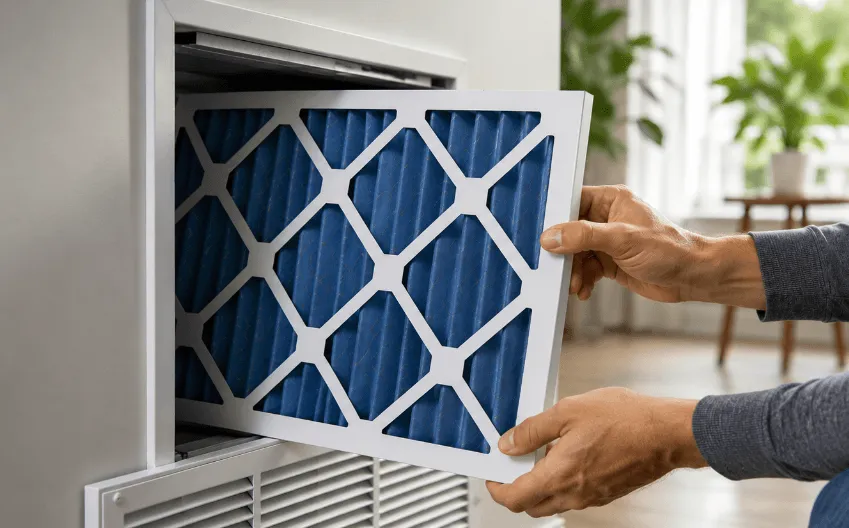
HVAC filtration: If your HVAC system can accommodate a MERV 13 filter, that rating provides strong capture of particles in the PM2.5 size range, according to EPA guidance on MERV ratings. If your system cannot safely handle MERV 13 due to fan capacity or filter slot size, use the highest-efficiency filter your system can accommodate without restricting airflow. Always ensure the filter fits snugly with no gaps around the edges, and replace it according to manufacturer's guidance and your local air conditions. For guidance on choosing the right rating, see MERV 8 vs. MERV 11 vs. MERV 13 compared and how to determine the right MERV rating for your home.
Portable air cleaners: Size the unit appropriately for the room. For wildfire smoke, look for a smoke Clean Air Delivery Rate (CADR) matched to your room size. For more on choosing between portable and central filtration, see portable HEPA air purifiers vs. HVAC filters.
Avoid ozone-generating devices. These add ozone to indoor air, and ozone is itself a lung irritant.
Particle filters, whether HVAC or portable, do not address ozone, carbon monoxide, nitrogen dioxide, or sulfur dioxide.
Is particle pollution driving today's AQI? If your HVAC system can accommodate MERV 13, use Filterbuy's size finder to find the correct filter for your system.
Why Do Different Apps Show Different AQI Numbers?
It is common to see different readings across weather apps, and the variation usually comes down to a few factors:
Forecasts vs. current data. Some apps show predicted AQI for later in the day; others show a recently calculated reading based on monitoring data.
Data sources. Apps pull from different monitoring networks, including regulatory monitors and lower-cost sensor networks, which can produce different values for the same location.
Update frequency and calculation methods. Monitoring stations and apps update at different intervals, and AQI calculations involve averaging windows that vary by pollutant.
When readings conflict, AirNow.gov is the official US source for AQI data, drawing from EPA-certified monitoring stations. Your state or local air quality agency is also a reliable reference.
Moderate AQI: What It Truly Means for You
Moderate AQI means acceptable air quality for most people. It is not a cause for alarm, but it is worth a moment of attention.
The practical takeaways:
Check the primary pollutant. Ozone and PM2.5 days look the same on a color scale but call for different responses.
Watch for your own symptoms. Individual sensitivity varies, and symptoms are a more reliable guide than any single number.
Use particle filtration when particles are the problem. A compatible HVAC filter or a properly sized portable air cleaner can reduce indoor PM2.5 levels on particle-driven yellow days. Neither removes ozone.
Follow local guidance if conditions worsen. AQI can shift throughout the day. Check current readings, not just the morning forecast.
Keep perspective. For most people, a yellow AQI day requires no change to daily routine.
Help keep particle pollution from circulating through your home. Find your HVAC filter size and choose the highest-efficiency Filterbuy filter your system can safely accommodate.
Frequently Asked Questions
Is an AQI of 75 safe?
An AQI of 75 falls within the Moderate category, which the EPA considers acceptable for the general public. Most people can continue normal activities without concern. Unusually sensitive individuals (those who personally react to pollutants at lower concentrations) may notice mild symptoms and can choose to moderate intense outdoor activity. Check which pollutant is driving the reading, as ozone and PM2.5 each call for slightly different timing.
Is an AQI of 100 safe?
AQI 100 is the upper edge of the Moderate category and sits just below the Unhealthy for Sensitive Groups threshold (AQI 101). The EPA considers AQI 100 acceptable for the general public, but unusually sensitive individuals are more likely to experience symptoms at this level than at lower Moderate readings. Sensitive groups, including people with asthma, heart disease, or lung disease, should pay closer attention as the number approaches 100 and consider reducing prolonged or strenuous outdoor activity.
Can children play outside during Moderate air quality?
Most healthy children can play outside normally during a Moderate AQI. Children as a group are considered more sensitive to air pollution than healthy adults, because they breathe more air relative to their body weight and their lungs are still developing (EPA: Patient Exposure and the Air Quality Index). A child who is unusually sensitive, particularly one with asthma or a respiratory condition, may benefit from shorter outdoor sessions or monitoring for symptoms, especially when the AQI is closer to 100.
Can Moderate air quality trigger asthma?
For some people with asthma, yes. The Asthma and Allergy Foundation of America notes that air pollution can trigger asthma symptoms, and individual sensitivity varies (AAFA: Air Pollution and Asthma). Not everyone with asthma will react at Moderate AQI levels. People with asthma should follow their personal care plan, keep a reliever inhaler accessible, and consult their healthcare provider about what AQI thresholds are relevant for their specific situation.
Does Moderate air quality affect pets?
Pets can be affected by air pollution in ways that parallel human responses. Animals with existing heart or respiratory conditions may be more sensitive. On a Moderate AQI day, keeping indoor air filtered and limiting outdoor activity for older or unwell pets is a reasonable precaution, particularly when the reading is toward the higher end of the range. If your pet shows signs of respiratory distress, consult a veterinarian.
Does MERV 13 filter out PM2.5?
MERV 13 filters capture a significant portion of particles in the PM2.5 size range, and EPA guidance recognizes MERV 13 as an effective option for fine particle reduction in residential HVAC systems (EPA: What Is a MERV Rating?). Effectiveness also depends on filter fit, airflow, runtime, and how frequently the filter is replaced. MERV 13 does not remove ozone or other gaseous pollutants. Always confirm your HVAC system can safely accommodate MERV 13 before upgrading, as some systems require a lower MERV rating to maintain adequate airflow.
Editorial methodology: This guide was reviewed against current EPA and AirNow guidance. Filter and HVAC recommendations were reviewed for technical accuracy. Health information is general and is not a substitute for individual medical advice.
Written by Michelle Wan · Reviewed by David Clark, Licensed HVAC Technician | Published July 4, 2026 · Updated September 10, 2026