
Outdoor Carbon Monoxide: How It Differs From Indoor CO Risk
July 30, 2026
Author: Michelle Wan, Brand Manager and Air Quality Writer | Technical Reviewer: David Clark, Licensed HVAC Technician| Published: July 30, 2026 | Updated: July 30, 2026
Is Outdoor Carbon Monoxide A Risk Inside Your Home?
Outdoor carbon monoxide rarely reaches harmful levels, and the carbon monoxide that hurts people forms inside the house. EPA identifies vehicles and fuel-burning machinery as the greatest sources of CO in outdoor air, and states that very high CO levels are unlikely to occur outdoors.
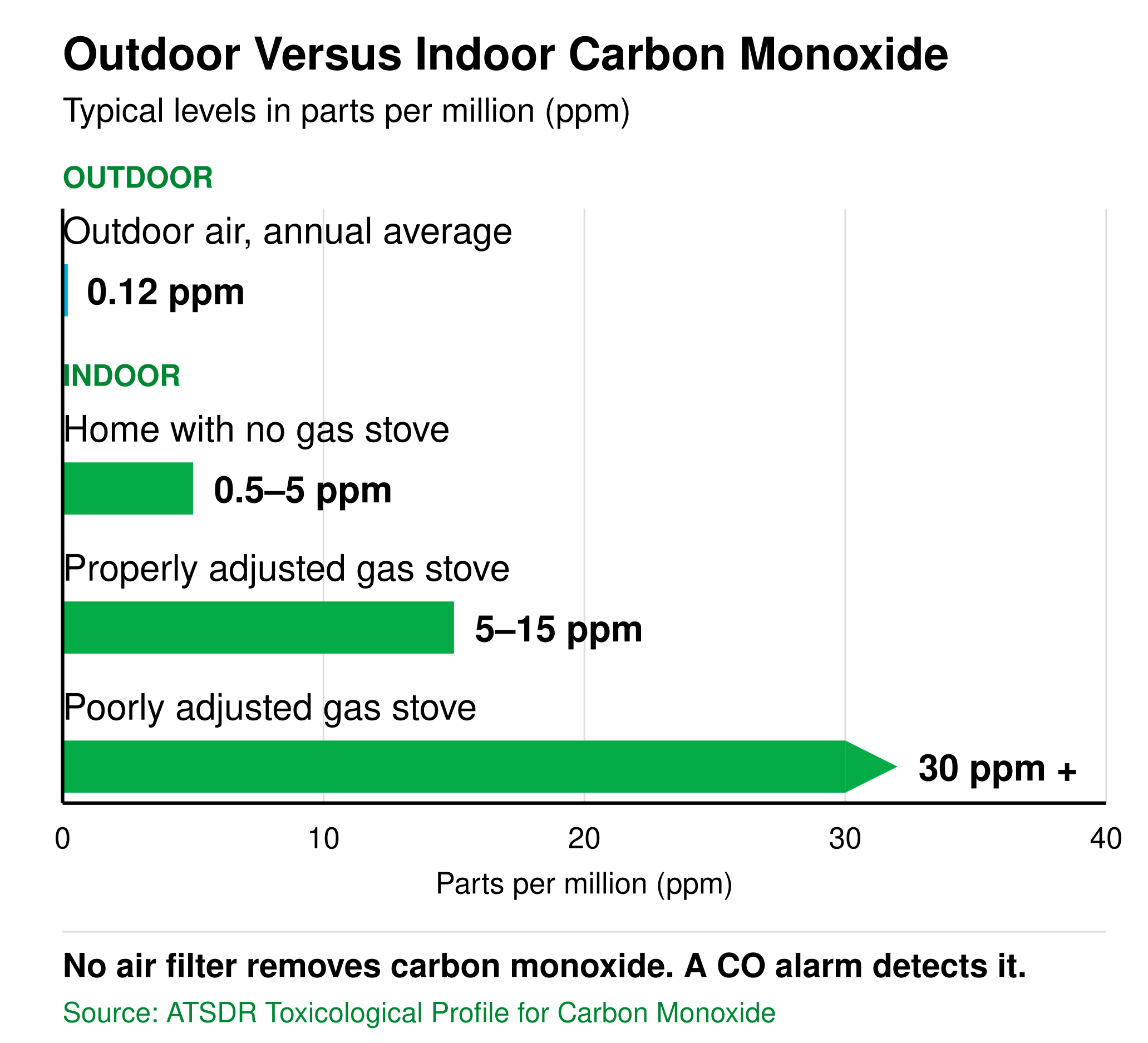
Outdoor air averages about 0.12 parts per million, while an ordinary home without a gas stove runs 0.5 to 5 parts per million. No air filter removes carbon monoxide, because CO is a gas molecule rather than a particle, so a working CO alarm is the household device that detects it.
Carbon monoxide needs an alarm, not a filter. For the particles your filter does catch, answer a few quick questions and we will match you to the right MERV rating.
Already know your size? Shop pleated filters built in Talladega, Alabama in over 600 sizes.
TL;DR
Outdoor carbon monoxide in the United States comes mostly from vehicle exhaust and rarely reaches concentrations that harm healthy people. Indoor carbon monoxide from furnaces, gas appliances, and generators kills more than 400 Americans a year. Outdoor CO does drift indoors, but the dangerous concentrations form inside, and no air filter removes the gas.
Key Takeaways
Vehicles and fuel-burning machinery produce most outdoor carbon monoxide, and EPA states that very high CO levels are unlikely to occur outdoors.
Ordinary indoor air in a home without a gas stove carries roughly four to forty times the outdoor background concentration of carbon monoxide.
No air filter, MERV rating, or activated carbon media removes carbon monoxide, because CO is a gas molecule rather than a particle.
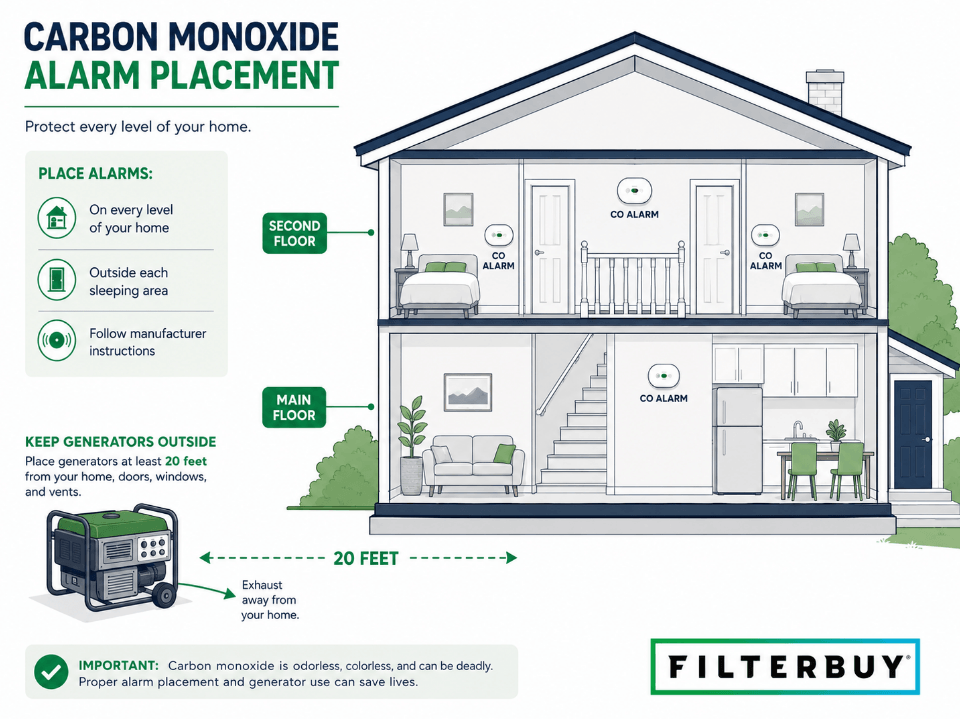
A working carbon monoxide alarm is the only household device that detects CO, and CPSC recommends one on every level of the home.
One portable generator produces as much carbon monoxide as hundreds of cars, so generator placement matters more than any outdoor air quality reading.
Where Outdoor Carbon Monoxide Comes From
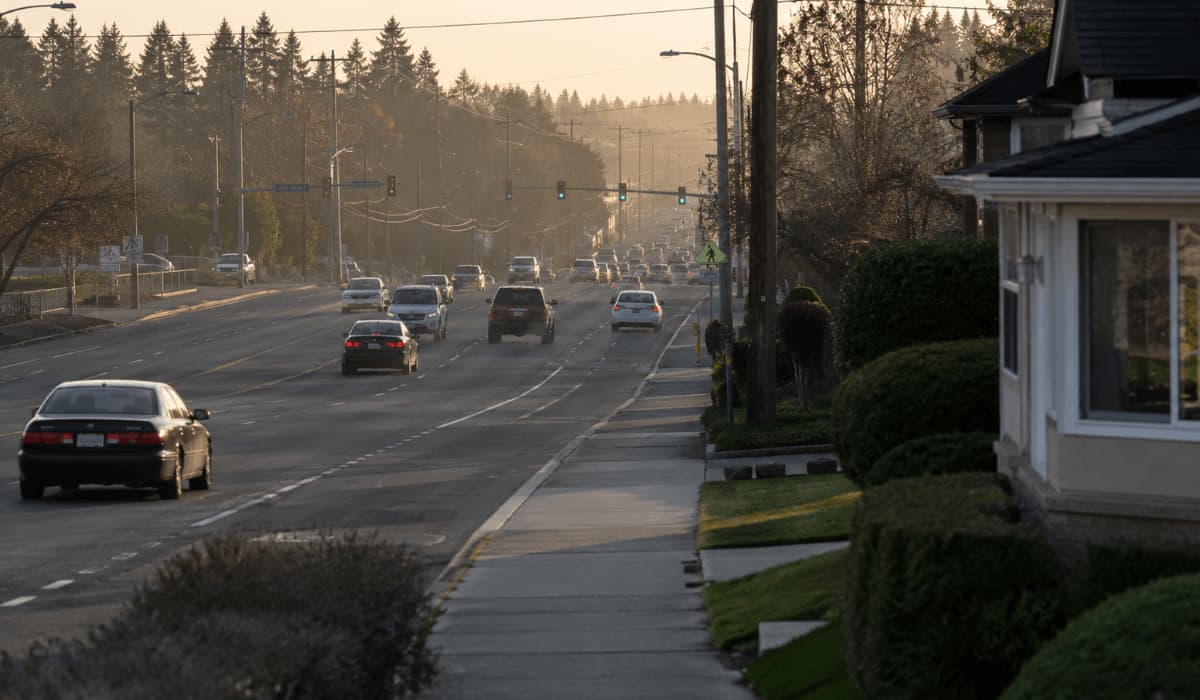
Outdoor carbon monoxide forms when engines and equipment burn fossil fuels incompletely. The Environmental Protection Agency identifies cars, trucks, and other vehicles or machinery that burn fossil fuels as the greatest sources of CO in outdoor air. Power plants, industrial boilers, incinerators, and wildfires add to the total. Concentrations peak beside busy roads and fall quickly with distance from traffic.
The American Lung Association adds that outdoor air near roads can carry too much CO where tailpipe emissions build up, and it advises against exercising along a busy street or highway. The same tailpipes emit nitrogen dioxide, a second traffic gas that behaves differently once it reaches a house.
Outdoor Versus Indoor Carbon Monoxide Levels Compared
Indoor carbon monoxide concentrations normally exceed outdoor concentrations by a wide margin, even in homes with no combustion problem. The Agency for Toxic Substances and Disease Registry places the Northern Hemisphere outdoor annual average near 0.12 parts per million, while ordinary homes without gas stoves run 0.5 to 5 parts per million.
Source: ATSDR Toxicological Profile for Carbon Monoxide. Linked in Supporting Statistics.
What These Numbers Show That The Source Pages Do Not
Filterbuy, a United States air filter manufacturer, assembled the figures above from a single ATSDR reference, then did the division the source document leaves undone. Ordinary indoor air in a home without a gas stove runs roughly four to forty times the outdoor background concentration, and air beside a poorly adjusted gas stove runs on the order of 250 times it. The outdoor figure is a hemispheric annual average while the indoor figures are localized readings, so treat these as orders of magnitude rather than precise multiples.
The ordinary indoor baseline already sits well above outdoor air before a single appliance misbehaves.
Does Outdoor Carbon Monoxide Get Inside Your Home
Outdoor carbon monoxide does enter homes. CO is a stable gas that moves through the same gaps, vents, and open windows that carry any outdoor air inside, and it does not settle onto surfaces the way dust does. What keeps the risk low is the starting concentration rather than the building envelope. Roadside air carries a few parts per million at most, so the amount that reaches an indoor space stays small.
Ventilation choices shift the balance both ways. Opening windows on a street with heavy stop-and-go traffic brings roadside air inside. Sealing a house for winter keeps outdoor CO out and keeps indoor CO in, which is why the National Center for Healthy Housing reports the most serious effects occur in winter when homes are closed up.
Attached garages turn an outdoor source into an indoor one. The Centers for Disease Control and Prevention advises never running a car or truck inside a garage attached to a house, even with the door open.
Why No Air Filter Removes Carbon Monoxide
No air filter removes carbon monoxide. Pleated HVAC filters capture particles by trapping them in a fiber matrix, and carbon monoxide is a single small gas molecule rather than a particle, so it passes straight through every MERV rating. Activated carbon media adsorbs many gases and odors onto its surface, but carbon monoxide adheres to carbon far too weakly for meaningful removal.
This matters because a large share of air purifier marketing claims otherwise. EPA states the limit plainly. Gas-phase filters target a limited number of specific gases, will not reduce pollutants they were not designed for, and none remove all gaseous pollutants in a home.
Filterbuy manufactures Odor Eliminator carbon filters, and those products reduce cooking and pet odors. They do not reduce carbon monoxide. MERV 13 pleated filters capture fine particles including wildfire smoke particulate. They do not capture CO either.
Filterbuy explains how activated carbon media adsorbs gases and which MERV rating a home actually needs in its filter basics library.
After manufacturing filters for over a decade and serving more than two million households, we have learned that no single filter type solves every air quality problem. The question we hear most about carbon monoxide is whether a better filter fixes it, and the honest answer is no. Carbon monoxide is a gas, so filtration is the wrong tool entirely. That is why we point customers toward a working CO alarm and annual appliance service rather than a filter upgrade when carbon monoxide is the concern.
— David Heacock, Founder and CEO, Filterbuy
Filterbuy has manufactured pleated HVAC filters in Talladega, Alabama for more than a decade, and publishes this position because a homeowner who believes a filter covers carbon monoxide may skip the alarm that would have warned them.
Does The Air Quality Index Report Carbon Monoxide
The United States Air Quality Index includes carbon monoxide as one of its five pollutants, yet the AQI number most people check almost never reflects CO. AirNow reports that most state and local forecasters issue forecasts for ozone and particle pollution, and only a few areas also forecast nitrogen dioxide and carbon monoxide.
The current reading on the AirNow site and app comes from the NowCast calculation, which EPA runs for ozone and particle pollution alone. A Good AQI reading tells you nothing about carbon monoxide inside your house.
Worth Knowing: Carbon monoxide sits inside the index without appearing in the number you actually look at, so checking your local AQI is not a way to check carbon monoxide.
Wildfire Smoke Carries Carbon Monoxide, But Not Very Far
All smoke contains carbon monoxide. The New York State Department of Health confirms that smoke from any fire releases carbon monoxide, carbon dioxide, and particulate matter. Carbon monoxide and fine particles then behave very differently once the plume leaves the fire, and that difference decides which of them reaches a distant neighborhood.
Fine particles stay suspended and travel hundreds to thousands of miles, which is why haze arrives in cities far from any flame. Carbon monoxide dilutes much faster, so it stays near the fire line where wildland firefighters work rather than reaching downwind suburbs.
During a distant smoke event, your filter and fan settings address the pollutant that actually arrived, PM2.5. For the mechanics, read how far wildfire smoke travels.
Who Faces Higher Risk And What Protects Them
People with coronary artery disease face the clearest risk. EPA explains that elevated outdoor CO concerns people with some types of heart disease, whose hearts already have a reduced ability to receive oxygenated blood, and that they become especially vulnerable while exercising. CDC adds infants, older adults, and people with anemia or breathing problems.
Outdoor workers exposed to concentrated exhaust form a second group. ATSDR names taxi drivers, traffic police, and toll booth workers among those likely to encounter higher ambient carbon monoxide.
Four actions carry nearly all the protection.
Install alarms on every level and outside every sleeping area, and replace each on schedule.
Have a licensed technician service your furnace, water heater, and other fuel-burning appliances yearly.
Never run an engine in a garage, basement, or any enclosed space.
Place portable generators outdoors only, at least 20 feet from windows, doors, and vents, exhaust pointed away.
How To Recognize Carbon Monoxide Exposure
Carbon monoxide poisoning imitates ordinary illness, which is the main reason it goes unrecognized. The Centers for Disease Control and Prevention lists headache, dizziness, weakness, upset stomach, vomiting, chest pain, and confusion, and notes that people typically describe the pattern as flu-like.
One detail separates it from actual flu. The American Lung Association points out that symptoms which ease after you leave the building and return when you come back point toward carbon monoxide rather than a virus. That pattern is worth more than any single symptom on the list.
If an alarm sounds, the Consumer Product Safety Commission advises getting everyone outside to fresh air first, then calling 911 from outside. Ventilating the house and hunting for the source comes after people are out, not before.
What A Carbon Monoxide Alarm Will And Will Not Catch
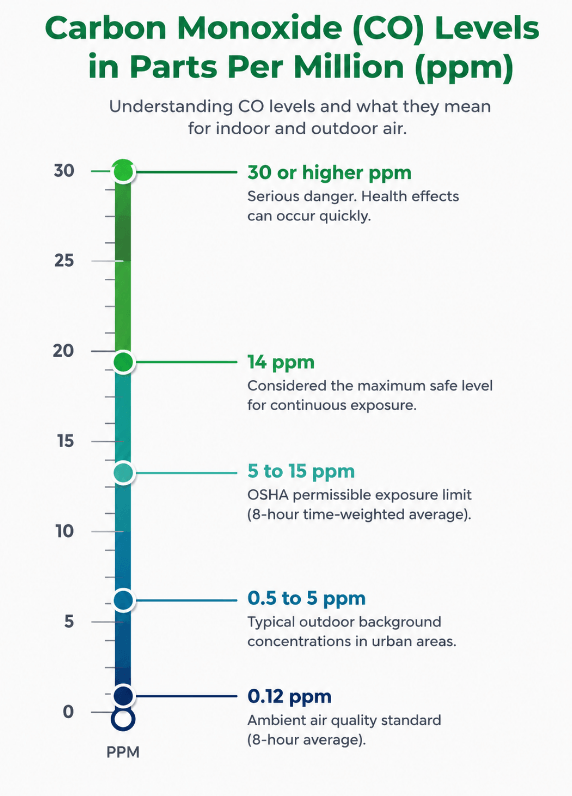
A working alarm is the right device, and it is built for one specific job. UL 2034, the standard every residential CO alarm sold in the United States is listed to, defines its alarm points as concentration-and-time pairs rather than instant triggers.
Below 30 ppm, an alarm is not permitted to sound at all.
At 70 ppm, it must sound between 60 and 240 minutes.
At 150 ppm, it must sound between 10 and 50 minutes.
At 400 ppm, it must sound between 4 and 15 minutes.
Those windows exist to prevent nuisance alarms, and they succeed at the job the standard was written for, which is preventing death from acute poisoning.
The ATSDR figures earlier on this page associate continuous exposure near 14 parts per million with cardiac effects in people who already have coronary artery disease. That concentration sits below the level at which a residential alarm is allowed to make any sound, so a silent alarm confirms that nobody in the house is about to be acutely poisoned without confirming that the air is clean.
Filterbuy Take: This is the one place where the standard advice, install an alarm, is not quite enough for every household. CDC advises choosing an alarm with a digital readout, which shows the current concentration rather than only sounding at the threshold. In a home with heart disease or a young child, that readout is worth the extra cost.
Essential Resources
Environmental Protection Agency, Basic Information about Carbon Monoxide (CO) Outdoor Air Pollution
Federal reference on outdoor CO sources and standards.
Source: EPA, Basic Information about CO Outdoor Air Pollution
AirNow, Using the Air Quality Index
Which pollutants the AQI and NowCast actually report.
Source: AirNow, Using the Air Quality Index
American Lung Association, Carbon Monoxide
Health effects and roadside exposure guidance.
Source: American Lung Association, Carbon Monoxide
National Fire Protection Association, Carbon Monoxide Safety
Alarm placement and combustion safety practice.
Source: NFPA, Carbon Monoxide Safety
Occupational Safety and Health Administration, Carbon Monoxide Publications
Workplace exposure guidance for roadside work.
Source: OSHA, Carbon Monoxide Publications
National Center for Healthy Housing, Carbon Monoxide
Housing-focused view of CO sources.
Source: National Center for Healthy Housing, Carbon Monoxide
New York State Department of Health, Exposure to Smoke from Fires
State guidance on carbon monoxide in smoke.
Source: New York State DOH, Exposure to Smoke from Fires
Supporting Statistics
More than 400 Americans die every year from unintentional carbon monoxide poisoning unrelated to fires, more than 100,000 visit an emergency department, and more than 14,000 are hospitalized.
Source: CDC, Carbon Monoxide Poisoning Basics
More than 200 people in the United States die every year from carbon monoxide produced by consumer products, more than 100 of those deaths are linked to portable generators, and one portable generator produces as much carbon monoxide as hundreds of cars.
Source: CPSC, Carbon Monoxide Information Center
Outdoor carbon monoxide averages about 0.12 parts per million annually across the Northern Hemisphere, while homes without gas stoves run 0.5 to 5 parts per million and air beside a poorly adjusted gas stove can reach 30 parts per million or higher.
Source: ATSDR Toxicological Profile for Carbon Monoxide
Frequently Asked Questions
Glossary
Carbon Monoxide (CO) A colorless, odorless gas from incomplete combustion of carbon-based fuels, and one of six criteria pollutants under the National Ambient Air Quality Standards.
Parts Per Million (ppm) A unit of gas concentration. One part per million equals one molecule of gas per million molecules of air.
Air Quality Index (AQI) The EPA scale from 0 to 500 reporting outdoor air quality for five pollutants, including carbon monoxide.
NowCast The calculation converting hourly monitor readings into a current AQI value. NowCast covers ozone and particle pollution only.
MERV Minimum Efficiency Reporting Value, rating how effectively an HVAC filter captures airborne particles. MERV carries no meaning for gases.
Activated Carbon Porous media that adsorbs certain gases and odors onto its surface. Activated carbon is not effective against carbon monoxide.
Carbon Monoxide Alarm A device with an electrochemical sensor that detects carbon monoxide and sounds an audible warning.
PM2.5 Airborne particles 2.5 micrometers in diameter or smaller, the fraction of wildfire smoke that travels farthest.
UL 2034 The safety standard every residential carbon monoxide alarm sold in the United States is listed to. It sets alarm points as concentration-and-time pairs and prohibits alarming below 30 parts per million.