
PM10 vs. PM2.5: What's the Difference and Which Filter Do You Need?
July 21, 2026

By Michelle Wan | Reviewed by David Clark, Licensed HVAC Technician | Published July 21, 2026 | Updated July 21, 2026
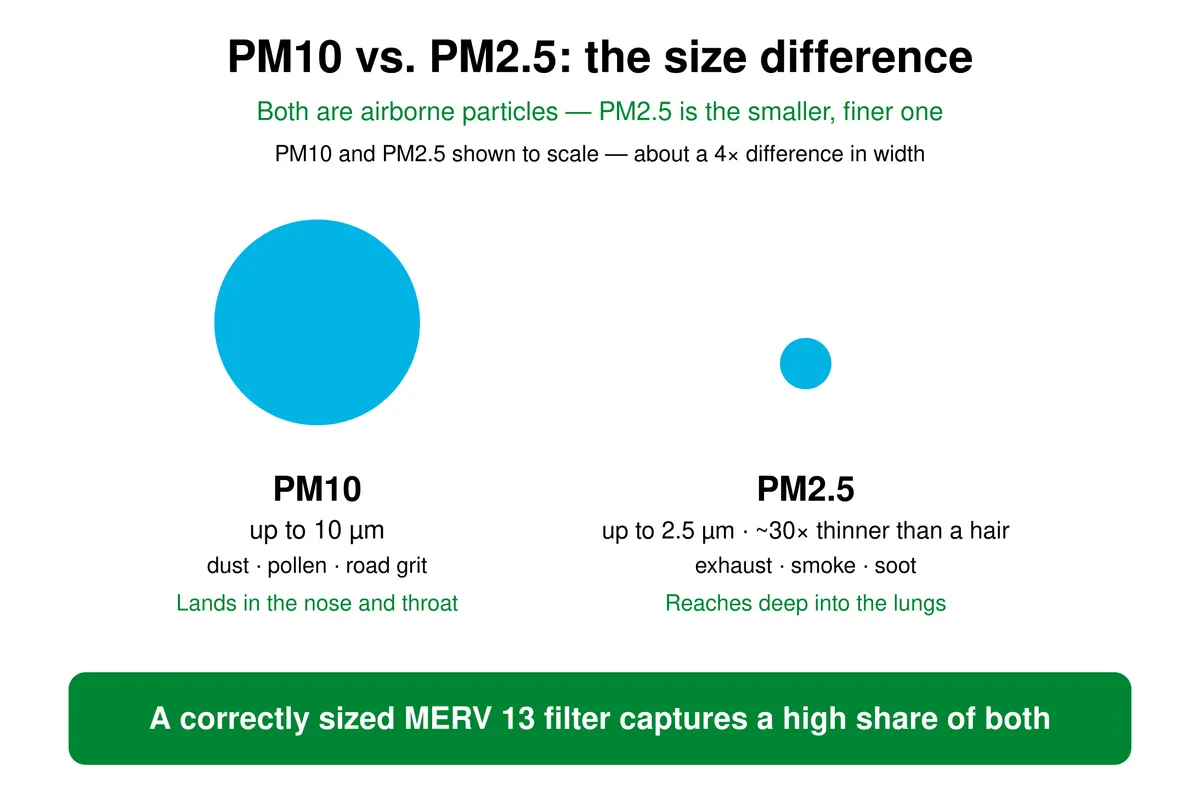
PM10 and PM2.5 are both airborne particles — the key difference is size, and PM2.5 is the smaller, finer one. PM10 is larger and mostly caught in the nose and throat, while PM2.5 is fine enough to travel deep into the lungs. A correctly sized MERV 13 filter captures a high share of both, and it's the rating the EPA recommends.
- PM10 — up to 10 µm (dust, pollen, road grit); lands in the nose and throat.
- PM2.5 — up to 2.5 µm, roughly 30× thinner than a human hair (exhaust, smoke, soot); reaches deep into the lungs.
Not sure which filter your home needs? Take the quick match quiz below.
Answer 3 quick questions and we'll match you to your perfect filter.
TL;DR
PM10 and PM2.5 are airborne particles that behave differently once inhaled. PM10 is larger and mostly caught in the nose and throat, while PM2.5 reaches deep into the lungs and even the bloodstream, making it more dangerous. Homes near highways, factories, or other high pollution zones face elevated levels of both year round. A correctly sized MERV 13 filter captures a high share of both and is the rating most health agencies recommend.
Key Takeaways
PM10 covers particles up to 10 micrometers wide, including dust, pollen, and road grit. PM2.5 covers particles up to 2.5 micrometers wide, including exhaust, industrial smoke, and wildfire soot.
PM2.5 poses the greater health risk since it travels deeper into the lungs and can enter the bloodstream.
The EPA recommends a filter rated at least MERV 13, or as high as the system allows.
Homes near highways, industrial sites, or wildfire-prone regions typically need higher MERV filtration.
MERV 13 is not true HEPA filtration.
On high pollution days, a continuous HVAC fan and a portable air cleaner help before a filter upgrade takes effect.
"I hear the same assumption from homeowners near highways and industrial parks: they think changing their filter more often will fix a high pollution problem. The rating matters far more than the schedule. A fresh MERV 8 filter still lets most fine particles through, while a MERV 13 filter catches far more of them."
Michelle Wan, Brand Manager and Air Quality Writer, Filterbuy
What Is PM10?
PM10 refers to particulate matter 10 micrometers wide or smaller. These larger particles irritate the eyes, nose, and throat and commonly come from road dust, farms, construction sites, and mining operations, according to the CDC. Because they are relatively large, the body's natural defenses catch most of them before the lower respiratory tract. Homes near unpaved roads, farmland, or active construction typically see higher PM10 levels on dry, windy days.
What Is PM2.5?
PM2.5 describes fine particles 2.5 micrometers wide or smaller, roughly 30 times thinner than a human hair, forming mainly from vehicle exhaust, power plants, factories, and wildfire smoke. Because they are so small, they bypass the body's natural filtering and travel deep into the lungs, and the smallest can cross into the bloodstream. The American Lung Association notes that people who live or work near a busy highway face a measurably higher risk of health harm.
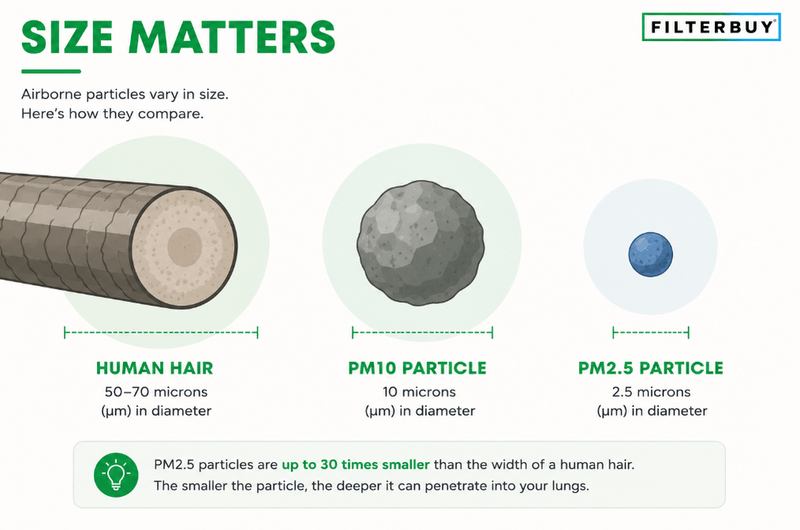
PM10 Vs. PM2.5: What Actually Sets Them Apart
The two categories differ in size, source, and how deep each travels inside the body.
Source: U.S. EPA and CDC particle pollution guidance.
Which One Is More Dangerous?
Both sizes affect health, but PM2.5 is generally the greater long term threat, linked to heart and lung disease, while PM10 tends to cause more surface level irritation. High pollution areas are rarely exposed to only one particle size, since traffic, industry, and wildfire smoke tend to raise both together, which is why an effective filter needs to address both ranges.
Common Sources Of High Outdoor Pollution
A few conditions raise both particle types at once.
Highway proximity: exhaust and road dust raise particle levels near busy roads. The CDC advises avoiding busy roads when pollution is high.
Industrial areas: factories, refineries, and power plants emit coarse dust and fine combustion particles.
Wildfire smoke: seasonal wildfires can push PM2.5 higher across wide regions for days, even far from the fire.
Which Filter Rating Captures PM10 And PM2.5?
HVAC filters are rated using MERV, or Minimum Efficiency Reporting Value, a scale measuring how well a filter captures particles of different sizes. Filters rated MERV 6 to 8 catch most larger PM10 particles but let a significant share of PM2.5 pass through. The EPA states MERV 13 and above must demonstrate at least 50 percent removal efficiency for the smallest particles tested, which is why it recommends MERV 13 or as high as the system will accommodate. Filterbuy carries pleated filters across the full MERV range, including MERV 13, sized for standard residential slots.
Best MERV Rating For High Pollution, Highway, And Industrial Homes
For homes near highways, industrial sites, or frequent wildfire smoke, MERV 13 is the baseline most agencies point to for reducing indoor PM2.5. Lower pollution suburban or rural homes may see adequate results from a MERV 8 to 11 filter, at lower cost and less airflow resistance.
Confirm system compatibility before purchase, not after. A MERV 13 filter restricts airflow more than a MERV 8, and an older blower can struggle with it and use more energy.
MERV 13 is a strong practical target, but it is not true HEPA filtration, which uses stricter testing and requires dedicated housing. Homeowners wanting HEPA level filtration usually pair a MERV 13 duct filter with a portable HEPA air cleaner where they spend the most time.
Source: U.S. EPA Guide to Air Cleaners in the Home.
How To Choose The Right Filter For Your Home
Check the maximum MERV rating your system can accommodate before upgrading.
Confirm the exact filter dimensions on your current filter's frame instead of estimating.
Choose MERV 13 if your home sits near a highway, industrial site, or wildfire-prone region and your system supports it.
Replace filters every 60 to 90 days, more often during heavy pollution stretches.
Ask a licensed HVAC technician if you are unsure about compatibility.
Filterbuy offers pleated MERV 13 filters sized for most residential HVAC systems.
What To Do On The Worst Pollution Days
A filter upgrade helps every day, but a few steps matter most when pollution spikes. Watch for these signs:
The outdoor AQI for your zip code reads orange, red, or purple on AirNow.
The air smells smoky, metallic, or like exhaust indoors with windows closed.
Coughing, eye irritation, or allergy symptoms flare up more than usual.
A few habits do more than a filter alone on those days:
Set the HVAC fan to "on" instead of "auto" so it keeps pulling air through the filter, a step ENERGY STAR recommends during smoke events.
Keep windows and doors closed, and skip candles or frying food without the range hood on.
Run a portable air cleaner in the room the household uses most.
Skip outdoor exercise until air quality improves.
Swap in a fresh MERV 13 filter if yours is past 60 to 90 days.
If You Rent Or Cannot Upgrade Your HVAC Filter
Renters and multi-unit residents often cannot swap in a higher MERV filter, since the landlord controls the shared system. That does not mean pollution exposure is out of your hands.
Run a portable HEPA air cleaner sized for your room, independent of the building's HVAC system.
Ask your property manager which MERV rating the building uses and whether a higher rating is possible at the next change.
Seal gaps around windows and doors on high pollution days.
Filterbuy's MERV 13 filters are ready whenever you move into a home with your own system.
"After manufacturing filters for over a decade and serving more than two million households, we consistently see the same pattern: homes near highways and industrial corridors need a higher MERV rating than the national average recommendation, and MERV 13 is where most of those households land."
David Heacock, Founder and CEO, Filterbuy
7 Essential Resources For Understanding And Reducing High Pollution Exposure
Each resource answers one question about high pollution exposure, ordered from understanding the risk to acting on it.
1. Understand The Pollutants The CDC Tracks Nationwide
The CDC breaks down the six criteria pollutants the EPA regulates, including how PM10 and PM2.5 differ.
Source: CDC: Air Pollutants
2. Check Your Real-Time Local Air Quality
AirNow explains the 0 to 500 AQI scale and what each color-coded level means.
Source: AirNow: AQI Basics
3. See The Long-Term Health Stakes Of A Polluted Area
The American Lung Association's State of the Air report details risks tied to long-term PM2.5 and PM10 exposure.
Source: American Lung Association: Health Impact of Pollution
4. Review The Research Linking Traffic Pollution To COPD
This PMC study links proximity to busy roads with a documented increase in COPD risk.
Source: PMC: Traffic-Related Air Pollution and COPD Risk
5. Choose The Right Filter Rating For Your Home
The EPA's consumer guide confirms MERV 13 as the minimum needed for the smallest, most dangerous particles.
Source: EPA: Guide to Air Cleaners in the Home
6. Get Filter Guidance For High-Risk Pollution Zones
ENERGY STAR recommends MERV 13 or the highest rating a system can handle.
Source: ENERGY STAR: An Air Cleaner Can Be Helpful in High-Risk Areas
7. Learn How To Shop For A Certified Air Cleaner
AAFA explains how to size a portable air cleaner and how pollution affects change frequency.
Source: AAFA: Air Cleaners -- What You Need to Know
Supporting Statistics
About two thirds of U.S. households use central air conditioning or a heat pump as their main cooling equipment, meaning most rely on a ducted filter that can be upgraded.
Source: U.S. Energy Information Administration
In 2025, the United States saw 77,850 wildfires that burned more than 5.1 million acres, one of several sources of periodic PM2.5 spikes.
Source: National Interagency Fire Center
94 percent of single-family homes built for sale in the Midwest in 2024 had a forced-air furnace, a ducted system that depends on a properly rated filter.
Source: U.S. Census Bureau
Frequently Asked Questions
What is the best air filter for high pollution areas?
A MERV 13 pleated filter is the best starting point because the EPA recommends it for capturing at least half of the smallest, most harmful airborne particles.
What MERV rating should I use near a highway?
MERV 13 is the recommended choice because traffic pollution contains a high concentration of fine PM2.5 particles that lower-rated filters are less effective at capturing.
Can a standard home HVAC system handle industrial area pollution?
Many standard residential HVAC systems can, but not all. A licensed HVAC technician can verify whether your system can safely support a MERV 13 filter.
Is MERV 13 enough for wildfire smoke too?
Yes. A MERV 13 filter captures a significant portion of wildfire smoke particles and is widely recommended during smoke events to improve indoor air quality.
Is MERV 13 the same as a true HEPA filter?
No. MERV and HEPA follow different testing standards. True HEPA filters typically require specialized housings and usually cannot be installed in a standard residential HVAC filter slot.
What if I rent and cannot change my HVAC filter?
Use a portable HEPA air purifier in the room where you spend the most time. It can improve your personal indoor air quality even if you cannot replace the shared HVAC filter.
Glossary
PM10: Particulate matter 10 micrometers wide or smaller, including dust, pollen, and road grit.
PM2.5: Fine particulate matter 2.5 micrometers wide or smaller, including exhaust, industrial smoke, and wildfire soot.
MERV: Minimum Efficiency Reporting Value, the scale rating how well a filter captures different particle sizes.
AQI: Air Quality Index, the EPA's tool for reporting outdoor air quality on a 0 to 500 scale.
HEPA: High Efficiency Particulate Air, a filtration standard distinct from MERV requiring dedicated housing.
HVAC: Heating, Ventilation, and Air Conditioning, the system that filters air in a home.