July 18, 2026
By Michelle Wan · Reviewed by David Clark, Licensed HVAC Technician · Published July 18, 2026 · Updated July 18, 2026
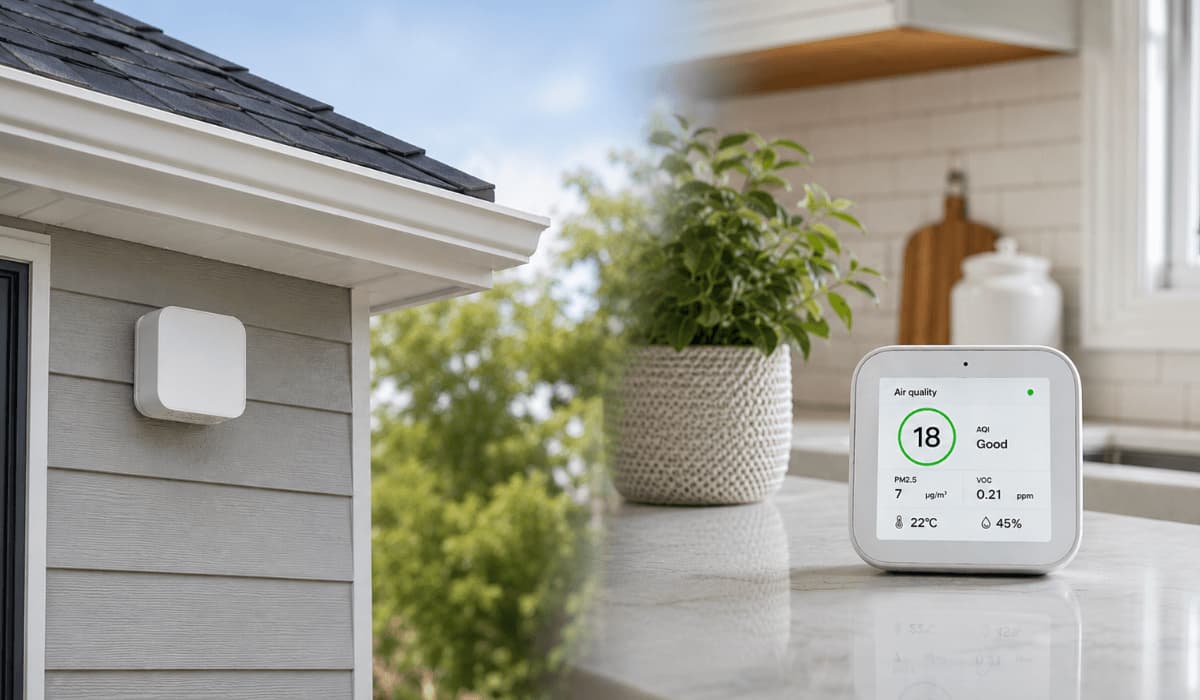
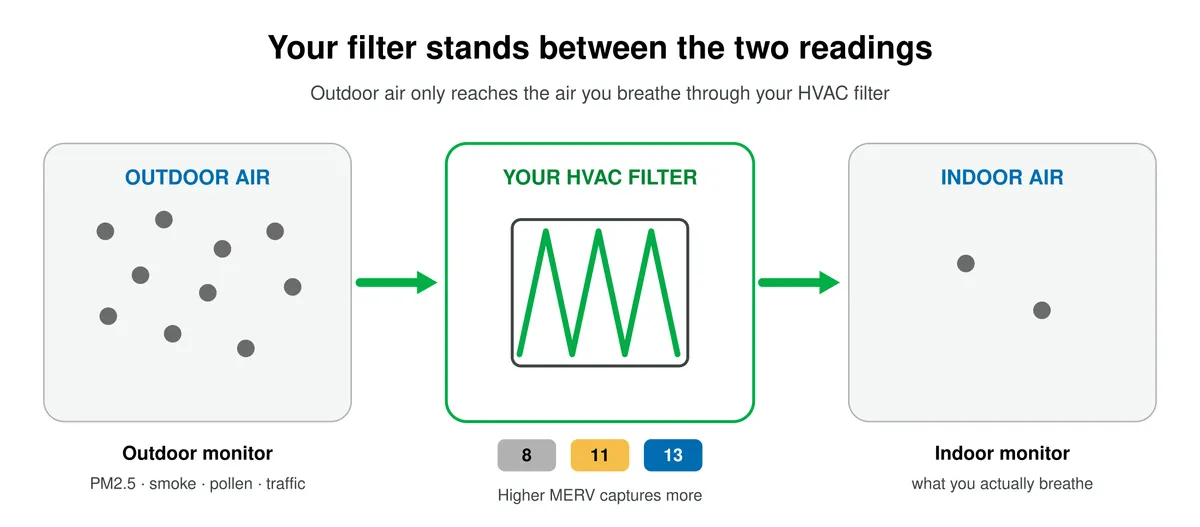
An outdoor monitor measures the pollution around your home; an indoor monitor measures the air you're actually breathing inside. The two readings often don't match, and the gap between them is your HVAC filter — it decides how much outdoor pollution reaches you.
Not sure which filter matches your air? Take the quick match quiz below.
Answer 3 quick questions and we'll match you to your perfect filter.
Prefer to browse on your own? Shop all Filterbuy air filters.
Outdoor and indoor air quality monitors answer two different questions. An outdoor monitor (PurpleAir, IQAir's outdoor units) reports the pollution around your home — wildfire smoke, traffic exhaust, pollen. An indoor monitor reports what you're actually breathing inside, which depends on ventilation, cooking, cleaning, and how well your HVAC filter is working. When an outdoor reading climbs, the fastest way to protect your indoor air is to check your filter.
Outdoor air quality monitors measure ambient conditions such as PM2.5, PM10, and sometimes ozone across a neighborhood or region, feeding networks like the EPA's AirNow.
Indoor air quality monitors measure the air inside one room or home, typically tracking PM2.5, CO2 as a ventilation proxy, VOCs, temperature, and humidity.
PurpleAir and IQAir are two of the most widely used consumer monitor brands. Both use laser particle counters for PM2.5, but they differ in data transparency and the pollutants they add beyond particulates.
A rising outdoor AQI does not automatically mean your indoor air matches it. Your HVAC filter rating decides how much outdoor pollution actually reaches the air you breathe.
Running an indoor and an outdoor monitor together lets you see when infiltration, not an indoor source, is the real driver of a bad reading.
I check outdoor AQI for a different U.S. city almost every morning. Over the past few fire seasons, the reader question has shifted from "what does this number mean" to "why did my house still smell smoky after the map turned green." That gap almost always traces back to one thing: what was in the HVAC filter before the smoke arrived. — Michelle Wan, Brand Manager and Air Quality Writer, Filterbuy
An outdoor air quality monitor measures the air at a fixed outdoor location, most often PM2.5 and PM10, sometimes adding ozone, nitrogen dioxide, and weather data. Readings from these monitors, from EPA reference stations to networked sensors like PurpleAir, feed the AQI shown on apps like AirNow. The Clean Air Act sets six pollutants behind the U.S. AQI, but on most days PM2.5 decides the number, since fine particles travel farthest and dominate wildfire smoke, vehicle exhaust, and haze. (See our guide to how the AQI is calculated.)
Housed in weatherproof enclosures, these monitors report the shared air a whole block breathes, which is why they matter in wildfire season: NOAA satellite tracking shows smoke plumes travel hundreds of miles, changing readings hours before anyone smells smoke. Ground-level ozone and stagnant weather push the same monitors high on a still summer afternoon, so smoke isn't always the cause.
An indoor air quality monitor measures the air inside a specific room, typically PM2.5, carbon dioxide (a ventilation proxy), VOCs, temperature, and humidity; some models also measure formaldehyde or PM1 for smoke sensitivity. Indoor sources drive most of what it sees: cooking, candles, cleaning products, new furniture, and pet dander all raise PM2.5 or VOCs with no outdoor event involved. The CDC and CPSC note indoor concentrations of some pollutants can run several times higher than outdoors, since well-sealed homes trap what's generated inside.
Outdoor air still reaches indoor monitors through open windows, ventilation, and gaps around doors, a process called infiltration. That's the connection this page is built around: an indoor reading mixes what your home makes with what leaks in, filtered by whatever sits in your HVAC system. (Filterbuy's quick guide to what VOCs are explains why monitors track them separately from PM2.5.)
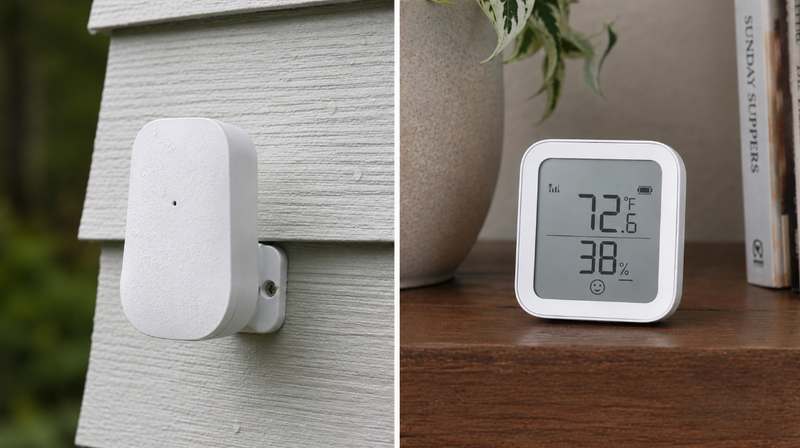
Both types share the same core technology, laser particle counters for PM2.5, but are built for different locations and answer different questions.
IQAir and PurpleAir are the two most-compared consumer monitor brands. Both build devices around laser particle counters for PM2.5 but differ in transparency and typical use: tracking a wildfire-prone neighborhood calls for a different feature set than checking whether a nursery is ventilated.
PurpleAir devices generally use dual Plantower laser sensors that cross-check each other. Researchers found that a correction formula (commonly LRAPA or EPA) brings PurpleAir readings close to regulatory-grade monitors, and the EPA folds corrected PurpleAir data into its AirNow Fire and Smoke Map, making it an informal standard for neighborhood monitoring.
IQAir's AirVisual line includes indoor (AirVisual Pro) and outdoor models, with the outdoor unit tracking more parameters. IQAir applies a proprietary correction it doesn't publish, making it harder to audit than PurpleAir's open approach, but its app pairs indoor and outdoor readings side by side. Neither brand's consumer models measure gaseous pollutants like ozone or NO2, so tracking gases needs a dedicated sensor or an EPA reference station.
Most home monitors fall into three categories. An outdoor-only sensor (like a PurpleAir outdoor unit) fits if your concern is neighborhood conditions such as wildfire smoke or regional pollution. An indoor-only monitor fits everyday concerns such as cooking fumes, a stuffy bedroom, or off-gassing furniture. A combined system (like IQAir's paired AirVisual Pro and Outdoor units) fits if you want both at once; comparing the two side by side is the only way to tell whether a bad indoor reading comes from inside the house or outdoor air leaking in.
Whichever setup fits, everything from here is about turning what your monitor shows into a filter decision. For a deeper one-time check, see our how to test your indoor air quality guide.
An outdoor monitor only tells you about the air outside your door; it can't know what filter is in your HVAC system or how well your home is sealed. That gap is why a high outdoor reading is a cue to act. A 2021 Nature Communications study found PM2.5 from wildfire smoke drove larger increases in respiratory hospitalizations than the same concentration of ordinary PM2.5. The EPA's wildfire guidance points to MERV 13 or higher as the rating that meaningfully captures fine smoke particulate moving through your HVAC.
Match your filter to the reading: Filterbuy's MERV rating for high-AQI days guide covers when MERV 8, 11, or 13 makes sense, and our MERV 13 vs. HEPA filter comparison covers whole-home filtration versus a room purifier.
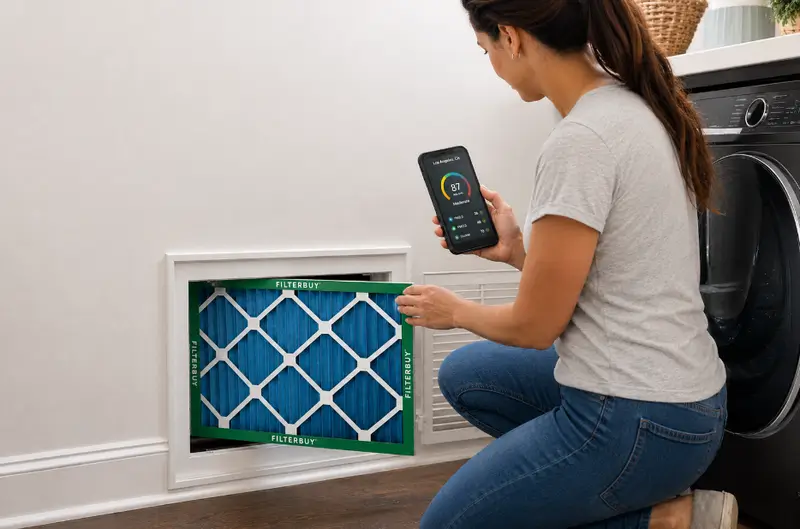
Running an indoor and outdoor monitor at once turns two numbers into one useful picture.
Place the indoor monitor where you spend the most time, away from stoves, windows, and vents that skew the reading toward one source.
Check a trusted outdoor source daily, such as AQI by ZIP code or the live wildfire and smoke map, especially in fire season.
Compare the two. If indoor tracks outdoor closely, infiltration is the driver: close windows and switch HVAC to recirculate. If indoor is high while outdoor is low, look inside first at cooking, cleaning, candles, or ventilation.
Act on the worst reading, not the average. Past outdoor AQI 100, sensitive groups should scale back outdoor activity; past 150, close up the house, run the HVAC fan continuously, and pull your filter — smoke loads a filter faster than everyday dust.
On Filterbuy's manufacturing side, filter orders climb in the days after a smoke advisory — so if both your readings are climbing, that filter is likely already overdue.
This is the most common confusion we hear: an outdoor AQI app shows a 0-to-500 index, but most indoor monitors show raw PM2.5 in micrograms per cubic meter (µg/m³) — two scales for the same pollutant. An indoor reading of 12 µg/m³ and an outdoor AQI of about 56 both describe Moderate air. The table below converts a raw indoor PM2.5 reading into the color categories your AQI app uses.
These bands mirror the EPA's 2024 PM2.5 breakpoints, the same official cutoffs used to calculate the outdoor AQI, applied to the raw concentration number your indoor monitor already shows you.
These bands mirror the EPA's 2024 PM2.5 breakpoints used to calculate the outdoor AQI, applied to the raw number your monitor shows.
A few setup mistakes explain most confusing readings:
Placing an indoor monitor near a stove, humidifier, or open window measures a hot spot, not the room.
Comparing a raw µg/m³ number directly to a phone app's AQI without converting the scales.
Treating a "Good" CO2 reading as proof of clean air; CO2 tracks ventilation, not particulates or VOCs.
Assuming no smell means no VOCs; several, including formaldehyde, are odorless at levels that still matter.
"Every fire season we watch filter orders spike in the days after a smoke advisory, which tells me most people are reacting to bad air instead of getting ahead of it. The monitor on your wall only does its job if the filter in your HVAC is already rated to catch what that monitor is reading." — Filterbuy Team
A federal agency maintains each and covers a different piece of the picture.
AirNow.gov: the government's official AQI portal; check a consumer sensor against regulatory-grade data.
EPA's Wildfires and Indoor Air Quality guide: how smoke enters a home and what to do at each stage.
CDC's Air Quality Resources for Professionals: the wildfire and particle-pollution guidance clinicians use for asthma, COPD, and heart disease.
The Inside Story: A Guide to Indoor Air Quality (EPA/CPSC): catalogs everyday indoor pollutants room by room.
40 CFR Part 58, Appendix G: the federal regulation defining how the AQI is calculated.
NOAA's Wildfire Smoke and Air Quality page: near-real-time satellite tracking of smoke plumes, often hours ahead of local AQI.
OSHA's Indoor Air Quality: Building Operations guide: ventilation benchmarks for checking your home's fresh-air exchange.
Wildfire PM2.5 hits harder: a 10 µg/m³ rise in wildfire-specific PM2.5 raises respiratory hospitalizations 1.3% to 10%, versus 0.67% to 1.3% for the same rise from other sources. (Aguilera et al., 2021, Nature Communications, NIH.)
Roughly 44% of Americans — about 152.3 million people — live where air pollution reached unhealthy levels, underscoring how often an outdoor reading is worth acting on. (American Lung Association, State of the Air, Key Findings.)
Federal research set the ventilation standard: DOE-backed Building America research helped develop ASHRAE 62.2, the residential ventilation standard an indoor monitor's rising CO2 reading is measured against. (U.S. DOE, ASHRAE Standard 62.2.)
PurpleAir's indoor-rated models can go inside, but its standard outdoor units are built for weatherproof mounting and aren't designed for indoor use. Check the model's rating first.
Both use laser particle counters for PM2.5. PurpleAir publishes its correction method and feeds the EPA's AirNow Fire and Smoke Map, giving strong third-party validation outdoors. IQAir's correction is proprietary and unpublished, making independent verification harder, though its devices are well regarded for indoor tracking.
No, but running both is the only way to tell whether a bad indoor reading comes from inside your home or from outdoor air leaking in. If you pick one, match it to your bigger concern: outdoor for wildfire smoke, indoor for everyday ventilation and indoor sources.
No. Filterbuy manufactures HVAC air filters. This guide exists because the reading is only half the picture; the next step is matching it to the right MERV-rated filter, which is what Filterbuy builds.
PM2.5: Fine particulate 2.5 microns or smaller, small enough to reach deep into the lungs and the main component of wildfire smoke.
VOC: A gas released from products such as paints, cleaners, and new furniture, tracked as a chemical off-gassing indicator.
Infiltration: Outdoor air entering through gaps around windows and doors, distinct from open-window ventilation.
MERV: A 1-to-20 scale rating of how well a filter captures particles; MERV 13 is the EPA's recommended minimum for wildfire smoke.
