
The Clean Air Act: How It Reshaped U.S. Air Quality (And What Remains)
August 5, 2026
Author: Michelle Wan, Brand Manager and Air Quality Writer
Reviewer: David Clark, Licensed HVAC Technician
Publish Date: August 5, 2026
Updated Date: August 5, 2026
Did The Clean Air Act Improve U.S. Air Quality?
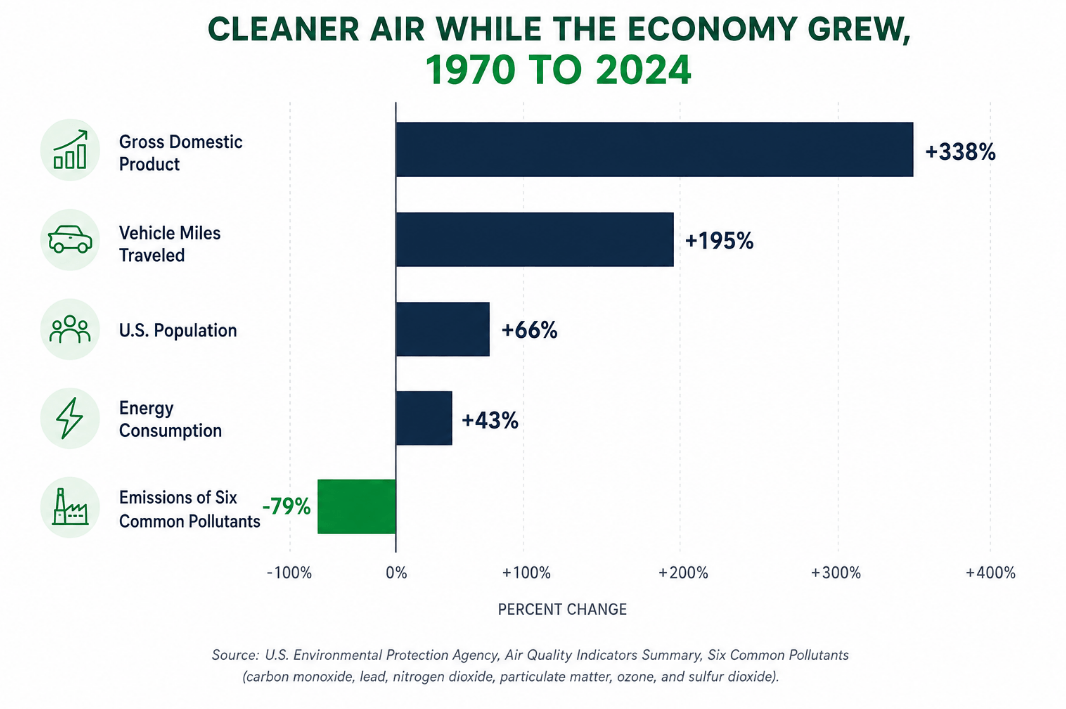
Yes. EPA reports that combined emissions of six common pollutants fell 79 percent between 1970 and 2024, while gross domestic product grew 338 percent. The law covers outdoor air only. No federal standard limits the air inside a private home, and states can ask EPA to strike wildfire smoke readings from the compliance record.
Cleaner air on the record does not always mean cleaner air in your house. Take the quick match quiz below to find the filter size and MERV level your system runs.
Answer 3 quick questions and we will match you to your filter.
Pleated in Talladega, Alabama, in over 600 sizes.
TL;DR
The Clean Air Act lets the U.S. Environmental Protection Agency set health-based limits on outdoor air pollution and requires states to meet them. Since 1970, EPA reports combined emissions of six common pollutants down 79 percent while gross domestic product grew 338 percent. The law never covered the air inside a private home, and it lets states set aside wildfire smoke readings when judging compliance. Cleaner air on the record does not always mean cleaner air in your house.
Key Takeaways
Congress built the modern Clean Air Act in 1970 and amended it in 1977 and 1990.
Combined emissions of the six principal air pollutants fell 79 percent between 1970 and 2024, while gross domestic product grew 338 percent.
Sulfur dioxide concentrations dropped 95 percent between 1980 and 2024. Ground-level ozone dropped 29 percent, the slowest of the six.
Roughly 109 million people lived in counties above a primary national standard in 2024, per EPA.
Researchers led by Marshall Burke at Stanford found wildfire smoke eroded about 25 percent of earlier PM2.5 progress across nearly three-quarters of contiguous states after 2016.
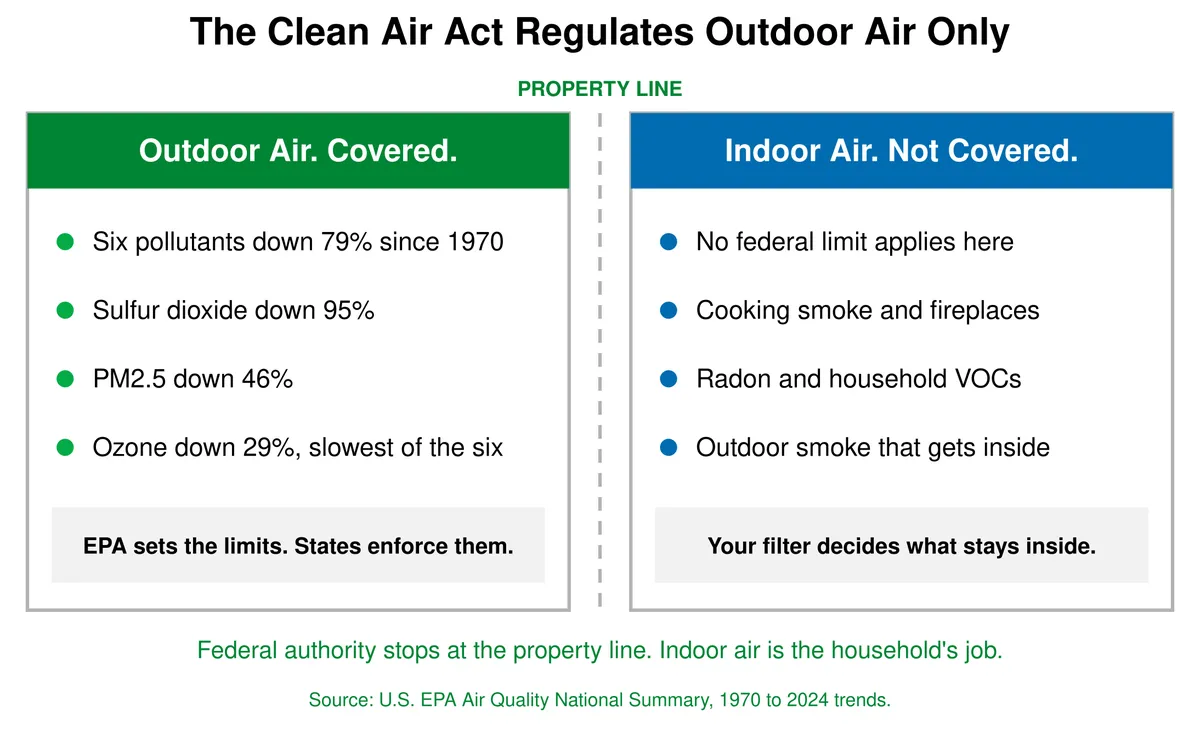
The Clean Air Act governs outdoor ambient air. No federal standard limits the air inside your home.
What Is The Clean Air Act?
The Clean Air Act is the primary federal law governing outdoor air pollution in the United States. Congress passed the first federal air legislation in 1955, expanded it in 1963, then rebuilt the statute in 1970, a sequence EPA traces in how the Clean Air Act evolved. The 1970 law gave the new Environmental Protection Agency power to set national health-based standards and required states to write enforceable plans to reach them.
Sources: Congressional Research Service and the U.S. Environmental Protection Agency.
How The Clean Air Act Actually Works
The Clean Air Act works through a division of labor. EPA sets national standards for six criteria pollutants, and each state writes a plan to meet them. Primary standards protect human health, including children, older adults, and people with heart or lung conditions. Secondary standards protect crops, buildings, ecosystems, and visibility.
EPA reviews the science on a recurring cycle and revises a limit when evidence supports it. A county exceeding a standard falls into nonattainment, obligating the state to add controls. Separate federal programs cover tailpipe emissions, fuel content, and new industrial sources, since pollution drifts across state lines.
The daily air quality number on your phone runs on this same statute. The index covers five pollutants regulated by the Clean Air Act, each anchored to its national standard, which is why a reading of 100 means something specific.
What The Clean Air Act Achieved From 1970 To 2024
The six criteria pollutants are the clearest measure of what the law accomplished. EPA's trends data shows steep declines in five and a much slower decline in the sixth. The table pairs each with what its trend means for the air moving through your HVAC system.
Source: U.S. EPA Air Quality National Summary, updated February 2026. Green marks a decline of 40 percent or more. Amber marks ozone, the slowest of the six to improve.
Filterbuy reads that table from the manufacturing side, and the split makes sense. Sulfur dioxide and lead were point-source problems with a few large emitters, and regulators could reach them directly. Fine particles and ozone come from everywhere at once, which is why they resisted the same approach and why they still reach into houses. Only one of the two responds to a filter.
What The Clean Air Act Has Not Solved
Three problems have outlasted the law's first 55 years: ground-level ozone, a fine-particle trend that stalled after decades of decline, and an exposure burden that never spread evenly. Ozone remains widespread across the Sun Belt and interior West. Roughly 109 million people lived in counties above at least one primary standard in 2024, by EPA's count. The American Lung Association's 2026 State of the Air report found 152.3 million Americans, 44 percent, in counties failing on ozone or particle pollution.
That burden falls unevenly. The same report found people of color more than twice as likely to live in a county failing all three measures.
Regulatory Air Versus The Air You Actually Breathe
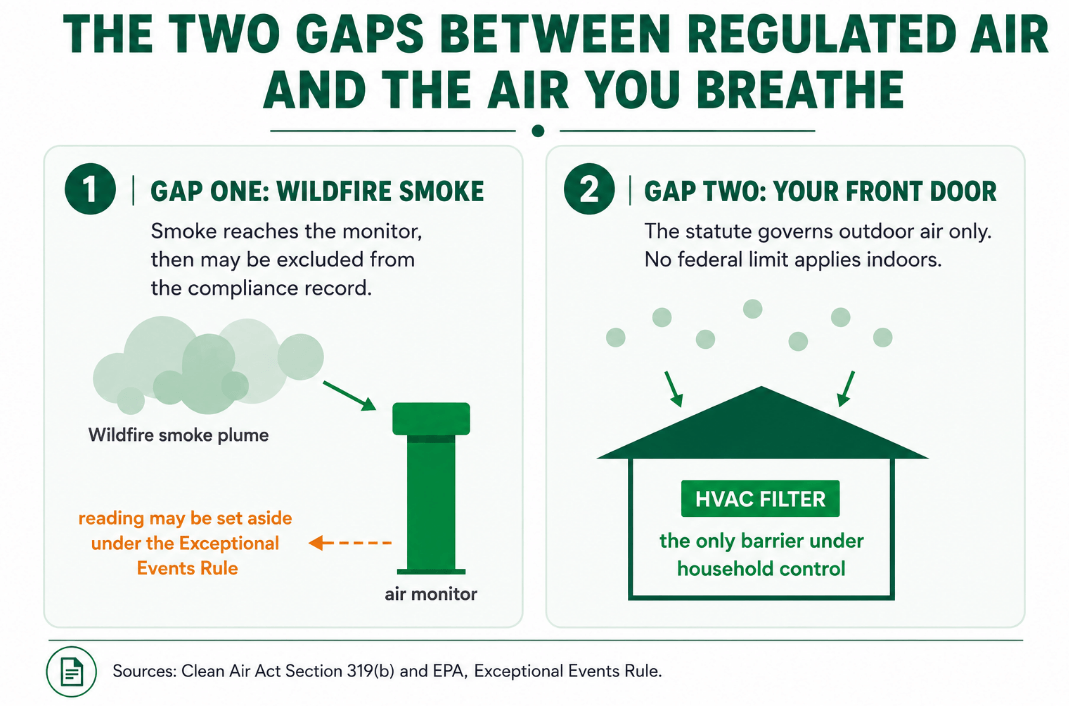
Two gaps separate the air the Clean Air Act measures from the air a family actually breathes. The first is wildfire smoke, which the law permits states to strike from the compliance record. The second is the front door, since the statute governs outdoor air and stops there. Both have widened as fire seasons grew longer.
Under Section 319(b) and EPA's Exceptional Events Rule, a state may ask EPA to exclude monitoring data caused by events outside its control, and wildfires qualify. EPA publishes tools for preparing these demonstrations. The particles still entered lungs. They simply stop counting toward the compliance record. Researchers at Resources for the Future call this a widening divergence between actual and regulatory air quality, and it grows as fires grow. The National Interagency Fire Center recorded 77,850 wildfires burning 5,131,474 acres in 2025.
Congress never extended the statute to private homes. The outdoor number tells you what is pressing against the house. Your building envelope and HVAC filter decide how much stays.
"Most of the smoke pages I write are for cities with no fire anywhere near them. Boston, the Great Lakes, the mid-Atlantic. People wake to an orange sky, check their local reading, and find nothing burning within a thousand miles. That changed how I read the federal numbers. The law stops pollution at the source, and smoke from another country has no source anyone here can regulate."
Michelle Wan, Brand Manager and Air Quality Writer, Filterbuy
What The Law Never Reached Indoors
The gap is easier to see when you name what falls inside it. A gas range raises nitrogen dioxide in a kitchen. Cooking puts fine particles into the rooms your family sleeps in, and so do candles and a wood fireplace. Radon rises from the soil under the slab. Household products release volatile organic compounds. EPA publishes guidance on all of it and enforceable limits on none of it, because the statute stops at the property line. That is not a loophole. Congress wrote an outdoor law and it does an outdoor job. Filterbuy works entirely inside the space it left.
Where The Clean Air Act Stands In 2026
The primary annual PM2.5 standard is 9.0 micrograms per cubic meter, and as of June 2026 it has survived a challenge from industry and from EPA itself. The D.C. Circuit upheld the limit EPA set in 2024, rejecting petitions from states and industry groups and denying the agency's request to vacate the rule it had issued.
EPA lowered the limit from 12.0 to 9.0 micrograms per cubic meter in early 2024. States and industry groups challenged it, arguing the agency exceeded its authority and should have weighed compliance costs and attainability. After the change in administration, EPA asked the court to vacate the standard it had set two years earlier. Appeal remains possible, and area designations have not been issued.
"After manufacturing filters for over a decade and serving more than two million households, we see the outdoor air in what comes back to us. Filters pulled after a smoke week are visibly darker than ones pulled in a clean month. That is the Clean Air Act working and not working at once. It cleaned up the smokestack. It never had jurisdiction over your return vent."
David Heacock, Founder and CEO, Filterbuy
What This Means For The Air In Your Home
The practical lesson we take from this is that the outdoor reading is a trigger, not a verdict. A smoke spike and a hot ozone afternoon produce similar numbers and call for opposite responses, and it is the most common mix-up Filterbuy hears about. Our guide on why the air quality is bad today separates the two, and you can pull a live local reading with our air quality index by ZIP code tool.
On a smoke day, close the windows and run the fan continuously rather than on auto, because a filter only captures what moves through it. A properly sized MERV 13 filter catches much of the smoke-sized fraction thinner filters pass straight through, provided your system holds normal airflow. Filterbuy MERV 13 air filters are built for that job, and they are pleated in Talladega, Alabama, in over 600 sizes.
Here is the test Filterbuy uses. The two look alike on the index and behave nothing alike inside a house.
Ozone is the honest exception. No MERV filter removes it, and any product claiming otherwise is overselling. On high-ozone days the answer is timing outdoor activity, not filtration. For the levels themselves, see how MERV ratings are measured and which MERV rating to run when the AQI climbs.
The households that ride out a bad smoke stretch comfortably bought filters in spring rather than during the event. The Filterbuy wildfire smoke air quality index guide lays out the full sequence, and our page on Canadian wildfire smoke crossing into U.S. air covers plumes arriving from the north.
Essential Resources
1. Air Quality National Summary, U.S. Environmental Protection Agency. Source: Air Quality - National Summary | US EPA
2. Clean Air Act: A Summary of the Act and Its Major Requirements, Congressional Research Service. Source: Clean Air Act: A Summary of the Act and Its Major Requirements | Congress.gov
3. AQI Basics, AirNow. Source: Air Quality Index (AQI) Basics
4. National Parks and the Clean Air Act, National Park Service. Source: Clean Air Act - Air (U.S. National Park Service)
5. Wildfire Smoke and People with Chronic Conditions, Centers for Disease Control and Prevention. Source: Wildfire Smoke and People with Chronic Conditions
6. State of the Air 2026 Key Findings, American Lung Association. Source: Key Findings | State of the Air | American Lung Association
7. Reconsideration of the National Ambient Air Quality Standards for Particulate Matter, Federal Register. Source: Federal Register : Reconsideration of the National Ambient Air Quality Standards for Particulate Matter
Supporting Statistics
1. Peer-reviewed research reports that wildfire smoke has offset roughly 25 percent of air quality improvements across three-quarters of contiguous states, and about 50 percent across most western states, since at least 2016.
2. The United States recorded 77,850 wildfires burning 5,131,474 acres in 2025.
Source: Statistics | National Interagency Fire Center
3. Exclusion of wildfire smoke data under the Exceptional Events Rule creates a growing divergence between actual and regulatory air quality.
Frequently Asked Questions
When Was The Clean Air Act Passed?
Congress passed the original Clean Air Act in 1963 and rebuilt it in 1970, when President Nixon signed the amendments creating the modern framework. Further amendments followed in 1977 and 1990.
Has The Clean Air Act Actually Worked?
EPA reports that combined emissions of the six principal air pollutants fell 79 percent between 1970 and 2024 while the economy grew 338 percent. EPA's benefit-cost study of the 1990 amendments puts benefits at more than 30 times costs. Progress has been uneven across pollutants and communities.
Why Is Ground-Level Ozone Still A Problem?
Ozone forms in the atmosphere rather than leaving a smokestack, so EPA must control the precursors that create it. Heat accelerates the reaction, so hot years and wildfire seasons push ozone up even when precursors fall.
Does The Clean Air Act Cover Wildfire Smoke?
Wildfire smoke affects the readings you see, but EPA's Exceptional Events Rule lets states request that smoke-influenced data be excluded from certain compliance determinations. The Clean Air Act does not regulate wildfires as a pollution source.
Does The Clean Air Act Regulate Indoor Air Quality?
No. It regulates outdoor ambient air only, which leaves ventilation and filtration as the household's main tools indoors.
What Is The Current Annual PM2.5 Standard?
It is 9.0 micrograms per cubic meter, lowered from 12.0 in 2024 and upheld by the D.C. Circuit in June 2026.
Glossary
Clean Air Act. The U.S. federal law, enacted 1963 and rebuilt 1970, authorizing EPA to regulate outdoor air pollution.
EPA. The U.S. Environmental Protection Agency, which sets and enforces national air quality standards.
NAAQS. National Ambient Air Quality Standards, the outdoor limits EPA sets for six pollutants.
Criteria Pollutant. One of six NAAQS pollutants: carbon monoxide, lead, nitrogen dioxide, ozone, particulate matter, sulfur dioxide.
State Implementation Plan. A state's federally enforceable plan for meeting and maintaining the national standards.
Nonattainment Area. An area where measured pollution exceeds a national standard, triggering added controls.
PM2.5. Fine particulate matter 2.5 micrometers or smaller, able to reach deep lung tissue and the bloodstream.
Ground-Level Ozone. A gas formed when sunlight reacts with vehicle and industrial emissions, and the main component of smog.
AQI. The Air Quality Index, EPA's 0 to 500 scale turning pollutant concentrations into daily health guidance.
Exceptional Events Rule. The EPA rule letting states request exclusion of data caused by uncontrollable events such as wildfires.
MERV. Minimum Efficiency Reporting Value, the 1 to 16 scale rating how well a filter captures airborne particles.
Prevention Of Significant Deterioration. The 1977 program limiting new pollution where air is already cleaner than national standards.