
Air Pollution Deaths: What The Global And U.S. Data Actually Show
August 5, 2026
Author: Michelle Wan, Brand Manager and Air Quality Writer | Reviewer: David Clark, Licensed HVAC Technician | Published: August 5, 2026 Updated: August 5, 2026
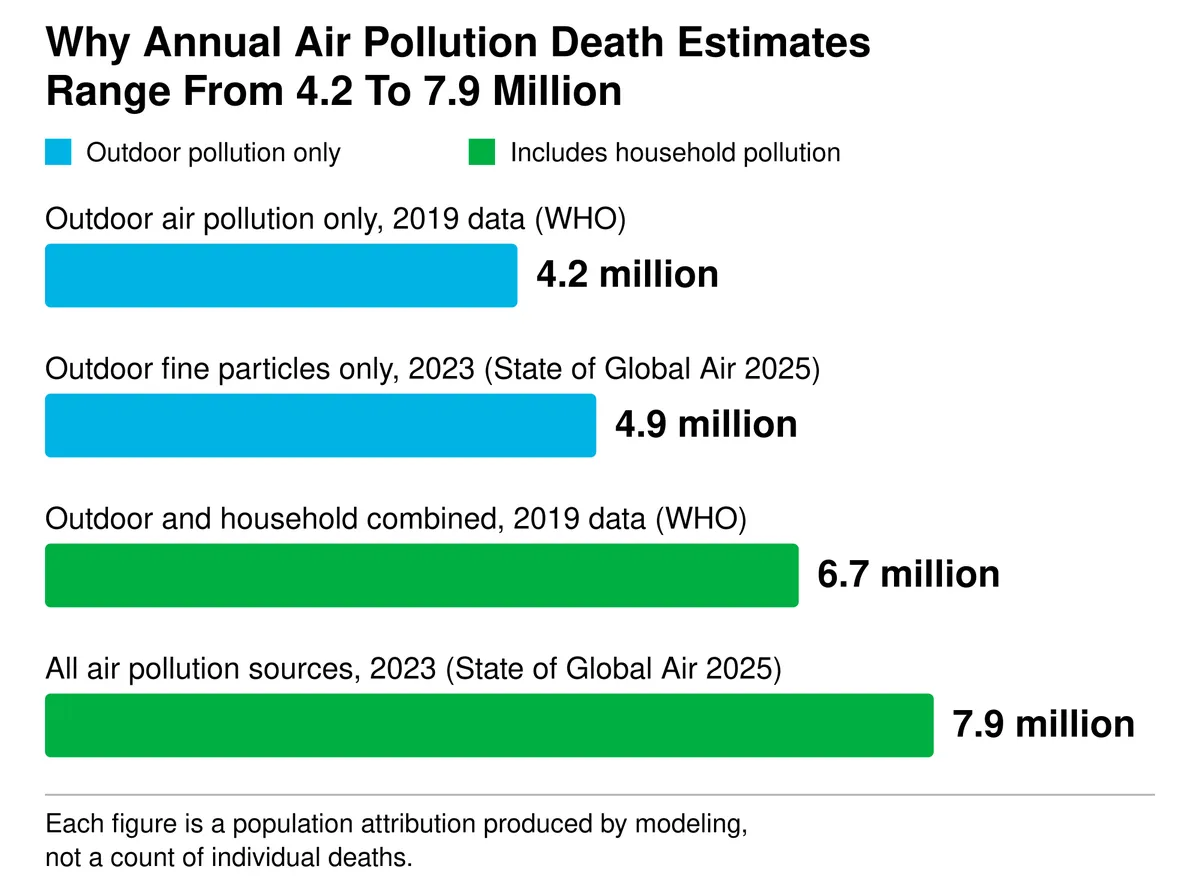
Credible estimates of annual air pollution deaths range from 4.2 million to 7.9 million worldwide, and both ends of that range are accurate. WHO attributes 4.2 million premature deaths each year to outdoor air pollution, based on 2019 exposure data. The State of Global Air 2025 report attributes 7.9 million deaths in 2023 to air pollution from all sources. What separates the two numbers is the reference year and the pollutants each one counts.
4.2 million per year from outdoor air pollution only (WHO, 2019 data)
6.7 million per year from outdoor and household air pollution combined (WHO, 2019 data)
4.9 million in 2023 from outdoor fine particles alone (State of Global Air 2025)
7.9 million in 2023 from all air pollution sources (State of Global Air 2025)
Every figure above is a population attribution produced by modeling, not a count of individuals whose death certificate names air pollution.
Most of your own exposure happens outdoors, where a household filter has no effect. A pleated MERV filter captures particles moving through your heating and cooling system, including outdoor fine particles that drift inside and the particles your household generates from cooking and pets. That is the part of your air you control.
Not Sure Which Filter Your System Takes?
Answer a few quick questions and we will match you to the right size and MERV rating for your home.
Already know your size?
TL;DR
The World Health Organization attributes 4.2 million premature deaths each year to outdoor air pollution and 6.7 million to outdoor and household air pollution combined, based on 2019 exposure data. The Health Effects Institute puts the 2023 figure at 7.9 million deaths from all air pollution sources. Both estimates are credible. The gap between them reflects two things the figures do not share, a reference year and a pollutant scope, plus ongoing revisions to modeling method. Neither organization is wrong.
Key Takeaways
WHO attributes 4.2 million premature deaths per year to ambient (outdoor) air pollution, using 2019 exposure data published in its October 2024 fact sheet.
The State of Global Air 2025 report attributes 7.9 million deaths worldwide in 2023 to air pollution from all sources, of which 4.9 million trace to outdoor PM2.5.
Noncommunicable diseases account for 86% of air pollution deaths worldwide, with heart disease and stroke forming the largest share.
The American Lung Association found that 44% of Americans, roughly 152.3 million people, live in counties that earned a failing grade for ozone or particle pollution in its 2026 report.
Low- and middle-income countries carry about 90% of the global burden, driven heavily by outdoor pollution and by cooking with solid fuels indoors.
Every figure on this page is a population attribution produced by modeling, not a count of individuals whose cause of death was recorded as air pollution.
How Many People Die From Air Pollution Each Year
Global estimates of annual air pollution deaths currently range from roughly 4 million to nearly 8 million, depending on which pollutants and sources the estimate counts. WHO reports 4.2 million premature deaths from outdoor air pollution alone. The Health Effects Institute reports 7.9 million deaths from all air pollution exposure. Neither number is a headcount. Both are statistical attributions produced by modeling how much disease would disappear if exposure dropped to a minimum-risk level.
Table 1. Global Air Pollution Death Estimates Compared
These estimates are not directly comparable. Each uses a different reference year and pollutant scope, and modeling methods change between editions. The 2021 figure is shown in grey because the 2025 report supersedes it.
Why Credible Sources Publish Different Numbers
Three differences explain nearly all the variation between published air pollution death tolls. The first is the reference year. The current WHO fact sheet covers 2019 exposure, while the State of Global Air 2025 report covers 2023. The second is scope. An outdoor-only figure excludes the household air pollution that dominates the burden in lower-income countries. The third is method. The Health Effects Institute states plainly that changes between its own report editions reflect improvements in scientific methods and modeling rather than sudden shifts in the underlying risk.
That last point matters for anyone comparing an older article to a newer one. When the 2024 report said 8.1 million for 2021 and the 2025 report said 7.9 million for 2023, the change reflected refined estimation, not a measured drop in deaths.
Which Figure Should You Cite
If you need a single number, use 4.2 million for outdoor air pollution and cite WHO, or 7.9 million for all air pollution and cite the State of Global Air 2025 report. Which one is correct depends entirely on what you are describing. The table below matches the common use cases to the right figure and the right source.
Table 2. Matching The Right Figure To What You Are Describing
Publish the reference year alongside any figure you use. A number quoted without its year is the single most common source of the confusion described on this page.
How Air Pollution Kills People
No death certificate lists air pollution as a cause of death. Air pollution appears in mortality statistics as a risk factor that raises the likelihood of diseases people do die from. WHO breaks the 2019 outdoor air pollution death toll into four disease categories.
Table 3. What Outdoor Air Pollution Deaths Are Caused By
Source: WHO ambient (outdoor) air pollution fact sheet, published October 2024, reporting 2019 data. Percentages are rounded by WHO and sum to 100.
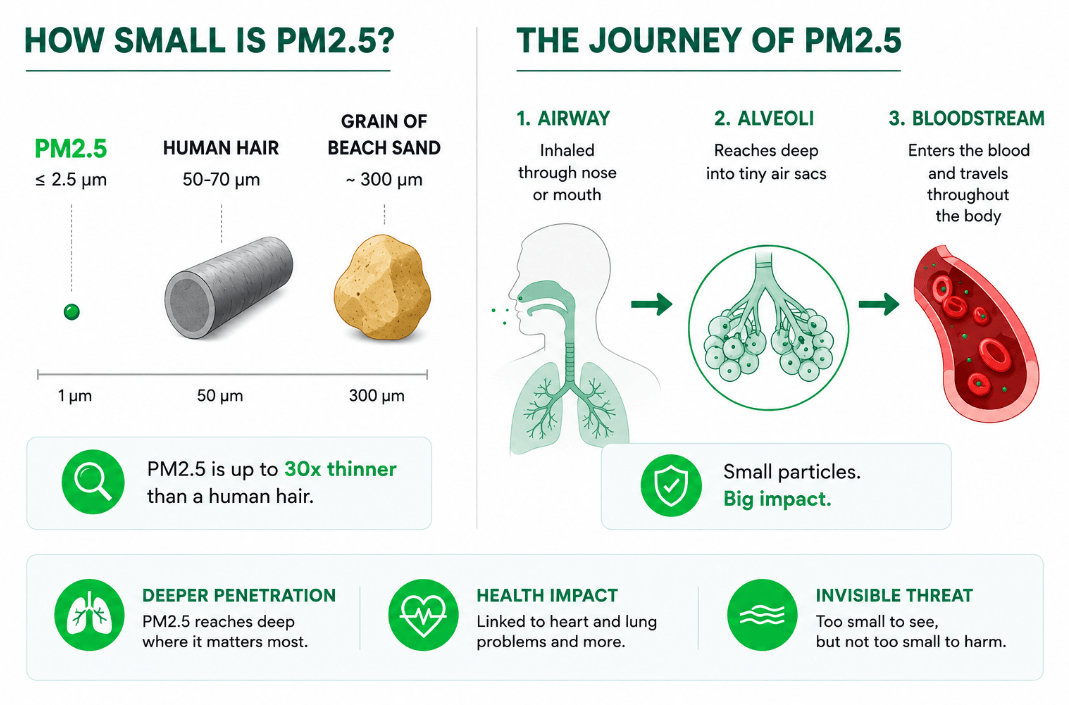
Fine particles drive most of that burden. Particles smaller than 2.5 micrometers travel past the upper airway and reach the alveoli, where they cross into the bloodstream. Peer-reviewed research links them to oxidative stress and vascular inflammation across multiple organ systems. The State of Global Air 2025 report added dementia to its accounting for the first time, attributing more than 625,000 deaths in 2023 to air-pollution-related dementia. Our explainer on how PM2.5 is measured and what levels are considered safe covers the exposure side in more detail.
Where The United States Fits In The Global Picture
The United States carries a far smaller share of global air pollution mortality than its population would suggest, and U.S. air quality has improved substantially over recent decades. The country publishes no single official annual death count the way WHO publishes global estimates. Instead, U.S. figures come from modeling studies, which commonly place annual PM2.5-attributable deaths in the tens of thousands to low hundreds of thousands. Regulation has tightened alongside that research, and the EPA lowered its annual PM2.5 standard to 9 micrograms per cubic meter in its first update to the standard in over a decade.
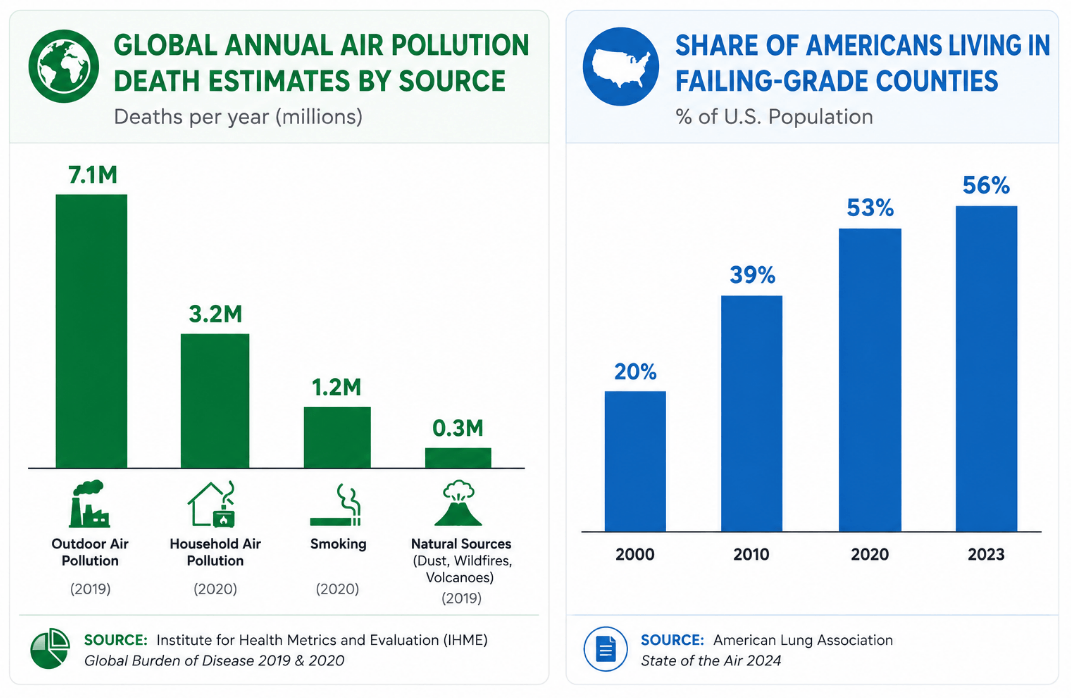
Exposure remains widespread even so. The American Lung Association reported in April 2026 that 152.3 million Americans, about 44% of the population, live in counties that failed at least one air quality measure. Nearly half of American children, 33.5 million people under 18, live in a county with a failing grade. You can check your local air quality by ZIP code to see where your own county stands today.
How To Read A Statistic That Includes You
Air pollution death tolls describe populations, not people. When WHO attributes 4.2 million deaths to outdoor air pollution, it is not counting 4.2 million individuals whose cause of death was recorded as air pollution. It is estimating how many fewer deaths would have occurred worldwide if exposure had sat at a minimum-risk level, with everything else held constant.
That has a practical consequence for reading your own risk. Air pollution did not kill a specific list of named people. It raised the probability of cardiovascular and respiratory illness slightly across billions of people at once, and the sum of those small shifts produces a very large number. Your own share of that shift depends on where you live, how long you have lived there, your age, and your existing heart and lung health.
Neither panic nor dismissal follows from this. A risk can be modest for you individually and still rank among the largest health burdens on the planet, because it applies to nearly everyone at once. Most coverage of this topic reports only one of those two facts.
What These Numbers Mean Inside Your Home
Global mortality statistics describe a problem that individual households mostly cannot solve on their own, and honest reporting requires saying so. WHO reported in June 2026 that roughly 2 billion people still cook with inefficient stoves and fuels, and that low- and middle-income countries bear about 90% of air pollution health impacts. A residential HVAC filter has no bearing on either of those drivers.
What a household filter does address is narrower and worth understanding clearly. A pleated MERV filter, the type Filterbuy manufactures, captures particles circulating through your heating and cooling system, including outdoor fine particles that migrate indoors and the particles your household generates from cooking and pets. Higher MERV ratings capture smaller particles, and our guide to how the MERV scale is structured explains where each rating lands. MERV 13 air filters offer the strongest fine-particle capture that most residential systems can handle without airflow problems.
A filter does not lower outdoor pollutant concentrations, does not remove gaseous pollutants such as ozone, and does not replace source control or ventilation. Filtration is best understood as one layer of indoor protection rather than a solution to global air pollution. Check what a good AQI means to judge when indoor protection actually matters.
Where We Part Ways With How These Numbers Get Used
Filterbuy manufactures pleated MERV air filters at its plant in Talladega, Alabama, so we have an obvious interest in you finding this page alarming.
The 7.9 million figure circulates widely across our industry as evidence that a filter is life-saving equipment. We do not accept that inference and we will not make it. The mortality burden behind that number is dominated by outdoor exposure and by cooking over solid fuels in homes without reliable electricity, and a pleated filter sitting in an American HVAC return touches neither one. No controlled trial has measured a reduction in deaths from residential filtration. Until one does, the supportable claim is lower fine-particle concentrations inside a single building, not deaths prevented.
That distinction matters more to us than the sale. A homeowner who buys a MERV 13 filter believing it cancels a global health risk has been sold something we did not make.
Every wildfire season I watch the same search pattern. People look up the death toll, get frightened by a global number, and then ask which filter to buy. The number is real. The leap from that number to a filter is where the reporting usually breaks, and closing that gap is the whole reason this page exists.
— Michelle Wan, Brand Manager and Air Quality Writer, Filterbuy
After manufacturing filters for over a decade and serving more than two million households, Filterbuy founder and CEO David Heacock puts the numbers in practical terms.
"Numbers this size can make people feel powerless. I tell homeowners to focus on the part they own. You cannot change what a power plant emits three states away, but you do decide what your family breathes for the eight hours they are asleep. That part is worth getting right."
Essential Resources
WHO fact sheet on ambient (outdoor) air pollution
Source: Ambient (outdoor) air pollution
State of Global Air 2025 report
Source: State of Global Air Report 2025
EPA on the health and environmental effects of particulate matter
Source: Health and Environmental Effects of Particulate Matter (PM) | US EPA
American Lung Association State of the Air 2026 key findings
Source: Key Findings | State of the Air | American Lung Association
CDC overview of air quality and health
Source: About Air Quality
AirNow guide to Air Quality Index basics
Source: Air Quality Index (AQI) Basics
Peer-reviewed review of particulate matter health effects
Supporting Statistics
Air pollution contributed to 7.9 million deaths worldwide in 2023, with 86% from noncommunicable diseases
Source: New Report Shows Nearly 9 of 10 Global Air Pollution Deaths are From Noncommunicable Diseases
Air pollution accounted for 8.1 million deaths globally in 2021, including more than 700,000 deaths in children under five
Air pollution remains the second leading risk factor for death, accounting for about one in eight deaths worldwide in 2023
Source: Insights into the air we breathe: The State of Global Air 2025 | Health Effects Institute
Frequently Asked Questions
Glossary
Ambient air pollution: Outdoor air pollution, measured in the open air of cities and rural areas. WHO uses this term interchangeably with outdoor air pollution.
Household air pollution: Indoor pollution generated primarily by burning solid fuels such as wood, charcoal, coal, or crop waste for cooking and heating.
PM2.5: Fine particulate matter measuring 2.5 micrometers or less in diameter, small enough to reach the alveoli and enter the bloodstream.
Premature death: A death occurring earlier than statistically expected, attributed to a risk factor through population modeling rather than identified on an individual death certificate.
Noncommunicable disease (NCD): A non-infectious chronic condition such as heart disease, stroke, diabetes, COPD, lung cancer, or dementia.
Attributable death: A death counted against a risk factor by population modeling, representing the estimated number of deaths that would not have occurred if exposure had been at a minimum-risk level. It does not identify specific individuals.
Global Burden of Disease (GBD) study: The Institute for Health Metrics and Evaluation research program that produces comparable risk-factor and mortality estimates across more than 200 countries.
State of Global Air: An annual report published by the Health Effects Institute with the Institute for Health Metrics and Evaluation, presenting global air quality and health-impact data.