
Is It Safe to Exercise Outside Today? Check AQI First
July 6, 2026

On a hazy afternoon the air can look flat and calm and still tempt you out for a run. That's exactly when outdoor exercise gets tricky. When you push the pace you breathe faster, deeper, and usually through your mouth, so your lungs pull in far more polluted air than they would at rest.
The Air Quality Index settles the outdoor half of that decision. The other half is the room you move the workout into — because on a smoke day, indoor air is only as clean as what your filter is pulling out of it.
Quick answer
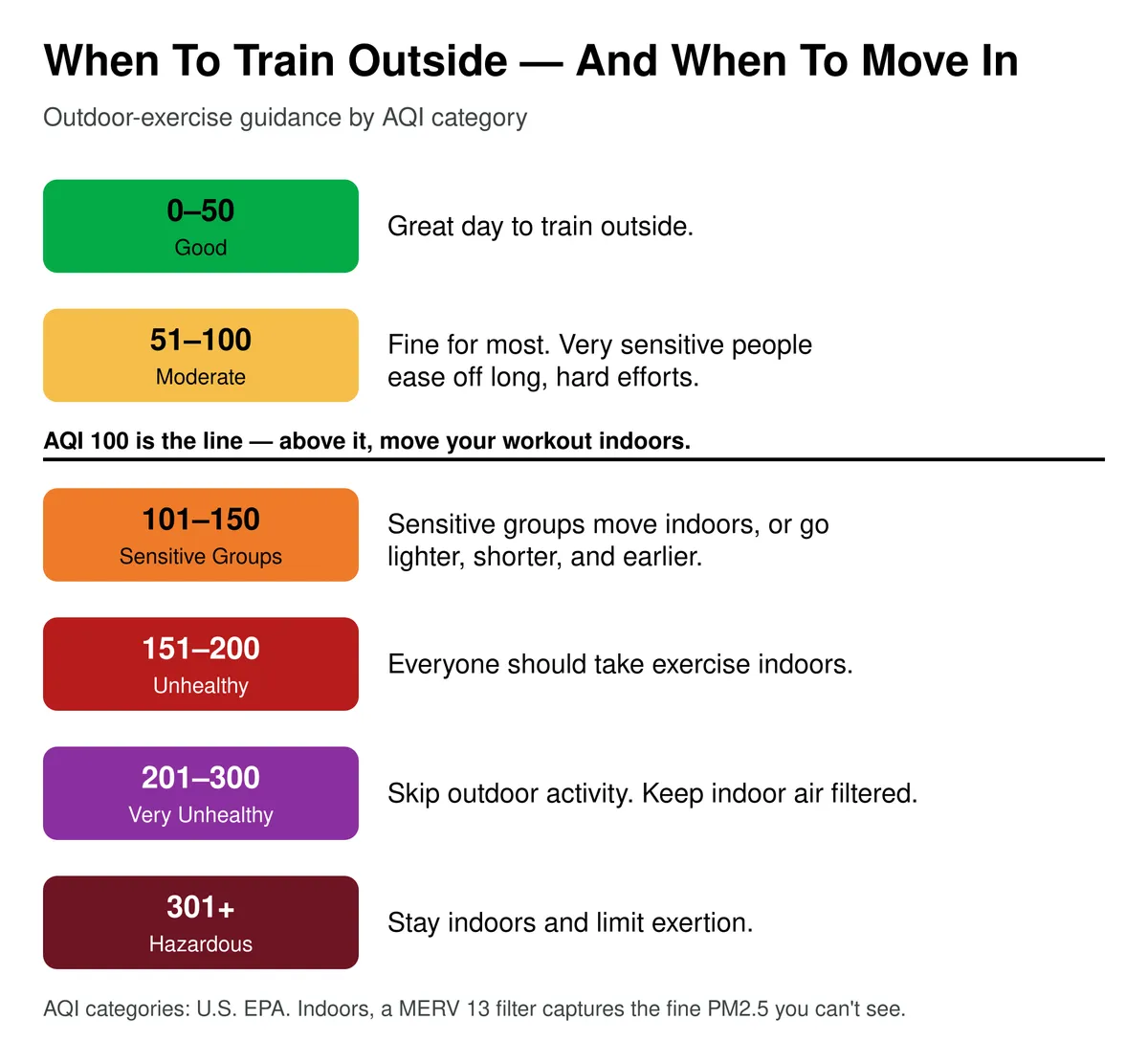
For most healthy adults, outdoor exercise is generally fine when the AQI is at or below 100. Once it passes 100 into code orange, sensitive groups should scale back or move indoors. At 151 and above — code red — everyone should train inside. Above 200, skip outdoor activity and keep your indoor air filtered until conditions improve.
When to Exercise Outside, by AQI
Find today's number, then read across. The left half is your outdoor call; the right half is what to do with the session instead.
| AQI | Category | Training outside | Training inside |
|---|---|---|---|
| 0–50 |
Good Green |
Good day to train outside. Everyone is clear to go. | No changes needed. |
| 51–100 |
Moderate Yellow |
Fine for most people. Unusually sensitive people ease off long, hard efforts. | Normal routine. Confirm your filter isn't overdue. |
| 101–150 |
Unhealthy for Sensitive Groups Orange |
Sensitive groups move indoors, or go lighter, shorter, and earlier in the day. | Close windows, run your HVAC fan while you train. |
| 151–200 |
Unhealthy Red |
Everyone should take exercise indoors. | Windows closed, fan on, MERV 13 in the system. |
| 201–300 |
Very Unhealthy Purple |
Skip outdoor activity. | MERV 13 plus a portable air cleaner in your workout space. |
| 301–500 |
Hazardous Maroon |
Health warning for everyone. Stay indoors. | Keep exertion light. Run the best filtration your system supports. |
Activity guidance follows U.S. EPA AirNow AQI categories and American Lung Association activity advice. Check your local AQI before every outdoor session. If you live with a heart or lung condition, follow the plan you've worked out with your healthcare provider — it takes priority over any general chart.
Moving the workout inside only helps if the air inside is clean
Ozone largely stays outside once you close the windows. Particle pollution doesn't — PM2.5 from wildfire smoke and traffic drifts in through gaps, doorways, and your HVAC system, so an indoor session in an unfiltered room can mean breathing hard on air that isn't much better than the air outside.
For smoky periods, the EPA recommends upgrading to an HVAC filter rated MERV 13 or higher to remove fine particle pollution from smoke in indoor air. Run the fan on "On" rather than "Auto" while you train, so indoor air keeps cycling through the media instead of only moving during cooling cycles.
Shop MERV 13 filtersOdd size? We also build custom-size filters to fit your slot. If your system can't take MERV 13, use the highest rating it accepts — check your owner's manual, or ask an HVAC technician.
Top Takeaways
- AQI 100 is the practical line. At or below it, most healthy people can train outdoors. Above it, risk climbs quickly.
- Sensitive groups feel it first. Children, adults over 65, people who are pregnant, and anyone with heart, lung, or blood-sugar conditions should cut back once the AQI passes 100.
- Exercise multiplies your exposure. Breathing harder pulls more fine particles deeper into your lungs, so a hard workout in bad air carries more risk than a slow walk.
- Know which pollutant is high. Ozone drops indoors once the windows are shut. Particle pollution follows you inside unless you filter it.
- Indoors beats a mask. Moving the session inside and filtering the air does more than a cloth or surgical mask, and an N95 makes hard breathing uncomfortable.
For most healthy adults, exercising outside is generally safe when the AQI is 100 or below. Once it climbs past 100, sensitive groups should move their workouts indoors, and at 151 or higher everyone should train inside. Whichever call you make, indoor air is only clean if you filter it, because fine PM2.5 particles drift in through windows and your HVAC system.
- AQI 100 or below — most healthy adults can train outside.
- AQI 101–150 — sensitive groups move indoors or go lighter and earlier.
- AQI 151 or higher — everyone takes the workout inside.
Answer a few quick questions and we'll match you to the right filter for your system.
Before you lace up your running shoes, you might be asking: is it safe to exercise outside today? Checking the Air Quality Index (AQI) is the best way to find out.
In general, an AQI of 0 to 50 means it is a great day for outdoor exercise. An AQI of 51 to 100 is usually okay for most people. When the AQI hits 101 to 150, sensitive groups should scale back. If the AQI reaches 151 or higher, you should consider moving your workout indoors.
Check today’s AQI near you on Filterbuy’s live air quality map before heading outside.
Air quality affects everyone differently. If you have asthma, COPD, heart disease, are pregnant, are recovering from illness, or experience symptoms during exercise, talk with a qualified healthcare professional. They can tell you exactly what is safe for your body.
Key Takeaways
Always check the AQI before engaging in outdoor activities to ensure the air quality is safe.
Individuals in sensitive groups, such as those with asthma, COPD, or heart disease, should take extra precautions when the AQI exceeds 100.
Consider moving your workout indoors if the AQI reaches unhealthy levels (151 or higher).
Consult with a healthcare professional if you are unsure about the safety of exercising in certain air quality conditions.
Be mindful of how air quality can impact your health and adjust outdoor plans accordingly.
Understanding the Air Quality Index (AQI)
AQI stands for Air Quality Index. The EPA uses this number and color system to communicate how clean or polluted outdoor air is.
A higher AQI indicates more polluted air and a greater potential health concern. You can check the current air quality near you to understand these daily risks. The AirNow website defines the AQI as the primary tool for communicating outdoor air quality and health.
Safe AQI Levels for Outdoor Exercise
Using the EPA's official categories, you can easily match your workout to the daily air quality. Here is a simple AQI exercise chart to help you decide.
| AQI | Color | What it means | Outdoor exercise guidance |
|---|---|---|---|
| 0–50 | Green | Good | Good day for outdoor exercise. Run, walk, or bike as planned. |
| 51–100 | Yellow | Moderate | Usually okay for most people. Unusually sensitive people may want to shorten or lighten activity. |
| 101–150 | Orange | Unhealthy for Sensitive Groups | Sensitive groups should reduce long or hard outdoor workouts. Others may want to slow down, shorten the workout, or choose a lower-traffic route. |
| 151–200 | Red | Unhealthy | Move long or intense workouts indoors. Sensitive groups should avoid outdoor exercise. |
| 201–300 | Purple | Very Unhealthy | Avoid outdoor exercise. Choose indoor activity in cleaner air. |
| 301+ | Maroon | Hazardous | Avoid outdoor physical activity. Stay indoors as much as possible. |
Not sure what your local AQI is right now? Use Filterbuy’s live AQI map to check current air quality by city, state, or ZIP code.
Safe AQI for Running Outside
For many healthy adults, an AQI under 100 is the easiest range for outdoor running. This is especially true for easy runs, walks, and moderate workouts.
Once the AQI reaches 101 to 150, runners should start thinking about intensity, duration, route, and personal sensitivity. At 151 or higher, moving, running, and hard cardio indoors is generally the smarter choice.
According to EPA guidance, healthy people may exercise during moderate air pollution based on AQI levels. However, older adults or people unusually sensitive to air pollution should avoid prolonged and intense exercise when air quality is moderate or worse.
AQI 0 to 50 Is Good for Running
This is the easiest green light. For most people, an AQI of 0 to 50 means outdoor air quality is good. You can usually run, walk, bike, or train outside exactly as planned.
AQI 51 to 100 for Outdoor Workouts
An AQI of 51 to 100 falls into the Moderate category. Many people can still exercise outside safely. Unusually sensitive runners may want to shorten the workout, lower the intensity, or keep a close eye on symptoms.
When to Scale Back When the AQI Is 101 to 150
This is the orange zone, which means you should think before you run hard. If you planned intervals, hills, or a long run, consider switching to an easy run, walk, or indoor workout. Sensitive groups should be particularly cautious. Learn more about what to do when AQI is above 100.
Moving Indoors When the AQI Is 151 or Higher
At an AQI of 151 or higher, outdoor air is classified as Unhealthy. For runners, this is a great time to use a treadmill, indoor bike, strength session, or recovery workout instead.
Why AQI Matters More for Runners and Cyclists
Running makes you breathe significantly harder. Long runs, tempo runs, and speedwork increase the volume of outdoor air you pull into your lungs.
The same AQI number matters more during a hard workout than during a short, casual walk. AirNow’s outdoor activity guidance explains that heavier breathing draws more pollution into the lungs. Reducing your intensity, duration, or time spent breathing hard can successfully reduce your exposure.
Why PM2.5 Matters on Smoke and Pollution Days
PM2.5 refers to microscopic particles in the air. These fine particles come from wildfire smoke, heavy traffic, combustion, and other sources.
If PM2.5 is driving the local AQI, conditions may stay poor even if the sky looks perfectly clear. Read our guide on what PM2.5 means to understand fine particle pollution.
Better Times to Run When Ozone Levels Are High
If ozone is the primary issue, morning is usually a better time to exercise than a hot, sunny afternoon. Still, always check the current AQI before you leave the house.
How Traffic-Heavy Routes Can Increase Pollution Exposure
Running next to heavy traffic can expose you to highly localized pollution, even when your city’s overall AQI looks acceptable. Choose parks, greenways, quieter streets, or indoor options whenever you can.
How to Decide If It Is Safe to Exercise Outside Today
Use this simple checklist to evaluate the air quality before your workout.
1. Check today’s AQI
First, check the AQI for the specific area where you plan to exercise. Air quality can vary wildly by city, neighborhood, wind direction, wildfire smoke, and traffic patterns. Use Filterbuy’s live AQI map to check today’s air quality before you head out.
2. Look at the color category, not just the number
Green and Yellow categories generally indicate that outdoor exercise is easier to plan. Orange means you should slow down or shorten your session, especially for sensitive groups. Red or worse means indoor exercise is the absolute best call.
3. Match the workout intensity to the air quality
A short walk impacts your lungs differently than a hard interval workout. When the AQI is elevated, make your workout easier, shorter, or move it indoors.
4. Consider your personal health risks
Be more cautious if you have asthma, COPD, heart disease, are pregnant, or are an older adult. Children, teens, and anyone who tends to feel symptoms when air quality changes should also take extra care. For personal health questions, ask a qualified healthcare professional.
5. Have an indoor workout backup plan
A treadmill run, indoor bike ride, strength workout, yoga session, or rest day can keep your fitness consistent. You never have to force an outdoor workout on a bad-air day.
A Simple AQI Rule for Runners
Keep this quick guide handy for your daily training.
Green: Go as planned.
Yellow: Usually okay, but listen to your body.
Orange: Shorten the run, slow the pace, or move hard workouts indoors.
Red or worse: Choose an indoor workout.
Treat AQI as one more training variable, just like heat, humidity, lightning, or extreme cold. Check it before you run, then adjust the workout to match the day.
Wearing a Mask to Run in Bad Air Quality
A mask should not be treated as permission to do a hard workout in unhealthy air. A well-fitting respirator may reduce particle exposure in certain situations, but masks can feel extremely uncomfortable during intense exercise.
Masks also do not solve every air quality problem. If the air is bad enough that you feel you need a respirator to run, moving your workout indoors is usually a smarter decision. Ask a qualified healthcare professional if you have questions about masks, breathing conditions, or exercising safely with a medical condition.
How Outdoor AQI Affects Indoor Air Quality When Exercising Inside
When the outdoor AQI is high, moving your workout indoors is a smart choice. Have you ever wondered how outdoor air and indoor air quality are connected? Poor outdoor air can absolutely seep right into your home.
To keep your indoor air cleaner during a workout, close all windows and doors. Avoid adding indoor particle sources like candles or gas stoves.
Make sure your HVAC filter is clean, properly sized, and ready for high-particle days. A high-quality filter traps microscopic pollutants before they circulate through your home air. If you use a MERV 11 or MERV 13 filter, you can breathe much easier while tackling that indoor bike or treadmill session.
Make the smartest choice for your lungs and your workout
So, is it safe to exercise outside today? Start by checking your local AQI. Green is generally a go, and Yellow is usually okay for most people. Orange means scale back, and Red or worse is a great reason to move your workout indoors.
The best workout is the one that fits today’s exact conditions. Check today’s AQI on Filterbuy’s live air quality map before your next run. Choose the option that makes the most sense for your air, your body, and your workout plan.
Moving your workout indoors? Make sure your HVAC filter is clean, properly sized, and ready for high-particle days.
Frequently Asked Questions
What is a safe AQI for running outside?
For most healthy adults, an AQI between 0–50 is ideal for outdoor running. If the AQI is between 51–100, it's generally still safe, but sensitive individuals might want to shorten or reduce the intensity of their workouts. At an AQI of 101–150, it's best to scale back. If the AQI is 151 or higher, moving your run indoors is the recommended choice.
Can I still exercise outside if the AQI is 100?
An AQI of 100 is at the highest end of the "Moderate" range. While many people can still exercise outside, those who are particularly sensitive to air quality should consider shortening their workout, lowering the intensity, or opting for an indoor activity.
Is it safe to run when the AQI is 150?
An AQI of 150 falls into the "Unhealthy for Sensitive Groups" category. Individuals in sensitive groups should avoid long or intense outdoor exercise. Even healthy adults should consider shortening their workout, slowing their pace, or moving strenuous training indoors.
At what AQI level should I not run outside?
Once the AQI reaches 151 or higher, it is generally recommended to move your run indoors. This is especially true for long runs, speedwork, or other high-intensity efforts. Those in sensitive groups may need to make this switch at a lower AQI.
Is walking safer than running when the AQI is high?
Yes, walking is a lower-intensity exercise than running, which means you breathe less heavily. On days with poor air quality, switching from a run to a walk can be a good way to reduce your exposure to pollutants while still staying active.
Should I wear a mask while running if the AQI is bad?
Wearing a mask should not be seen as a license to perform high-intensity exercise in unhealthy air. If the air quality is poor enough that you feel a mask is necessary, moving your workout indoors is often the safer and more effective choice. For personalized advice, consult a qualified healthcare professional.
By Michelle Wan · Reviewed by David Clark, Licensed HVAC Technician · Published July 5, 2026 · Updated July 5, 2026