September 22, 2026
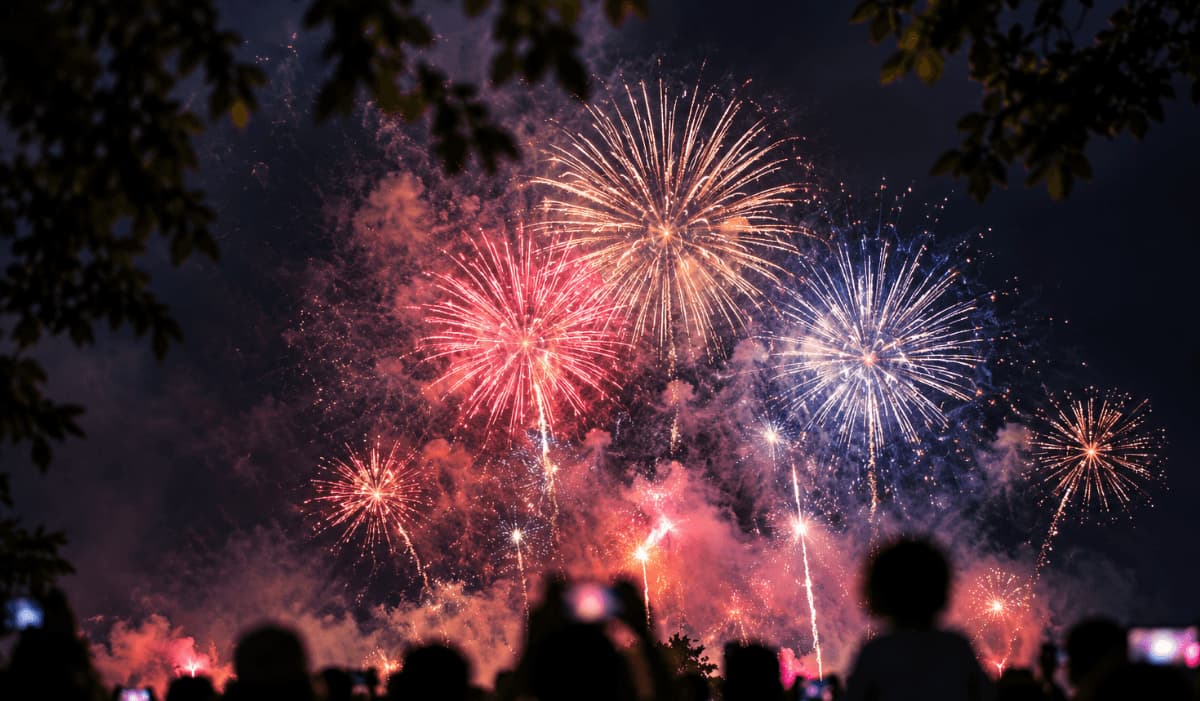
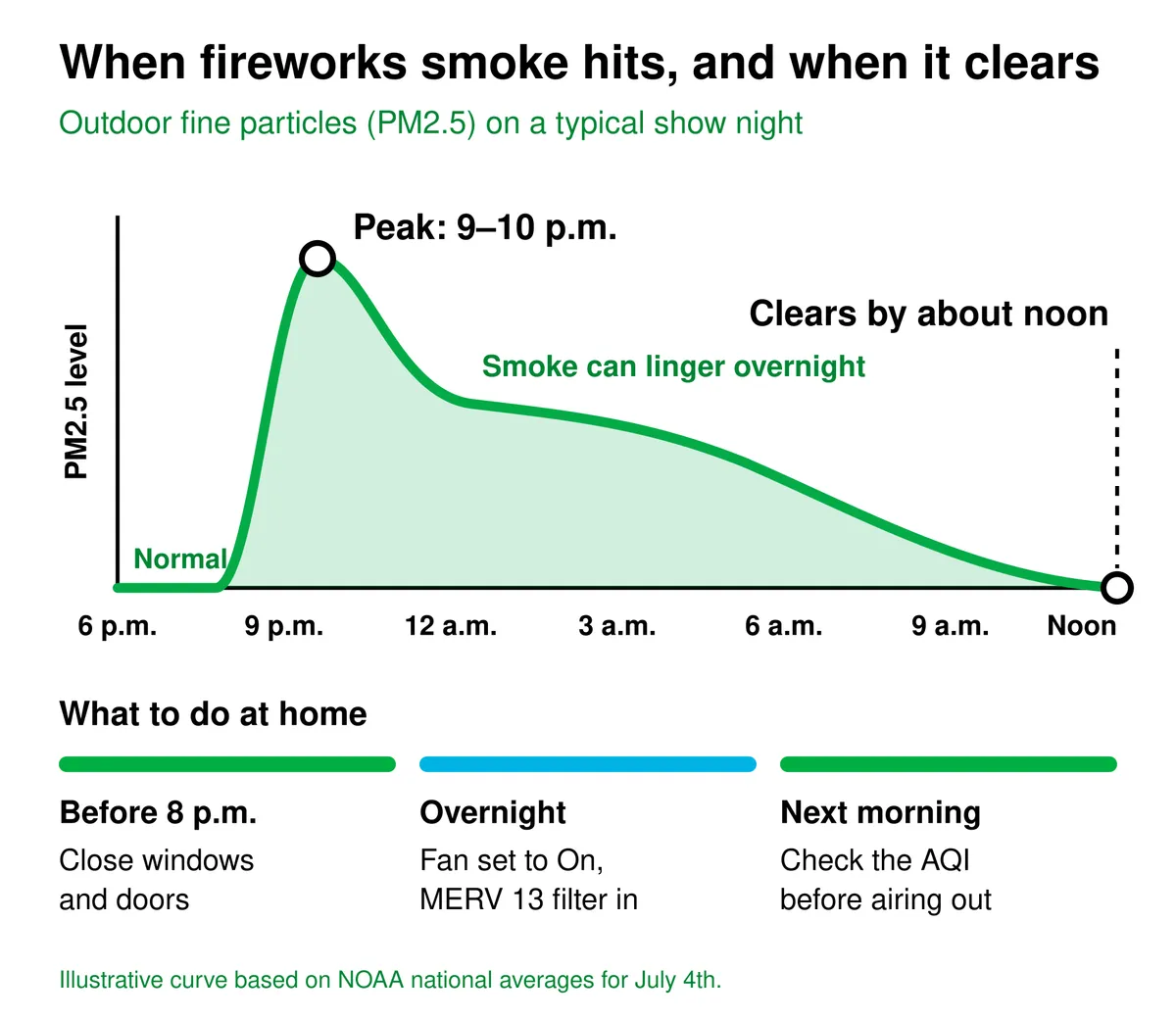
Fireworks raise fine particle pollution (PM2.5) by about 42% on an average July 4th night, with the peak around 9–10 p.m. Levels usually drop back to normal by noon the next day.
Before the show, close your windows and run your HVAC fan with a MERV 13 filter, which captures microscopic particles.
Not sure which filter fits your system? Take the quick match quiz below.
Find my filter match Shop Filterbuy filters
Answer a few quick questions and we'll match you to the right filter for your home.
Already know your size? Shop filters at Filterbuy, made in the USA in 600+ sizes.
Fireworks send fine particle pollution (PM2.5) soaring for one night, from late evening until about noon the next day. July 4th and New Year's Eve bring the biggest spikes, and the smoke carries metals everyday pollution doesn't. Close the windows before the show, run your HVAC fan with a MERV 13 air filter, and wait for the AQI to drop before airing out.
A NOAA study of 315 U.S. monitoring sites found PM2.5 averaged 42% higher over the 24 hours after 8 p.m. on July 4th than on nearby days.
PM2.5 peaks around 9–10 p.m. and usually returns to normal by noon the next day.
Near a launch site the jump is far bigger: one monitor beside a fireworks field recorded a 370% rise in 24-hour PM2.5.
The metals that color fireworks, such as copper, strontium, and barium, end up in the smoke.
Fireworks smoke gets indoors, but a closed-up house and a MERV 13 filter, the EPA's recommended minimum for smoke, keep more of it out.
On an average July 4th night, fireworks raise PM2.5, the fine particle pollution tracked by the Air Quality Index (AQI), by about 42%, according to a 2015 NOAA analysis. Local peaks run far higher.
Sources: NOAA (Seidel & Birnbaum, 2015); Clarity Movement D.C. sensor network via Envirotech Online (2026); IQAir (2026); German Federal Environment Agency (UBA, 2020).
Washington, D.C.'s record-scale 250th anniversary display triggered a Code Red alert, and one monitor near the National Mall hit an AQI of 288, in the Very Unhealthy range, around 5 a.m.
What that looks like on your AQI map: NOAA's national average on show night, 20–35 µg/m³ an hour, falls in the Moderate (yellow) band of EPA's current PM2.5 scale. Beside a fireworks field in Ogden, Utah, one monitor climbed to about 500 µg/m³, more than double the 225.5 µg/m³ mark where Hazardous begins. So check your own ZIP code's reading.
Since 2013, Filterbuy has built HVAC filters in U.S. plants it owns, including one in Utah, the state where researchers measured how fireworks smoke gets indoors. To us, fireworks night is a wildfire smoke day squeezed into a few hours, with similar particles and the same routes inside, so the same fix works.
Two details shape Filterbuy's advice. First, the published numbers probably understate what your family breathes, since NOAA's researchers note that monitors rarely sit where spectators stand. Second, a spike that lasts only a few hours barely registers against daily and annual standards, so a daily AQI that looks fine can hide a very bad 2 a.m.
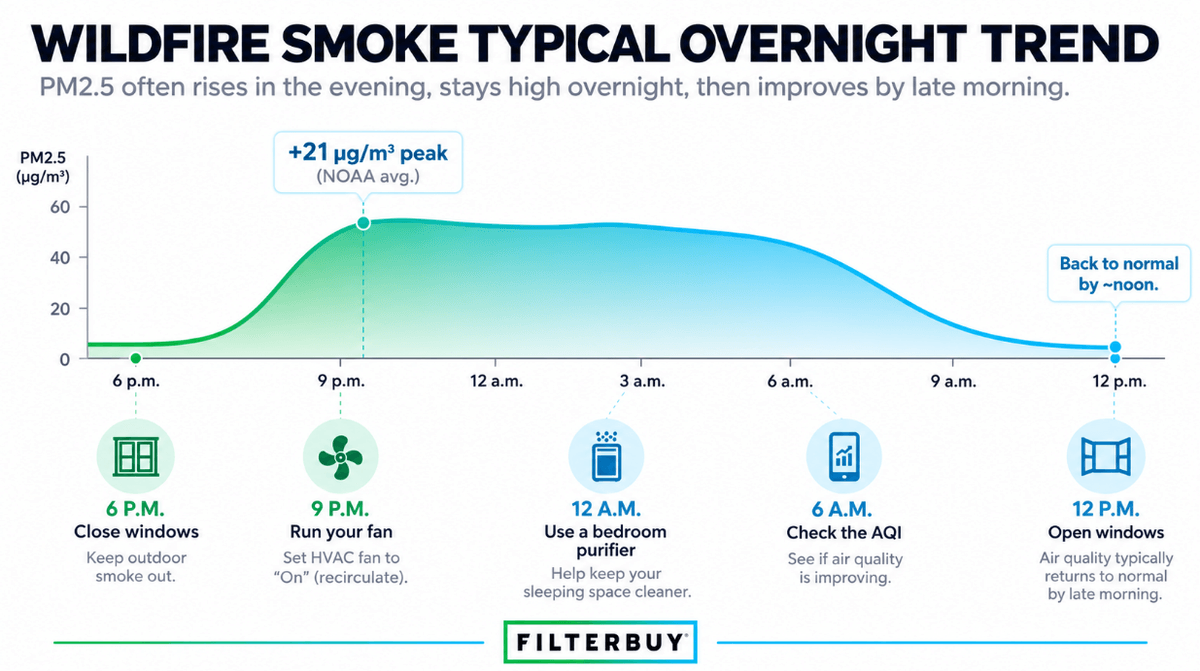
The worst air usually arrives between about 9 p.m. and the early morning hours, then clears by midday. On calm, humid nights, smoke settles near the ground, so the peak can come hours after the last shell. Filterbuy's tip: the dirtiest air often drifts in while everyone is asleep with the windows open.
Built from NOAA national averages and 2026 Washington, D.C. sensor data (Clarity Movement).
Fireworks smoke blends fine particles, gases, and metal compounds. Those metals create the colors: strontium makes red, copper makes blue, barium makes green, and aluminum adds white and silver sparkle.
When a 2020 NYU Grossman School of Medicine study tested 12 consumer fireworks sold in the U.S., two contained harmful levels of lead. Particles from five of them significantly increased oxidation in human lung tissue and mice.
The American Lung Association notes fireworks also release gases such as sulfur dioxide and carbon monoxide. Backyard fireworks hit people nearby hardest, since the smoke hangs low where you breathe.
People with asthma, COPD, or heart disease tend to feel fireworks smoke first, along with children, older adults, and pregnant people. Location matters too: homes near launch sites, downwind of big shows, or on streets full of backyard fireworks get the heaviest exposure.
That burden isn't spread evenly. A study of 751 PurpleAir sensors in California found July 4th PM2.5 peaks more than twice as high in communities with lower incomes, larger minority populations, and higher asthma rates.
If someone in your home has asthma or COPD, follow their action plan and keep rescue medication within reach. Chest pain or trouble breathing calls for medical attention right away.
The differences come down to weather and how your home is running. Summer nights tempt people to open windows, while cold winter air can hold smoke near the ground longer. Germany's Federal Environment Agency reports that particulate pollution in the early hours of New Year's Day usually ranks among the year's highest.
Yes. Smoke slips in through open windows, door traffic, building gaps, and HVAC fresh-air intakes. In a 2024 University of Utah study, 53–58% of outdoor fireworks particles made it inside a building with MERV 13 filters, compared with 13–22% during winter inversions.
A PNAS analysis of 3,977 U.S. residences found outdoor sources made up a median of 52% of residential PM2.5.
Filterbuy recommends the same playbook from our wildfire smoke guide: seal the house first, then let a MERV 13 filter clean whatever gets in.
Check your AQI in the afternoon. The Filterbuy Live AQI Map or AirNow.gov shows where your air stands.
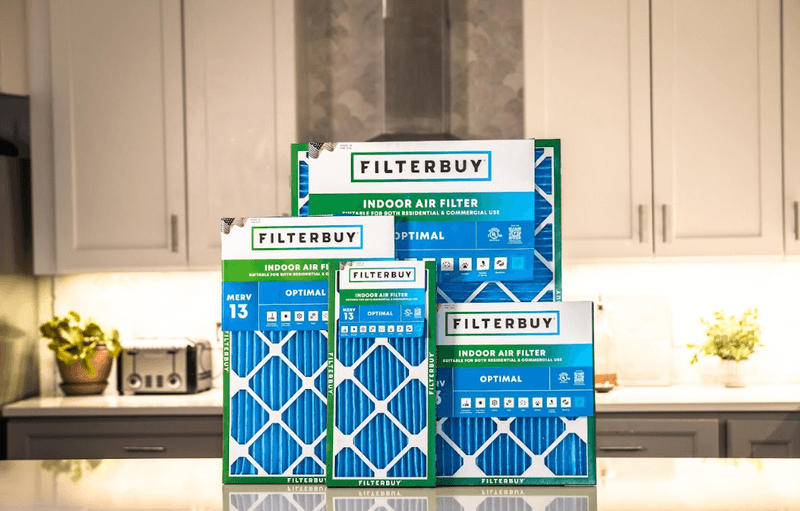
Put in a fresh MERV 13 filter a day or two ahead. Grab a Filterbuy MERV 13 filter; the EPA recommends MERV 13 or higher during smoky periods if filters are changed often.
Close windows and doors by 8 p.m. Then close the fresh-air intake or switch your system to recirculate.
Set the thermostat fan to On, not Auto. EPA guidance supports this, because a running fan keeps pulling smoky air through the filter.
Add a portable air cleaner in bedrooms. Room air cleaners and HVAC filters work best as a team, and our MERV 13 vs. HEPA guide explains why.
Wait to air out. Open up once the AQI is back to Good or Moderate, usually by midday.
Check your filter the next day. If it looks dark brown or black, replace it. Filterbuy's schedule shortens to 30 days during smoke. Here's how to find your air filter.
"The rating matters far more than the schedule. A fresh MERV 8 filter still lets most fine particles through, while a MERV 13 filter catches far more of them."
Michelle Wan, Brand Manager and Air Quality Writer, Filterbuy
"Most systems I test are not struggling because the filter is too efficient. They are struggling because it has been in there since spring."
David Clark, Licensed HVAC Technician, Filterbuy HVAC Solutions
Averaged over 1999–2013, July 4th PM2.5 broke the EPA's 24-hour standard at 10 of 315 U.S. monitors and at none on surrounding days. (NOAA)
Across 14 years of EPA samples, toxic metal levels ran higher around July 4th and New Year's Eve than at any other time of year. (NYU Langone Health)
A 10-by-12-foot bedroom needs an air cleaner with a smoke CADR of at least 80. (U.S. EPA)
About 14 hours after the evening peak. NOAA's data show PM2.5 returning to normal by noon the next day, though calm weather can stretch that out.
A well-fitted N95 respirator filters fine particles, but cloth masks don't. Ahead of D.C.'s 2026 show, Park Service planners reportedly recommended N95s for outdoor viewers.
Filterbuy's rule of thumb is to check the AQI that afternoon. If it's 101 or higher, the level EPA considers unhealthy for sensitive groups, watch from indoors or pick a drone show, which the American Lung Association notes produces no smoke. Otherwise, stand upwind and bring rescue medication.
PM2.5 (fine particulate matter): Airborne particles 2.5 micrometers or smaller that can reach deep into the lungs.
AQI (Air Quality Index): The EPA's 0 to 500 air quality scale; above 100 is unhealthy for sensitive groups.
µg/m³ (micrograms per cubic meter): The unit for particle pollution in air.
MERV (Minimum Efficiency Reporting Value): ASHRAE's 1 to 16 scale for how well an HVAC filter captures particles.
MERV 13: Captures at least 50% of 0.3–1.0 micron, 85% of 1.0–3.0 micron, and 90% of 3.0–10 micron particles.
HEPA filter: A portable air cleaner filter that removes at least 99.97% of 0.3-micron particles.
Recirculate mode: An HVAC setting that closes the outdoor-air intake and cleans indoor air instead.
NOAA: The U.S. National Oceanic and Atmospheric Administration.
Filterbuy: A family-owned U.S. maker of HVAC air filters, founded in 2013, with plants in four states.
CADR (Clean Air Delivery Rate): How much filtered air a portable air cleaner delivers.
Winter inversion: A cold-weather pattern where a warm air layer traps pollution near the ground.
Code Red / Code Purple: Local alerts for the AQI's Unhealthy and Very Unhealthy categories.
Keep reading: Best MERV filter for wildfire smoke | PM10 vs. PM2.5 explained | How to use EPA AirNow
Check your air before the next big fireworks night on the Filterbuy Live AQI Map, then find your filter size in 600+ options, made in the USA and shipped free.
