August 13, 2026
Author: Michelle Wan, Brand Manager and Air Quality Writer
Reviewer: David Clark, Licensed HVAC Technician
Publish Date: August 13, 2026 · Updated Date: August 13, 2026
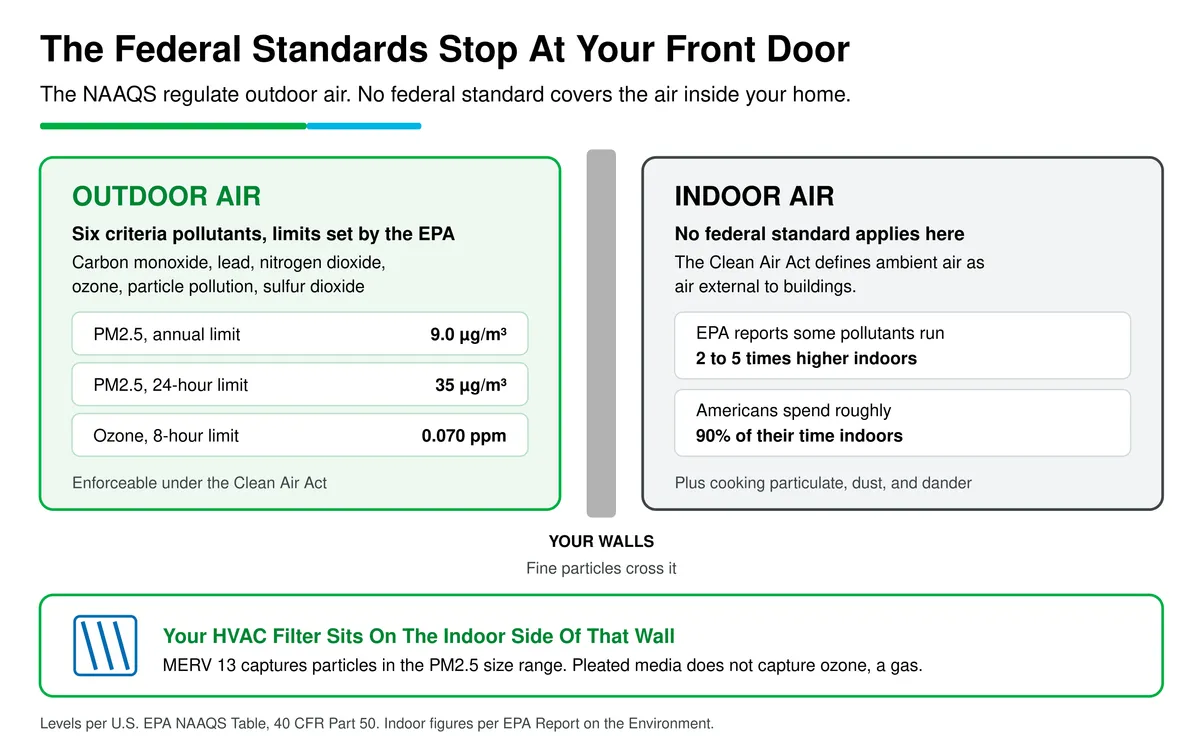
The NAAQS are the legal limits the U.S. EPA sets on six pollutants in outdoor air under the Clean Air Act. Those six are carbon monoxide, lead, nitrogen dioxide, ozone, particle pollution, and sulfur dioxide. The annual PM2.5 limit is 9.0 µg/m³ and the 8-hour ozone limit is 0.070 ppm. Every one of these standards covers ambient air, which the Clean Air Act defines as air external to buildings, so none of them reaches the air inside your house.
Primary standards protect health. Secondary standards protect crops, buildings, and visibility.
The AQI on your phone is these standards converted. AQI 50 matches the annual PM2.5 standard of 9.0 µg/m³, and AQI 100 matches the 24-hour standard.
Indoor air has no federal equivalent. The EPA reports that concentrations of some pollutants run 2 to 5 times higher inside than outside.
Once you know which pollutant drives your local reading, the next question is what your filter can actually capture on the indoor side.
Answer a few quick questions and we will match you to the right filter for your home.
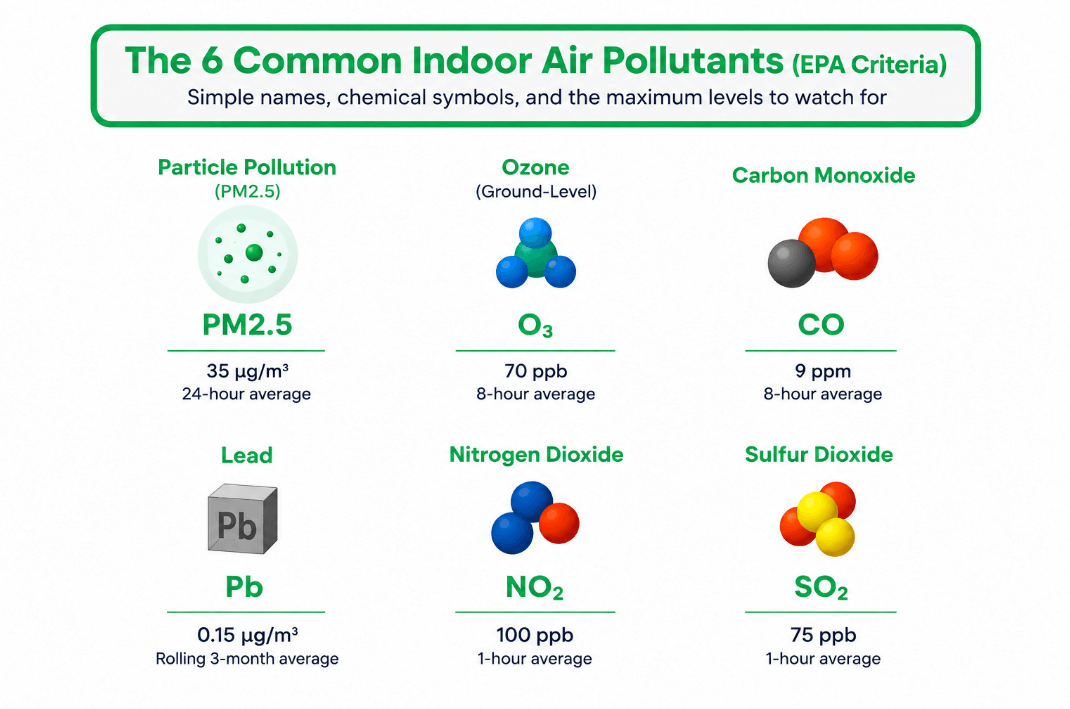
The National Ambient Air Quality Standards (NAAQS) are the legal limits the U.S. Environmental Protection Agency sets for six air pollutants under the Clean Air Act: carbon monoxide, lead, nitrogen dioxide, ozone, particle pollution (PM2.5 and PM10), and sulfur dioxide. The EPA must review each standard every five years, though reviews usually run longer, and the strictest recent change lowered the annual PM2.5 limit to 9.0 micrograms per cubic meter. Every NAAQS applies to outdoor air only.
The NAAQS are federal limits on six criteria air pollutants, set under Clean Air Act sections 108 and 109. Primary standards protect health; secondary standards protect crops, buildings, and visibility.
The annual PM2.5 standard is 9.0 µg/m³, tightened from 12.0 in 2024 and upheld by the D.C. Circuit in June 2026. The 8-hour ozone standard is 0.070 ppm, unchanged since 2015.
A standard's averaging time tells you how fast that pollutant does damage. Sulfur dioxide is measured hourly because asthma can react in five minutes; lead is measured over rolling three-month periods because it accumulates.
The AQI on your phone is these standards converted. AQI 50 is the annual PM2.5 standard; AQI 100 is the 24-hour standard.
Every NAAQS is judged as a multi-year average or percentile, so a county meeting every standard still records unhealthy days.
NAAQS regulate outdoor air. Indoor concentrations of some pollutants run 2 to 5 times higher, and no federal standard covers them.
The National Ambient Air Quality Standards (NAAQS) are federal limits on how much of six pollutants may be present in outdoor air across the United States. The EPA sets them under the Clean Air Act, codified at 40 CFR Part 50. Those six are criteria air pollutants, not because they are the only harmful things in the air but because Congress directed the EPA to publish air quality criteria documents on them.
One word in that name carries more weight than it looks. Under the Clean Air Act, "ambient" means air external to buildings, making the NAAQS a yardstick for the air over your neighborhood, not the air in your hallway.
Responsibility splits across two levels of government: the EPA writes the standards, states enforce them through State Implementation Plans. For how that framework was built, see our guide to how the Clean Air Act reshaped U.S. air quality.
Below is the complete set of current NAAQS per the EPA's NAAQS Table, last updated November 4, 2025. Levels are in parts per million (ppm), parts per billion (ppb), or micrograms per cubic meter (µg/m³).
Source: U.S. EPA, NAAQS Table (40 CFR Part 50). The 10 ppb annual secondary SO2 standard was added in 2024; many third-party charts still show the superseded 3-hour figure.
Two of these have Filterbuy deep dives of their own: sulfur dioxide and nitrogen dioxide, both gases a pleated filter cannot capture.
Almost every version of this table online reproduces the pollutant and the level, then stops. We think that gets it backwards. The averaging time and form are not administrative details. They are the EPA telling you how fast each pollutant does damage.
Sulfur dioxide is measured over one hour. The EPA judged that window necessary to protect people with asthma from exposures "as short as 5 minutes," since a daily average would smooth a five-minute plume away.
Lead uses a rolling three-month average. Because lead accumulates in the body, there is no single bad hour to catch, so the standard watches a season instead.
Ozone uses the fourth-highest daily maximum, averaged over three years. No other form is smoothed this heavily, which fits a pollutant whose harm builds across repeated hot afternoons.
PM2.5 is the only pollutant with both an annual and a 24-hour standard. Fine particles hurt two ways, chronic and acute, so the EPA regulates them on two clocks at once.
PM2.5 matters most inside a house, and its double standard is why a smoke week and a hazy summer both count as air quality problems while calling for opposite responses.
This reading of the table is Filterbuy's; the levels, averaging times, and forms are the EPA's, sourced above.
Primary standards protect human health, including sensitive groups such as people with asthma, children, and older adults. Secondary standards protect public welfare: visibility, crops, forests, livestock, and buildings.
For most pollutants, the two levels match. PM2.5 is the clearest exception, set at 9.0 µg/m³ annually for health and 15.0 µg/m³ for welfare, where the looser figure mainly protects visibility.
One factor the EPA may not weigh when setting either number is cost. Under the Clean Air Act, the level rests on health and welfare evidence alone.
Section 109(d)(1) requires review at five-year intervals, with input from the Clean Air Scientific Advisory Committee (CASAC), an independent expert panel. Those reviews usually run longer, and any one can end with the standard revised or left as it stands.
The most consequential recent change was to PM2.5. In February 2024, the EPA lowered the primary annual standard from 12.0 to 9.0 µg/m³, its first change in over a decade. Industry groups and several states sued, and the EPA itself later asked the court to vacate the rule. On June 26, 2026, the D.C. Circuit unanimously upheld the 9.0 µg/m³ standard, rejecting both. Harvard's Environmental and Energy Law Program tracks the litigation.
Implementation has lagged. The EPA missed its deadline to designate which areas fail the 2024 standard, and in July 2026, a federal court ordered those designations by February 6, 2027. Ozone has been quieter, holding at 0.070 ppm since October 2015, with the 2008 standard still in effect for areas designated under it.
A county meets a NAAQS when its pollution, averaged as the standard specifies, sits at or below the federal limit. What it does not tell you is whether the air was clean every day.
Because the forms tolerate a handful of bad days without triggering a violation, they catch chronic pollution rather than certifying any single afternoon. A county in attainment can still issue a smoke-week alert without contradicting its status. Attainment is a three-year verdict; the Air Quality Index is the daily one.
One fact resolves most of that confusion, and we have not seen another explainer say it plainly. The AQI breakpoints are not a separate scale. The EPA sets them from the NAAQS levels.
In the 2024 rule, the agency described "setting the lower breakpoints (50, 100 and 150) based on the levels of the primary annual and 24-hour PM2.5 standards." Side by side, the translation is direct:
So when your app turns from green to yellow, PM2.5 is crossing the annual federal standard, and yellow to orange crosses the 24-hour one. Those color bands are the NAAQS made visible. For the arithmetic, see Filterbuy's explainer on how the AQI is calculated.
One caveat: a single yellow afternoon does not mean your county is failing. Since the standard is a three-year average, one day above 9.0 µg/m³ registers as a data point rather than a violation.
Whatever your own county's status, the national picture is worth knowing. The American Lung Association's State of the Air 2026 report found that 152.3 million people (44% of Americans) live in counties with failing grades for ozone or particle pollution, including 33.5 million children.
I spent a long time reading these standards as a pass/fail grade for a place. They are not that. Every one is a three-year verdict, and some throw out the worst days on purpose. Once the form column clicked, the federal number and the number on my phone stopped contradicting each other. They were never answering the same question.
— Michelle Wan, Brand Manager and Air Quality Writer, Filterbuy
The NAAQS govern ambient air, and no federal equivalent exists for the air inside a house. Americans spend roughly 90% of their time indoors, where the EPA reports concentrations of some pollutants run 2 to 5 times higher than outdoors. Your county can be in attainment for every criteria pollutant while your living room carries cooking particulate, dust, dander, and VOCs. Nor does outdoor air stay outdoors: fine particles infiltrate the building envelope and join whatever the household already generates.
Filterbuy has manufactured air filters in the U.S. since 2013, from factories in Alabama, Florida, Pennsylvania, and Utah, serving more than two million households. None of that amounts to expertise in federal air regulation, and we do not claim it. What it gives us is one narrow vantage point: we build the last thing standing between the outdoor number and the room you sleep in. From there, two rows matter most.
The pollutant your county fails on should change what you buy. Pleated media does real work against fine particles and nothing against ozone, a gas, so any filter marketed as solving both is overselling. MERV 13 is the benchmark for PM2.5 capture; see how MERV ratings are measured.
The 24-hour standard is the row that maps to a filter. Where the annual standard describes the air you live in year-round, the 24-hour standard describes the days you notice, and those are the days a loaded filter fails you.
People read a passing grade for their county and assume the question is settled. The federal standard is a real achievement, and it was never written to answer that question. It stops at the front door by design. What happens on the other side is our job. It is a smaller job than the Clean Air Act's, but it covers the ninety percent of the day you spend indoors.
— David Heacock, Founder and CEO, Filterbuy
Comparing your air to a NAAQS takes two lookups, because the standards and the daily index measure different things. The AQI tells you what the air is doing now; an attainment designation tells you whether your county's three-year average clears the federal limit. Check both, note which pollutant drives the reading, then deal with what is already inside.
Look up today's conditions. Check the air quality index for your ZIP code or AirNow, remembering that it describes today, not attainment.
Check your county's status. The EPA Green Book lists every nonattainment area by pollutant and standard.
Read the pollutant, not just the number. An AQI of 90 driven by ozone needs different action than one driven by PM2.5; our guide to why the air quality is bad today separates them.
Handle what's inside. Confirm your filter size, match the MERV rating to your household, and change it on schedule.
Attainment is calculated from monitors, and most U.S. counties have none for PM2.5. Peer-reviewed work in Environmental Science & Technology Letters estimated that 44% of urban areas exceeding the new 9.0 µg/m³ standard would go undetected because of network gaps, a shortfall covering roughly 20 million people and skewing toward lower-income and minority communities.
None of this makes attainment meaningless. It does mean "not designated nonattainment" and "measured and found clean" are two different statements, and for much of the country only the first is true. Where no monitor exists, satellite data and local sensor networks are the fallback.
How many NAAQS pollutants are there?
There are six criteria pollutants: carbon monoxide, lead, nitrogen dioxide, ozone, particulate matter, and sulfur dioxide. Particulate matter carries two separate standards, PM2.5 and PM10.
What is the current EPA PM2.5 standard?
The primary annual PM2.5 standard is 9.0 µg/m³, and the 24-hour standard is 35 µg/m³. The annual limit was lowered from 12.0 µg/m³ in February 2024 and upheld in court in June 2026.
What is the EPA ozone standard?
The 8-hour ozone NAAQS is 0.070 ppm for both the primary and secondary standards, set in 2015.
Are the NAAQS legally enforceable?
Yes. States must submit State Implementation Plans showing how they will attain and maintain each standard, and areas that fail are designated nonattainment, which triggers additional pollution-control requirements.
Do the NAAQS apply to indoor air?
No. The NAAQS apply only to ambient air, defined in the Clean Air Act as air external to buildings. No federal standard sets enforceable limits for pollutant concentrations inside a private home.
Does the EPA consider cost when setting a NAAQS?
No. The Clean Air Act directs the Administrator to set the level based on health and welfare evidence. Cost enters later, in how states plan to meet the standard.
How does the AQI on my phone relate to the NAAQS?
The AQI breakpoints are derived from the NAAQS levels. For PM2.5, an AQI of 50 corresponds to 9.0 µg/m³ (the annual standard) and an AQI of 100 corresponds to 35.4 µg/m³ (the 24-hour standard). The AQI reports today; the NAAQS is judged over three years.
What if my county has no air quality monitor?
Attainment designations depend on monitoring data, and most U.S. counties have no regulatory PM2.5 monitor. A county with no monitor is not designated nonattainment, but that is not the same as being measured and found clean.
EPA NAAQS Table: the authoritative list of every current standard, its averaging time, level, and form. The source for the table on this page.
EPA: Process of Reviewing the NAAQS: how a five-year review actually runs, from Call for Information through CASAC advice to final rule.
EPA Green Book: Nonattainment Areas for Criteria Pollutants: searchable designations by area, pollutant, and standard.
EPA: National Ambient Air Quality Standards for Particulate Matter: the agency's own summary of the February 2024 PM2.5 rule.
Federal Register: Reconsideration of the NAAQS for Particulate Matter: the primary rulemaking document behind the 9.0 µg/m³ limit.
Harvard EELP: PM2.5 NAAQS regulatory tracker: dated timeline of the litigation, including the June 2026 D.C. Circuit decision.
American Lung Association: State of the Air 2026 Key Findings: county-level grades for ozone and particle pollution.
EPA Report on the Environment: Indoor Air Quality: the source for the 90%-indoors and 2-to-5-times figures.
AirNow: AQI Basics: how the daily index maps pollutant concentrations to health categories.
EPA Air Quality National Summary: long-run concentration trends for all six criteria pollutants.
Environmental Science & Technology Letters: monitoring network coverage under the new PM2.5 standard: the peer-reviewed estimate of how many exceeding areas the current monitor network misses.
NAAQS (National Ambient Air Quality Standards): Federal limits set by the U.S. EPA on six pollutants in outdoor air, codified at 40 CFR Part 50.
Ambient air: Outdoor air. The Clean Air Act defines it as air external to buildings.
Criteria air pollutant: One of the six pollutants for which the EPA publishes air quality criteria and sets a NAAQS: CO, lead, NO2, ozone, particulate matter, and SO2.
Primary standard: A NAAQS set to protect human health, including sensitive groups.
Secondary standard: A NAAQS set to protect public welfare: visibility, crops, animals, vegetation, and buildings.
PM2.5: Fine particulate matter 2.5 micrometers or smaller, able to reach deep lung tissue and the bloodstream.
PM10: Inhalable particulate matter 10 micrometers or smaller.
Attainment/nonattainment: EPA designations for whether an area meets a given NAAQS. Nonattainment areas face added controls.
Form (of a standard): The statistical rule for judging compliance, for example, a 3-year average of the annual mean, or a 98th percentile.
Averaging time: The window over which a pollutant's concentration is measured, from one hour to one year, reflecting the timescale on which it affects health.
Design value: The statistic calculated from monitoring data and compared against a standard's level to determine attainment.
SIP (State Implementation Plan): A state's EPA-approved plan for attaining and maintaining the NAAQS.
CASAC (Clean Air Scientific Advisory Committee): The independent expert committee that advises the EPA during NAAQS reviews.
AQI (Air Quality Index): The EPA's daily 0–500 scale translating pollutant concentrations into a public health rating. Distinct from the NAAQS.
MERV (Minimum Efficiency Reporting Value): The 1–16 scale rating an HVAC filter's particle capture efficiency. MERV 13 is the common benchmark for PM2.5 capture.
Michelle Wan is Filterbuy's Brand Manager and Air Quality Writer. She translates pollutant science and EPA guidance into steps homeowners can act on, and appears in Filterbuy's educational videos and social content. Working directly with Filterbuy's U.S. manufacturing team across its Alabama, Florida, Pennsylvania, and Utah factories grounds her writing in how filters are actually built and used rather than in spec sheets. She holds a B.A. in Sociology from the University of California, Santa Cruz. More from Michelle Wan.
David Clark is a Licensed HVAC Technician and reviews Filterbuy's technical air quality content.
About Filterbuy. Filterbuy is a family-owned American manufacturer building air filters in the U.S. since 2013, from factories in Alabama, Florida, Pennsylvania, and Utah. Its catalog runs to 600+ standard sizes plus custom dimensions, pleated in Talladega, Alabama, and shipped factory-direct.
Filterbuy reviews this page against the EPA's published NAAQS Table each quarter and after any final rule. Last verified: August 13, 2026.
